PROPHETIC DIARY OF THE L.C.C.
Reading edition
(For the Next Ten Years.)
1894. Scheme accepted for building Hôtel de Ville at a cost of £3,000,000.
1895. Purchase of Kensington Gardens as a Recreation-ground for the Improvement Committee.
1896. The Council buys St. Paul's Cathedral as a Private Chapel for the marriage of its members and their families.
1897. Completion of The Bumble Steam-yacht of the L. C. C., costing £100,000.
1898. Uniforms for the Members ordered at an expense of £500,000.
1899. Purchase of a Crown and other Jewels for the Chairman on State occasions.
1900. The Palaces erected for occupation by the Members in Eaton, Belgrave, Grosvenor, and Berkeley Squares acquired and taken into use.
1901. A sum not exceeding £5,000,000 voted by the L. C. C. for statues commemorating themselves, their wives, and their families.
1902. Resolution carried by acclamation confiscating the entire sum received from the ratepayers for the L. C. C. Secret Service Fund.
1903. Petition for Metropolitan Improvement unanimously rejected.
1904. Act abolishing the L. C. C. passed in Parliament at a single sitting.
"Commons Preservation Society."—A most useful body, no doubt. "But," asks Lord T. Noddie, "as our Upper House is so often threatened, why isn't there a "Lords Preservation Society?"
DANCE TILL DAWN.
Charming maidens, smiling brightly, Moving gracefully and lightly As the fawn, Linger still, let me invite you, Surely on this short June night you Dance till dawn. Till the early bird will get the Worm, and seaside shrimpers net the Shrimp or prawn. Whilst they print the morning paper, Let us glide and whirl and caper Till the dawn. Till, with waking chirp of sparrows, Early costermongers' barrows Forth are drawn. Till the candles flare and gutter. And the daylight, through the shutter, Peeps at dawn; Till the cock is crowing; listen! And the dainty dewdrops glisten On the lawn; Till my pretty partner's posies, Made of June's delightful roses, Droop at dawn; Till my collar's limp and flabby— Then I hail the sleepy cabby, As I yawn; Home, to dream of sweet cheeks blushing Like the sky, now rosy flushing At the dawn.
Très Beau-tanical.—An Aladdin-like Magic-Lamp and Magic-Lantern Night at the Botanical Gardens on Wednesday. A thousand additional traditional lamps. The Flower of the Aristocracy, being at the State Ball, is represented by the Aristocracy of Flowers (in the absence of Lord and Lady Battersea, without whom no Floral Fête can be absolutely perfect) in every part of these beautiful gardens. Bands playing; but not sufficient distance between them, so that when they performed, simultaneously, entirely different tunes, the effect was far from soothing to the listeners' nerves. Why not adopt the plan admirably carried out at the Marlborough House Garden Party, where one band having finished, another, at a distance, commenced? Why among the harmony of colours at the Botanical should there be produced by the conflict of two tunes, taken in different times, but played at the same moment, an inharmonious whole?
Ladies' Fashions.—Extremes: Minimum—Bonnet; a ribbon and rosette. Maximum—Hat; a Flower Garden on a Yard of Straw.
THE MODERN NYMPH'S REPLY TO THE PASSIONATE SHEPHERD.
If times were as when time was young, And reason ruled each shepherd's tongue, Thy pretty speeches might me move, To live with thee, and be thy love. But times are changed in field and fold, At shocking prices sheep are sold, And farmers look exceeding glum, Foreboding darker days to come. The weeds do choke the thriftless fields, No profit now the harvest yields; Honey is sought, but only gall Is found, for still the prices fall. Thy pinks, thy stocks, thy Provence roses, Are pretty, and I'm fond of posies; But wages may not long be gotten When folly's rife, and business rotten. A man of straw thy master seems, No grain of sense is in thy dreams, And my Papa would not approve Even if I would be thy love. But, when times mend, sheep-farms succeed, And all on English mutton feed, Ask me again, and thou may'st move, To live with thee, and be thy love.
OPERATIC NOTES.
Tuesday, July 4. State Visit to the Opera.—Yes, "Todgers's could do it when it liked," as Charles Dickens remarked in Martin Chuzzlewit, and Sir Coventgardensis Druriolanus can do it when he likes, rather! The front of the house is quite a "mask of flowers," which the Master of the Gray's Inn Revels, himself present in a gorgeous and awe-inspiring uniform, regards with a benign and appreciative smile. Interesting to note a number of ordinarily quiet and unobtrusive individuals, personally known to me as the mildest-mannered men, who now appear as the fiercest, and, on such a night, the hottest of warriors; seeing that if it is 98 in the shade, the temperature must be ten degrees higher to those who are buttoned up to the chin in a military uniform, with straps, belts, buckles, boots, weighted too with a dangling, clattering sword, and having to carry about a thickly-furred hat, with a plume in it like a shaving-brush, that obstinately refuses to be hung up, or sat upon, or put out of sight, in any sort of way whatever, and which, like a baby in arms, must be carried,—or dropped. The Venetians on the stage in all their mediæval bravery are not arrayed like one of these simple English yeomen, for, as I am given to understand, to that glorious body of our country's agricultural defenders do these dashing Hussars, in their Hessian-fly boots, belong! Ah! with such warriors England is safe!
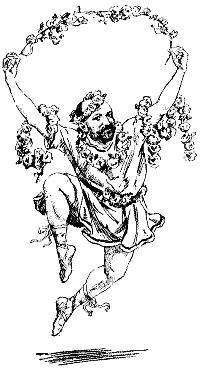
"Pas de Druriolanus; or, All among the Roses."
Then there are what Mr. Weller would have termed "My Prooshan Blues," and likewise the diplomatic Muscovite, in hard-looking cap, blue, naval-looking coat, and (apparently) flannel boating trousers, falling, rather short, on to ordinary boots, with plain unornamental spurs; a costume which, on the whole, suggests that its wearer, at the command of the Autocrat of all the Russias, must be ready at a second's notice to execute a forced march, dance a hornpipe, run as a footman, take somebody up as a policeman, head a cavalry charge, or (still in spurs) steer a torpedo boat on its dangerous errand. Opera going strong, with the De Frisky Bros. & Co. The Last Act (by Royal Command) is omitted, and so for the first time in dramatic history the story of Romeo and Juliet ends as happily as possible. The lovers are only interrupted by the fall of the curtain, and there are no sleeping draughts, poisonings, or burials. It is a realisation of the line in The Critic, "In the Queen's name I charge you all to drop your swords and daggers!" Only the order is given in the Princess's name, and the swords, daggers, and deadly draughts are all dropped accordingly. Greatest possible success. Gloria Druriolano!
Friday Night.—First performance of I Rantzau, and first-rate performance, too. The Plot is simply a Plot of Land. Scene laid—laid for seven dramatis personæ—in a Vague Village of the Vosges; time, present century. The Rantzaus are the Capulets and Montagues of this district; the son of one faction is in love with the daughter of the other; but it doesn't end tragically, and the lovers marry. That's all. It was played as a Drama at the Français, with Got in it; when subsequently it was turned into an Opera, it had the "Go" taken out of it. De Lucia, Ancona, Castelmary, Bispham, and Corsi doing their very best, as do also the lamplighter and his assistant, who deftly perform their "Wagnerian watchman" "business" to characteristic music. Mlle. Bauermeister great in a small part; and Madame Melba does her very best with the singularly uninteresting part of Luisa, who is a very "Limited Loo." Signor Mascagni conducted the Opera, and was himself conducted on to the stage as often as possible in order to receive the congratulations of his "friends in front." I Rantzau not "in it" with Mascagni's Cavalleria, which, like the Rantzau family at the end of the piece, "still holds the field." Thermometer 95° in the stalls. House animated and appreciative.
Saturday.—Les Huguenots. Grand Cast. Thermometer down again.
A DITTY OF THE DOG-DAYS.
Ninety-one in the shade, by Negretti and Zambra! 'Tis O that I dwelt in an ice-crevasse, Or rented a share in the Mer de Glace, Or hired (ere I melt and resolve to gas) That patio cool in the chill Alhambra (Not "Lei-ces-ter Squarr," but Granada far), Where fountains sprinkle and plash and tinkle— Ay me! that my dream can ne'er come to pass! "Fourteen hours of the sun!" says the "Jordan Recorder"— Each day it grows hotter in London town! The plane-trees are withered and burnt and brown; Ere Lammas has come the leaves are down! The months have been mixed—they're out of order; We'd the weather of June six weeks too soon; And now we swelter and gasp for shelter— We're grilled alive from toe to crown! There's drought in the fields, and drought in my gullet! I would that I sat in a boundless tank Of claret and soda, and drank and drank! My thirst with Pantagruel's own would rank— Gargantuan draughts alone may lull it! A shandygaff "chute" à la Boyton would suit, Or of Pilsener lager a Nile or Niagara— Would that it through my œsophagus sank! I'd long to be Nansen, that bold Norwegian, Who's off to the north like a sailor-troll; Dry land I prefer in my inmost soul, And his tub-like Fram will pitch and roll, But she's bound at least for a glacial region! Or stay, to be sure! here's Professor D——r To cold can consign us untold degrees minus— There's no need to visit the Northern Pole! With this decuman "heat-wave" I grow delirious, And babble a prayer to the Maid who sways The Weather-department (on working-days) Of the Daily Graphic—in crazy phrase— The bale-fire to quench of far-distant Sirius! To the Man in the Moon at noon I croon For a lunatic boon, if that lone buffoon Can stay this canicular, perpendicular, Bang-on-my-forehead, horrid, torrid, Beaming, gleaming, and ever-streaming Blaze of rays that maze and daze!!
ROBERT AT THE MANSHUN HOUSE.
I have long nown as how as the present Lord Mare was one of the werry nicest, as well as one of the werry liberallists, of Lord Mares as we has had for many years, but I most suttenly did not kno, till larst Saturday, that, noticing, as he must have done, how shamefoolly the County Counsellors is a trying for to destroy the grand old Copperation, and take pusession of Gildhal and the Manshun House, he had the courage to assemble round his ospiterbel Table all the most princiblest of the great writers of our wunderful and powerful Press, and let them judge for theirselves whether sich a hinstitootion as he represented was worth preserwin or not! Ah, that was sumthink like a Bankwet that was! Why amost eweryboddy was there as was anyboddy. And the ony trubble as that caused was, that they was all so jolly glad to meet each other, under sitch unusual suckemstances, that nothink on airth coud keep em quiet, no, not ewen when the Amerrycan Embassader torked to em for about arf a nour!
One of the most distinguist of the skollars as I was waiting on told one of the most butiful Painters, in my hearing, as how he thort it wood be rayther a wise thing of all future Lord Mares if they himmitated the present Lord Mare's exampel; and I wentur, with all umility, to say Ditto to the distinguisht Skoller. Robert.
Ge-o-m-etrically Considered.—The illuminations were as good as they could be everywhere. The brilliant initials, "G. M.," wanted nothing to render them perfect. If that want had been supplied, then, as "nothing" is represented by a cipher, the initials would have commemorated the G. O. M.
From Henley to the Opera on the Night of the State Performance.—"Rich and rare were the gems they wore;" and two ladies, with magnificent tiaras, if they had only shown up at Henley, would have won the prize for "The Diamond Skulls."
Mrs. R. caught sight of a heading in a daily paper—"Board of Trade Returns." Our old friend at once exclaimed. "Then where has the Board of Trade been to? Where is it returning from? I really don't call this attending to business."
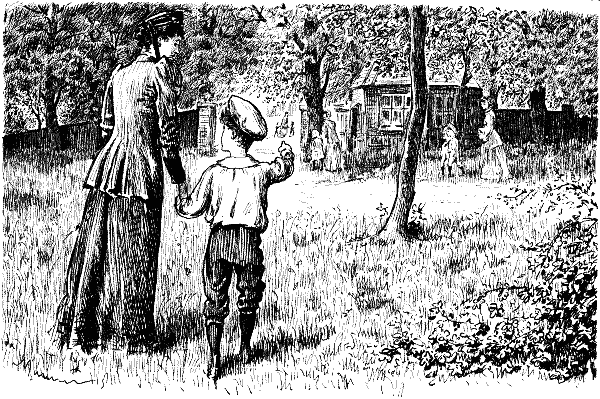
A DECLARATION OF INDEPENDENCE.
Tommy (on his way to the Browns' Juvenile Garden Party). "Now, Nurse, remember, when once we've passed that Garden Gate, you don't belong to Me!"
FATHER WILLIAM.
(Latest Anglo-Teutonic Version, as repeated to the Caterpillar of State by Alice, in Blunderland, from vague and mixed reminiscences of Southey, Lewis Carroll, and the Reports of the Debates in the British Parliament and the German Reichstag, concerning the Home-Rule Bill and the Army Bill respectively.)
"I'm afraid I am changed, Sir." said Alice; "I can't remember things as I used—and I don't keep to the same author for ten minutes together!"
"Can't remember what things?" said the Caterpillar of State.
"Well, I've tried to sing 'Rule, Britannia', but it all came different, and got mixed up with 'The Watch on the Rhine!'" Alice replied, in a very melancholy voice.
"Repeat 'You are old, Father William,'" said the Caterpillar of State.
Alice folded her hands, and began:—
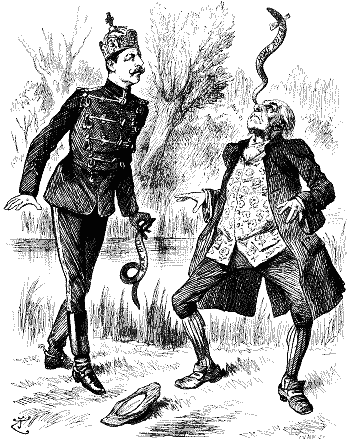
"Good-morrow!" the youth to the Woodcutter cried; "Father William, you're 'sniggling,' I see!" With a smile of bland 'cuteness the Old Man replied, "Master William, good morrow! I be!" "You are old, Father William," the young Kaiser said, "And your hair, what there is of it, 's white; And yet you still stand at the Government's head— Do you think, at your age, it is right?" "Some twenty years since," Father William replied, "I'd a passionate wish to retire; But as I grow younger each year, I have tried To subdue that untimely desire." "You are old," said the youth, "yet your seat appears firm, You are still pretty good over timber; Your double back somersaults make your foes squirm. What keeps you so nimble and limber?" "In my youth," said the Senior, "I kept all my limbs— And some say my principles—supple; And that's why old age neither stiffens nor dims, And years with alertness I couple." "You are old," said the youth, "and your 'jaw' should be weak, I've often heard Bizzy pooh-pooh it. Yet you polish off Joe, and tap Goschen's big beak; Pray, how do you manage to do it?" "In my youth," said the Sage, "Fair Debate was the law, And genuine Eloquence rife; And so in an age of mere Brummagem 'jaw' I can still hold my own in the strife." "You are old," said the youth; "one would hardly suppose That your eye was as steady as ever; Yet you balance that eel on the end of your nose— What makes you so awfully clever?" "You are young," smiled old Will; "you don't yet understand. The point—of the eel—you'd be missing; But when you're an Old Parliamentary Hand You will find it as easy as kissing!" "I've caught an eel, also," observed the young 'sniggler,' "I'm not, like you, beaked à la Toucan; Mine's still smaller than yours, and a terrible wriggler; I wish I could work it as you can!" "The equilibrist's art," the Old Juggler replied, "Is not to be learned in a jiffy. With the help of your Eyes (Ayes), and your Nose (Noes), and good 'side,' You may win—if you do not turn 'squiffy.'"
"That is not said right," said the Caterpillar of State.
"Not quite right, I'm afraid," said Alice, timidly; "some of the words have got altered."
"It is wrong from beginning to end," said the Caterpillar, decidedly; and there was silence for some minutes.