Volume 104 — THE MAN FROM BLANKLEY'S.
Reading edition
A Story In Scenes.
Scene III.—Mrs. Tidmarsh's Drawing-room. Wall-paper of big grey peonies sprawling over a shiny pale salmon ground. Over-mantel in black and gold. Large mirrors: cut-glass gaselier, supplemented by two standard lamps with yellow shades. Furniture upholstered in yellow and brown brocade. Crimson damask hangings. Parian statuettes under glass, on walnut "What-nots"; cheap china in rosewood cabinets. Big banner-screen embroidered in beads, with the Tidmarsh armorial bearings, as recently ascertained by the Heralds' College. Time, twenty minutes to eight. Mrs. Tidmarsh is seated, flushed and expectant, near the fire, her little daughter, Gwendolen, aged seven, is apparently absorbed in a picture-book close by. Miss Seaton is sitting by a side-table, at some distance from them. Enter Mr. Tidmarsh, who, obeying a sign from his wife, approaches the hearth-rug, and lowers his voice to a cautious under-tone.
Mr. Tid. It's all right, Seakale got in at Blankley's just as they were closing. They said they would send round and stop the person, if possible—but they couldn't say, for certain, whether he mightn't have started already.
Mrs. Tid. Then he may come, even now! May I ask what you intend to do if he does, Montague?
Mr. Tid. Well, that's what I rather wanted to ask you, my dear. We might tell Seakale to send him away.
Mrs. Tid. If you do, he'll be certain to send away the wrong person—Uncle Gabriel, as likely as not!
Mr. Tid. Um——yes, I never thought of that—no, he must be shown up. Couldn't you explain to him, quietly, that we have made up our party and shan't require his—hem—services?
Mrs. Tid. I? Certainly not, Montague. You hired him, and you must get rid of him yourself!
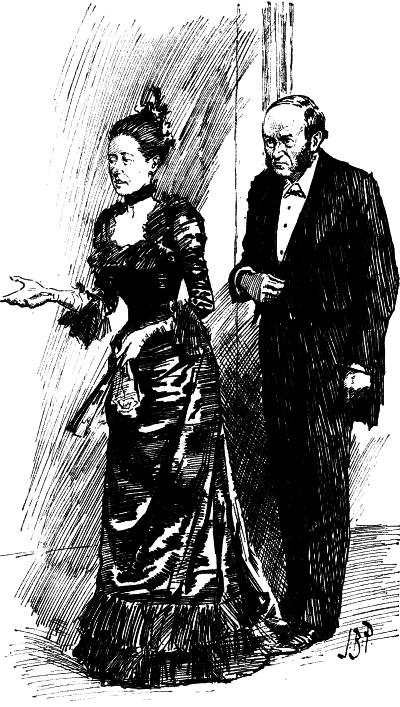
"Mr. and Mrs. Ditchwater!"
Mr. Tid. (uneasily.) 'Pon my word, Maria, it's an awkward thing to do. I almost think we'd better keep him if he comes—we shall have to pay for him anyhow. After all, he'll be quite inoffensive—nobody will notice he's been hired for the evening.
Mrs. Tid. He may be one of the assistants out of the shop for all we can tell. And you're going to let him stay and make us thirteen, the identical thing he was hired to avoid! Well, I shall have to let Miss Seaton dine, after all—that's what it comes to, and this creature can take her down—it will be a little change for her. Gwennie, my pet, run down and tell Seakale that if he hears me ring twice after everybody has come, he's to lay two extra places before he announces dinner. (Gwennie departs reluctantly; Mrs. T. crosses to Miss Seaton.) Oh, Miss Seaton, my husband and I have been thinking whether we couldn't manage to find a place for you at dinner to-night. Of course, it is most unusual, and you must not expect us to make a precedent of it; but—er—you seem rather out of spirits, and perhaps a little cheerful society—just for once——I don't know if it can be arranged yet, but I will let you know about that later on.
Miss Seaton (to herself). I do believe she means to be kind! (Aloud.) Of course, I shall be very pleased to dine, if you wish it.
Seakale (at door). Mr. and Mrs. Gabriel Gilwattle, and Miss Bugle!
[Enter a portly old Gentleman, with light prominent eyes and a crest of grizzled auburn hair, in the wake of an imposing Matron in ruby velvet: they are followed by an elderly Spinster in black and silver, who rattles with jet.
Miss Bugle (after the usual greetings). I hope, dearest Maria, you will excuse me if I am not quite in my usual spirits this evening; but my cockatoo, whom I have had for ages, has been in convulsions the whole afternoon, and though I left him calmer, done up in warm flannel on the rug in front of the fire, and the maid promised faithfully to sit up with him, and telegraph if there was the slightest change, I can't help feeling I ought never to have come.
Aunt Joanna (to her host.) Such a drive as it is here, all the way from Regent's Park, and in this fog—I told Gabriel that if he escapes bronchitis to-morrow——
Seakale. Mr. and Mrs. Ditchwater! Mr. Toomer!
Mr. Ditch. Yes, dear Mrs. Tidmarsh, our opportunities for these festive meetings grow more and more limited with each advancing year. Seven dear friends, at whose board we have sat, and they at ours, within the past twelve months, carried off—all gone from us!
Mrs. Ditch. Eight, Jeremiah, if you count Mr. Jaunders—though he only dined with us once.
Mr. Ditch. To be sure, and never left his bed again. Well, well, it should teach us, as I was remarking to my dear wife as we drove along, to set a higher value than we do on such hospitalities as we are still privileged to enjoy.
Mr. Toomer (to Mrs. Tid.) My poor wife would, I am sure, have charged me with all manner of messages, if she had not been more or less delirious all day—but I am in no anxiety about her—she is so often like that, it is almost chronic.
Seakale. Mr. and Mrs. Bodfish! Miss Flinders! Mr. Poffley!
Mr. Bodf. (after salutations.) Mrs. Bodfish and myself have just been the victims of a most extraordinary mistake! We positively walked straight into your next-door neighbour's house, and if we had not been undeceived by a mummy on the first landing, I don't know where we should have found ourselves next.
Mrs. Tid. A mummy! How very disagreeable; such a peculiar thing to have about a house? But we really know nothing about the people next door. We have never encouraged any intimacy. We thought it best.
Mrs. Bodf. I told their man-servant as we came away that I considered he had behaved disgracefully in not telling us our mistake at once; no doubt he had a motive; people are so unprincipled!
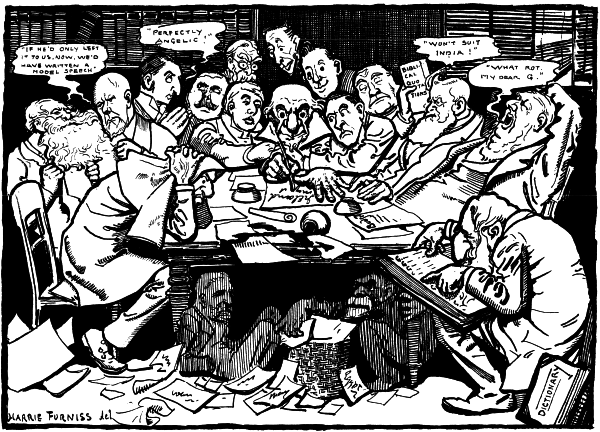
WRITING THE QUEEN'S SPEECH.
Little Gwendolen (drawing Miss Seaton into a corner). Oh, Miss Seaton, what do you think? Mother's going to let you dine downstairs with them—won't that be nice for you? At least, she's going to, if somebody comes, and you're to go down with him. He isn't like a regular dinner-guest, you know. Papa hired him from Blankley's this morning, and Mother and he both hope he mayn't come, after all; but I hope he will, because I want to see what he's like. Don't you hope he'll come? Don't you, Miss Seaton, dear?
Miss Seaton (to herself). Then that was why! And I can't even refuse! (Aloud.) My dear Gwennie, you shouldn't tell me all these things—they're secrets, and I'm sure your Mother would be very angry indeed if she heard you mention them to anybody!
Gwen. Oh, it was only to you, Miss Seaton, and you're nobody, you know! And I can keep a secret, if I choose. I never told how Jane used to——[Miss Seaton endeavours to check these disclosures.
Uncle Gab. (out of temper, on the hearth-rug). Seven minutes past the hour, Monty—and, if there's a thing I'm particular about, it's not being kept waiting for my dinner. Are you expecting somebody else? or what is it?
Mr. Tid. (nervously). Well, I half thought—but we won't wait any longer for him—he is not worth it—ha! there he is—I think I heard the front door—so perhaps I may as well give him——eh?
Uncle Gab. Just as you like—my dinner's spoilt as it is. (Catching sight of the banner-screen.) What have you stuck this precious affair up for, eh?
Mr. Tid. To—to keep the fire off. Maria's idea. Uncle—she thought our—hem—crest and motto would look rather well made up like this.
Uncle Gab. (with a snort). Made up! I should think it was! Though what you want to make yourself out one of those good-for-nothing aristocrats for is beyond me. You know my sentiments about 'em—I'm a thorough-going Radical, and the very sound of a title——
Seakale (with a fine combination of awe and incredulity). Lord Strathsporran!
[There is a perceptible flutter in the company, as a ruddy-haired and rather plain young man enters with an apologetic and even diffident air, and pauses in evident uncertainty as to his host and hostess.
Uncle Gab. (to himself.) A Lord! Bless my soul! Monty and Maria are getting up in the world!
Guests (to themselves.) A Lord! No wonder they kept the dinner back!
Miss Seaton (after a hurried glance—to herself.) Good Heavens! Douglas Claymore!—reduced to this! [She lowers her head.
Mr. Tid. (to himself.) They might have told me they were going to send us a Lord—I never ordered one! I wonder if he's genuine—he don't look it. If I could only find out, quietly!
Mrs. Tid. (to herself.) Gracious! And I was going to send him in with the Governess! (To her Husb. in a whisper.) Montague, what are you about? Go and be civil to him—do!
[She rings the bell twice: Mr. Tidmarsh advances, purple with indignation and embarrassment, to welcome the new-comer, who shakes him warmly by the hand.
(End of Scene III.)
Her Way of Putting It.—Mrs. R. thinks she has an excellent memory for riddles. She was delighted with that somewhat old conundrum about "What is more wonderful than Jonah in the whale?" to which the answer is, "Two men in a fly," and determined to puzzle her nephew with it the very next time she met him. "Such a capital riddle I've got for you, John!" she exclaimed, "Let me see. Oh, yes—I remember—yes, that's it;" and then, having settled the form of the question, she put it thus—"What is more wonderful than two men in an omnibus?" And when she gave the answer, "Jonah in a fly," and correcting herself immediately, said, "No—I mean, 'Jonah in a whale,'" her nephew affectionately recommended his excellent relative to lie down and take a little rest.
Railway Rates.—What better rate can there be than that of the Flying Dutchman to the South, and the Flying Scotchman to the North; the two hours and a-half express to Bournemouth, and the Granville two hours to Ramsgate? The word "Rates" is objectionable as being associated with taxes—and to avoid the taxes the Fishermen are going to employ smacks and boys. Poor boys! there are a lot of smacks about. As the Pantomime and Music-hall poet sang, "Tooral looral lido, whacky smacky smack!" But though they, the Fishermen, hereby avoid the Rails, yet they can't do without their network of lines.
When an actor has to make love to an actress on the stage, it is "purely a matter of business." Real "love-making" is never a matter of business; most often 'tis very much the contrary. The "matter of business" comes in with "making an uncommonly good marriage," but the love-making has little to do with this, except as it is, on the stage, "a matter of business."