Volume 103 — FROM DAY TO DAY.
Reading edition
(A Study in Political Journalism, from some of the Morning Papers.)
No. I.
To-day, the first pollings of the General Election take place, and the electors will be called upon to decide one of the most momentous issues that have ever been submitted to the judgment of the country. For ourselves, we cannot doubt for a moment as to what the verdict will be. It is impossible that a policy of empty promises, backed by mere misrepresentation, should prevail against a glorious record of administrative, legislative, and financial success. Careful calculations have convinced us that those who now hold the reins of office will return to power with a largely increased majority, to continue their beneficent work. The country recognises by this time that anything short of that would mean disaster to the commonwealth. Even with a small majority, the forces of disorder would be able to work untold mischief. Such a result, however, is not within the bounds of possibility, seeing that the Election will be fought purely and simply on the Irish question, which has been placed fully before the electorate in all its bearings. Our organisation is perfect, and our triumph assured.
No. II. (Three Days Later.)
We are constrained to admit that, so far, the result of the Elections has not come up to the confident anticipations of our Party. Seats have been lost that ought to have been retained. On the other hand, we have failed to win seats that we had a right to count upon as certainties. It is not easy to apportion the responsibility for failure. Over-confidence and a consequent want of energy may have had something to do with it; but the chief reason is to be found in the disgracefully defective organisation of the Party. The story is an old one. We have ourselves deemed it our duty to lay this aspect of the case before the Leaders of the Party, but our repeated warnings have been unheeded, and the necessary consequences have followed. Our opponents, however, have not much to congratulate themselves upon. The Irish question has been kept studiously in the back-ground, and the results, so far as they have gone, only prove conclusively that there is no diminution whatever in the dislike with which the majority of the electorate regard the proposals of the party of disorder. We are far from saying that even now we shall lose the Election. Everything may yet be retrieved. But, even should the result be numerically favourable to the Opposition, they will be powerless for mischief with the small majority which is all they are likely to get.
No. III. (A Week Later.)
The Elections are now nearing an end, and it is possible to summarise the results. It is not surprising that our opponents should be reduced to the lowest depths of despair. They counted with the utmost certainty on a majority of two hundred. But, as matters stand, it is out of the question that their preponderance should exceed fifty. Where are now the confident boastings with which they inaugurated the campaign? They have confused the judgment of the electors with every kind of side-issue. Misrepresentations have been sown broadcast, and have, in too many instances, succeeded. But the great heart of the country is still sound. Votes must be weighed as well as counted, and it is safe to assume that, with a paltry and heterogeneous majority of merely fifty, the advocates of revolution will be reduced to impotence, even if they can succeed in forming a Government at all. The result is one on which our Party may well congratulate themselves. They have worked hard, and the solid fruit of their efforts is now within their reach. We may safely say that the Irish policy of our opponents has received its death-blow.
"THERE HE BLOWS!"
(
The German Emperor has gone Whaling in the North Seas.
)
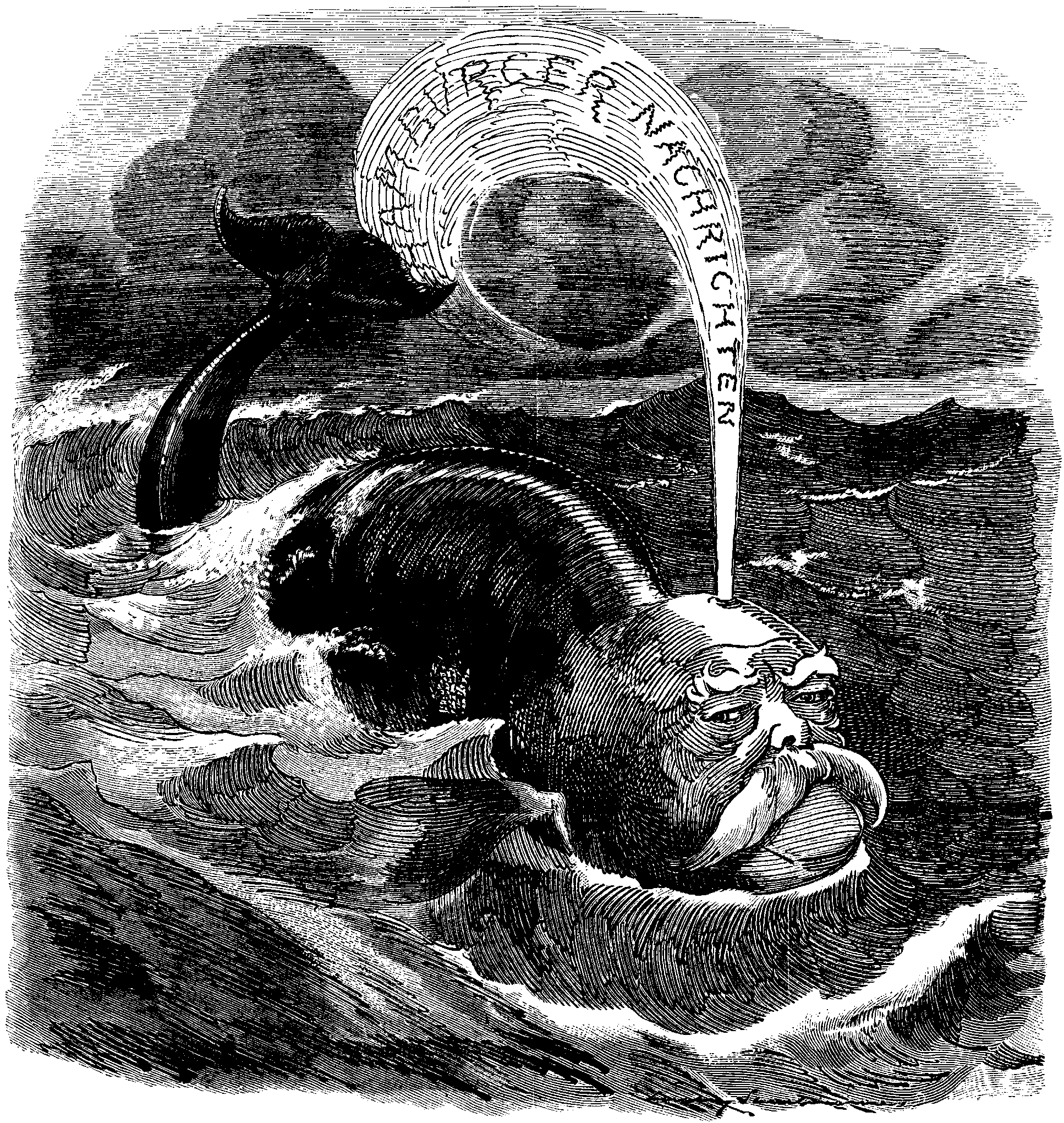
"There he blows! There he goes!" Like a Titan in throes, With his wallopping tail, and his wave-churning nose, The spouting Cetacean Colossus! Eh? Harpoon that Monster! The thought makes one pale, With one thundering thwack of that thumping big tail, To the skies in small splinters he'd toss us! Rolling in foaming wild billows, ice-laden He goes, like the "boisterous sea" (vide HADYN!) "Upheaved from the deep," swift, tremendous, Leviathan sports on the far-foaming wave. If he runs athwart us, what power shall save, From the doom to which promptly he'd send us? His "soundings," or "diggings," are many and deep; But would that his "three-hundred fathoms" he'd keep, Below in the ocean's cold quiet. But no, not at all; he's not that sort of whale! He must breathe, he must blow, he must roar, till the gale Is charged with the sound of his riot. Leviathan loves the wild turmoil of strife, And lashing the billows to him is true life; Behold how he buffets and scourges them! Chase him? The Captain (though also a Kaiser), Might think that his course to avoid him were wiser, Until sheer necessity urges them. And yet whales are beaten—by narwhals and men, And other mere pigmies. 'Tis said, now and then, E'en sword-fish can compass their ruin, By stabbing together—in Cassius's way With Cæsar. Leviathan, dead, is a prey To dog-fish, and sea-birds, or Bruin. There he blows! There he goes! Would an amateur Whaler, Like WILHELM, that fine blend of Statesman and Sailor, Incline to the chase and the capture Of such a huge, wandering, wallopping whale, To whom "Troubling the waters" with blow-holes and tail Seems a source of such riotous rapture?