Volume 103 — CONVERSATIONAL HINTS FOR YOUNG SHOOTERS.
Reading edition
The Smoking-Room.
(With which is incorporated "Anecdotes.")
Let us imagine, if you please, that the toils and trampings of the day are over. You are staying at a comfortable country-house with friends whom you like. You have had a good day at your host's pheasants and his rabbits. Your shooting has been fairly accurate, not ostentatiously brilliant, but on the whole satisfactory. You have followed out the hints given in my previous Chapters, and are consequently looked upon as a pleasant fellow, with plenty to say for himself. After tea, in the drawing-room, you have had an hour or two for the writing of letters, which you have of course not written, for the reading of the morning papers from London which you have skimmed with a faint interest, and for the forty or eighty or one hundred and twenty winks in an armchair in front of the fire, which are by no means the least pleasant and comforting incident in the day's programme. You have dressed for dinner in good time; you have tied your white tie successfully "in once;" you have taken in a charming girl (Rose Larking, let us say) to dinner. The dinner itself has been good, the drawing-room interlude after dinner has been pleasantly varied with music, and the ladies have, with the tact for which they are sometimes distinguished, retired early to bed-rooms, where it is believed they spend hours in the combing of their beautiful hair, and the interchange of gossip. You are in high spirits. You think, indeed you are sure (and again, on thinking it well over, not quite so sure), that the adorable Rose looked kindly upon you as she said good-night, and allowed her pretty little hand to linger in your own while you assured her that to-morrow you would get for her the pinion-feather of a woodcock, or die in the attempt. You are now arrayed in your smoking-coat (the black with the red silk-facings), and your velvet slippers with your initials worked in gold—a birthday present from your sister. All the rest are, each after his own fashion, similarly attired, and the whole male party is gathered together in the smoking-room. There you sit and smoke and chat until the witching hour of night, when everybody yawns and grave men, as well as gay, go up to their beds.
Now, since you are an unassuming youngster, and anxious to learn, you ask me probably, how you are to bear yourself in this important assembly, what you are to speak about, and how? The chief thing, I answer, is not to be a bore. It is so easy not to be a bore if only you give a little thought to it. Nobody wants to be a bore. I cannot imagine any man consciously incurring the execration of his fellow-men. And yet there exist innumerable bores scattered through the length and breadth of our happy country, and carrying on their dismal business with an almost malignant persistency. Longwindedness, pomposity, the exaggeration of petty trivialities, the irresistible desire to magnify one's own wretched little achievements, to pose as the little hero of insignificant adventures, and to relate them to the whole world in every dull detail, regardless of the right of other men to get an occasional word in edgewise—these are the true marks of the genuine bore. He must know that you take no interest in him or his story. Even if you did, his manner of telling it would flatten you, yet he fascinates you with that glassy stare, that self-conscious and self-admiring smirk, and distils his tale into your ears at the very moment when you are burning to talk over old College-days with Chalmers, or to discuss an article in the Field with Shabrack.
I remember once finding myself, by some freak of mocking destiny, in a house in which two bores had established fortified camps. On the first night, we all became so dazed with intolerable dulness, that our powers of resistance faded away to the vanishing point. Both bores sallied out from their ramparts, laid our little possessions waste, and led, each his tale of captives back with him, gagged, bound, and incapable of struggle.
So next day, when the accustomed train Of things grew round our sense again,
we agreed together, those of us, I mean, who had suffered on the previous night, that something must be done. What it was to be we could not at first decide. We should have preferred "something lingering, with boiling oil in it," but at last we decided on the brilliant suggestion of Shabrack, who was of the party, that we should endeavour by some means or other to bring the two bores, as it were, face to face in a kind of boring-competition in the smoking-room that very night, to engage them in warfare against one another and ourselves to sit by and watch them mutually extinguishing one another; a result that, we were certain, could not fail to be brought about, owing to the deadly nature of the weapons with which each was provided. Both the bores, I may observe, shot execrably during the day. In the evening, after a short preliminary skirmish, from which Shabrack the hussar extricated us with but little loss, that which we desired came to pass. It was a terrible spectacle. In a moment both these magnificent animals, their bristles erect, and all their tusks flashing fiercely in the lamp-light, were locked in the death-grapple. Every detail of the memorable struggle is indelibly burnt into my brain. Even at this distance of time, I can remember how we all looked on, silent, awestruck, fascinated, as the dreadful fight proceeded to its inevitable close. For the benefit of others, let me attempt to describe it in the appropriate language of the Ring.
Great Fight Between the Kentish Proser and the Hampshire Dullard.
Round I.—Both men advanced, confident, but cautious. After sparring for an opening, the Proser landed lightly on the jaw with,—"When the Duke of Dashbury did me the honour to ask me to his Grace's noble deer-forest." He ducked to avoid the return, but the Hampshire Champion would not be denied, and placed two heavy fish-stories fair in the bread-basket. The Proser swung round a vicious right-hander anecdote about a stag shot at 250 yards, but the blow fell short, and he was fairly staggered by two in succession ("the tree-climbing rabbit," and "the Marquis of Dullfield's gaiters"), delivered straight on the mouth. First blood for the Dullard. After some hard exchanges they closed, and fell, the Dullard underneath.
Round II.—Both blowing a good deal. The Proser put up his Dukes, and let fly with both of them, one after another, at the Dullard's conk, drawing claret profusely. Nothing daunted, the Dullard watched his opportunity, and delivered a first-class Royal Prince on the Proser's right eye, half closing that optic. The men now closed, but broke away again almost directly. Some smart fibbing, in which neither could claim an advantage, ensued. The round was brought to a close by some rapid exchanges, after which the Proser went down. Betting 6 to 4 on the Dullard.
Round III., and last.—Proser's right peeper badly swollen, the Dullard gory, and a bit groggy, but still smiling. Proser opened with a ricochet, which did great execution, but was countered heavily when he attempted to repeat the trick, the Dullard all but knocking him off his legs with a fifty-pound salmon. After some slight exchanges they began a hammer-and-tongs game, in which Proser scored heavily. Dullard, however, pulled himself together for a final rush. They met in the middle of the ring, and both fell heavily. As neither was able to rise, the fight was drawn. Both men were heavily damaged, and were carried away with their jaws broken.
There you have the story. The actual result was that these two ponderous bores all but did one another to death. So exhausted were they by the terrible conflict, that our comfort was not again disturbed by them during this particular visit. We were lucky, though at first we scarcely saw it, in getting two evenly matched ironclad bores together. If we had had only one, the matter would have been far more difficult.
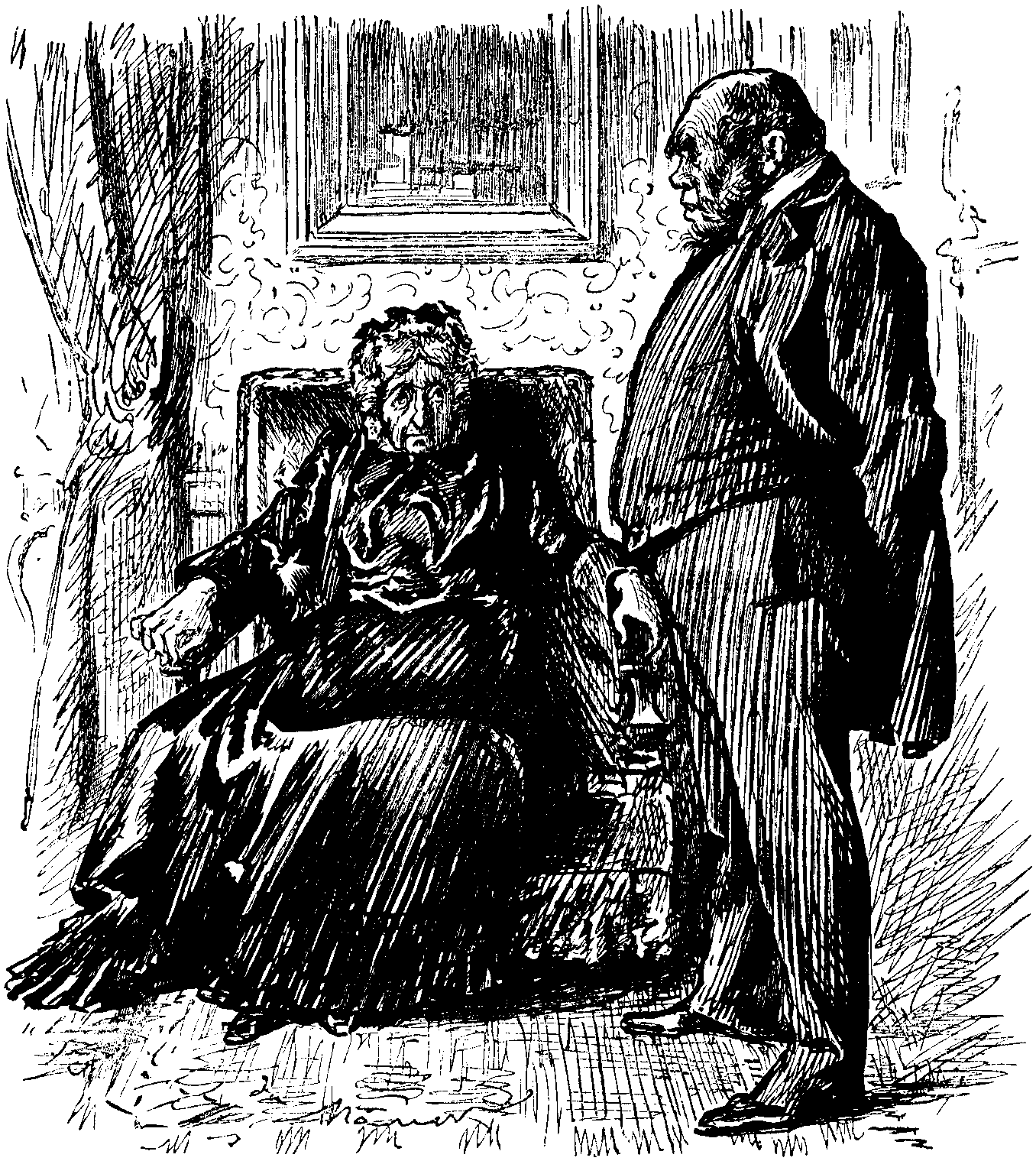
THE SERPENT'S TOOTH.
"Didn't I send 'im to Heton an' Hoxford? Didn't I send 'im into the Harmy, along o' some o' the biggest Nobs in all Hengland, with an Allowance fit for a young Hearl? And what's the hupshot of it all? Why, he gives Dinners to Dooks and Royal 'Ighnesses, an' don't even harsk 'is pore old Father to meet 'em. 'Ighnesses, indeed! I could buy up the 'ole blessed lot! And, what's more, I wouldn't mind tellin' 'em so to their Faces, for Two Pins!—Ah! just as soon as look at 'em—and 'e knows it!"
Undecided.
Goosey, Goose, Uganda, With whom will you wander, With the English, with the French? Or with King Mwanga?
Advice Gratis (by a Bill Poster).—"Invest all your savings in hoardings."