Volume 103 — DIARY OF A STATESMAN.
Reading edition
("Made in France.")
Monday.—Immense enthusiasm. The Ministry never so strong. When asked my intentions, replied, "My intentions are the intentions of my country." They nearly shook my hand off in their delight. Grand official reception in the evening. Everyone there. All the Diplomatic body offered congratulations.
Tuesday.—Ministry suddenly threatened by an unseen danger. Everything going smoothly, when someone in the back benches interrogated us about an open window in the corridors. Considering the question frivolous, declined to answer. Enormous excitement, all the Members shaking their fists, and gesticulating. "Urgency" asked for. We protested; and, after a heated debate, secured the passing to the Order of the Day pur et simple by a majority of two! Too close to be pleasant.
Wednesday.—We have been defeated! The window incident was renewed. The Minister of Justice explained that it was the accidental carelessness of a Commissionnaire of Police. Although the man was brave, and crippled by a wound, the Chamber demanded his immediate dismissal. We protested. "Urgency" was voted by a majority of 343, and we immediately resigned. Bore to have to pack up!
Thursday.—Have refused to join no less than five combinations. Too dangerous. None of them seemed sufficiently stable. Six men have been tried, but at present without result. Well, if nothing is done by to-morrow morning, I shall go into the country for a little shooting. Fido is quite ready—he has his coat out, his moustache curled, and can carry a bag in his mouth. He is very good at tricks too. Altogether a thorough sporting dogue.
Friday.—Back again. Others being unable to form a Cabinet, have formed one myself. Think it will hold together, but one never knows. So far we have had an overwhelming vote of confidence. Put it to the Members whether we might do what we pleased with the windows. "Yes," and "Urgency" voted almost simultaneously. No doubt a veritable triumph!
Saturday.—Everything went smoothly until the afternoon, when a Deputy wished to know the correct time. Minister of Education gave it as a quarter to six. It was proved that he was wrong. He should have said ten minutes to the hour. Serious Ministerial crisis in consequence. Fearful excitement. A Bill brought in and passed legalising everything that four men and a boy might decide. Ministry forced to protest; turned out in consequence. Base ingratitude; but a time will come! Generally hop in and out of office twice in a fortnight. Quite accustomed to it. Good exercise.
Sunday.—Released from my Ministerial duties. Shall have a day's shooting with Fido in consequence. But I must be back again to-night, because I am sure to be expected to form a New Ministry to-morrow!
Query.—Why cannot Mr. Gladstone eat more than two-thirds of a rabbit, whether boiled or curried? Answer.—It does not matter what Mr. Gladstone or anybody else can do, as nobody can eat a rabbit (w)hole.
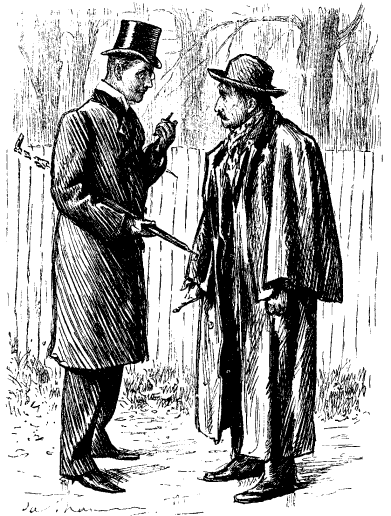
KINDLY MEANT.
"Where are you staying? I'll call and see you."
"Don't! You'll only think the Worse of me when you see my Surroundings!"
"Oh, my dear Fellow, that's impossible, you know!"
"SMALL BY DEGREES, AND BEAUTIFULLY LESS."
Dear Mr. Punch,—I see that the authorities at Monte Carlo very properly have refused permission to Doctors, their wives and families, to visit the tables of the Casino. I have not yet ascertained the reason for the prohibition, but no doubt it is because the "powers that be" consider Physicians too valuable to the community to run the risk of endangering their lives in the excitement of play. If we may accept this as a basis, we can see how the idea can be developed. If it is right to exclude Doctors, why then, as a kindred class, Lawyers should also be refused admission. Of course Clergymen of all denominations are, even now, conspicuous by their absence. If they are not, the decree of banishment should refer also to the wearers of the cloth.
We have now got rid of Doctors, Lawyers, and Parsons—three of the Professions. To be consistent, we must take the fourth. This will prevent Musicians from gambling. But if Musicians are tabooed, why not Actors? And if Actors, why not Artists? And if we except Artists, we must join Literature and Science, or there might be jealousy. And now we have excluded Doctors, Lawyers, Parsons, Musicians, Actors, Artists, Authors, Men of Science, and everyone more or less connected with them.
Now we must remember what is bad for the master must be equally bad for the man. So if a Doctor is excluded, a Chemist, an Undertaker, and a Grave-digger would also be kept away. A Lawyer would carry with him Judges, Magistrates, Clerks, and Law Stationers. The Clergy would represent everyone connected with a church, from an Archbishop to a Bell-ringer. Then, if we are to take away the Professions, Commerce must follow—wholesale and retail. In one blow we keep out of the rooms nearly the entire community.
Still there are the Army, the Navy, and the Civil Service. But these are all more or less branches of the original class. They, like the Doctors, work for the public good. Without an Army and Navy and a Civil Service, how would the State exist? So they must go. And now we have very little left. We have lost the Doctors, the Clergy, the Lawyers, the Contributors to Fine Arts, the Merchants, the Traders, and the Servants of the Crown. Naturally the lower orders would follow the lead of the upper classes, and then there would be only the Croupiers left. And as the Croupiers may not play themselves, and would have the play of no one to superintend, they, too, might be excused, as their labour would be in vain.
And now having reduced the visitors of the tables to an unknown quantity, I may disappear myself. Yours retiringly,
Spanish Castle, Isle of Skye. An ex-X.
A Rush of One.—The Times, a few days ago, alluding to the unemployed loafer, said, "it is he who flocks" to Relief Committees, and so forth. How delightful to be able to flock all by yourself! It recalls the bould Irish soldier who "took six Frenchmen prisoners by surrounding them"?
The Grammar Of Art.—"Art," spell it with a big or little "a," can never come first in any well-educated person's ideas. "I am" must have the place of honour; then "Thou Art!" so apostrophised, comes next.
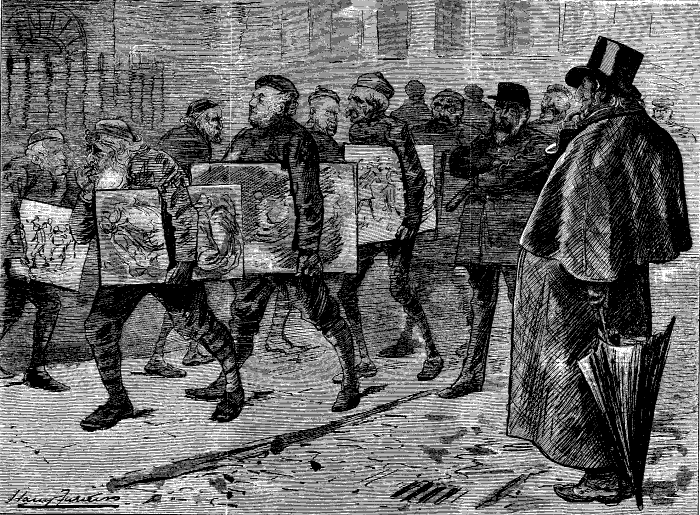
ROYAL ACADEMICIANS AT MILLBANK.
("We understand that Millbank Prison, the site offered by Sir William Harcourt for the National Gallery of British Art, has been accepted by Mr. Tate."—Morning Papers.)