Volume 102 — HISTORY AS SHE IS PLAYED!
Reading edition
Questioner. Why should M.V. SARDOU be called the Historian of the French Revolution?
Answerer. Because in Thermidor he has given an entirely new version of the "Reign of Terror."
Q. Was the "Reign of Terror" very terrible?
A. Not very. At the Opéra Comique it had its comic side.
Q. How was that?
A. For instance, les tricoteuses were represented by comely, albeit plump maidens, who seemed more inclined to dance round a Maypole than haunt a scaffold.
Q. Were ROBESPIERRE, ST. JUST, and the rest, cruel and vindictive?
A. I should say not; and I found my conclusion on the fact that they engaged an actor given to practical joking as an officer of the Public Security.
Q. From this, do you take it that ROBESPIERRE must have had a subtle sense of humour?
A. I do; and the impression is strengthened by his order for a general slaughter of Ursuline Nuns.
Q. Why should he order such a massacre?
A. To catch the heroine of Thermidor, a lady who had taken the vows under the impression that her lover had been killed by the enemy.
Q. Had her lover been killed?
A. Certainly not; he had preferred to surrender.
Q. Can you give me any idea of the component part of a revolutionary crowd?
A. At the Opéra Comique, a revolutionary crowd seems to consist of a number of mournful loungers, who have nothing to do save to take a languid interest in the fate of a tearful maiden, and a few gens d'armes a little uncertain about their parade-ground.
Q. How do the mournful loungers express their interest in the fate of the tearful maiden?
A. By pointing her out one to another, and when she is ordered off to execution removing their hats, and fixing I their attention on something concealed behind the scenes.
Q. What is your present idea of the Reign of Terror?
A. My present idea of the Reign of Terror is, that it was the mildest thing imaginable. In my opinion, not even a child in arms would have been frightened at it.
Q. Do you not consider M. MAYER deserving of honour?
A. Certainly I do. For has he not removed (with the assistance of M. SARDOU and the Opéra Comique) several fond illusions of my youth?
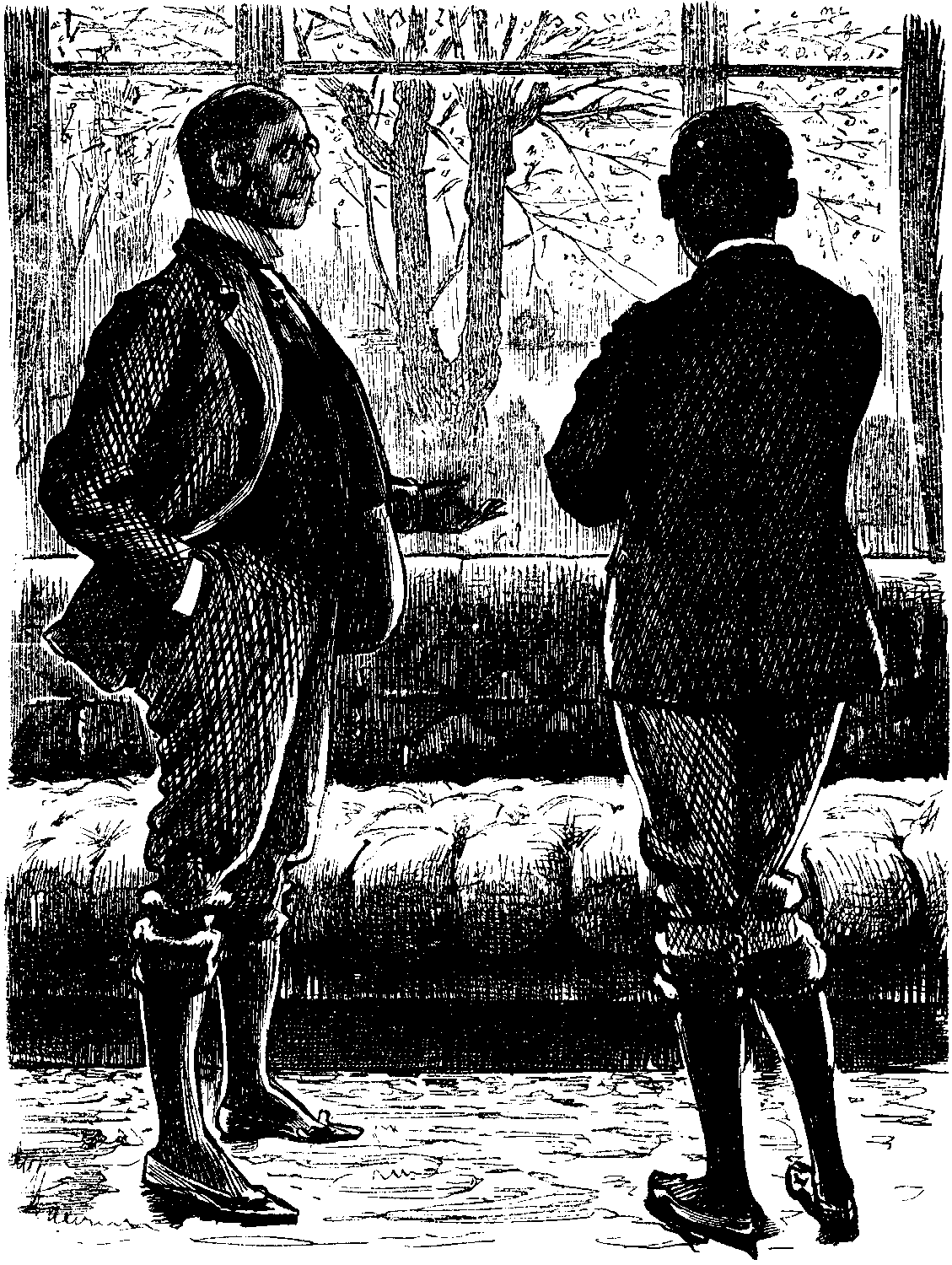
NATURE V. ART.
Æsthetic Friend. "YES, THIS ROOM'S RATHER NICE, ALL BUT THE WINDOW, WITH THESE LARGE BLANK PANES OF PLATE-GLASS! I SHOULD LIKE TO SEE SOME SORT OF PATTERN ON THEM—LITTLE SQUARES OR LOZENGES OR ARABESQUES—"
Philistine. "WELL, BUT THOSE LOVELY CHERRY BLOSSOMS, AND THE LAKE, AND THE DISTANT MOUNTAIN, AND THE BEAUTIFUL SUNSETS, AND THE PURPLE CLOUDS—ISN'T THAT PATTERN ENOUGH?"
THE MORNING OF THE DERBY.—Hamlet considering whether he shall go to Epsom for the great race or not, soliloquises, "Der-be or not Der-be, that is the question." [N.B.—As to the other lines, go as you please. "The rest is silence."]
"MARRIED AND SINGLE" should be played by Lady-Cricketers. No single young person under seventeen should be permitted an innings, as any two sweet sixteens would be "not out," and there would be no chance for the other side. Match-makers are only interested in the Single.