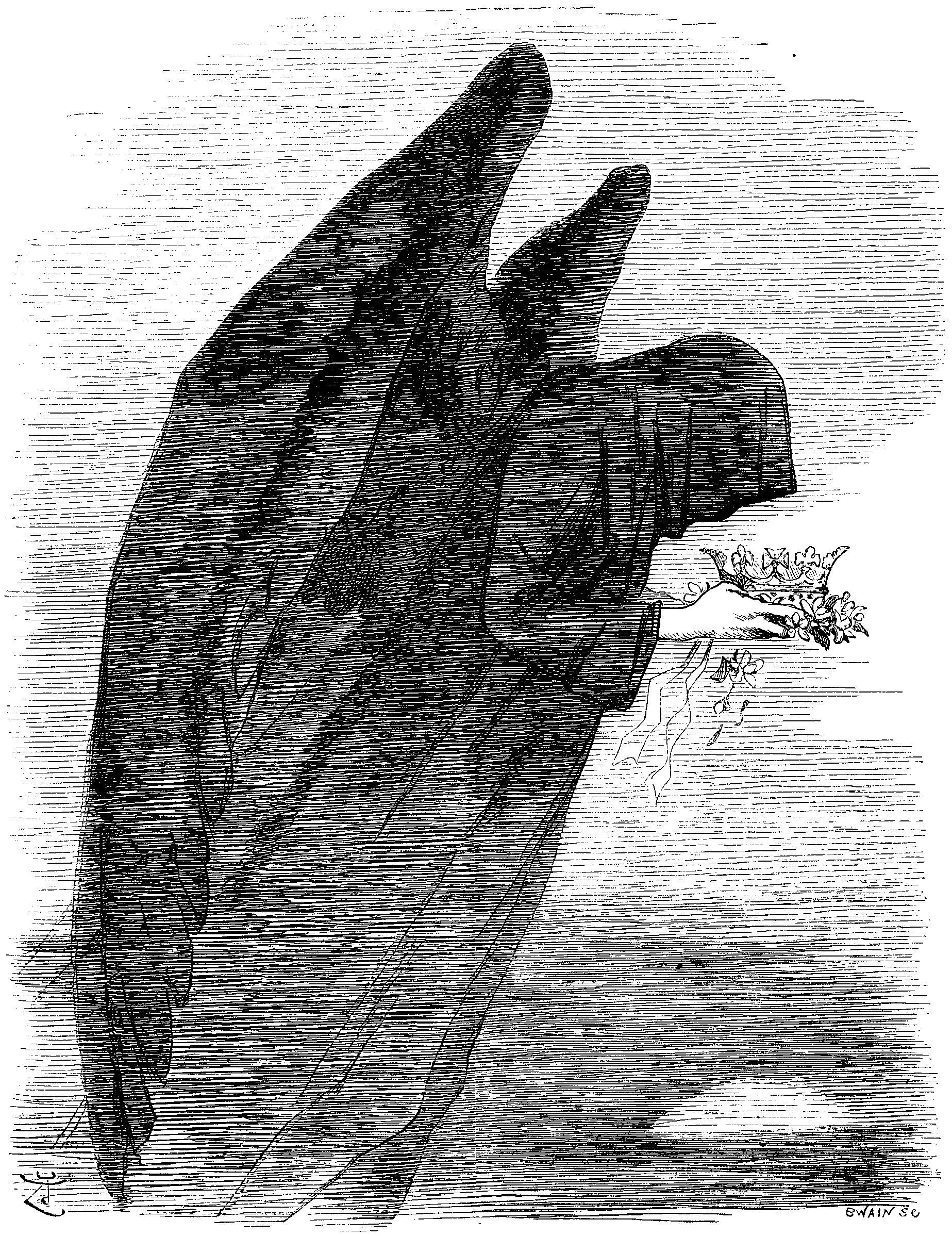
Volume 102 — THE BRIDAL WREATH.
Reading edition
IN MEMORIAM
H.R.H. THE DUKE OF CLARENCE AND AVONDALE.
BORN, JAN. 8, 1864. DIED, JAN. 14, 1892.
"I thought thy bridal to have deck'd ... And not have strew'd thy grave."—Hamlet.
But yesterday it seems,
That, dreaming loyal dreams,
Punch, with the People, genially rejoiced
And now relentless Death
Silences all the joy our hopes had voiced.
The Shadow glides between; The garland's vernal green Shrivels to greyness in its spectral hand. Joy-bells are muffled, mute, Hushed is the bridal lute, And general grief darkens across the land.
Surely a hapless fate For young hearts so elate, So fired with promise of approaching bliss! Oh, flowers we hoped to fling! Oh, songs we thought to sing! Prophetic fancy had not pictured this.
Young, modest, scarce yet tried, Later he should have died, This gentle youth, loved by our widowed QUEEN! So we are apt to say, Who only mark the way, Not the great goal by all but Heaven unseen.
At least our tears may fall Upon the untimely pall Of so much frustrate promise, unreproved; At least our hearts may bear In her great grief a share, Who bows above the bier of him she loved.
Princess, whose brightening fate We gladly hymned of late, Whose nuptial happiness we hoped to hymn With the first bursts of spring, To you our hearts we bring Warm with a sympathy death cannot dim.
Death, cold and cruel Death, Removes the Bridal Wreath England for England's daughter had designed. Love cannot stay that hand, And Hymen's rosy band Is rent; so will the Fates austere and blind.
Blind and austere! Ah, no! The chill succeeds the glow, As winter hastes at summer's hurrying heel. Flowers, soft and virgin-white, Meant for the Bride's delight, May deck the pall where love in tears must kneel.
Flowers are they, blossoms still, Born of Benignant Will, Not of the Sphingian Fate, which hath no heed For human smiles or tears; The long-revolving years Have brought humanity a happier creed.
Prince-Sire of the young dead, Mother whose comely head Is bowed above him in so bitter grief; Betrothed one, and bereaved, Queen who so oft hath grieved,— Ye all were nurtured in this blest belief.
Hence is there comfort still, In a whole land's good-will, In hope that pallid spectre shall not slay. The unwelcome hand of Death Closes on that white wreath; But there is that Death cannot take away!
AT MRS. RAM'S.—They were talking of Mr. JOHN MORLEY. "He's not a practical politician," said some one, "he's a doctrinaire." "Is he, indeed?" said our excellent old Lady, "then I daresay I met him when I was in Scotland." Observing their puzzled expression, she added, "Yet it's more than likely I didn't, as, when in the North, I was so uncommonly well that I never wanted a medical man." Subsequently it turned out that she had understood Mr. J.M. to be a "Doctor in Ayr."
Song for Lord Rosebery.
(After "Tom Tug," in the "Waterman.")
Then farewell, my County Council, Cheek, and fads, and bosh farewell, Never more in Whitehall Gardens Shall your ROSEB'RY take a spell.
CHANGE OF NAME SUGGESTED.—Why call the place Monte Carlo, why not Mont "Blanc" Junior? The Leviathan Winner who broke the record and the tables, Mr. HILL WELLS, might also alter his name according to his luck. A run of HILL-luck would settle him: but when "WELL's the word," he could forget the HILL-doing of the previous day.