Volume 102 — ESSENCE OF PARLIAMENT.
Reading edition
EXTRACTED FKOM THE DIARY OF TOBY, M.P.
House of Commons, Monday, February 8.—The coming of Prince ARTHUR anxiously looked for as Members gathered for last Session of a memorable Parliament. When, in August last, he, with the rest of us, went away, OLD MORALITY still sat in Leader's place. He was, truly, just then absent in the flesh, already wasting with the dire disease that carried him off. It was JOKIM who occupied the place of Leader; Prince ARTHUR, content to sit lower down. It seemed to some that when vacancy occurred JOKIM, that veteran Child of Promise, would step in, and younger men wait their turn. But youth of certain quality must come to the front, as BONAPARTE testified even before he went to Italy, and as PITT showed when the Rockingham Administration went to pieces.
Prince ARTHUR came in shortly after four o'clock. House full, especially on Opposition Benches; faint blush suffused ingenuous cheek as welcoming cheer arose. Seemed to know his way to Leader's place, and took it naturally. Pretty to see JOKIM drop in on one side of him with MATTHEWS on the other, buttressing him about with financial reputation and legal erudition. Tableau quite undesigned, but none the less effective. Prince ARTHUR, young, hot-tempered and, though not without parts, prone to commit errors of judgment. But with JOKIM at his left shoulder, and HENRY MATTHEWS at his right, humble citizens looking on from opposite Benches, felt a sweet content. On such a basis, the Constitution might stand any blast.
In absence of Mr. G., who still dallies with the sunshine of Riviera, SQUIRE OF MALWOOD, fresh from hunting in the New Forest, more than fills the place of Leader of Opposition. A favourable opportunity for distinguishing himself marred by accidental prevalence of funereal associations.
"The Squire," said PLUNKET—watching him as, with legs reverently crossed, and elbow sympathisingly resting on box, carefully suggestive of life-sized figure of tombstone-mourner, he intoned his lamentation—"is not fitted for the part, and consequently overdoes it. L'Allegro is his line. Il Penseroso does not suit him."
Everyone glad when, sermon over, and the black-edged folios put aside, the Squire began business. Happy enough in his attack on JOKIM, always a telling subject in present House of Commons.
"He is," says SAGE OF QUEEN ANNE'S GATE, drawing upon his theatrical experiences, "like the Policeman in the Pantomime; always safe for a roar of laughter if you bonnet him or trip him up over the doorstep."
For the rest, as Prince ARTHUR pointed out when he came to reply, Squire's speech had very little to do with the Address, on which it was ostensibly based. Couldn't resist temptation of enlarging on financial science for the edification of the unhappy JOKIM.
"Finance," observed DICKY TEMPLE, "is HARCOURT's foible."
"Yes," said JENNINGS, whom everyone is glad to see back in better health, "and funeral sermons are his forte."
Through nearly hour and half the Squire mourned and jibed, Prince ARTHUR listening attentively, all unconscious of the Shades hovering about the historic seat in which he lounged, as nearly as possible, at full length—OLD MORALITY, kindly generous, pleased in another's prosperity; STAFFORD NORTHCOTE, marvelling at the madness of a world he has not been loth to quit; DIZZY tickled with the whole situation, though perhaps a little shocked to see a Leader of the House resting apparently on his shoulder-blades in the seat where from 1874 to 1876 there posed an upright statuesque figure with folded arms and mask-like face, lit up now and then by the gleam of eyes that saw everything whilst they seemed to be looking no whither. PAM was there, too, with slightly raised eyebrows as they fell on the youthful form already installed in a place he had not reached till he was almost twice the age of the newcomer. JOHNNY RUSSELL, scowled at the intruder under a hat a-size-and-half too big for his legs. CANNING looked on, and thought of his brief tenure of the same place whilst the century was young. Still further in the shade PITT joined the group.
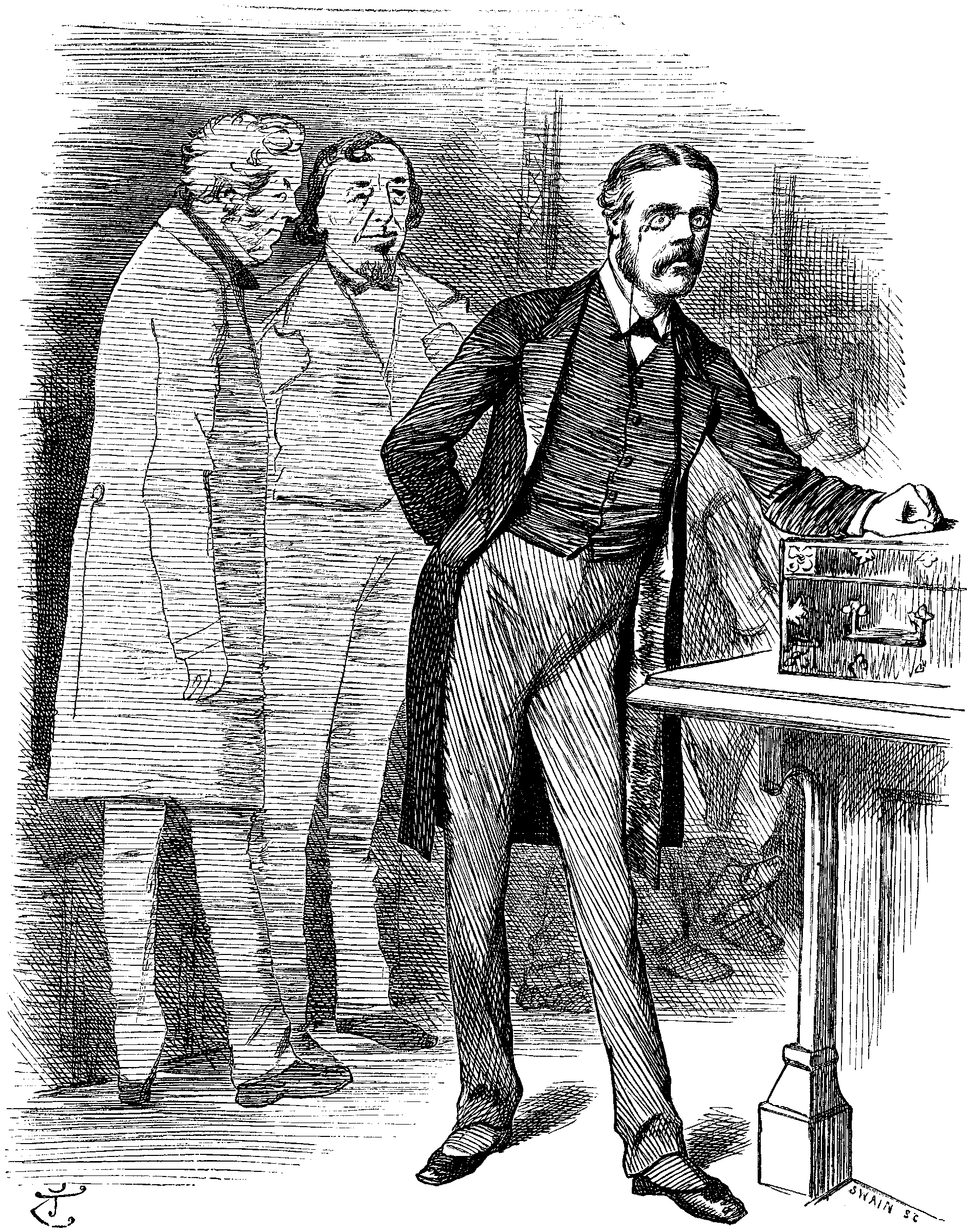
"THE COMING OF ARTHUR."
Shade of Pam. "H'M! A LITTLE YOUNG FOR THE PART,—DON'T YOU THINK?"
Shade of Dizzy. "WELL, YES! WE HAD TO WAIT FOR IT A GOOD MANY YEARS!—BUT I THINK HE'LL DO!!"
"Well at least he was even younger when he came to our place," PAM whispered in DIZZY's ear, startling him as he inadvertently touched his cheek with the straw he still seems to hold in his teeth, as he did when JOHN LEECH was alive.
Prince ARTHUR, facing the crowded Opposition Benches, of course saw nothing of this; lounged and listened smilingly as the Squire, having shaken up JOKIM and his one-pound notes, went oft to Exeter to pummel the MARKISS.
Business done.—Address moved.
Wednesday.—Evidently going to be an Agricultural Labourer's Session. Small Holdings Bill put in forefront of Programme. District Councils hinted at. In this situation it was stroke of genius, due I believe to the MARKISS, that such happy selection was made of Mover of Address.
"It's trifles that make up the mass, my dear nephew," the MARKISS said, when this matter was being discussed in the Recess. "No detail is so small that we can afford to omit it. It was a happy thought of yours, perhaps a little too subtle for some intellects, to associate CHAPLIN with Small Holdings. In this other matter, let me have my way. Put up HODGE to move the Address. It will be worth 10,000 votes in the agricultural districts. I suppose he wouldn't like to come down in a smock frock with a whip in his hand? Don't know why he shouldn't; quite as reasonable as a civilian getting himself up as a Colonel or an Admiral. With HODGE in a smock frock moving the Address we'd sweep the country. But that I must leave to you; only let us have HODGE."
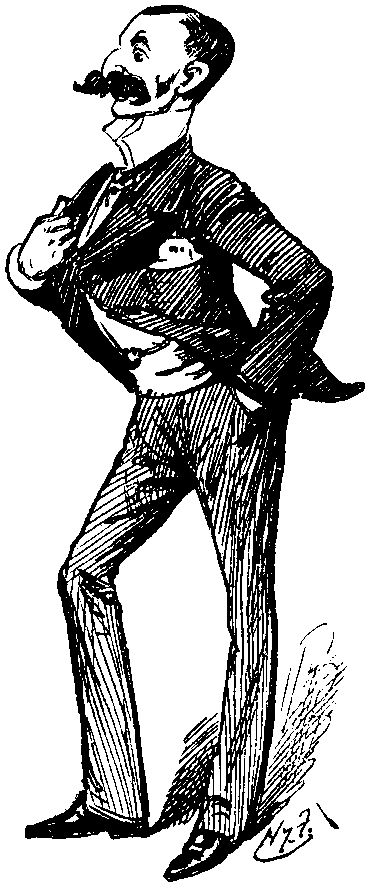
So it was arranged. But Member for Accrington wouldn't stand the smock-frock. Insisted upon coming out in war-like uniform. Trousers a little tight about the knees, and jacket perhaps a trifle too tasselly. But made very good speech in the circumstances.
Orator Hodge (in mufti).
Business done.—Bills brought in by the half hundred.
Thursday Night.—Things been rather dull hitherto. House as it were lying under a pall, "Every man," as O'HANLON says, "not knowing what moment may be his next." Still on Debate on Address. When resumed to-night, CHAMBERLAIN stepped into ring and took off his coat. When Members saw the faithful JESSE bring in sponge and vinegar-bottle, knew there would be some sport. Anticipation not disappointed. JOE in fine fighting form. Went for the SQUIRE OF MALWOOD round after round; occasionally turned to aim a "wonner" at his "Right Hon. Friend" JOHN MORELY. Conservatives delighted; had always thought just what JOE was saying, but hadn't managed to put their ideas into such easily fleeting, barbed sentences. Only once was there any shade on the faces of the country gentlemen opposite. That spread when JOE proposed to quote the "lines of CHURCHILL."
"No, no," said Lord HENRY BRUCE in audible whisper, "he'd better leave GRANDOLPH alone. Never knew he wrote poetry. If he did, there's lots of others. Why, when we're going on so nicely, why drag in CHURCHILL?"
Depression only momentary. Conservative cheers rose again and again as JOE, turning a mocking face, and shaking a minatory forefinger at the passive monumental figure of the guileless SQUIRE OF MALWOOD, did, as JOHN MORLEY, with rare outburst of anger, presently said, from his place in the centre of the Liberal Camp, "denounce and assail Liberal principles, Liberal measures, and his old Liberal colleagues."
After this it was nothing that, some hours later, O'HANLON, rising from a Back Bench, and speaking on another turn of the Debate, should observe, in loud voice, with eye fixed in fine frenzy on the nape of the Squire's neck, as he sat on the Front Bench with folded arms, "I do not believe in the Opposition Leaders, who have split up my Party, and are now living on its blood."
Business done.—JOSEPH turns and rends his Brethren.
Friday Night.—In Commons night wasted by re-delivery of speeches made last year by Irish Members pleading for amnesty for Dynamitards. JOHN REDMOND began it. No Irish Member could afford to be off on this scene, so one after another they trotted out their speeches of yester-year.
Lords much more usefully occupied in discussing London Fog. MIDDLETON moved for Royal Commission. MARKISS drew fine distinction. "What you really want to remedy," he said, "is not the fog itself, but its colour." Rather seemed to like the fog, per se, if only his particular fancy in matter of colour gratified. Didn't mention what colour he preferred; but fresh difficulty looming out of the fog evident. Tastes differ. If every man is to have his own particular coloured fog, our last state will be worse than the first.
Business done.—None.