Volume 102 — A WAITING GAME.
Reading edition
THE OLD KEEPER. "GENTLY! GENTLY!—MY BEAUTY! I'LL SAY '
WHEN
'!"
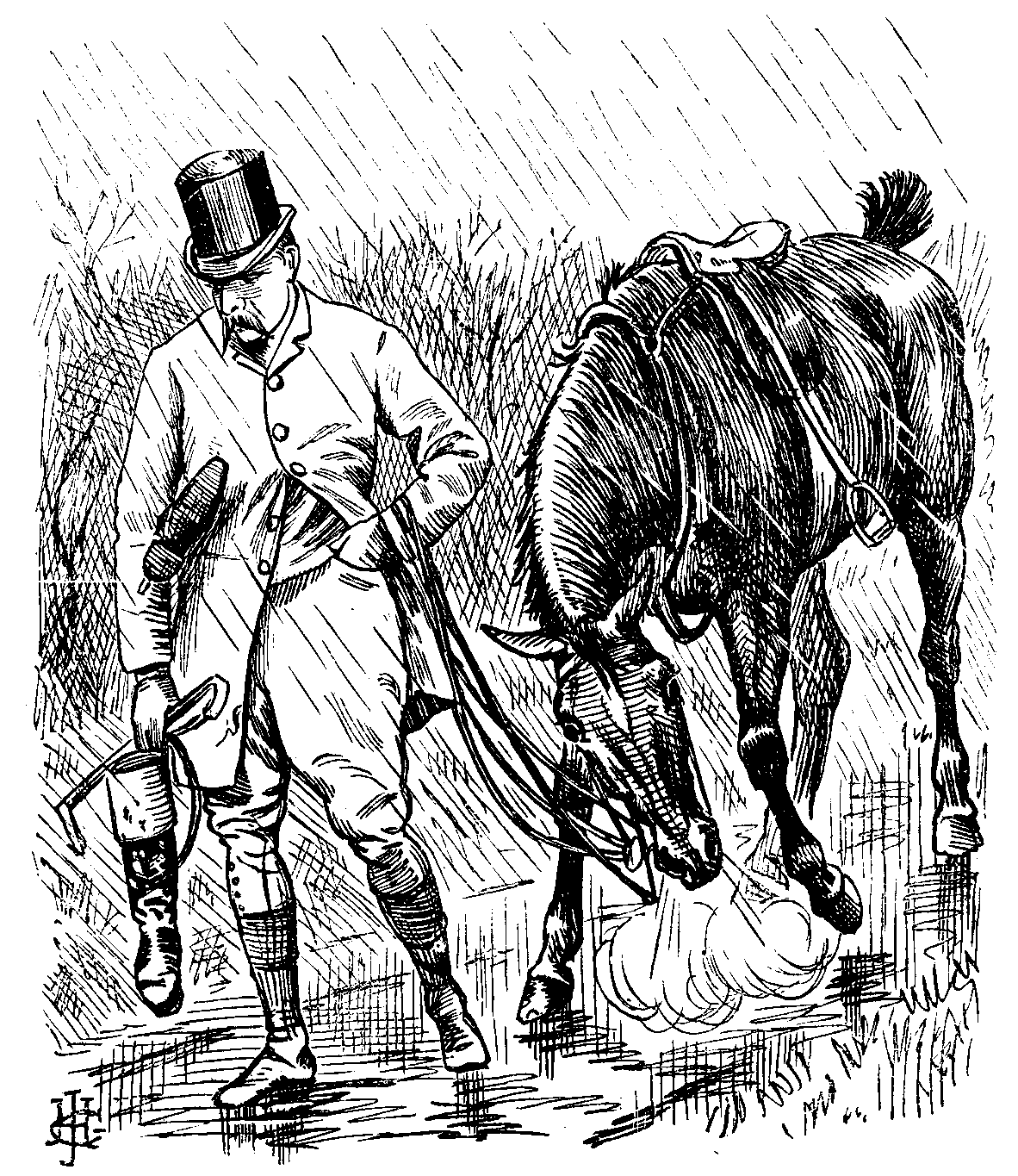
REALLY PLEASANT!
SIX MILES FROM HOME, HORSE DEAD LAME, AWFULLY TENDER FEET, AND HORRIBLY TIGHT BOOTS.
MR. PUNCH'S BOAT-RACE NOVEL.
STONYBROKE.
CHAPTER I.
IT was the eve of the University Boat-Race. In the remote East the gorgeous August sun was sinking to his rest behind the purple clouds, gilding with his expiring rays the elevated battlements of Aginanwater Court, the ancestral seat of His Grace the Duke of AVADRYNKE, K.C.B., G.I.N., whose Norman features might have been observed convulsively pressed against the plate-glass window of his alabaster dining-hall. There was in the atmosphere a strange electric hush, scarcely broken by the myriad voices of hoarse betting-men, raucously roaring out the market odds of "Fifty to one. Oxbridge!" or "Two ponies to a thick 'un, Camford!" Well would it have been for the Duke of AVADRYNKE had he never offered the hospitality of his famous river-side residence to the Oxbridge Crew. But the Duke had the courage of his ancient boating-race whose banner waved proudly upon the topmost turret, bearing upon its crimson folds the proud family motto, "Dum Vivo Bibo."
And the sun went down, and within Aginanwater Court the sounds of wild revelry shook the massive beams.
CHAPTER II.
THE Oxbridge Crew still sat in the marble supper-room, amid the débris of the feast that the Duke's Seneschal had laid out for them. The floor was paved with Magnums and Maximums of the best Heidanseekerer champagne, most of them as empty as the foolish head of the Duchess of AVADRYNKE, which was at that moment reposing upon the brawny chest of Lord PODOPHLIN, the celebrated No. 5 of the Oxbridge Crew. On a raised dais at the end of the room the ladies of the Tarara corps de ballet were performing the final steps of the Sinuous Shadow-dance, specially dedicated to the Oxbridge Crew by the chef d'orchestre of Tarara's Halls.
"May I be jiggered," observed the Oxbridge President, Sir WELFORARD LONGSTROKE, as he selected his fourth regalia from the Duke's pearl-encrusted box, and lit it with all the abandon of a Society darling, "may I be jiggered if this is not ripping! What say you?" he continued, addressing young PULYER WRIGHT, the Coxswain, and tossing him playfully four times to the raftered ceiling—"shall we not beat the dastard foe from Camford to-morrow?" A roar of applause sprang from the smoking mouths of his seven companions.
But at this moment the Duchess of AVADRYNKE and Lord PODOPHLIN rose unobserved and quitted the room. In another minute the sound of hurrying wheels, gradually growing fainter in the distance, was heard by no one in the avenue. And the dance went on, and revelry rose to its maddest pitch. But no one, who, as has been recorded above, had heard the sound of the wheels, gave a thought to the Duke of AVADRYNKE, as he sat tearing his hair in the violet bedroom, having learnt from the faithful Seneschal the terrible news of the Duchess's elopement with the heir to the house of PODOPHLIN.
CHAPTER III.
THE morn of the race dawned clear and sparkling. Far as the eye could reach, the banks of the river were rich with Millions, and firm enough to bear any run upon them however heavy. But Sir WELFORARD LONGSTROKE was ill at ease. His No. 5 had fled leaving no trace, and he had no one to fill the vacancy. He looked the very model of an aquatic hero. His broad chest was loosely clad in a pair of blue satin shorts, and his fair hair fell in waving masses over his muscular back. His thoughts were bitter. The Camford crew had started on the race some ten minutes ago, and the Oxbridge craft still waited idly in the docks for want of a No. 5.
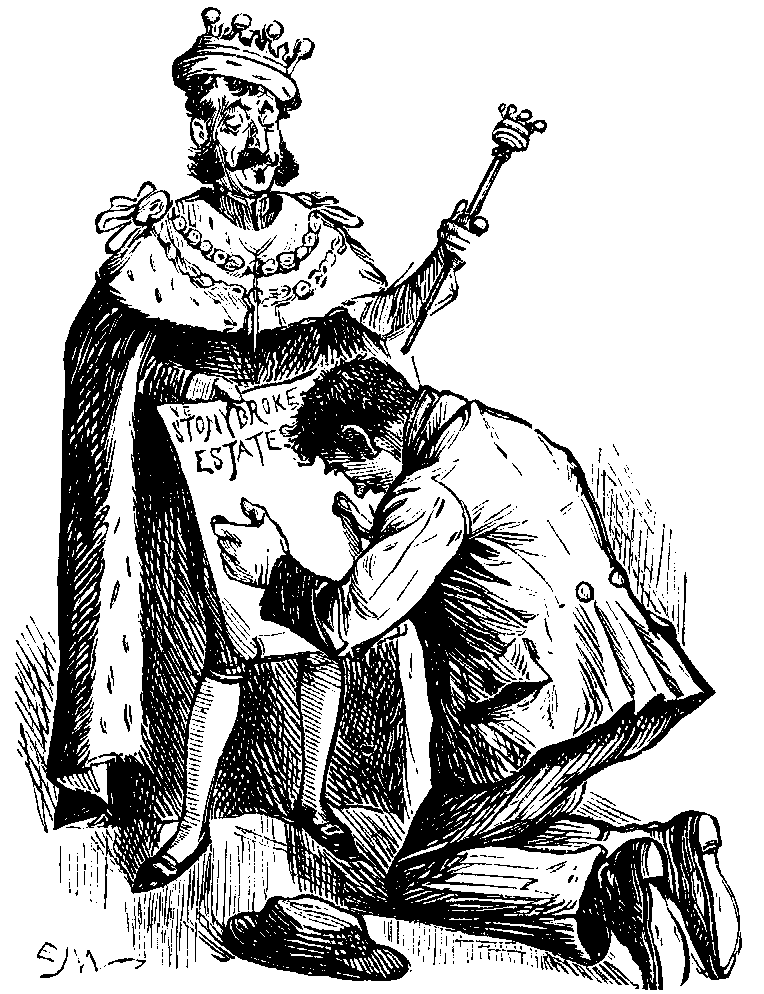
Touching Finale.
"Surely," Sir WELFORARD thought to himself, "PODOPHLIN might have postponed the elopement for one day." A confused noise interrupted his meditations. Some ten yards from him a man roughly clad, but with the immense muscular development of the Arri Furnese Apollo, was engaged in fighting three bargees at once. As Sir WELFORARD stepped forward, this individual struck a terrible blow. His ponderous fist, urged by the force of a thirty-inch biceps, crashed through the chest of his first foe, severed the head of the second from his body, and struck the third, a tall man, full in the midriff, propelling him through the air into the middle of the river. "That's enough for one day," he said, as with an air of haughty melancholy he removed his clay-pipe from his mouth. His face seemed familiar to Sir WELFORARD. Who could he be? All doubt was removed when he advanced, grasped Sir WELFORARD by the hand, and, in tones broken with emotion, said, "Don't you recognise me? I am your old College chum, Viscount STONYBROKE."
CHAPTER IV.
"SAVED! Saved!" shouted Sir WELFORARD, joyously—"there is yet time!" Then, rushing into rhyme, he asked, "Will you row in the race, In PODOPHLIN'S place?"
"Will I row in the race?" repeated Lord STONYBROKE—"just won't I!" And, without removing his hobnails, or his corduroys, he sprang lightly into the Oxbridge racing-boat. The rest is soon told. In less time than it takes to narrate the story, the Camford lead was wiped out. The exertion proved too much for seven men in the Oxbridge Crew, but the gigantic strength of the eighth, Lord STONYBROKE, was sufficient of itself to win the race by fifty lengths. And that night, when the Prime Minister handed to him the reward of victory in the shape of a massive gold dessert service, he was also able to announce that the STONYBROKE estates and the STONYBROKE title had been, by the Monarch's command, restored to their original possessor, as a reward of conspicuous valour and strength. [THE END.]
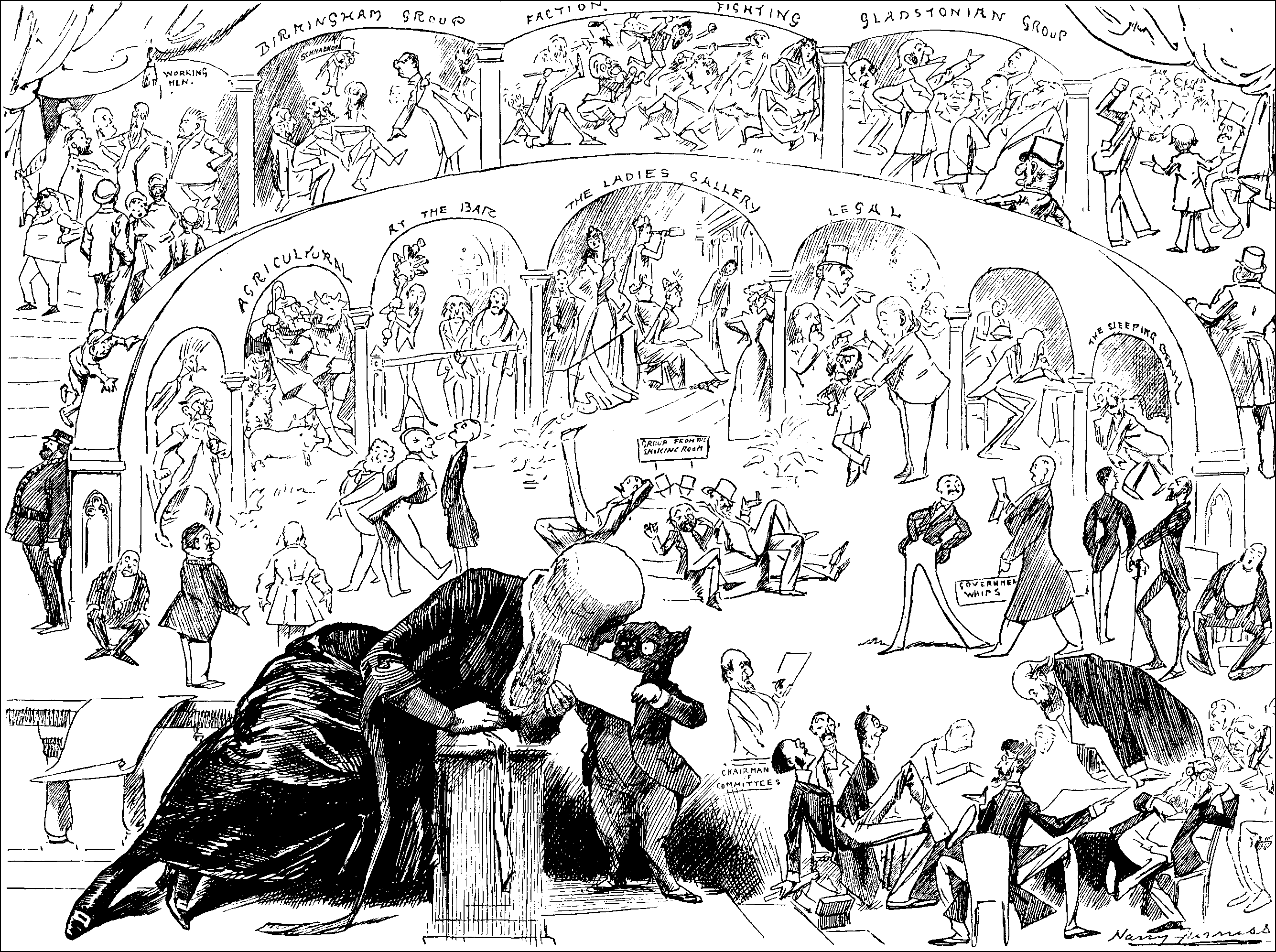
THE HOUSE OF COMMONS WAX-WORKS. THE CHIEF GROUPS.
Walt Whitman.
"The good grey Poet" gone! Brave, hopeful WALT! He might not be a singer without fault, And his large rough-hewn rhythm did not chime With dulcet daintiness of time and rhyme. He was no neater than wide Nature's wild, More metrical than sea-winds. Culture's child, Lapped in luxurious laws of line and lilt, Shrank from him shuddering, who was roughly built As cyclopean temples. Yet there rang True music through his rhapsodies, as he sang Of brotherhood, and freedom, love and hope, With strong wide sympathy which dared to cope With all life's phases, and call nought unclean. Whilst hearts are generous, and whilst woods are green, He shall find hearers, who, in a slack time Of puny bards and pessimistic rhyme, Dared to bid men adventure and rejoice. His "yawp barbaric" was a human voice; The singer was a man. America Is poorer by a stalwart soul to-day, And may feel pride that she hath given birth To this stout laureate of old Mother Earth.
OUR CRICKETERS.—The English Cricketing Team came to the end of their Australian tour last week, where, under the leadership of Lord SHEFFIELD, out of twenty-six matches they won thirteen, lost two, and eleven were drawn. The Eleven of course were drawn over and over again, i.e., photographed. It will henceforth be a recommendation for any Cricketer to say he was out under this distinguished captaincy, as to this introduction the host will rejoin, "Ah, I know that man, he comes from SHEFFIELD." Not only were the English team successful playfully, but also artistically, as in every match they played with GRACE.
BRAWLING AT HOME AND ABROAD.—On the same day in the papers appeared accounts of brawling in a Church in Paris, where a free fight ensued and no police interfered, and of a row in a Church in London Road, when the police walked off with an anti-curate and put an end to the disturbance. Some things we do manage better in England.
COCKNEY CLASSICS.—Of the Guildhall Loan Collection, Mr. Deputy HORA is the Chairman. As a Deputy must be a representative officer—except, perhaps, in the case of a "Depitty Sawbones," vide Sam Weller—the temporary motto of the Deputy's Ward might well be, "Hora pro nobis."
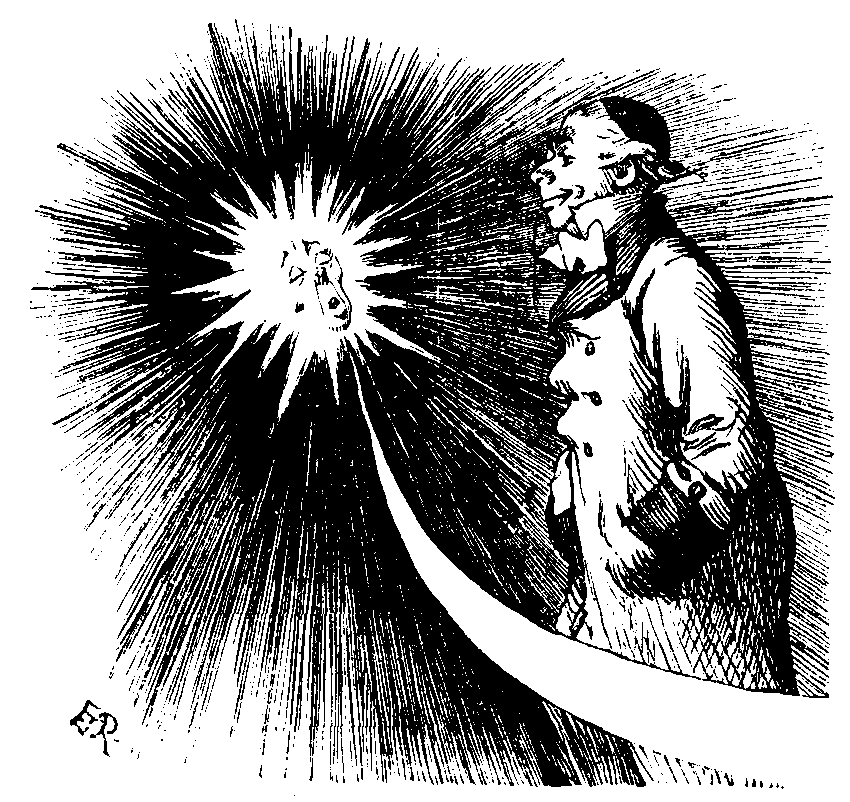
A NEW COMET.
["Mr. DENNING, whose name is well known as a comet-finder, discovered a small FAINT Comet on Friday, March 18, at Bishopton, Bristol."—Times.
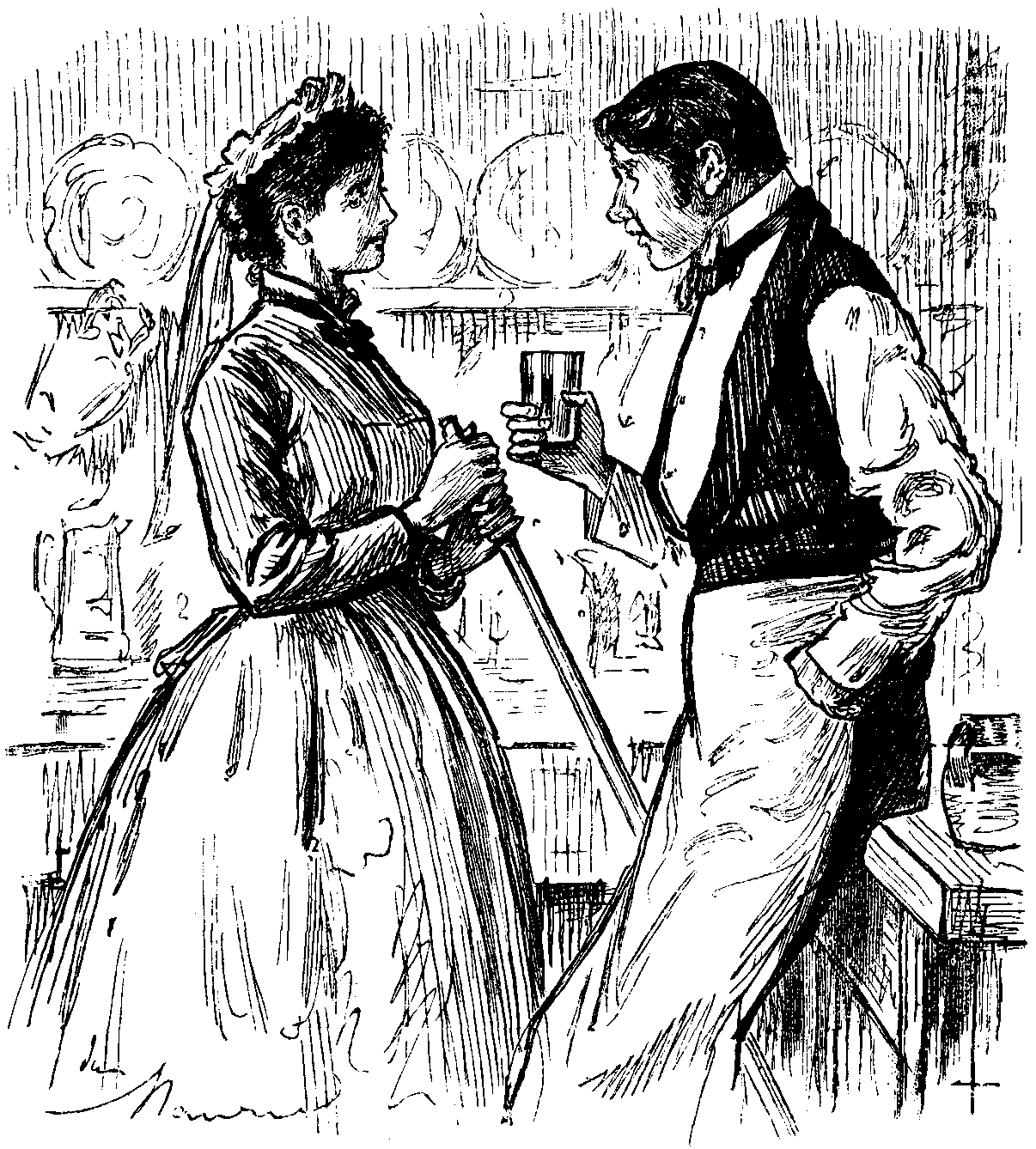
HASTY!
Mary. "IF MISSUS DON'T WITHDRAW WHAT SHE HAS SAID TO ME, I SHALL LEAVE THE HOUSE!"
Thomas. "WHAT DID SHE SAY?"
Mary. "SHE SAID, 'I GIVE YOU A MONTH'S NOTICE!'"
ESSENCE OF PARLIAMENT.
EXTRACTED FROM THE DIARY OF TOBY, M.P.
Seymour-Keay.
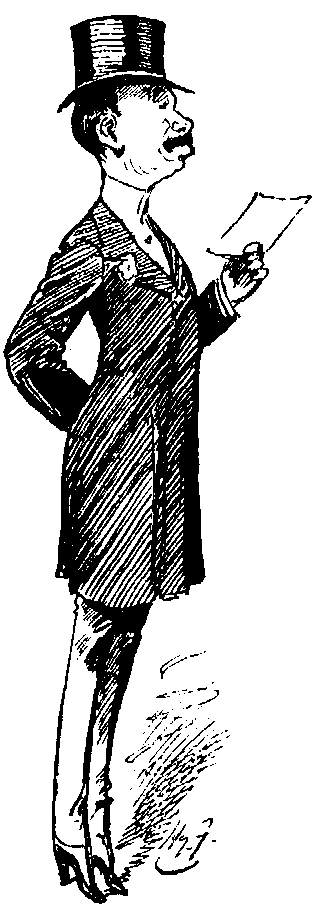
House of Commons, Monday. March 28.—Strange sight witnessed in House to-night. Subject of Debate, Indian Council Bill; Benches nearly full. Pup and dog, I've known the House for nineteen years, and never before saw the like. Explanation not found in fact of CURZON making his maiden speech as Minister in charge of Bill, though that had some influence at outset. Able speech it proved, our newest Minister having the great gift of lucidity. It was later than that when House filled, nearly two hours later, for in meantime SCHWANN had delivered Address as long as the Ganges, and MACLEAN (who was waiting his turn to speak) says, nearly as muddy.
Curious how India seems to affect eminent orators, making them for the time pointless, dull, and above all, verbose. Probably no subject other than India could unite such galaxy of born orators and debaters. SWIFT MACNEILL, RICHARD TEMPLE, SAMUEL SMITH, OCTAVIUS MORGAN, JULIUS 'ANNIBAL PICTON and SEYMOUR-KEAY—one followed the other as in a necklet of diamonds gem succeeds gem, till the wearied eyesight can scarce decide which is the more brilliant. SEYMOUR-KEAY was, indeed, too much for the SPEAKER, who thrice called him to order, the last time with stern voice and threatening brow that made SEYMOUR tremble from the altitude of his boot-heels.
It was none of these who filled the House with Members listening intently to a speech on internal affairs of India, It was Mr. G. who performed the miracle. No one expected to find him in this galley; being there, the banks were rapidly crowded with a throng lost in admiration of his strong, swift, graceful stroke. Difficult to say which the most admirable, the lofty height, far above the littleness of Party conflict, from which he surveyed the topic, the charm of his language or the dexterity with which, without seeming to rebuke the follower who had moved the Amendment and the eminent men who were prepared to support it, he sustained the Ministry in their effort to reconstruct the Indian Councils, and suggested that the Amendment should with all haste be put into the fire. Whilst SCHWANN appropriated an hour of the Sitting, and SEYMOUR-KEAY exceeded that time, twenty-five minutes served Mr. G. for a speech delivered without note, apparently without preparation, and which left nothing more to be said.
"Upon my word, Sir," I said, a little out of breath trying to keep pace with him running up the Duke of YORK'S steps going home to dinner, "you grow younger every year, and, if I may say so, mellower."
"You certainly may say so, TOBY, if you like," he smilingly replied, "but the calendar says otherwise."
"What," I asked—
"What has the calendar to do With Mr. G.? What Time's fruitless tooth With gay immortals such as you, Whose years but emphasise your youth?"
"Ah, I know that—with a slight difference. LOWELL wrote it to WENDEL HOLMES on his seventy-fifth birthday. I knew HOLMES too; he used to crow over me because he was just four months older, and yet, as he said, whilst I pleaded age as a reason why I could not visit the United States, he crossed the Atlantic at seventy-seven. Perhaps when I've got this Home-Rule question off my hands, I may find time to go to the United States."
"Yes," I said, "you'll be another year younger then, and more at leisure."
Business done.—Indian Council Bill read Second Time.
R. Cuninghame Graham.
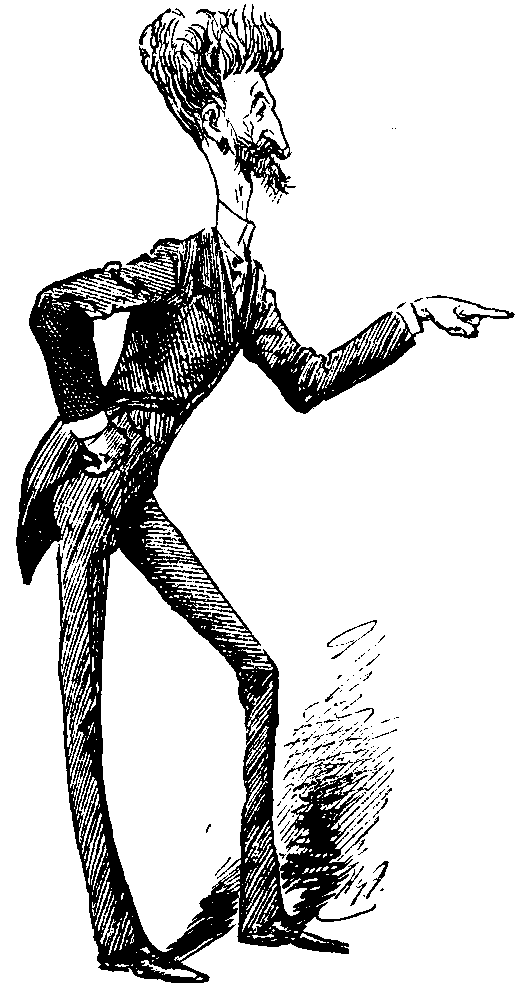
Tuesday.—Some sensation created at Morning Sitting by discovery of CUNINGHAME GRAHAM addressing House from Conservative Benches. There was a well-known Member of the Parliament of 1874 who hit upon new device for, as he reckoned, doubling his chance of catching SPEAKER'S eye. Noted that SPEAKER called alternately upon Members from either side. If debate were opened from Opposition Benches, SPEAKER would next turn to other side of House, and call on Ministerialist. Happy thought occurred to our old friend. After rising several times from his seat below Gangway on Opposition Benches, and been passed over by SPEAKER in favour of another, he, whilst Member was speaking, crossed floor of House, and, when speech concluded, jumped up from other side. Being again ignored by the startled SPEAKER, went back to own place again to try his chances there. Don't remember that the manœuvre was a success. Certainly not been generally adopted.
GRAHAM seems now to have recurred to it; or can it be the case that he, too, has joined "the Gentlemen of England"? House so agitated by this problem, that it quite loses thread of debate; a thrilling discussion, to which FERGUSSON contributed a luminous speech, upon the Telephone.
WILFRID LAWSON much interested in new development of affairs.
"The Government," he says, "if only with the instincts of self-preservation, should hasten the Dissolution. If they go on a little longer, no saying what they may come to, with JOE as their principal champion in town and country, with JOHN REDMOND as their favourite orator; led into the Lobby the other day by BURT against the Eight Hours Bill, they only want to recruit CUNINGHAME GRAHAM to their ranks to make the medley complete. If they go on another three months, we shall see them some Sunday following CUNINGHAME GRAHAM'S red flag as he leads them to Trafalgar Square, there to be addressed by Alderman JOHN BURNS."
Business done.—Got into Committee on Civil Service Estimates.
"Crude and wasteful."
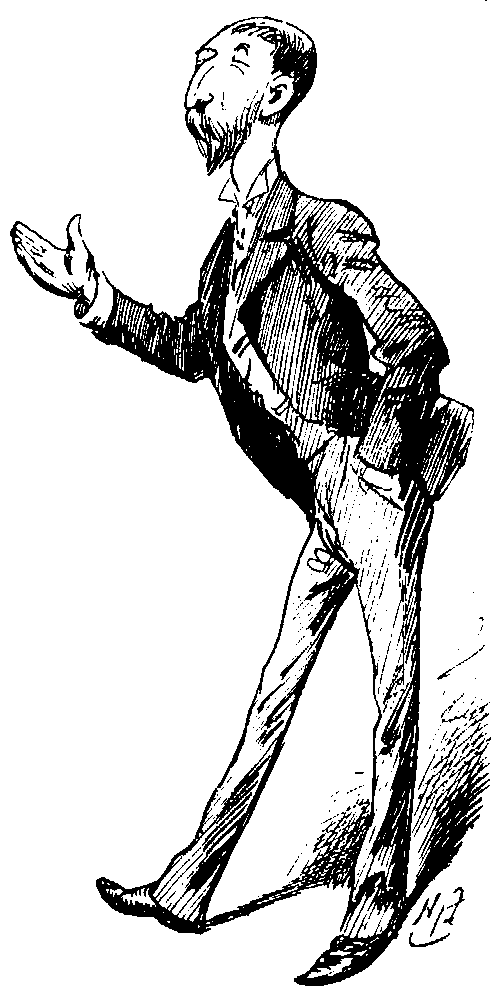
Thursday.—Scotch Members made a night of it. Great muster of the Clans. Government have £265,000 to make over to Scotland in relief of Local Taxation and promotion of Education. Scotch Members don't object to the money, but take exception to its plan of distribution. Member after Member rises from Opposition Benches, biting at hand that proffers the boon. "Crude and wasteful," BUCHANAN calls this scheme, and Scotch Members lustily cheer.
A capital debate of its kind, but not picturesque; Benches empty, only the LORD-ADVOCATE on the Treasury Bench.
"I'll tell you how you can manage these fellows, my dear CASABLANCA," said JEMMY LOWTHER, crossing the Gangway, and seating himself for a moment by the solitary Minister.
"Beg your pardon, my name is PEARSON."
"Of course," said JEMMY, "I know very well; only a quotation; thinking of the Boy who stood on the burning deck, whence all but he had fled, doncha. Was going to tell you how you can get out of this trouble. Fellows opposite righteously indignant at your proposed disposition of money. Very well; you get up, say you're sorry to have offended; had no idea you'd made such a mistake; only atonement you can offer is to withdraw the proposed grant altogether. Then you'll see how they'll sit up."
"Excellent idea," said LORD-ADVOCATE. "Shall mention it to GOSCHEN when he comes back—if he ever does," he added with weary voice, looking down the deserted Bench. Scotch Members, all unconscious of JEMMY LOWTHER'S machination, went on talking till midnight, when debate stood adjourned.
Business done.—None.
Friday.—In Committee of Supply; SAGE OF QUEEN ANNE'S GATE thinks opportunity favourable for Prince ARTHUR to tell all he knows about Dissolution. Prince ARTHUR quite agreeable, but really knows nothing. Radicals look angry at being thus put off; show signs of intention to discuss the matter. Mr. G. interposes; makes one of his bland speeches; wouldn't press question now (a suggestion that pleases Ministers); by-and-by time will come, then we shall see; whereat SAGE and his friends brighten up; Mr. G. sits down having pleased everybody; storm blown off.
Curious to note the altered condition in atmosphere of House since Mr. G. came back. Turmoil stopped; restlessness soothed; Ministerial work goes on smoothly, whilst the GRAND OLD PACIFICATOR looks on benevolently.
"Yes," said PRINCE ARTHUR, uneasily, "this is all very well. He holds back the curs that would snap at our heels; but it's only because he, a wilier tactician, knows that no practical advantage is to be gained from that kind of sport. Wait till he thinks the hour has struck, and you'll see he'll not only let slip the dogs of war, but lead the rush himself."
Business done.—In Committee of Supply.
REMBRANDT, TITIEN, VÉLASQUEZ, ET CIE. WHISTLER, SUCCESSEUR.
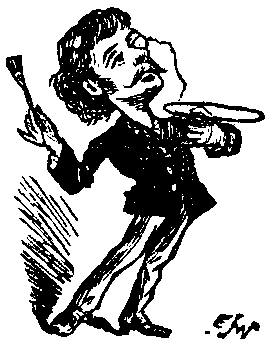
Oh, what a catalogue! Whatever made you think Numbers should mix in a way never seen? 3, that's a flood of milk, 20, a flood of ink, Touching a gruel-like sea, that's 15. Next time, to make a delightful variety, Hang upside down all the works in your show, Whilst, on their heads, the élite of Society, Gasp, "Fin de Siècle, quite chic, don't you know!" Why play such pranks to draw people who scoff? It is They to whose critical words you are deaf. Though in your country you are not a prophet, is This how you make one, that's spelt with an F? Strange that the only kind critic you mention Is French. He compares you with REMBRANDT & CO.; His words seem the sole ones that claim your attention: We'll end in his tongue, like the list of your show. Cher Monsieur VISTLAIRE, allez chez la nation Voisine, et emportez ces œuvres "splendides," "Destinées à l'éternité des admirations," Ainsi que dit ce critique candide!

NOTICE.—Rejected Communications or Contributions, whether MS., Printed Matter, Drawings, or Pictures of any description, will in no case be returned, not even when accompanied by a Stamped and Addressed Envelope, Cover, or Wrapper. To this rule there will be no exception.