Volume 101 — THE TRUE TENNYSON.
Reading edition
We have all been startled to find from the researches of Mr. WOODALL in Notes and Queries, that "Between the story sung by the Poet Laureate in his romantic poem The Lord of Burleigh, and the actual fact, there seems to be little in common." HENRY CECIL, Earl and afterwards Marquis of EXETER, married Miss SARAH HOGGINS under the name of JOHN JONES, having a wife alive at the time, and she did not die as the poem relates. It is obvious then that TENNYSON must be re-written, and we offer his Lordship the following humble suggestions. The Lord of Burleigh should henceforward run somewhat as follows:—
Quoth he, "Gentle SARAH HOGGINS," Speaking in seductive tones, "You must wed no HODGE or SCROGGINS, But espouse your own J. JONES." Oh! he was an artful party, And that marriage was a crime. He'd a wife alive and hearty, Though she'd left him for a time.
The above discovery has, of course, led to doubts regarding other Tennysonian heroines. Was Lady CLARA VERE DE VERE, for example, as black as the poet has painted her? Perish the thought! Here are a couple of specimen stanzas for an amended version:—
Lady CLARA VERE DE VERE, I vow that you were not a flirt, The daughter of a hundred Earls Would not a single creature hurt. "Kind hearts are more than coronets," What abject twaddle, on my word; And then the joke is in the end,— We know they made the bard a Lord. The tale of how young LAURENCE died, In some audacious print began; The fact is that he took to drink, He always was that sort of man. And as for ALFRED, why, of course You snubbed him; but was that a crime, That he should go and call you names, And print his atrabilious rhyme?
Then, again, was the Amy of Locksley Hall quite as shallow-hearted and so forth as the angry rhymester declares? It will probably turn out that she was not. Hence the verses should run in this fashion:—
And I said, "My Cousin AMY, speak the truth, my heart to ease. Shall it be by banns or license?" And she whispered, "Which you please." Love took up the glass of Time and waved it gaily in the air, Married life was sweet at Number Twenty-Six in Camden Square. AMY faithless! Bless your heart, Sir, that was not the case at all: It was pure imagination that I wrote in Locksley Hall.
This process will doubtless have to be applied to many of the poems, but we must leave the congenial task to the Laureate.
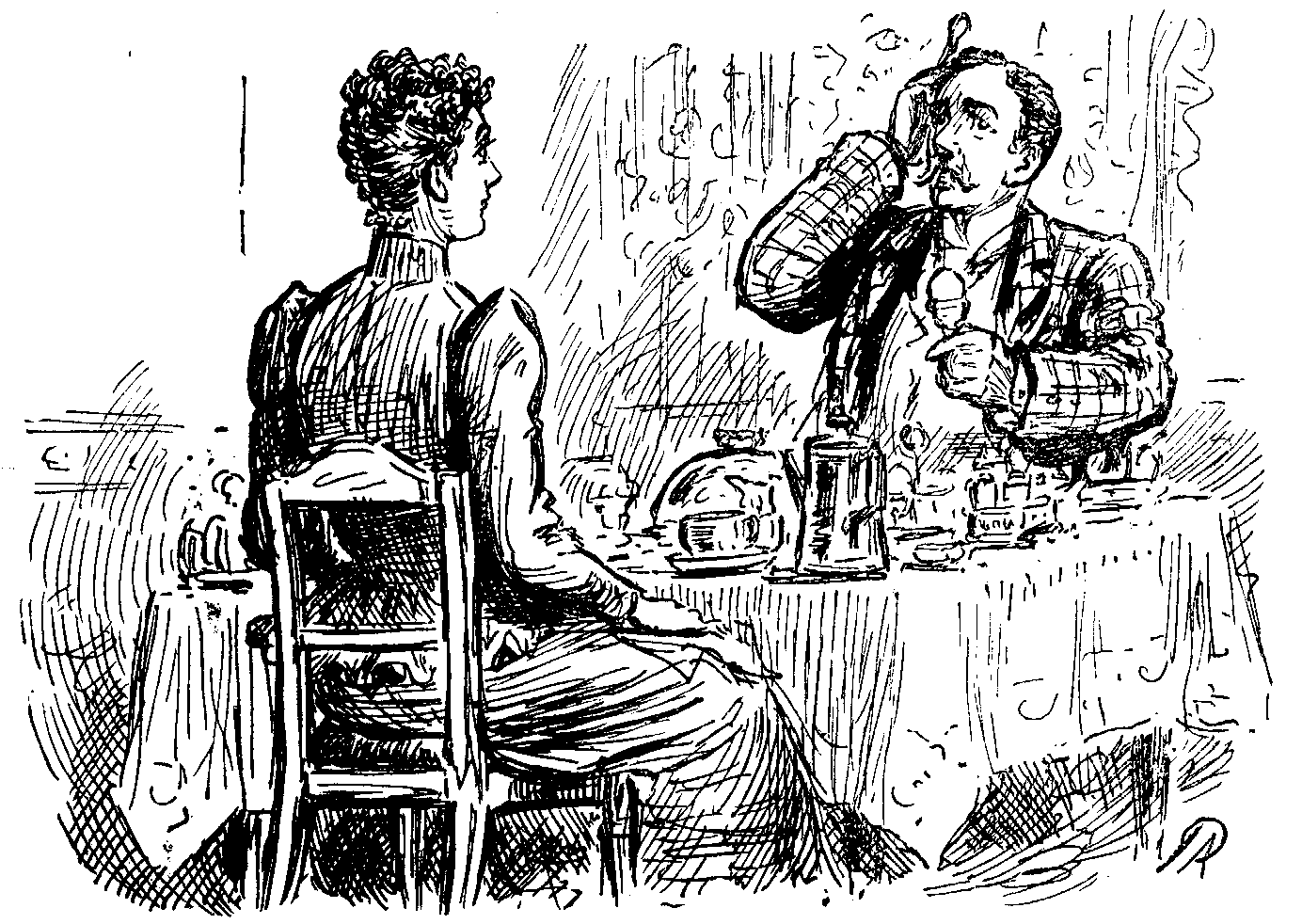
George (about to enjoy the first new-laid Egg from the recently set-up Fowl-house). "WHY—CONF—THEY'VE BOILED THE PORCELAIN NEST-EGG!"
A SONNET OF VAIN DESIRE.
AFTER THE HOLIDAYS.
As when th' industrious windmill vainly yearns To pause, and scratch its swallow-haunted head, Yet at the wind's relentless urging turns Its flying arms in wild appeal outspread; So am I vex'd by vain desire, that burns These barren places whence the hair hath fled, To wander far amid the woodland ferns, Where dewdrops shine along the gossamer thread; Where its own sunlight on the reddening leaf Sleeps, when soft mists have swathed the sunless tree, Or where the innumerous billows merrily dance; Yet must I busily dissemble grief Whirl'd in the pitiless round of circumstance, Rigid with trained respectability.
New Way out of a Wager.
DESMOND, Theosophist Colonel, now thinks better Of his rash vow his gift to "demonstrate," Receiving a "precipitated letter" Warning him not to be—precipitate. Many a Betting Man who'd hedge or tack Must wish he had Mahatmas at his back.
The Beggar's Petition.
(New Version.)
Life must not be lost, Sir, with lightness, To labour for life gives me pain; My exchequer's affected with tightness, But begging's the pink of politeness, Like Scribes, Sir, "I beg—to remain!" *
* And didn't CHARLES LAMB, in his most delightful essay On the Decay of Beggars, deplore their gradual disappearance?
DOCTOR LAURIE.
Song by a Scotch Student. AIR—"Annie Laurie."
["According to Dr. LAURIE, of Edinburgh University, the "teaching of Greek, so far as it is attempted in our secondary schools, is positively harmful."—Daily News.]
Pedagogue brays are bonnie, When Greek they'd fain taboo; And 'tis here that Doctor LAURIE Gi'es utterance strictly true, Gi'es utterance strictly true, Which ne'er forgot should be, And for bonnie Doctor LAURIE, A Scottish boy would dee. Auld HOMER is a humbug, ANACREON is an ass; Sumphs scrape enoo o' baith o' them, The "Little-go" to pass, The Little-go to pass— It affects them "harmfullee." Ah! but bonnie Doctor LAURIE, He kens Greek's a' my ee! Like diplomas fause and lying, Are "passes" such as this. Why should Scotch lads sit sighing O'er the Anabasis?— O'er the Anabasis? XENOPHON's fiddle-de-dee? Oh, for bonnie Doctor LAURIE, I'd shout with three times three!
UNDER-LYNE'D.—Said Sir W. VERNON HARCOURT, at Ashton-under-Lyne, "I am very glad to be enabled to come here from the hospitable roof of Mr. RUPERT MASON." ... And again, "I have come here also from the roof of Mr. MATHER." Quite a Sir WILLIAM ROOFUS! But what was he doing on the roof? Was there a tile off in each case? Something wrong with the first house that a Mason couldn't set right? And with the second, did Sir ROOFUS sing, "Oh dear, what can the Mather be?" And why the invidious distinction between the two roofs? The first being hospitable, and the second having no pleasant epithet to recommend it.
PROPOSED NEW TITLE FOR LORD GR-M-TH-RPE.—Baron (H)ALTER EGO.
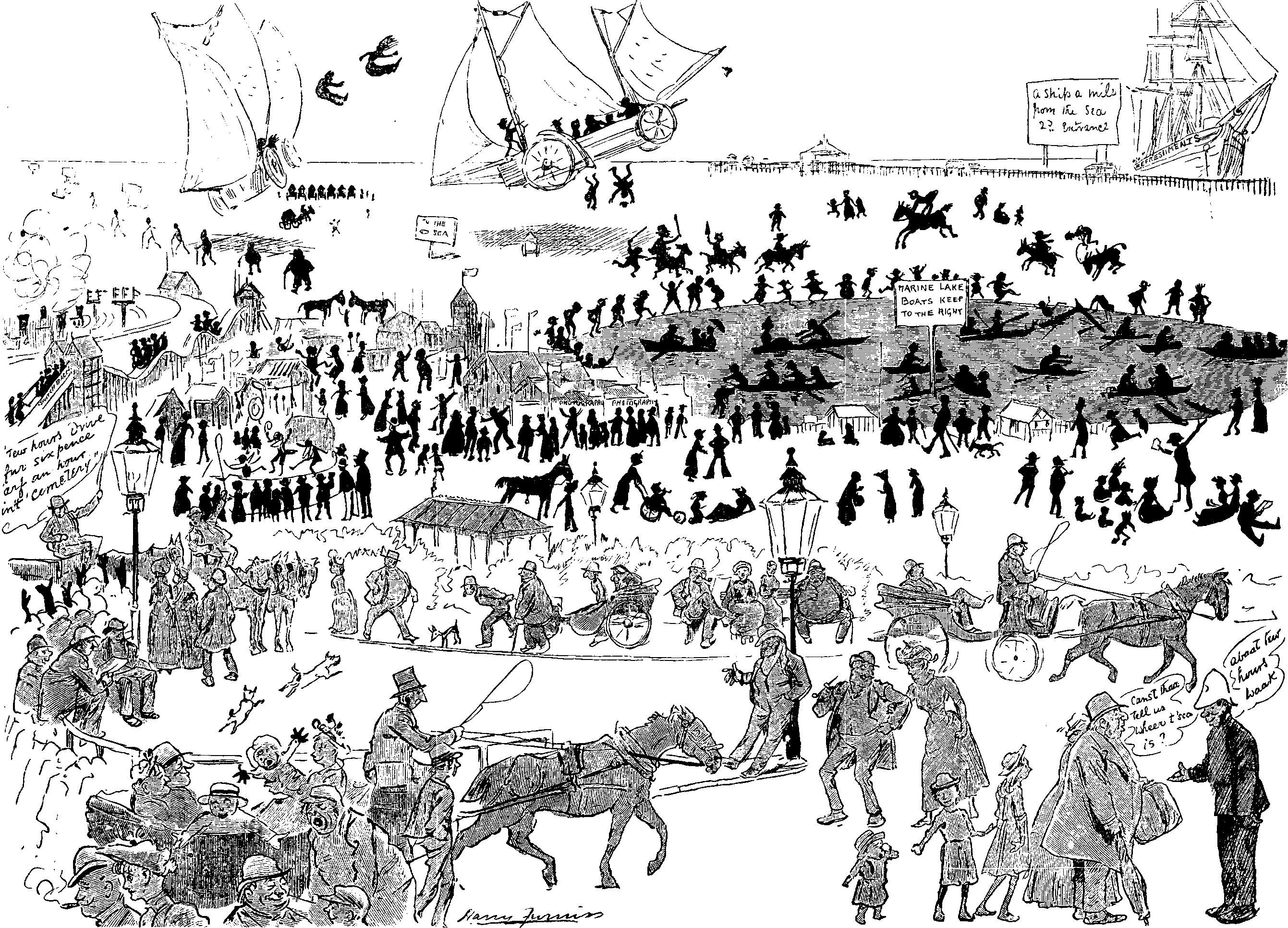
A LANCASHIRE WATERING-PLACE.
POPULAR SONGS RE-SUNG;
OR, MISS BOWDLER AT THE MUSIC HALLS.
INTRODUCTORY.
DEAR MR. PUNCH,
In these progressive days earnest reformers, especially those of the London County Council type, yearn to chasten and æstheticise the Muse of the Music Hall, who is perhaps the only really popular Muse of the period. My name gives me a sort of hereditary right to take exceptional interest in such matters, though indeed my respected, and respectable, ancestor is not in all things the model of his more catholic and cosmopolitan descendant. The McDougall regimen would doubtless be a little too drastic. To improve the Music-hall Song off the face of the earth, is an attempt which could only suggest itself to puritan fanaticism in its most arbitrary administrative form. The proletariat will not "willingly let die" the only Muse whose ministrations really "come home to its business and its bosom." No, Sir, the People's Pegasus cannot, must not be ruthlessly consigned to the knackers. But may it not be gently bitted, discreetly bridled, and taught to trot or amble with park-hack paces in the harness of Respectability?
It is in this hope and faith that the following drawing-room versions of some of "the most popular Comic (and Sentimental) Songs of the Day" have been attempted by
Your respectful admirer, VIRGINIA BOWDLER.
To the Respectable Citizen, the Moral Matron, and the Young Person, with a love of larkiness and lilt, but a distrust of politics, pugilism, and deep potations, the following eclectic adaptation of this prodigiously popular ballad may perhaps be not altogether unwelcome.
No. I.—TWO LOVELY BROWN EYES,
AIR—"Two Lovely Black Eyes".
Strolling one Sunday near Bethnal Green, This "æsthete" you might have seen, Surveying "the People" with scornful spleen When, oh, what a surprise! An Art Exhibition I chanced to see, Therein I entered right speed-i-lee, When—on a canvas—there shone on me Two lovely brown eyes! Chorus. Two lovely brown eyes! Oh, what a surprise! Smiling right down on a dingy throng, Two lovely brown eyes! From a canvas of "High Art" sort they shone, Their owner was cinctured with classic zone, She was spare of flesh, she was big in bone, Oh, what a surprise! A parson, whom everyone owned "a good sort," Had hung them there for the pleasure and sport Of the dreary dwellers in slum and court, Those lovely brown eyes! Chorus. Two lovely brown eyes! Oh, what a surprise! Drawing the gaze of an East-End crowd, Two lovely brown eyes! My own regard, as I loitered there, Fastened on one proletariat pair, With finery frowsy, and oily hair; Oh, what a surprise! "SALLIE" and "BILL" were the names they flung Frankly abroad with unreticent tongue, Lounging and staring where graciously hung Those lovely brown eyes. Chorus. Two lovely brown eyes! Oh. what a surprise! SALLIE and BILL your calm beauty could thrill; Two lovely brown eyes! Art (so I argue) for all is best, Here, in the East, on the Day of Rest, Lo! my pet theory put to the test! Oh, what a surprise! The chap staring there is a Coster true, Trowsered in corduroy, belchered in blue; What does he think of your heavenly hue, Two lovely brown eyes? Chorus. Two lovely brown eyes! Oh, what a surprise! "SALLIE", he whispered, "she's got, like you, Two lovely brown eyes!"
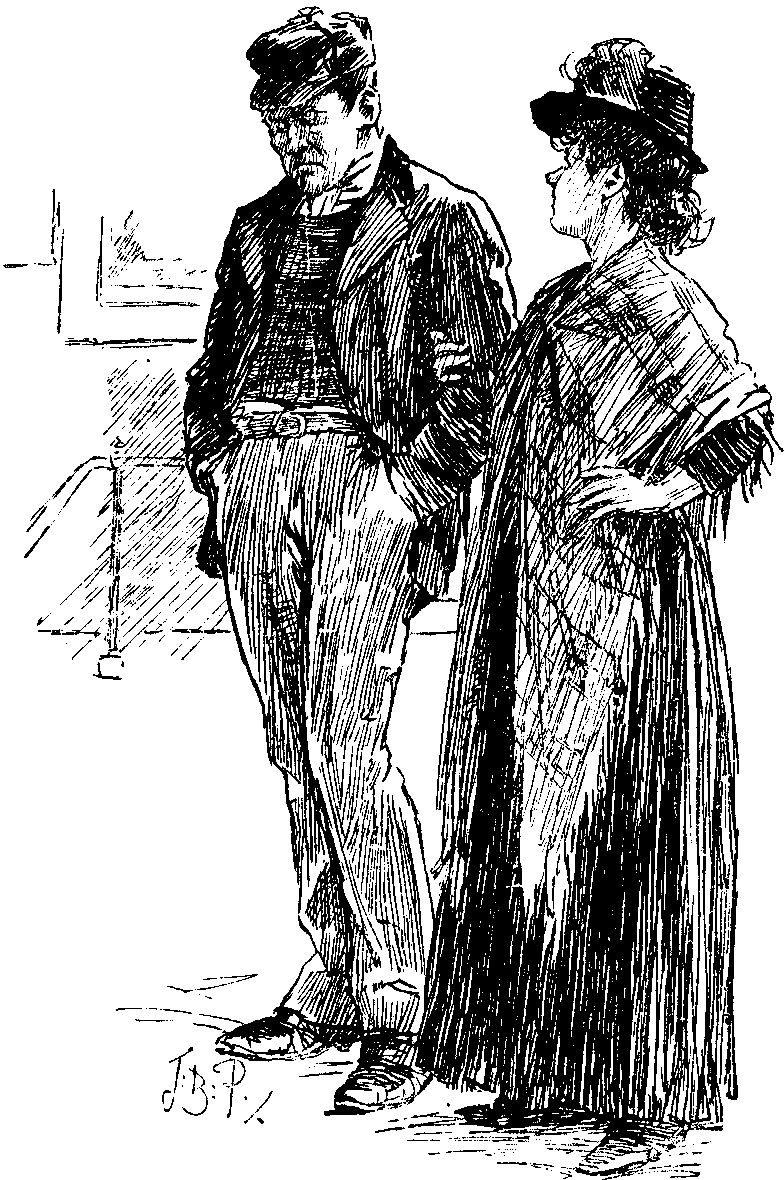
The picture was one of BURNE-JONES'S best; "SALLIE" was snub-nosed and showily drest; I sought her visage in querulous quest, When oh, what a surprise! Plump in the midst of a "puddingy" face, Coarse-cut in feature, devoid of grace, Nature capricious had chosen to place Two lovely brown eyes! Chorus. Two lovely brown eyes! Oh, what a surprise! There on each side of a salient "snub," Two lovely brown eyes: Brown? Ah, yes! But, alack! alack! The brown was fringed with a halo of black, Fruit, it was plain of some marital thwack, Oh, what a surprise! "She," sighed the girl, "has a beautiful chump, Though she do seem to 'ave got the 'ump. Them pair o' lamps never felt a thump, Them lovely brown eyes!" Chorus. Two lovely brown eyes! Oh, what a surprise! Something seemed telling that man he was wrong, Two lovely brown eyes! Say, was it fancy? I saw a flush O'er the coarse cheeks of that Coster rush, "Stash it!" he murmured. A Coster blush? Oh, what a surprise! SALLIE,—she clung to his muscular arm— With a look half lovingness, half alarm, He stooped and—kissed her! Now, was it your charm, Two lovely brown eyes? Chorus. Two lovely brown eyes! Oh, what a surprise! Was it your influence, gentle yet strong, Two lovely brown eyes? "BILL," whispered she, "you may bet two d She never nagged at 'er bloke—like me— He never wheeled a whelk-barrer, d'yer see? Oh, what a surprise! Parties with cultcher and piles o'cash Ain't no temptation to row or bash, But—who's to tell but she's jilted 'er mash— Miss Lovely Brown Heyes?" Chorus. Two lovely brown eyes! Oh, what a surprise! Twinkled like stars 'twixt a tear and a frown, Two lovely brown eyes. The moral you've caught I can hardly doubt; On Art versus Morals men sneer or shout, Leave it to OSCAR to fight that out, If you would be wise. Better, far better, it is to let Beautiful things work their way—you bet! Then the Coster's wife may less frequently wet Her lovely brown eyes. Chorus. Two lovely brown eyes! Oh, what a surprise! Art-loving-Man is less likely to black Two lovely brown eyes!
MEN OF THE PAST.
(COMPILED BY THE MAN OF THE PRESENT.)
CROMWELL.—An English Brewer. Uncertain about his aspirates. Distinctly vulgar. Face disfigured by warts.
PETER THE GREAT.—Quite a common sort of Russian. Man with coarse tastes. Came to England to learn ship-building. Fond of low society; in fact, the type of an enterprising cad.
WASHINGTON.—Entirely provincial English rebel, who caused considerable trouble in America. Family fair, but not to be traced beyond three generations. Used to eat peas with his knife.
HANNIBAL.—Brutal barbarian. Feeblest ideas of stategy. Went the wrong way over the Alps. Given to oaths from childhood up. Quite a classical nobody.
BUONAPARTE.—A Corsican Parvenu.
The Garrick School.
School for young actors is the Garrick Playhouse. Upon the road to fame a quarter-way house For IRVING fils. And likewise note we there The heir apparent of a parent HARE.
"DIO, age!" of which the classic American translation is, "Do tell!"