Volume 101 — DRAWING THE BADGER.
Reading edition
(A Natural History Note.)
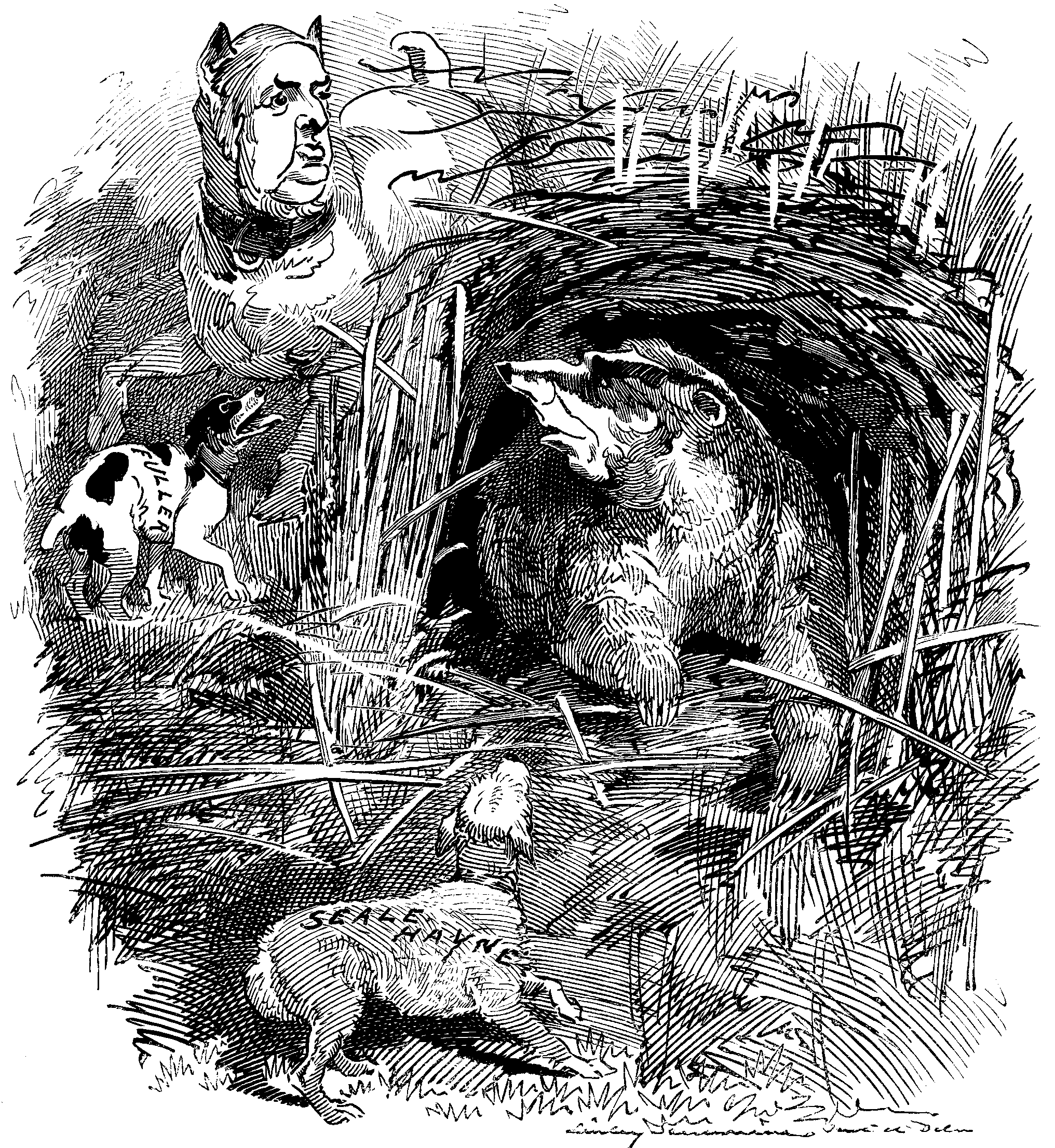
The Badger (Meles-Taxus) is at once one of the most inoffensive and (in one sense) offensive of our few remaining British Carnivora. He is described by NAPIER of Merchiston, in his Book of Nature and of Man, as a "quiet nocturnal beast, but if much 'badgered' becoming obstinate, and fighting to the last, in which it is a type of a large class of Britons, who like to be let alone, but when ill used can fight."
That great new authority on Natural History, Mr. G.A. HENTY (author of Those Other Animals), should be able to tell us much about the Badger. Therewith he would be able, in his own favourite fashion, to "point a moral" (against the Demogorgon Democracy), and "adorn a tale" (of laboured waggery). He might find the subject as suggestive of sardonic chaff as American women and Republican institutions.
What says the popular WOOD? He describes the Badger as "slow and clumsy in its actions," and as "rolling along so awkwardly that it may easily be mistaken for a young pig in the dusk of the evening." Woe, however, to whomsoever does take the creature for "a young pig." "Being naturally as harmless an animal as can be imagined, it is a terrible antagonist when provoked to use the means of defence with which it is so well provided."
We tax the patience of poor Meles-Taxus, Until he turns with tooth and claws and whacks us. The natural home of Taxus—the Exchequer— Harbours a creature that keeps up its pecker.
"For the purpose of so-called 'sport,' the Badger used to be captured and put into a cage ready to be tormented; at the cruel will of every ruffian who might chose to risk his dog against the sharp teeth of the captive animal."
This particular sort of "sport" is a little out of date. But "drawing a Badger" is not unknown even in these humanitarian days. Dogs will sometimes voluntarily rush in to risk their hides and muzzles against the aforesaid sharp teeth, &c. Look at those in the picture!
The two small, if aggressive, terriers seem unequally matched against the "clumsy" but strong-jawed and terribly-toothed Badger. They have drawn him, indeed, out of his hole, and one of them, at least, seems rather sorry for it, if you may judge by the way in which he turns tail and makes for his protector, the big Bull-Terrier. The ventripotent broken-haired tyke looks more valorous—for the moment. Yap! yap! yap! Meles-Taxus takes little notice of him, however. His eyes are on that sturdy specimen of Canis familiaris there, whose bold eyes in turn are on him. Both, perhaps, experience—
That stern joy which warriors feel In foemen worthy of their steel."
"Drawn by those two tiny yelpers? Not a bit of it! But you, my complacent canine Colossus—come on if you dare!" And he does dare, evidently. Whether he'll regret his daring remains to be seen.
The Memory of Milton.
MILTON forgotten? Nay, my BESANT, nay; Not wholly, even in this petty day, When learning snips, when criticism snaps, And the great bulk of readers feed on scraps. Still, still he finds his "audience fit, though few," The rest forget not since they never knew.
The Off-Portsmouth Phrase-Book.
Have you caught a fish?
No, but I have bagged a cannon-ball.
Is the sea too rough for your boat?
No, the sea is not too rough, but the Torpedoes are decidedly embarrassing.
Is that a pretty shell that you are going to carry home to your children?
No, it is a live one, that, if it bursts a yard nearer, will blow us into smithereens.
Do you propose returning to your lodging to-night?
That is a matter that will be decided by the Commander of the nearest practising gun-boat.
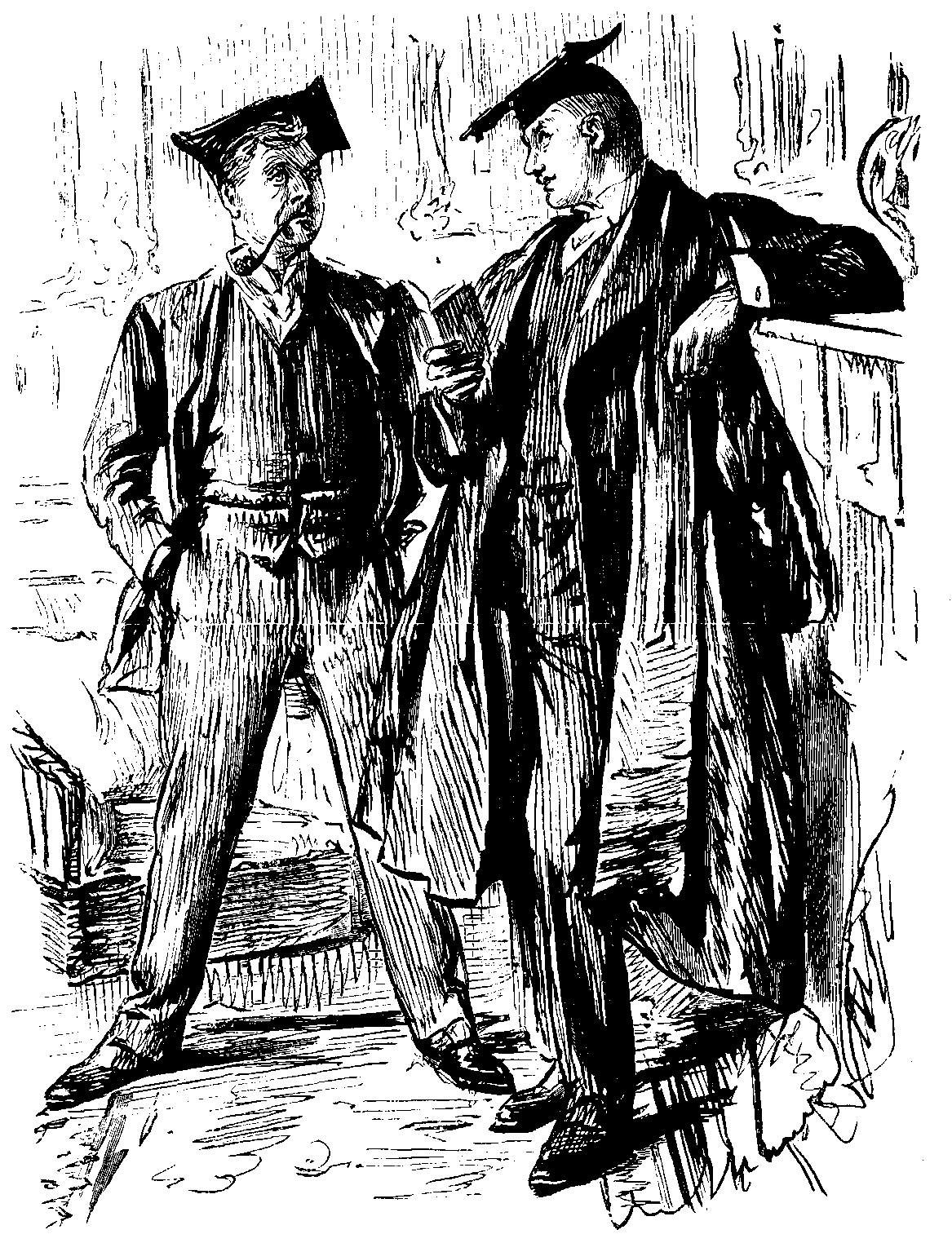
THE RESULT OF TOO MUCH GREEK.
First Classic. "BY THE WAY, HADN'T DANTE GOT ANOTHER NAME?"
Second Classic. "YES; ALFIERI, I THINK—OR ELSE ALIGHIERI."
First Classic. "AH, PERHAPS YOU'RE RIGHT. I HAD A NOTION IT WAS GABRIEL ROSSETTI, OR SOMETHING!"
CUTTING REMARKS.
Tied to Time.
Mr. HENRY AUTHOR JONES has taken a theatre wherein to play his own plays to his own taste. On the first night of The Crusaders this taste was not exactly the taste of the audience. Mr. HENRY AUTHOR JONES seemed to object to be tied to time, and the result was the prompt appearance of that terrible conqueror of things terrestrial, General Boredom. Since the initial performance, it is reported that matters have gone on more smoothly. According to the "usual sources of information" the dramatist has been cheered on leaving his theatre, and heartily congratulated. On one occasion he actually supplemented his piece with a speech! Apparently he was under the impression that there could not be too much of a good thing—JONES for choice! It may be that since the first performance, there has been some curtailment made in the play. To judge from appearances it was a question of cutting—either the author the play, or the public the theatre!
QUITE A NEW SPEC.—We have just received a prospectus of a Company entitled "The Monarch Insurance Society." Of course, all the Crowned Heads of Europe will be in it. We haven't yet read it, the title being sufficient for the present. Ça donne à penser. Will it provide New Monarchs for old ones? Will it give good sovereigns in exchange for bad ones? If so—where will the profit come in?
FRENCH AS SHE IS "WRIT."
The Standard's own Vienna Correspondent, when reporting the unpleasant incident in the life of the Duc d'ORLÉANS, told us how the Prince, on unwittingly "accepting service," said to the astute lawyer's clerk, "Mais, Monsieur, ce n'est pas le moment." To which the clerk replied, "also in French," says the Standard, "One time is as good as another." But why was not the lawyer's clerk's French as she is spoke given as well as that of M. le Duc? And how much more telling it would have been had M. le Duc been served well and faithfully by a clerk like Perker's Mr. Lowten, fresh, very fresh, from a carouse at the "Magpie and Stump," or even by one of Messrs. Dodson and Fog's young men who enjoyed themselves so much when "a twigging" of the virtuous Mr. Pickwick.
"Mais, Monsieur, ce n'est pas le moment," says the Duke, to which our Mr. Lowten would have replied in Magpie-and-Stumping French, "Eggskewsy moy, Mossoo, le Dook, ung Tom is aussy bong qu'ung autre. Mossoo ler Dook ar maintenong pérusé ler documong; voici le copy et voilà two. Bonsoir, il faut que je l'accroche."
Whereupon he would have "hooked it," as it appears this particular lawyer's clerk did, and was not seen again. No doubt he joined a circle of admiring friends in the legal neighbourhood (some Magpies-and-Stumps still exist), where, over a glass and a cigar, he recounted the merry tale of how he had served a Duke.
The relation of Hypnotiser to the Hypnotised at the Aquarium may be simply described as "GERMANE to the subject.'
SONG AND CHORUS FOR THE COUNTY COUNCIL ON NEXT DEBATE ON THE WATER SUPPLY—"Young BENN he was a nice young man."