Volume 101 — July 4, 1891.
Reading edition
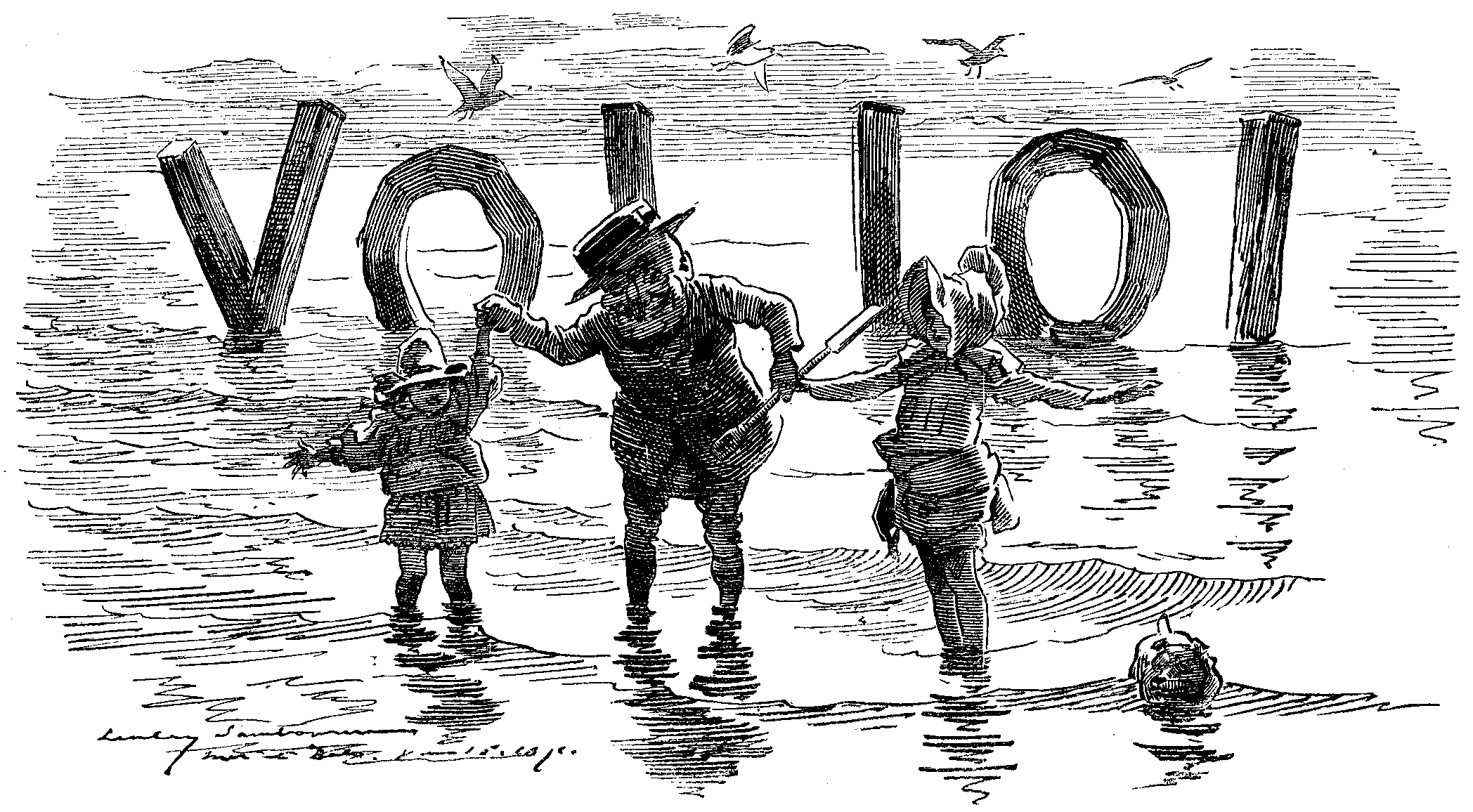
URBI ET ORBI.
Mr. PUNCH returns thanks for the anticipatory congratulations on the occasion of his Jubilee, and takes this opportunity of informing his friends—which means Everybody Everywhere—that the 50th anniversary of his natal day is July 18 prox., which day Mr. PUNCH hereby gives full and entire permission to the aforesaid Everyone Everywhere to keep as a whole Holiday, and do in a general way, and to the utmost of their ability, just exactly what best pleases them.
PUNCH.
THE CHANTREY BEQUEST À LA MODE DE LISLE.
["Mr. DE LISLE wished the Government to veto any pictures purchased under the Chantrey Bequest that did not meet with their approval."—Daily Paper.]
SCENE—A Studio in the Royal Academy. The President and several Members of the Council waiting arrival of Government to inspect their most recent purchase.
President (with assumed joviality). Well, my dear Colleagues, I do not think exception can be taken to this composition. Simple and effective, is it not?
First Member of Council (gloomily). Oh, you never know! I think we ought to have opposed the admission of the Cabinet—what should they know about Art?
Second Mem. (drily). Enough to make speeches at the annual dinner—to which they wouldn't come if we snubbed them.
First Mem. What of that? I am sure the President is quite eloquent enough to stand alone.
Pres. (with a graceful bow). You are most kind. But, hush! here comes Lord SALISBURY!
Enter the PRIME MINISTER. Cordial greetings.
Premier (briskly). I am sure you will forgive me if I get through this quickly. (Looking at picture.) Hm! Yes, very nice; but did EDWARD the Black Prince wear his Garter ribbon in battle? I am sure I refrain from appearing in mine under similar circumstances. (To Pres.) Do you think the Artist could paint it out?
Pres. I feel sure he will do everything in his power to satisfy your Lordship's artistic instincts.
Premier. Just so.
[Exit R. when enter FIRST LORD of the TREASURY, L.
Pres. (greeting new-comer cordially). Most glad to see you, my dear Right Hon. Sir!
First Lord. Very good indeed of you to say so, but am always anxious to do my duty to my Queen and Country. (Gazing at picture.) Hm! Not bad! But, I say, I do know something of yachting, and that isn't the way to brace up the marling-spike to the fokesell yard with the main jibboom three points in a wind with some East in it! If I may venture a suggestion—hope Artist will paint out the gondola. Ta-ta! A bird in the hand is worth two in the bush. [Exit.
Pres. Well, well, I do not know what our friend will think of the matter, but perhaps the Hansom of Venice is a little superfluous. Why here is the HOME SECRETARY.
[Enter that august personage—mutual greeting.
Home Sec. (examining picture). Yes, very nice. Just my idea of what a historical picture should be! Sea-view very fair indeed, and I think that the suggestion of the presentation at Court is also extremely neat. The Black Prince, perhaps, a little near OLIVER CROMWELL, but then that is a detail that will not challenge particular attention. I like too the view of Vauxhall Gardens—very good, indeed! But why should a scene of this great historical importance be laid in Charing Cross during a labour demonstration?
Pres. (frankly). I cannot say that I have looked up all my authorities, but I do not think our friend would allow himself to be wrong on so important a point.
Home Sec. Well, I think it would be in better taste if the Artist cut out that stampede of police—it is not true to nature! [Exit.
Pres. There may be something in what he says, but I do wish these amateurs would keep their suggestions to themselves.
Enter FIRST LORD of the ADMIRALTY.
Pres. (cordially). My dear Lord, delighted to see you—what do you think of it?
First Lord. Hm! Yes! Perhaps! But, I say, what right has the Artist to put the white ensign on the top of that light-house? It's against the regulations—they should be flying the Trinity House flag—if anything. That must come out, you know—it really must! [Exit.
Pres. Silly blunder, but it can be easily remedied. Ah! the Secretary of State for War! (Enter that official) Well, Mr. STANHOPE, and how do you like the new purchase?
War Minister (after, a glance at the canvas). Tol lol. But come, I say, come; the Iron Duke never wore a hat like that! And, I say, as it isn't raining, why has he put up his umbrella? In the cause of historical accuracy that should not be allowed. [Exit.
Pres. (drily). I am afraid our friend will have enough to do. (Enter the remainder of the Cabinet together). Well, Gentlemen—hope you approve of our purchase?
Remainder (together). Not at all. You should have only bought the frame! [Scene closes in on the consideration of this new point.
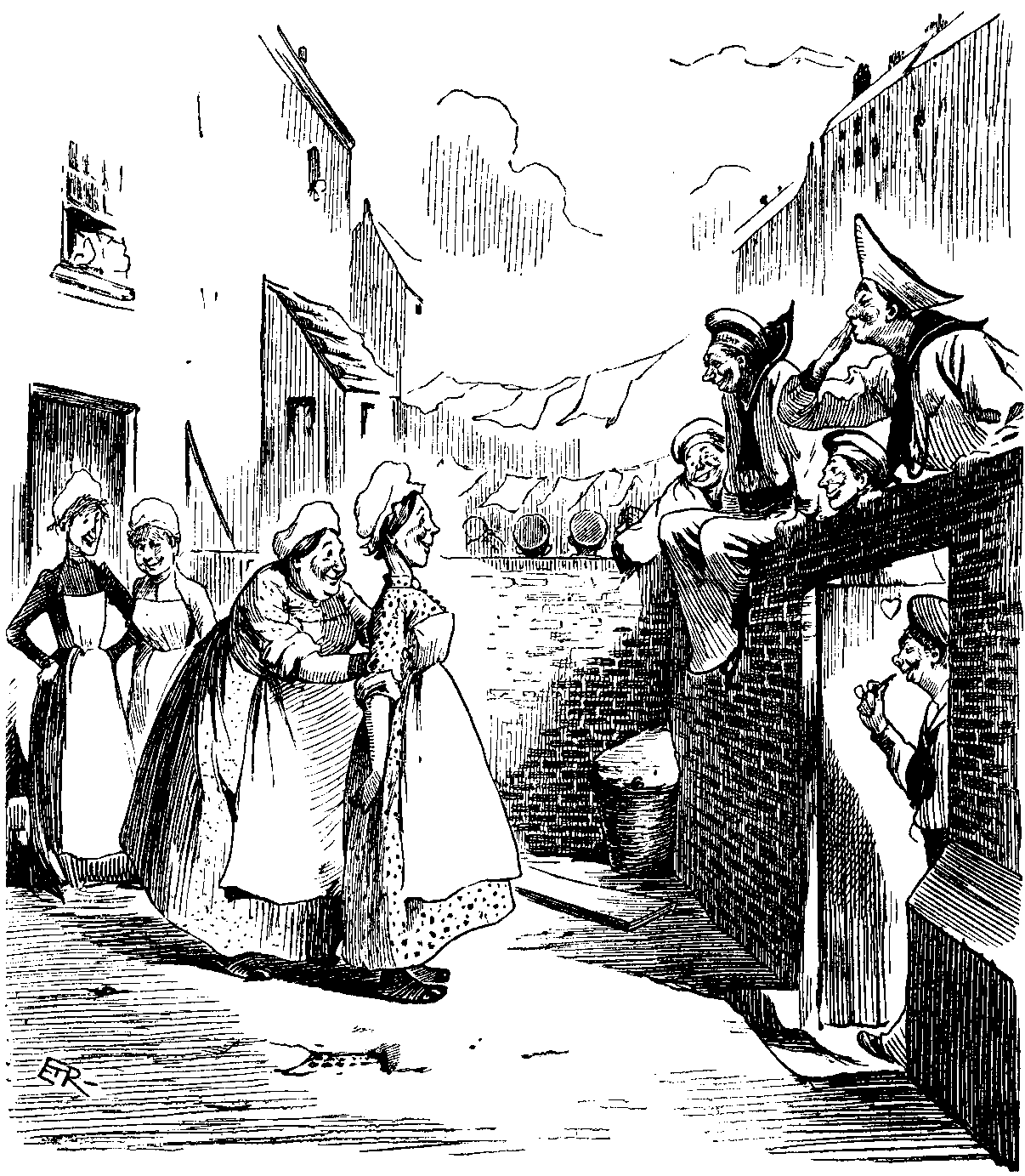
"MANNING THE (BACK-)YARDS."
CHELSEA, JUNE, 1891. FOUR BELL(E)S.
MR. PUNCH EXPLAINS.
[Last week Mr. Punch congratulated King HENRY'S "holy shade" on the Four-hundredth Anniversary of the Foundation of Eton College.]
To Mr. Punch's friends, who think he blundered, In thinking Eton's years were just four hundred, And acted quite in error when he paid Congratulations to King HENRY'S "shade," A word of explanation now is due, To show how what he stated then was true. The word is this—that fifty years have now Elapsed since Mr. Punch first made his bow; And though since then with many friends he's parted, Himself he is as young as when he started. Just fifty years ago it now appears That fair Etona claimed four hundred years. Ungallant it had been if one had told her That Mr. Punch kept young whilst she grew older! Yet if it is indeed the Fourth Centenary Or Jubilee the Ninth since holy 'ENERY Became the founder of a Royal College— Well, Mr. Punch prefers to have no knowledge. He only does not know—has never known a More worthy toast than "Floreat Etona!"
The New Crusaders.
["Kaiser Wilhelm, according to a Berlin Journal, has given his consent to a lottery being instituted throughout the Empire 'for combating the slave trade in Africa.' Tickets to the amount of eight millions of marks will be issued, five and a half millions of which will be devoted to prizes."—Daily Telegraph Berlin Correspondent.]
KNIGHTS-ERRANT of earth's earlier days, Might learn from WILHELM KAISER. They risked their lives in Paynim frays, We moderns have grown wiser. 'Tis not enough by Big Bazaars To buttress Churches tottery; We, with the dice "financing" wars, Conduct Crusades—by Lottery!
LIVE AND LEARN.—Mr. PARKINSON will now probably admit that the foolish process known as "breaking a butterfly on a wheel" may bring the breaker woe.
SHAKSPEARE AND NORTH, NOT CHRISTOPHER.
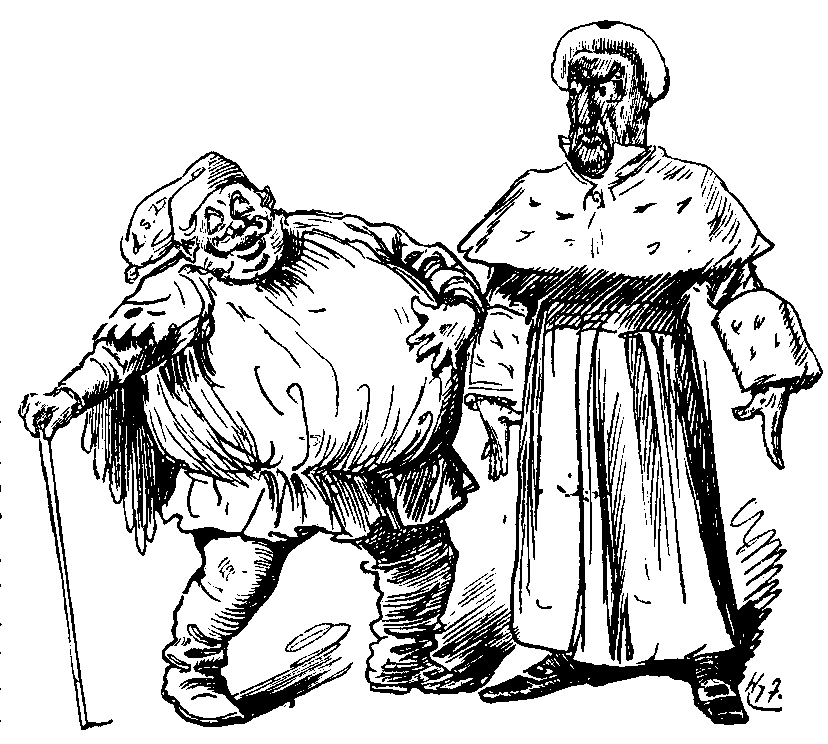
C-l-n-l N-rth as Falstaff.
L-rd C-l-r-dge as Lord Chief Justice.
Henry the Fourth, Part II., Act ii., Sc.
Colonel NORTH is popularly supposed to have been the architect of his own fortune, but he doesn't seem to have profited much by his architectural knowledge when applied to house-building. The burly Colonel—we forget at this moment what regiment is under his distinguished command—has met many a great personage in his time, but, like the eminent barbarian who encountered a Christian Archbishop for the first time—St. Ambrose, we rather think it was, but no matter—our bold Colonel had to climb down a bit on coming face to face with the Lord Chief Justice of England. What a cast for a scene out of Henry the Fourth! Falstaff, Colonel NORTH, and My Lord COLERIDGE for the Lord Chief Justice. The scene might be Part II., Act ii., Scene 1, when the Lord Chief says to Sir John, "You speak as having power to do wrong; but answer, in the effect of your reputation, and satisfy the poor woman,"—only for "woman," read "architect." Curious that the name of GAMBLE should be the pre-surname of Mister Colonel NORTH'S brother. What's in a name? Yet there's a good deal in the sound and look of GAMBLE NORTH, especially when up before the Lord Chief, who must quite recently have got hold of quite a little library of useful knowledge. Also odd that most of Mr. NORTH'S money seems to have been made in the South. But "A 1," that is, the architect, won, and the gallant Mister Colonel, or Colonel Mister, left the Court, feeling comparatively A-Norther man. Never mind, even the Millionairey Colonel can't always be lucky.
MR. PUNCH'S QUOTATION BOOK.
I.—FOR INFERIOR CHAMPAGNE.
'How mad and bad and sad it was— But then, how it was sweet!"—BROWNING.
II.—FOR MR. GLADSTONE.
"Et longa canoros Dant per colla modos."—VIRGIL.
III.—FOR THE NEW BISHOP OF LICHFIELD.
"Gaiter.—A covering for the leg."—ENGLISH DICTIONARY.
IV.—FOR A TENNIS-PLAYER, IMPRISONED BY BAD WEATHER.
"They also serve who only stand and wait."—MILTON.
AT ST. JAMES'S HALL.—Hair PADDY REWSKI is a pianofortist up to the time and tune of day. Knowing that L'Enfant Prodigue is now all the go, he keeps himself up to date by performing the Musical Prodigy Son's, I mean MENDELSSOHN'S "Songs without Words;" and this so effectively, that the last wordless song he was obliged to repeat, and much obliged the audience by repeating. Then the good fellar played La Campanella, Which I prefer to Gentle Zitella, The Princess LOUISE, &c., were there, and "&c." was really looking uncommonly well considering the heat. Bravo, PADDY REWSKI! Ould Ireland for ever!