Volume 101 — AFTER THE SEASON.
Reading edition
A Proposal Fin de Siècle.
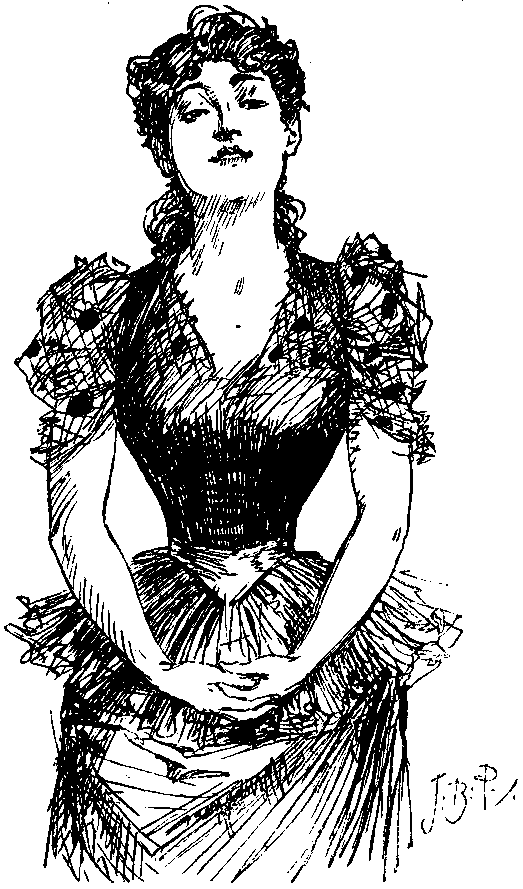
Farewell! since the Season is over, Ah me, but its moments were sweet! You are oft', viâ Folkestone or Dover, To some Continental retreat. On Frenchman and German you'll lavish The smiles that can madden me still; While I, with the gillie McTavish, Am breasting the heather-clad hill. Oh, do you remember the dances, The dearest were those we sat out, How I frowned when detecting your glances On others, which caused you to pout? You are changeful and coy and capricious, A weathercock easily blown; But when shall I hear the delicious One word that proclaims you my own? They say that an eloquent passion Has long become quite out of date, That true love is never the fashion, And marriage a wearisome state. They conjure up many a bogie, To guard a man's bachelor life, And keep him a selfish old fogey, And stop him from taking a wife. They vow that a wife needs a carriage, And opera-boxes and stalls, That money's the one thing in marriage, And cheques are as common as calls. They say women shy (like some horses) At vows made to love and obey; They tell you drear tales of divorces, And scandals, the talk of the day. But hang all those cynical railings, Just write me one exquisite line To say you'll look over my failings, And promise me you will be mine. And though I'm aware it's the merest Small matter of detail, to clear The ground, I may mention, my dearest, I've full thirty thousand a year.
BACON AND A MOUTHFUL.—Last Friday His Honour Judge BACON had to decide a case which was headed in the papers "Cagliostromantheon." What a mouthful! Mrs. CHURCHILL-JODRELL, who was a fair defendant, won the case; and His Honour—this appeal having been made to His Honour by Mr. B. PLAYFAIR, an excellent name for any gentleman, on or off the stage, but especially for one described as "an actor,"—decided that His Honour was satisfied. Peace with His Honour!
NEW TORY NURSERY RHYME.
(By "A Cambridge Parson.")
["The last reliance of the Tories in extremity is the policy of 'Dishing.'"—Sir W. Harcourt.]
Hey diddle diddle, The voters we'd fiddle With Free Education—that "boon." But Wisbech birds laugh At such plain party "chaff," And the "Dish"—at the polls—proves a "Spoon."
FROM GRANDOLPH THE EXPLORER.
Oh, for one hour of the Amphytrion! I can't even send you a digest of the news generally, for my power to digest is already becoming seriously impaired. Here, indeed, as say the Witches in Macbeth (I think it's the Witches, but haven't my Shakspeare handy, I mean my Handy Shakspeare, with me—wish I had), "Fowl is Fare." Send my Pilgrim's Scrip next week. Till then, Yours ever, GRANDOLPH.
IN THE NAME OF CHARLES DIBDIN!
A Lay for the Lifeboat Service.
[An urgent appeal is made on behalf of the Royal National Lifeboat Institution, which is declared to be "in dire financial straits," the deficit for last year being £33,000. Subscriptions and donations will be thankfully received by CHARLES DIBDIN, Esq., Secretary, R.N.L.I., 14, St. John Street, Adelphi, London, W.C.]
True "tuneful CHARLEY is no more," As DIBDIN's Monument informs us; But memory of the man who bore That honoured name still stirs and warms us. And here's another of his name, Who still the British Sailor's serving; Then who could see without sore shame JOHN BULL from his plain duty swerving? Thirty-three Thousand to the bad, Our Lifeboat Service, once our glory? Nay, JOHN, that will not do, my lad; Next year must tell a different story. Think, what would "tuneful CHARLEY" say To such a thing? In racy lingo, Upon our backs his lash he'd lay, And give the slothful Britons "stingo." Thirty-five thousand lives they've saved, Our Life-boat rescuers, already. The seas around our shores they've braved, With valour prompt and patience steady. Shall they be floored for L.S.D., Because JOHN BULL his pockets buttons? Then the old keepers of the Sea Must be, in pluck, as dead as muttons. True, lads, on such a text as this "We sadly miss old CHARLEY's line;" But were we mute, Neptune would hiss His sons degenerate off the brine. Old "CHARLEY" spins his yarns no more! He's dead, as Scrooge declared old Marley. What then? Wake up, from shore to shore, And—send your guineas to Young CHARLEY!
"Great Scot!"
[Extorted, by circumstances beyond his control, from a stolid but unsuccessful Saxon Shootist at Bisley and Wimbledon, after the match at the latter place between picked twenties of the London Scottish and the London Rifle Brigade, won easily by the former team.]
Oh! the Scot lot are all cracks at a shot, And extremely successful at Hunting the Pot. This particular "Saxon" the hump has got, Being licked by a team which is Picked and Scot.
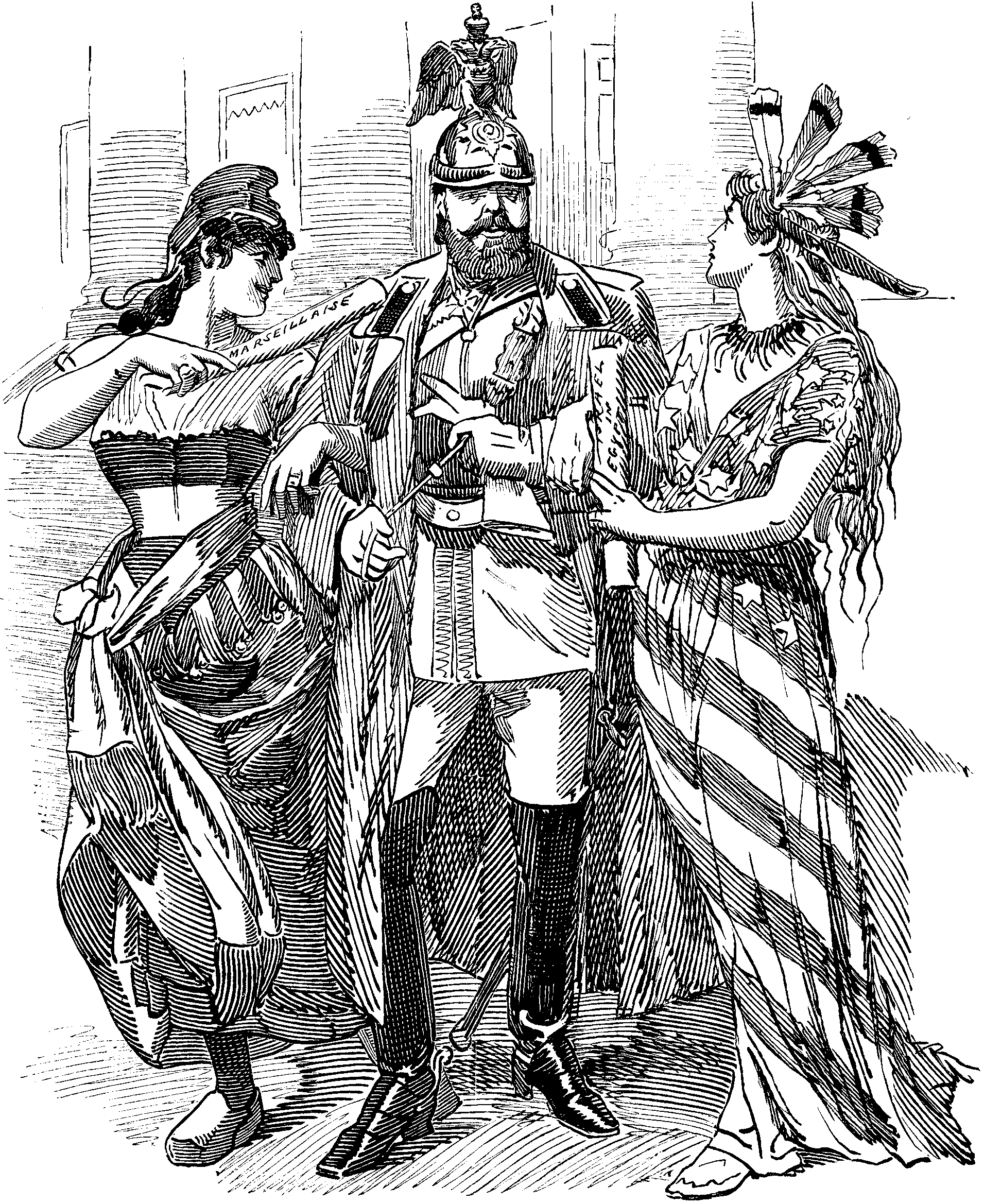
SETTING THEIR CAPS AT HIM; OR, AN AUTOCRAT IN ODD COMPANY.
["Never," said the CZAR, at the Imperial dinner to which the Officers of the French Fleet were invited, "could I have believed that Republican Sailors, that Republican Soldiers, could have such a bearing."—Times.
"The CZAR has, at the instance of the United States, ordered a temporary relaxation of the measures for the expulsion of the Jews from Russia."—Times.]
Autocrat
(
aside
). "HUMPH! CHARMING CREATURES, BOTH; BUT CAN'T SAY I LIKE THEIR COSTUMES!"
"How happy could I be with either?" Humph! N-n-o-o, I can hardly say that! Yet here we are, tripping together, Republics and proud Autocrat! Two cats and a Boreal Bruin!— So satire will say, I've no doubt. And some will declare it must ruin The Russdom once ruled by the knout. I wonder—I very much wonder— What NICK to this sight would have said— I fear he'd have looked black as thunder, And savage as RURIC the Red. For this did we lose the Crimea? For this did we larrup the Jews? I really had not an idea Republics could rule—and amuse. Miss FRANCE looks extremely coquettish. How well Miss COLUMBIA can coax! The Teuton, no doubt, will look pettish, The Briton will grumble "a hoax." Aha! I can snub a Lord Mayor, And give shouting Emperors a hint; I back La Belle France. Her betrayer My meaning must see, plain as print. My reply to the great Guildhall grumble Had less of politeness than pith, But—well I've no wish so to humble My friend Mr. EMORY SMITH, Or CRAWFORD, the Consul. No thank ye, Persona gratissima, he; And therefore I yield to the Yankee The boon I refused to J.B. But yet, all the same, it is funny To see Three like us in One Boat. COLUMBIA looks dulcet as honey, Miss F.'s every glance is a gloat. I never imagined Republics Could have such a "bearing" as these. Enjoyingly as a bear cub licks The comb sweetly filled by the bees, I list to their flattering-chatter; Their voices are pleasant—in praise; But—well, though it seems a small matter, I don't like that dashed "Marseillaise." And "Israel in Egypt" sounds pointed I'd Pharaoh the miscreants—but stay, My soliloquy's getting disjointed, I've promised! COLUMBIA looks gay, La Belle France displays a grande passion; My arms they unitedly press. One thing though; the Phrygian fashion Is not my ideal of dress. They swear that they both love me dearly, Their "best of old Autocrat Chaps!" They are setting their Caps at me, clearly, But,—well, I don't quite like the Caps!
THE CAPLESS MAID.
["The plaintiff gave evidence that she was engaged as a sort of house and parlour-maid ... and was discharged after she had been there nine days, because she refused to wear a cap ... His Honour: I do not think she was bound to wear a cap."—Daily Paper.]
What shall we do with our Maid? How shall we treat her best? Shall the gems that are rare be strewed in her hair? And shall she in silks be drest? Shall we make her a gift of gold? Shall we make her our queen? Perhaps. But whatever we make her, wherever we take her, We never must make her wear caps. Imperious, capless, supreme, Do just as you please evermore; And wear what you will, for we shall be And never complain as before. We may put all our money in mines, We may put all our cheese into traps, But we put, it is clear, our foot in it, dear, When we try to put you into caps.
THE DIFFERENCE.
["It needs no argument to show that in the summer of 1893 Mr. GLADSTONE is less likely to take an active part in any electoral contest than he can be in the spring or autumn of 1892."—Mr. Edward Dicey, on "The Next Parliament."]
"Time's on our side," said GLADSTONE. DICEY, too, Takes Edax Rerum as his friend most true. GLADSTONE Time's "Hour Glass" trusts; but DICEY's blithe Because his hopes are centred on Time's scythe. Faith lives in Life, but Fear's most vigorous breath Lives "in the sure and certain hope"—of Death!
Resignation.
"Fire! Fire!" "Where? where?' SHAW's resigned. Then find Another one! Many gone? Fire! Where? Here's a scare!!
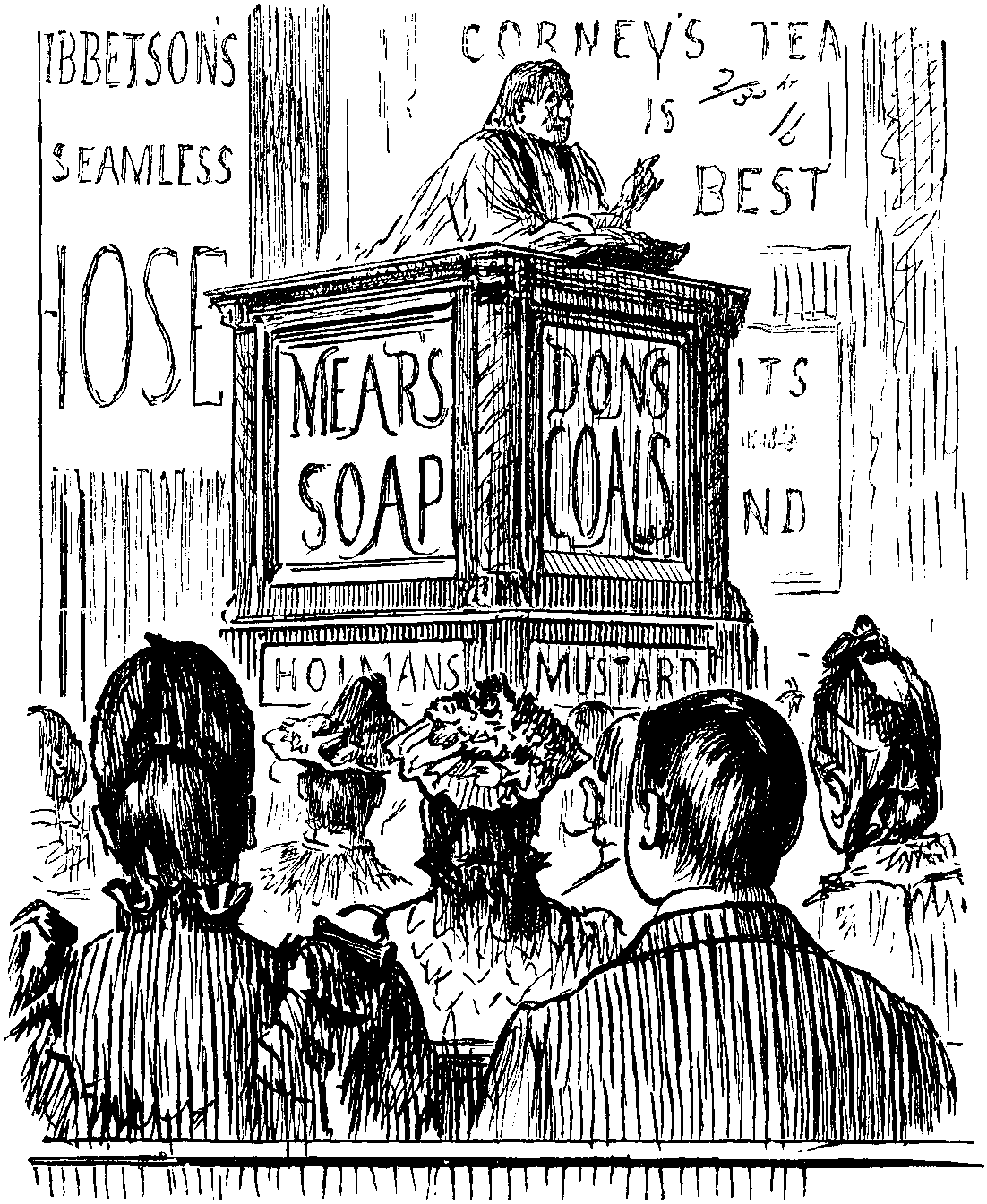
A NEW WAY OF PAYING CHURCH DEBTS.
(
Vide "Liverpool Daily Post," July 23 1891.
)