Volume 100 / Act 4 — ESSENCE OF PARLIAMENT.
Reading edition
EXTRACTED FROM THE DIARY OF TOBY, M.P.
House of Commons, Monday, March 16.—House of Commons really looked to-night as if it meant fighting. No lack of matter for quarrel. Even before public business was reached, Orders bristled with Motions raising controversial points. Lord CHUNNEL-TANNEL, that man of peace, was to the fore; his Bill, extending Manchester. Sheffield, and Lincolnshire Railway into London via Lord's Cricket Ground, down for Second Reading. That redoubtable Parliamentary Archer BAUMANN also on alert. Has taken under his personal charge the social and material welfare of Metropolis; at one time HARRY LAWSON, on other side of House, disputed supremacy of position with him. But, as SARK says, BAUMANN has immense advantage of making Liberal speeches from Conservative side.
"If," says SARK, "I had to begin my Parliamentary life again, I would sit for a Tory borough, and advocate Radical notions. If it were possible, I would, with such a programme, like to represent one of the Universities, Oxford for choice. There's a sameness about fellows who fret up from Liberal benches and spout Radicalism, or about men who talk Toryism from the Conservative camp. It's what was expected; what the House of Commons enjoys is the unexpected. GRANDOLPH knows that very well. If he'd come out as a Liberal, he wouldn't have been half the power he is. The secret of success in political life, my young friend, is to sit in darkness, and clothe yourself with light. The thing doesn't hold good in the converse direction. A man sitting on Liberal benches, and talking Toryism, will gain cheers from other side, but not much else. Look at HORSMAN in the past; look at JOKIM in the present. Certainly he is CHANCELLOR OF THE EXCHEQUER; but, even with that, I suppose you wouldn't call him a political success?"
Cupid's Bowman.
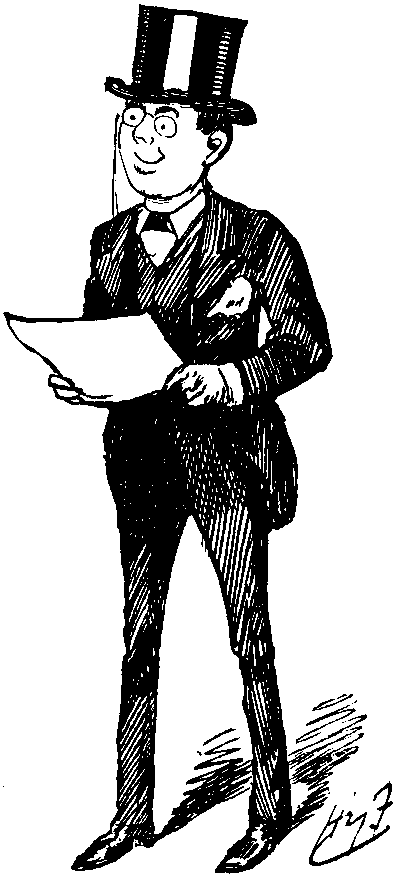
SARK a little prosy and opinionated; otherwise a good fellow. Whilst his homily in progress ground considerably cleared. Manchester, Sheffield, and Lincolnshire Bill put oft till to-morrow; Kensington Subway Bill withdrawn; BAUMANN triumphant. Still remained public business; OLD MORALITY led off with proposal to take Tuesdays and Fridays for morning sittings and Opposition mustered in great force; Mr. G. present, glowing with his own eulogy on ARTEMIS. OLD MORALITY moved Resolution with deprecatory deferential manner; only desire was to do his duty to QUEEN and Country and meet the convenience of Honourable Gentlemen sitting in whatever part of the House they might find themselves. Evidently expected outburst of indignant refusal, long debate, and a big division. Some indignation, but little debate and no division. Everyone on Opposition Benches seemed to expect some one else to declare himself irreconcilable. When question put, a pause; no one rose to continue the successive brief speeches; before you could say JAMES FERGUSON, Government had, on this 16th of March, practically secured all working time for remainder of Session.
"I feel like CLIVE," said OLD MORALITY; "or was it WARREN HASTINGS? Anyhow I am amazed at my own moderation."
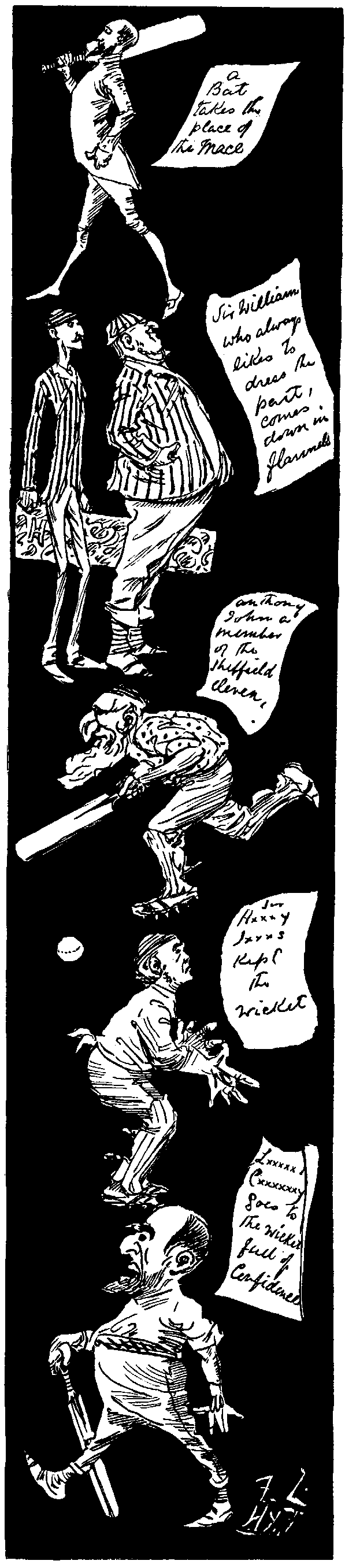
THE LORDS IN THE COMMONS.
Business done,—Morning Sittings arranged for rest of Session.
Tuesday.—"Lords" and Commons came in conflict to-day under novel circumstances. Lord TANNEL-CHUNNEL, pending settlement of question about making his Channel Tunnel, is promoting new trunk line of railway. Means to bring the Manchester, Sheffield and Lincoln line straight into London; terminus comes in by Lord's Cricket Ground; invades the sweet simplicity of St. John's Wood; artistic population of that quarter up in arms; shriek protest in Lord CHUNNEL-TANNEL's ear, and shake at him the angry fist. But TANNEL-CHUNNEL not a Baron easily turned aside from accomplishment of his projects. Squares Committee of "Lords"; impresses into support of his scheme representatives of all the big towns on the route; Manchester, Nottingham, Leicester, all cheer him on; Liberals, Conservatives, Dissentient Liberals, swell his majority. Second Reading of Bill carried by more than two to one.
"How's that, Umpire?" CHUNNEL-TANNEL asked, carrying out his bat. "Well played, indeed!" said the SPEAKER.
Seemed at one time as if blood would flow, and gore would stain the floor of House. BARNES and WIGGINS were in it, but what it was all about not quite clear. Something to do with a coal-truck. As far as could be made out from choked utterances of BARNES, there had at some remote period been a coal-truck despatched to London by the Midland route. Something happened to it; either it was delayed, or it arrived empty, or it didn't arrive at all. However, it was quite clear to BARNES that the time had come when a new line of railway giving direct access to London from the Midlands was an urgent necessity. WIGGINS observed to be wriggling in his seat during the BARNES oration. Made several attempts to catch SPEAKER's eye; at length succeeded; his suppressed fury was terrible to behold: his rage Titanic. He at least knew all about that coal-truck; though, as far as House was concerned, he did not succeed in lifting the mystery in which BARNES had enveloped it. Whether it was WIGGINS's coal, or merely WIGGINS's truck; whether WIGGINS happened to be in the truck when it went astray; or whether it was BARNES that was in it; or whether nothing was in it but the coal; or whether, coming back to an earlier point, there was no coal in the truck when it did (or did not) arrive at St. Pancras: these were questions the House vainly pursued, withered, as it was, under the wrath of WIGGINS The only point clearly perceived was, that BIGGINS is a director of Midland Railway.
"About that Coal Truck?"
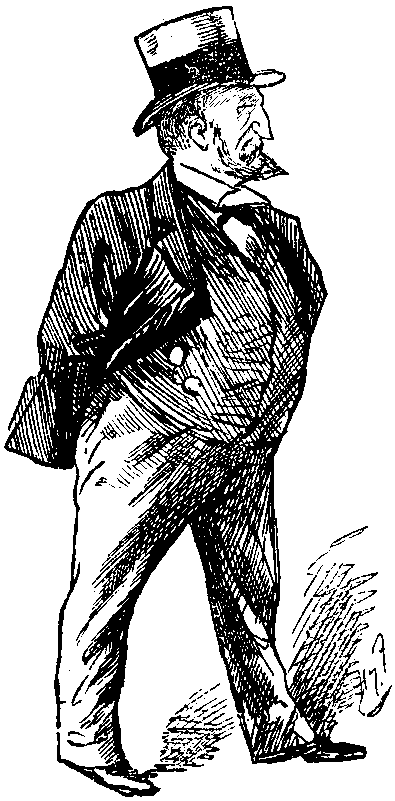
In ordinary circumstances there are not to be found in House two more affable men than BARNES and WIGGINS. Amongst many other virtues, WIGGINS is, SARK tells me, one of the best judges of cigars in House, and is never without a sample in his case. It is sad to think that a man so gifted by nature, so favoured by fortune, should let his angry passions rise round a coal-truck. House, contemplating the episode, glad to shut it out by rushing off to Division Lobby. Business done.—Manchester, Sheffield, and Lincolnshire Railway Bill, Read a Second Time, by 212 Votes to 103.
Thursday.—House engaged in considering Lords' Amendments to Tithes Bill. Things as dull as usual; House nearly empty; walk about corridors through tea-room, newspaper-room, and library; almost deserted; in smoking-room came upon little group playing cards; three of them; SOLICITOR-GENERAL, CHABLES RUSSELL, and ASQUITH, LOCKWOOD looking on.
"I suppose," I said, "they're playing whist; why don't you make up the hand?"
"Whisht! it's not whist!" LOCKWOOD whispered, keeping his eye closely fixed on game. "It's Baccarat. (Ah! CLARKE! I saw you. Come, pay up. You did that very clumsily.) It's the Tranby Court case you know. I'm not in it, but my learned brethren here hold briefs on either side, and they say they are bound, in the interests of their clients, to master the intricacies of the game. I must say they have managed very successfully to subordinate their horror of gambling. RUSSELL, you know, has a positive distaste for any game of chance. But as he says, a Barrister must sometimes put his prejudices in his pocket. ASQUITH brings to the game a serious aspect that positively sanctifies it. As for EDWARD CLARKE, he's wonderfully nimble. He was trying la poucette just now when I called out to him. As everything turns upon this, my learned friends say they must make themselves acquainted with it. But I hope it won't lead to any breaking up of families. I'm told the Judges who are likely to be trying cases in London before Whitsuntide, impelled by a similar sense of duty, are also studying Baccarat. The L.C.J. is reported to have developed a wonderful talent. As a family man, and Recorder of Sheffield, I'm glad I'm not briefed in the case."
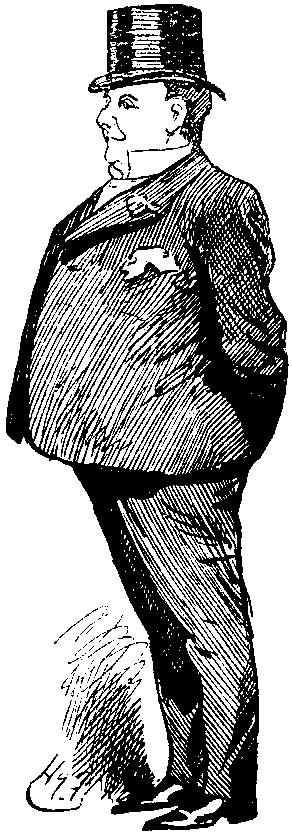
"Young Harry."
Business done.—Tithes Bill.
Friday.—Young HARRY LAWSON, with his beaver up, moved Resolution approving the opening for certain hours, and under special regulations, of the National Museums and Galleries, closed in London to the public on Sundays, made capital and convincing speech; supported by men like JOHN LUBBOCK, and, from Conservative side, MAYNE and ELCHO. Earlier in sitting, the voice of Whitechapel, Hoxton, Shoreditch, and Bethnal Green, had been heard by petition, praying for the boon. But dear old ROBERT FOWLER knows better what is good for the people. Opposed Motion. OLD MORALITY, who never goes into his picture gallery at Greenlands after midnight on Saturday, whipped up Government forces; Motion lost by 166 against 39.
Mr. BUNG, who had been watching Debate from Distinguished Strangers' Gallery, hugely delighted. "S'elp me," he said, "that'll stop their little game for this Parliament, at least. What do they mean hinterfering with honest tradesmen? If you go opening your bloomin' mooseums and picter galleries on Sunday afternoons, what's to become of ME?"
Business done.—Mr. BUNG's; and very effectively, too.
"Flat, Stale, and Unprofitable."
HAMPDEN, farewell! Ere this you may have found The World you swore was flat is really round. But many a man, with brains beneath his hat. Swears that the World is round, and finds it flat.