Volume 100 — "PLEASE GIVE ME A PENNY!"
Reading edition
NEEDY INCOME-TAX PAYER (loq.). "HOPE YOU WON'T FORGET ME
THIS TIME
, SIR!!"
FOR BETTER OR WORSE!
(Two Views of the Same Subject.)
POSSIBLE ROMANCE.
SCENE—A Dungeon beneath the Castle Moat. Wife chained to a post, with bread and water beside her. Enter Husband, with cat-o'-nine-tails.
Husband. And now, after ten days' seclusion, will you make over your entire property to me, signing the deed with your life's blood?
Wife (in a feeble voice). Never! You may kill me, but I will defy you to the last!
Husband. Then die! [He is about to leave the dungeon, when he is met by a Messenger from the Court of Appeal.
Messenger. In the name of the Law, release your prisoner!
Husband. Foiled! [Joy of Wife, and tableau, as the Curtain falls.
PROBABLE REALITY.
SCENE—The Church-door of a fashionable Church. Wife bidding adieu to Husband.
Husband. Surely, now that my name and fortune are yours, you will reconsider your decision, and at least accompany me back to our wedding breakfast?
Wife (in a firm voice). Never! You may kill me, but I will defy you to the last!
Husband. This is rank nonsense! You must take my arm. [He is about to leave the Church-porch, when he is met by a Messenger from the Court of Appeal.
Messenger. In the name of the Law, release your prisoner!
Husband. Sold! [Joy of Wife, and tableau, as the Curtain falls.
"WHAT'S IN A NAME?"
The "Cony" is feeble, the Bear's a rough bore. But CONYBEARE'S both, and perhaps a bit more!
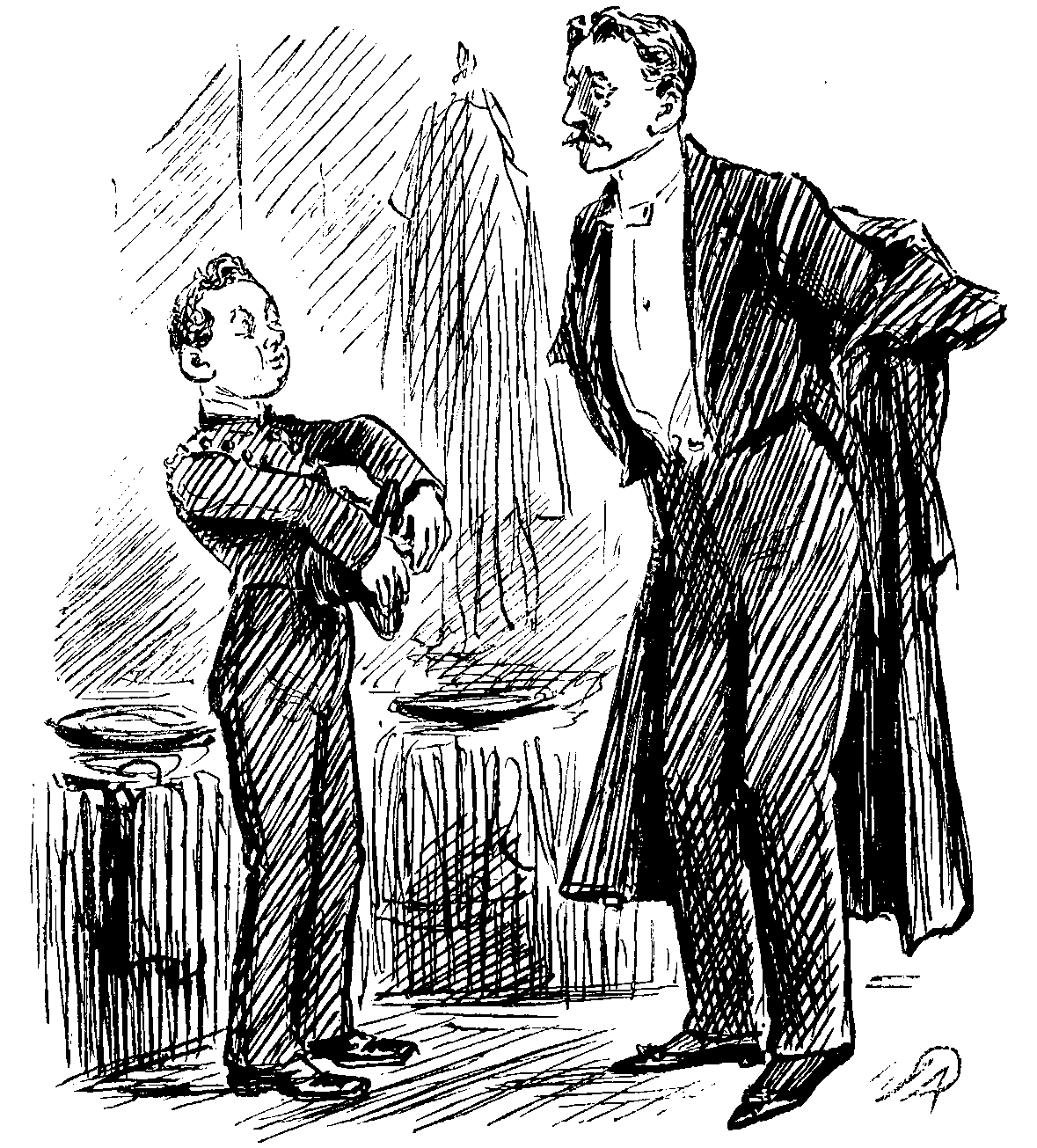
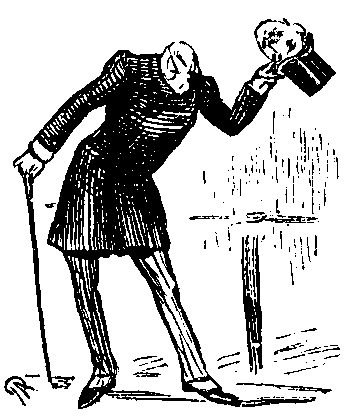
SMART NEW BOY IN CLOAK-ROOM HAS NOTED GENTLEMEN SHUTTING UP THEIR CRUSH HATS, AND PROMPTLY FLATTENS DE JONES'S BEST SILK TOPPER!
THE OTHER MAN.
My health is good, I know no pain, I am not married to a wife; From all accounts I'm fairly sane, And yet I'm sick to death of life. The path that leads to wealth and fame Cannot be traversed in a day; I find it twice as hard a game, Because a spectre bars the way. It has no terrors such as his Away from which the children ran; It's not the Bogey, but it is The Other Man. I met a girl, she seemed to be A kind of vision from above. She wasn't—but, alas! for me, I weakly went and fell in love. Her father was a millionnaire, Which didn't make me love her less. I thought her quite beyond compare, And gave long odds she'd answer "Yes." She thrilled me with each lovely look She gave me from behind her fan, She took my heart, and then she took— The Other Man. Farewell to Love! I thought I'd try My level best to get a post; The salary was not too high, Two hundred pounds a-year at most. Committeemen in conclave sat, Their questions all were cut and dried: Oh, was I this? And did I that? And twenty thousand things beside— As did I smoke? and could I play At golf? or did I get the gout? And—most important—could I say My mother knew that I was out? Then two were chosen. Should I "do"? Perhaps!—and, just as I began To hope, of course they gave it to The Other Man. All uselessly I've learnt to swear And use expressions that are vile; In vain, in vain I've torn my hair In quite the most artistic style. Yet one thing would I gladly learn— Yes, tell me quickly, if you can— Shall I be also, in my turn, The Other Man?
THE KEY TO A LOCK.
["A lock of ——'s hair, set in a small gold-rimmed case, and said to be an ancient family possession, was knocked down for forty pounds."]
Take yonder lock of tangled hair, A silver seamed with sable, Dim harbinger from dreamland fair Of reverie and fable; Yes, grandson mine, the treasure take, A trinket loved, if little, And wear it, darling, for my sake, In yonder locket brittle; Small, as my banker's balance, small And faint—a touching token; My luck, the lock, the locket, all Seem, child, a trifle broken. Investments, boy, are looking glum; They flit and fade; in fine a Not inconsiderable sum Has gone to—Argentina. Nay, chide me not; one day, refilled By these, may shine your pocket, And Fortune's resurrection gild The lock within the locket. Because, you see, when strong and sage You grow, and all the serried Lights of the great Victorian age With me are quenched and buried; When other men in other days Walk paramount—then shall you Submit the thing to such as praise The Past, its relics value. The curl was worn, you'll tell your friends, By TENNYSON or BROWNING (The detail of the name depends On who is worth renowning). You'll vaunt that one who knew the grand Victorian Stars, and rather Deserved himself to join the band (In fact your father's father), Who, past expression, loved whate'er The market cottons then to, Committed to your childish care This genuine memento. You'll catalogue it, as befalls Your choice, my little gran'son; You'll bear it to the deathless halls Of CHRISTIE, WOODS, AND MANSON. So, when the fateful hammer sounds, And you have cashed in rhino A cheque for, haply, forty pounds, You'll bless your grandsire, I know; Who, while his fortunes failed, and much Was life's horizon o'ercast, Created souvenirs with such A keen, commercial forecast.
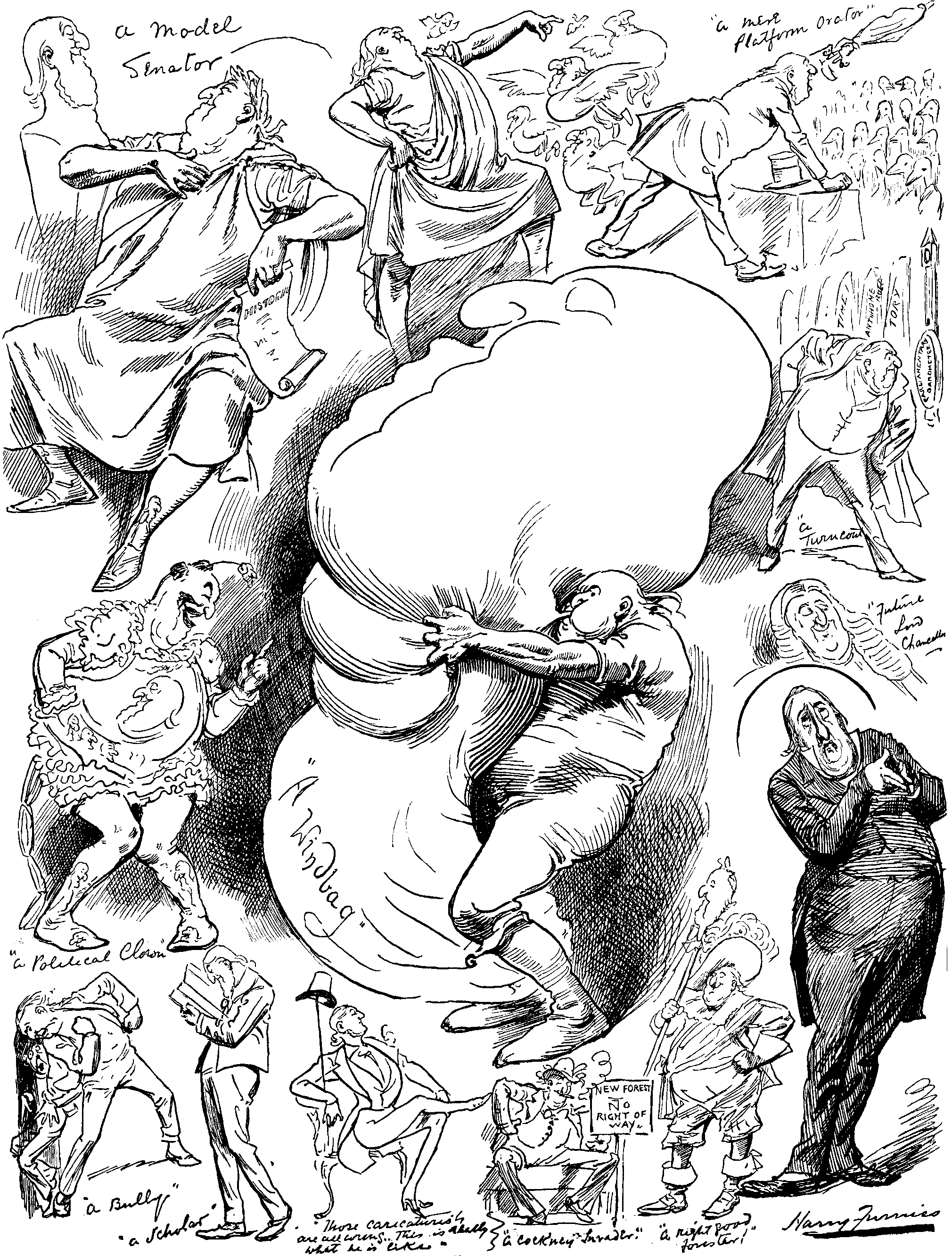
ALL-ROUND POLITICIANS—SIR WILLIAM VARIETY HARCOURT.
BACCHUS OUTWITTED; OR, THE TRIUMPH OF SOBRIETY.
(Fragment from a Romance founded upon evidence given before the Select Committee upon Dram-drinking.)
"I really think the experiment should be made," said the Professor. "Our knowledge on the subject is so imperfect, that nothing definite can be accurately pronounced."
"True enough," replied one of his friends; "but although the end to be attained is excellent, may not the means be termed by the scrupulous 'questionable?'"
"By the over-scrupulous, perhaps," returned the Professor, with a smile.
"And the expense," observed a second of his intimates, "will be no small consideration. If we put the matter to a thorough test, a large quantity—a very large quantity of the necessary liquid will have to be purchased and disposed of. Am I not right in hazarding this supposition?"
"Undoubtedly," responded the Professor, "and the cost will be enhanced by the fact that the necessary liquids will have to be of the best possible quality. As Dr. PAVEY observed before the Committee 'It is not the alcohol in itself that is injurious, but the by-products.' Our aim must be to eliminate the by-products."
"I think the idea first-rate," said the third friend; and then he paused and added, seemingly as an after-thought, "Pass the bottle."
So the Professor and his three companions decided to make the investigation in the cause of scientific research. It was resolved that after a week they should meet again, and that in the meanwhile they should in their own persons carry on the experiment continuously. When this had been arranged the friends parted company.
At the appointed time the contemplated gathering became a concrete fact. The Professor's friends were the first to appear at the rendezvous. They were unsteady as to their gait, their neckties were in disorder and their hair falling carelessly over their eyes, added a fresh impediment to an eyesight that seemingly was temporarily defective. They sank into three chairs regarding one another with a smile that gradually resolved itself into a frown. Then they filled up the pause caused by the non-appearance of the Professor by weeping silently. Their emotion was not of long duration, as the originator of the experiment was soon in their midst. He seemed to be in excellent health and spirits.
"My dear friend," he said, and it was noticeable that he was prone to clip his words, and to use the singular, in lieu of the plural, when the latter would have been more conventional, "My dear friend, glad see you all. Hope you well."
His comrades received the well-meant greeting with a resentful frown, which ended in further weeping.
"This very painful," continued the Professor, resting his hand somewhat heavily on the back of a chair; "very painful indeed! Fact is, you been taking wrong things!"
His friends sorrowfully shook their heads negatively.
"Yes you have! Sure of it! You, Sir—imbibed whiskey! No harm in good whiskey—excellent thing, good whiskey! But injuriverius—should say, injurious—if has too much flavour of malt! Your whiskey too much flavour of malt! You took brandy—bad brandy—too much taste of grapes! You took rum—bad rum—too much mo—mo—molasses! Now I took all three—whiskey, brandy, rum, but pure—no by-products. No, not at all. Result! See! Sober as judge!"
And, succumbing to a sudden desire for slumber, the Professor, at this point of his discourse, joined his friends under the table!
CYCLING NOTES.
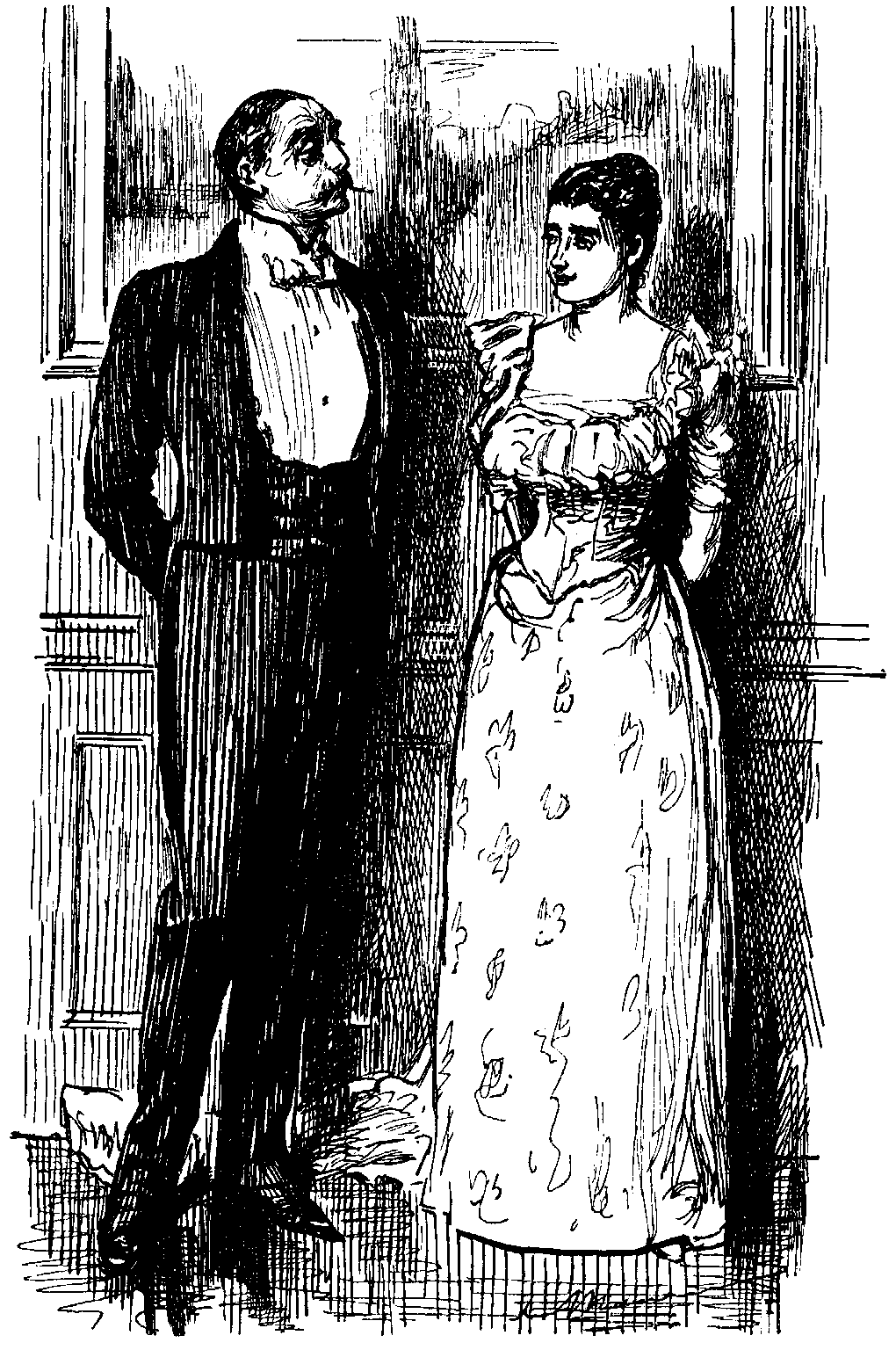
He. "DO YOU BELONG TO THE PSYCHICAL SOCIETY?"
She. "NO; BUT I SOMETIMES GO OUT ON MY BROTHER'S MACHINE!"
LEAVES FROM A CANDIDATE'S DIARY.
March 20. "George Hotel," Billsbury.—Arrived here yesterday afternoon. Mother made up her mind to come with me, being very anxious, she said, to hear one of my splendid speeches. She brought luggage enough to last for a week, and insisted on taking her poodle Carlo, who was an awful nuisance, in the train. He growled horribly at old TOLLAND and BLISSOP when they came to see me at the Hotel before dinner. Very awkward. TOLLAND wanted to put before me the state of the case with regard to registration expenses. The upshot was that the Candidate is expected to subscribe £80 a year to the Association for this purpose, which I eventually agreed to do. Found fourteen letters waiting for me. No. 1 was from Miss POSER, the Secretary of the Billsbury Women's Suffrage League, asking me to receive a small deputation on the question, and to lay my views before them. No. 2 from the Anti-Vaccination League, stating that a deputation had been appointed to meet me, in order to learn my views, and requesting me to fix a date. No. 3 and No. 4, from two local lodges of Oddfellows, each declaring it to be of the highest importance that I should become an Oddfellow and proposing dates for my initiation. Nos. 5, 6 and 7 were from Secretaries of funds for the restoration or building of Churches and Chapels, appealing for subscriptions. Nos. 8, 9, and 10, from three more local Cricket Clubs, who have elected me an Honorary Member, and want subscriptions. No. 11 from a Children's Meat Tea Fund. No. 12 asked me to subscribe to a Bazaar, and to attend its opening in June. No. 13, from the local Fire Brigade, and No. 14 from the Secretary of the Local Society for improving the Breed of Bullfinches, recommending this "national object" to my favourable notice. Shall have to keep a Secretary, likewise a book of accounts. Where is it all going to end?
The Mass Meeting went off well enough. The Assembly Rooms were crammed. (The Meteor says, with its usual accuracy and good taste, "The attendance was small, the proceedings were dull. A wonderful amount of stale Jingoism was afterwards swept up by the caretakers from the floor. Our Conservative friends are so wasteful.") I was adopted as Candidate almost unanimously, only ten hands being held up against me. One or two questions were asked—one about local option, which rather stumped me—but I managed to express great sympathy with the Temperance party without, I hope, offending publicans.
Carlo somehow or other got out of the hotel and followed us to the meeting without being noticed. Poodles are all as cunning as Old Nick. He lay quite low in some corner or other, until Colonel CHORKLE was in the middle of a tremendous appeal to "the stainless banner which 'as so often been borne to triumph by Billsbury's embattled chivalry." The Colonel thumped on the table very hard, and Carlo, I suppose, had his eye on him and thought he was going to thump me. At any rate he sprang out and dashed at the Colonel, barking furiously. I had to seize him and take him outside. The Colonel turned quite pale. The Meteor says: "The war-like ardour which burns in the breast of Colonel CHORKLE was well-nigh extinguished by an intelligent dog, whose interruptions provoked immense applause." I had to apologise profusely to the Colonel afterwards. Mrs. CHORKLE looked daggers at me. Mother was delighted with the meeting. She has written about it to Aunt AMELIA.
ESSENCE OF PARLIAMENT.
EXTRACTED FROM THE DIARY OF TOBY, M.P.
House of Commons, Monday Night, April 13.—So long since Lord STALBRIDGE parted company from RICHARD GROSVENOR that he forgets manners and customs of House of Commons. Not being satisfied with choice made by Committee of Selection of certain Members on Committee dealing with Railway Rates and Charges, STALBRIDGE writes peremptory letter to Chairman, giving him severe wigging; correspondence gets into newspapers; House of Commons, naturally enough, very angry. Not going to stand this sort of thing from a mere Peer, even though he be Chairman of North-Western Railway. Talk of making it case of privilege. Sort of thing expected to be taken up from Front Bench, or by WHITBREAD, or some other Member of standing. Somehow, whilst thing being thought over and talked about, SEXTON undertakes to see it through. As soon as questions over tonight, rises from below Gangway, and in his comically impressive manner, announces intention of putting certain questions to JOHN MOWBRAY, Chairman of Committee of Selection. Ordinary man would have put his questions and sat down. But this a great occasion for SEXTON. Domestic difficulties in Irish Party kept him away from Westminster for many weeks. No opportunity for Windbag to come into action; now is the time, as champion of privileges of House of Commons. Position one of some difficulty. Not intending to conclude with a Motion, he would be out of order in making a speech. Could only ask question. Question couldn't possibly extend over two minutes; two minutes, nothing: with the Windbag full, bursting after compulsory quiescence since Parliament opened.
SEXTON managed admirably; kept one eye on SPEAKER, who from time to time moved uneasily in chair. Whenever he looked like going to interrupt, SEXTON lapsed into interrogatory, which put him in order; then went on again, patronising JOHN MOWBRAY, posing as champion of privileges of House, and so thoroughly enjoying himself, that only a particularly cantankerous person could have complained. Still, it was a little long. "This isn't SEXTON'S funeral, is it?" HARCOURT asked, in loud whisper.
A Cameron Man.
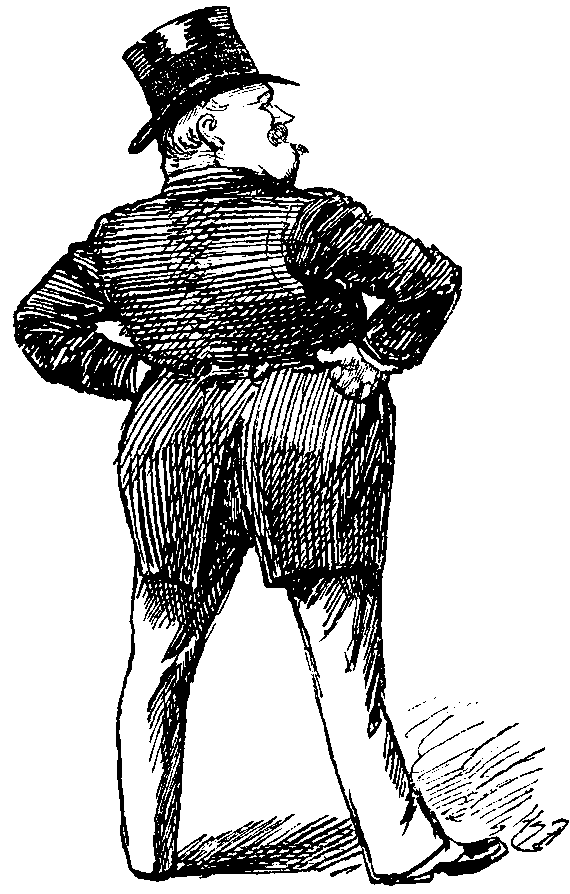
"No," said CAMPBELL-BANNERMAN; "it was meant to be STALBRIDGE'S; but I fancy SEXTON will save him from full inconvenience of the ceremony."
So it turned out; House tired of business long before Windbag SEXTON had blown himself out. Poor JOHN MOWBRAY admittedly flabber-ghasted by the interminable string of questions under which SEXTON had tried to disguise his speech. STALBRIDGE got off without direct censure, and DONALD CAMERON abruptly turned the conversation in the direction of Opium.
Business done.—In Committee on Irish Land Bill.
House of Lords, Tuesday.—Lords met to-night after Easter Recess; come together with a feeling that since last they met a gap been made in their ranks that can never be filled. The gentle GRANVILLE'S seat is occupied by another. Never more will the Peers look upon his kindly face, or hear his lisping voice uttering bright thoughts in exquisite phrase.
KIMBERLEY sits where he was wont to lounge. K. a good safe man; one of the rare kind whose reputation stands highest with the innermost circle of those who work and live with him. To the outside world, the man in the street, KIMBERLEY is an expression; some not quite sure whether he isn't a territory in South Africa. Known in the Lords, of course; listened to with respect, much as HALLAM'S Constitutional History of England is occasionally read. But when tonight he rises from GRANVILLE'S seat and makes a speech that, with readjustment of circumstance, GRANVILLE himself would have made, an assembly not emotional feels with keen pang how much it has lost.
The MARKISS should be here. Perhaps for himself it is as well he's away. To him, more than anyone else in the House, the newly filled space on the Bench opposite is of direful import. _The MARKISS has no peer now GRANVILLE is gone; the two were in all characteristics and mental attitudes absolutely opposed, and yet, like oil and vinegar, the mixing perfected the salad of debate. The lumbering figure of the black-visaged Marquis at one side of the table talking at large to the House, but with his eye fixed on GRANVILLE; at the other, the dapper figure, with its indescribable air of old-fashioned gentlemanhood, the light of his smile shed impartially on the benches opposite, but his slight bow reserved for the MARKISS, as, leaning across the table, he pinked him under the fifth rib with glittering rapier—this is a sight that will never more gladden the eye in the House of Lords. GRANVILLE was the complement of the MARKISS; the MARKISS was to GRANVILLE an incentive to his bitter-sweetness. Never again will they meet to touch shield with lance across the table in the Lords. LYCIDAS is dead, not ere his prime, it is true;
"But, O the heavy change, now thou art gone, Now thou art gone, and never must return!"
It seemed in stumbling inadequate phrase that CRANBROOK, KIMBERLEY, DERBY, and SELBORNE strummed their lament. But, speaking from different points of view, without pre-concert, they struck the same chord in recognising the ever unruffled gentleness of the nature of LYCIDAS—a gentleness not born of weakness, a sweetness of disposition that did not unwholesomely cloy. Only Mr. G. could have fitly spoken the eulogy of GRANVILLE. After him, the task belonged to the MARKISS, and it was a pity that circumstances prevented his undertaking it. Business done,—Irish Land Bill in Commons.
Wednesday.—Brer FOX turned up today, unexpectedly. So did MAURICE HEALY, even more unexpectedly. Irish Sunday Closing Bill under discussion. Great bulk of Irish Members in favour of it. First note of discord introduced by Windbag SEXTON. Belfast Publicans, who find their business threatened, insist that he shall oppose the Bill; does so accordingly, separating himself from his party. Brer FOX quickly seized the opportunity; he, too, on he side of the Publicans, who hold the purse, and, money (like some of their customers) is tight. So PARNELL lavishly compliments Windbag SEXTON on his "large and patriotic view"; hisses out his scorn for the Liberal Party; declares that Ireland abhors the measure, which he calls a New Coercion Bill.
"The mildest-mannered Man."
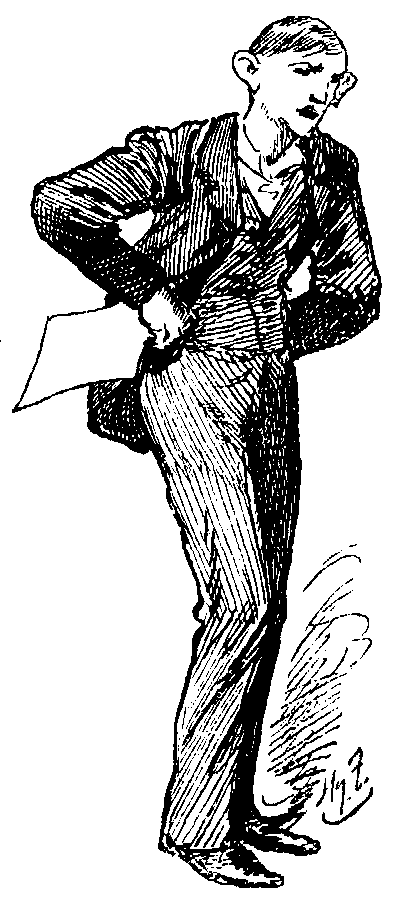
Then, from bench below him, uprises a bent, slight figure, looking less like a man of war than most things. A low, quiet voice, sounds clearly through the House, and Mr. MAURICE HEALY is discovered denying Brer FOX'S right to speak on this or any other public question for the constituency of Cork.
"If he has any doubt on this subject," the mild-looking young man continued, "let him keep the promise he made to me about contesting the seat."
That was all; only two sentences; but the thundering cheers that rang through House told how they had gone home.
Business done.—Irish Sunday Closing Bill read Second Time.
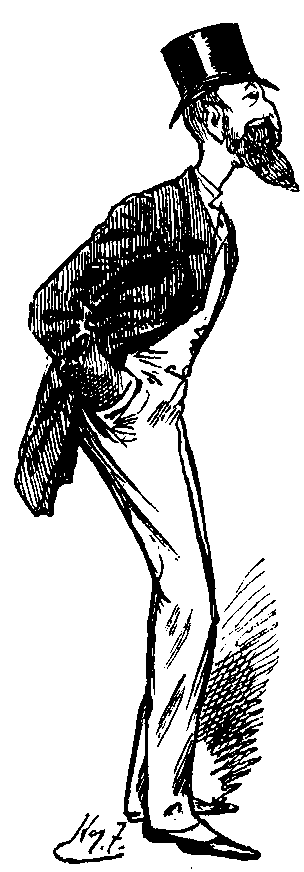
Friday.—GRANDOLPH looked in for few minutes before dinner. A little difficulty with doorkeeper. So disguised under beard, that failed to recognise him; thought he was a stranger, bound for the Gallery. But when GRANDOLPH turned, and glared on him, saw his mistake as in a flash of lightning.
"Same eyes, anyhow," said Mr. JARRATT, getting back to the safety of his chair with alacrity.
GRANDOLPH sat awhile in corner seat, stroking his beard, to the manifest chagrin of his jilted moustache.
"Awfully dull," he said. "Glad I'm off to other climes; don't know whether I shall come back at all. If Mashonaland wants a King, and insists upon my accepting the Crown, not sure I shall refuse."
"GRANDOLPH seems hipped," said WARING, watching him as he swung through the Lobby. "It's the beard. Never been the same man since he grew it.
"There was a Young Man with a beard, Who said, 'It is just as I feared! Two Owls and a Hen, four Larks and a Wren, Have all built their nests in my beard.'"
Business done.—Committee on Irish Land Bill Dropping into Poetry, again.

NOTICE.—Rejected Communications or Contributions, whether MS., Printed Matter, Drawings, or Pictures of any description, will in no case be returned, not even when accompanied by a Stamped and Addressed Envelope, Cover, or Wrapper. To this rule there will be no exception.