Volume 100 / Act 2 — TAKING THE CENSUS.
Reading edition
(A Story of the 6th of April, 1891.)
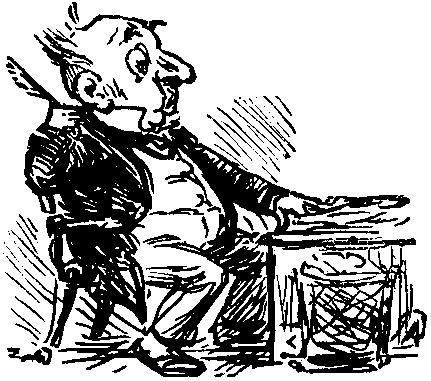
As I have but a limited holding in the Temple, and, moreover, slept on the evening of the 5th of April at Burmah Gardens, I considered it right and proper to fill in the paper left me by the "Appointed Enumerator" at the latter address. And here I may say that the title of the subordinate officer intrusted with the addition of my household to the compilation of the Census pleased me greatly—"Appointed Enumerator" was distinctly good. I should have been willing (of course for an appropriate honorarium) to have accepted so well-sounding an appointment myself. To continue, the general tone of the instructions "to the Occupier" was excellent. Such words as "erroneous," "specification," and the like, appeared frequently, and must have been pleasant strangers to the householder who was authorised to employ some person other than himself to write, "if unable to do so himself." To be captious, I might have been better pleased had the housemaid who handed me the schedule been spared the smile provoked by finding me addressed by the "Appointed Enumerator" as "Mr. BEEFLESS," instead of "Mr. BRIEFLESS." But this was a small matter.
I need scarcely say that I took infinite pains to fill in my paper accurately. I have great sympathy with the "Census (England and Wales) Act, 1890," and wished, so far as I was personally concerned, to carry out its object to the fullest extent attainable. I had no difficulty about inserting my own "name and surname," and "profession or occupation." I rather hesitated, however, to describe myself as an "employer," because the "examples of the mode of filling-up" rather suggested that domestic servants were not to count, and for the rest my share in the time of PORTINGTON, to say the least, is rather shadowy. For instance, I could hardly fairly suggest that in regard to the services of my excellent and admirable clerk, I am as great an employer of labour as, say, the head of a firm of railway contractors, or the managing director of a cosmopolitan hotel company. Then, although I am distinctly of opinion that I rightly carried out the intentions of the statute by describing myself as "the head of the family," my wife takes an opposite view of the question. In making the other entries, I had no great difficulty. The ages of my domestics, however, caused me some surprise. I had always imagined (and they have given me their faithful and valuable services I am glad to say for a long time) that the years in which they were born varied. But no, I was wrong. I found they were all of the same age—two-and-twenty. To refer to another class of my household—I described my son, SHALLOW NORTH BRIEFLESS (the first is an old family name of forensic celebrity, and the second an appropriate compliment to a distinguished member of the judicial Bench, whose courtesy to the Junior Bar is proverbial) as a "scholar," but rejected his (SHALLOW's) suggestion that I should add to the description of his brother (one of my younger sons, GEORGE LEWIS VAN TROMP CHESTER MOTE BOLTON BRIEFLESS—I selected his Christian names in anticipated recognition of possible professional favours to be conferred on him in after-life) the words "imbecile from his birth," as frivolous, untrue, and even libellous. We had but one untoward incident. In the early morning of Monday we found in our area a person who had evidently passed the night there in a condition of helpless intoxication. As she could offer no satisfactory explanation of her presence, I handed her over to the police, and entered her on the Census Paper as, "a supposed retired laundress, seemingly living on her own means, and apparently blind from the date of her last drinking-bout." I rejected advisedly her own indistinctly but frequently reiterated assertion that "she was a lady," because I had been warned by "the general instructions" to avoid such "indefinite terms as Esquire or Gentleman."
As I wished to deliver my completed schedule to the "Appointed Enumerator" in person, I desired that he might be shown into my study when he called for the paper.
"Excuse me, Sir," he said, after looking through the document at my request; "but you see there is a fine of a fiver for wilfully giving false information."
"Yes," I returned, somewhat surprised at the suggestion; "and the proposed penalty has rendered me doubly anxious to be absolutely accurate. Do you notice any slip of the pen?"
"Well, Sir," he answered, with some hesitation, "as the young chap who does the boots tells me that he has never heard of you having had a single brief while he's been with you, and that's coming three years, hadn't you better put 'retired' after 'Barrister-at-Law'? It will do no harm, and certingly would be safer!"
Put "retired" after Barrister-at-Law! "Do no harm!" and be "safer!"
I silently intimated by a dignified gesture to the "Appointed Enumerator." that our interview was at an end, and then, taking my walking-stick with me, went in earnest and diligent search of "the young chap who does the boots!"
(Signed) A. BRIEFLESS, JUNIOR.
Pump-Handle Court, April 7, 1891.
"UP, GUARDS, AND ACT 'EM!"
The "them" in this adapted quotation must be taken to mean "Burlesques;" and if these gay and lighthearted soldiers continue their histrionics as victoriously as they have done up to now, they will become celebrated as "The Grinny-diers-and-Burlesque-Line-Regiments." Private MCGREEVY, as a cockatoo, capital: his disguise obliterated him, but as Ensign and Lieutenant WAGGIBONE stealthily observed, "What the eye doesn't see, the heart doesn't MCGREEVY for." The music, by the talented descendant of Israel's wise King SOLOMON, was of course good throughout, and in the Cockatoo Duet better than ever. The ladies were exceptionally good. Mrs. CRUTCHLEY defied the omen of her name, which is not suggestive of dancing, and "Jigged away muchly Did Mrs. CRUTCHLEY." The Misses SAVILE CLARKE,—the Savilians among the Military,—were charming. Lieutenant NUGENT is an old hand at this, and his Paul Prior was not a whit behind his former performances. There's one more Guard O, Major RICARDO. He played Crusoe, And well did he do so! Three cheers for everybody! With the Guards' Burlesque, we fear no foe. Chorus, Gentlemen, if you please, "We fear no foe!"
THE OLD (CRICKETING) 'OSS AND THE YOUNG (GLOUCESTER) COLTS.
Fifty, not out! A good start beyond doubt, In a Twenty-four field, Doctor W.G. And may Ninety-one bring us lots of good fun, With you at the Wickets for Figures of Three, To see the Old 'Oss stir in good time to foster The coming-on "Colts," should give courage to Glo'ster!
"Such a Dawg!"
The enclosed was cut from The Field of last week:—
R. —— —— WANTS some friend to give him a small BULLDOG with a smile, for a house pet.—To be sent for inspection to, &c.
It is to be hoped that the advertiser will not get an animal that (to quote from Hamlet) "may smile and smile and be a villain!"
Ignotus.
Prate not about Fame! I've addressed half the world, In Court and in cottage, in Castle and slum! I've been warbled, and chorussed, and tootled, and skirled, Yet, for kudos, I might just as well have been dumb. Though familiar to all men, I'm wholly unknown; You're inclined to pooh-pooh, and to say I am wrong? Nay, listen, and you my correctness will own: 'Tis I wrote the words of a Popular Song!
NEW AND INTERESTING WORK.—As a companion to Dr. WRIGHT's The Ice Ages in North America and its bearing upon the Antiquity of Man, will shortly appear The Penny-Ice Age in London and its bearing on the Youth of the Metropolis.
A Brummagem Bolus.
(By an elate Liberal-Unionist.)
An "ill-starred abortion" WEG christened our party; At present, as JOE hints, that sounds quite ironic. True, lately our health did appear far from hearty, But Aston has acted As-tonic!
NOTE FOR CRITICS.—How can any of us expect the truth from a historian who himself tells us that he merely "transcribes from MSS. lying before him!"
WHAT THE ITALIANS SEEM TO WANT IN LOUISIANA.—An unfair field, or no FAVA!
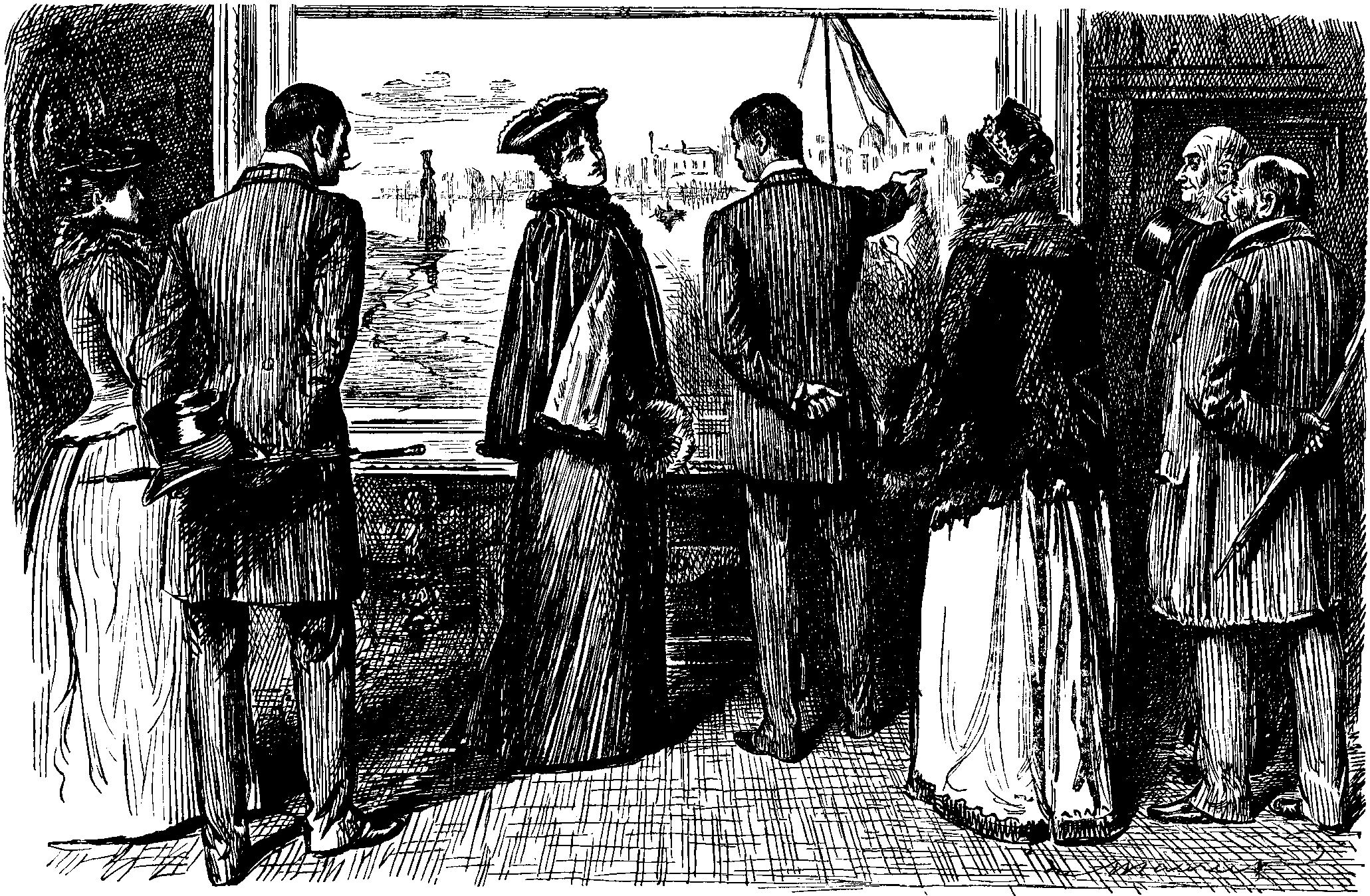
PICTURE SUNDAY.
(
What Our Artist has to put up with.
)
Fair Damsel (to Our Artist, who is explaining the beauties of his Picture). "CHARMING! CHARMING! BUT, OH, MR. FITZMADDER, WHAT A DELIGHTFUL ROOM THIS WOULD BE FOR A DANCE,—WITH THE MUSICIANS IN THE GALLERY, AND ALL THE EASELS AND PICTURES AND THINGS CLEARED AWAY!"