Volume 150 — THE WATCH DOGS.
Reading edition
XXXVIII.
My dear Charles,—One of these days I will tell you the more intimate history of the Corps to which I have the honour to belong, and this will give you some cause for mirth. Its members are of all sorts, ages and origins, and they have had between them some odd experiences since that first day when, parading hastily in Kensington Gardens, they wished they hadn't been quite so glib, in their anxiety to get to war, about professing full knowledge of the ways and wiles of the motor bicycle. One at least of them paid the price of inexactitude then and there; he still shudders to think how, put to the test, he unintentionally left the Park for a no less fashionable but much more crowded thoroughfare, to arrive eventually, in the prone position, in a byway of Piccadilly, where small fragments of the machine may still be collected by industrious seekers of curios.
Another, whom the low cunning of the Criminal Bar enabled to avoid the immediate test, paid the full price, with compound interest, later on. Casual observers of the retreat, had there been any, would have become familiar with the sight of him bringing up the rear—a very poor last. To see him arrive, perspiring, over the brow of a hill, with his faithful motor at his side, was to know that the Huns were at the bottom of it. On one occasion they even beat him in the day's march, but were too kind or too blind to seize their advantage. As usual he was taking his obsession along with him, though, if he had but known, he might have got it to do the work by the simple formality of turning the petrol tap from OFF to ON. His was ever a curious life, from the first moment of his joining the Army in tails, a bowler hat, and a large sword wrapped in a homely newspaper. But the inward fun of it all is not for the present, Charles; our clear old friends, the Exigencies, forbidding.
I am reminded of it all by having just crossed with one of the later-joined members. He came fresh from the line to a Head-quarters, and he was walking about in a lane, working off some of his awe of his new surroundings, when he was overtaken by a car containing a General, who stopped and asked him what he was. So imposing was the account he gave of himself that it was said to him, "No doubt, then, you'll know the way to ——," a village at the back of beyond, where a division was lying at rest. In the Army, at any rate at a Head-quarters, we all know everything. So he said, "No doubt, Sir," hoping, if the worst came to the worst, to give some vague directions and not to be present when they were found wanting. But it was his bad luck to have struck one of the more affable Generals. Could he spare the time to come along and direct the driver?
So on to the box he got (it was a closed car) and, with the General's eye always upon his back, he did his best as guide, a task for which his previous career of stockbroker had ill qualified him. The first thing to happen was that the car, proceeding down a narrow lane, got well into the middle of a battalion on the march, which, when the car was firmly jammed amongst the transport, ceased to be on the march, and took a generous ten minutes' halt.... The second thing to happen was a level crossing; which, as they approached it, changed its mind about being a road and became a railway. A nice long train duly arrived, and (this needs no exaggeration) stayed there, with a few restless movements, for twenty minutes by the clock.... The third thing to happen was that he lost himself (and the General); the fourth was the falling of dusk, and the fifth a ploughed field, with which my friend, alighting, had to confess that he was not so intimately acquainted as he could have wished.
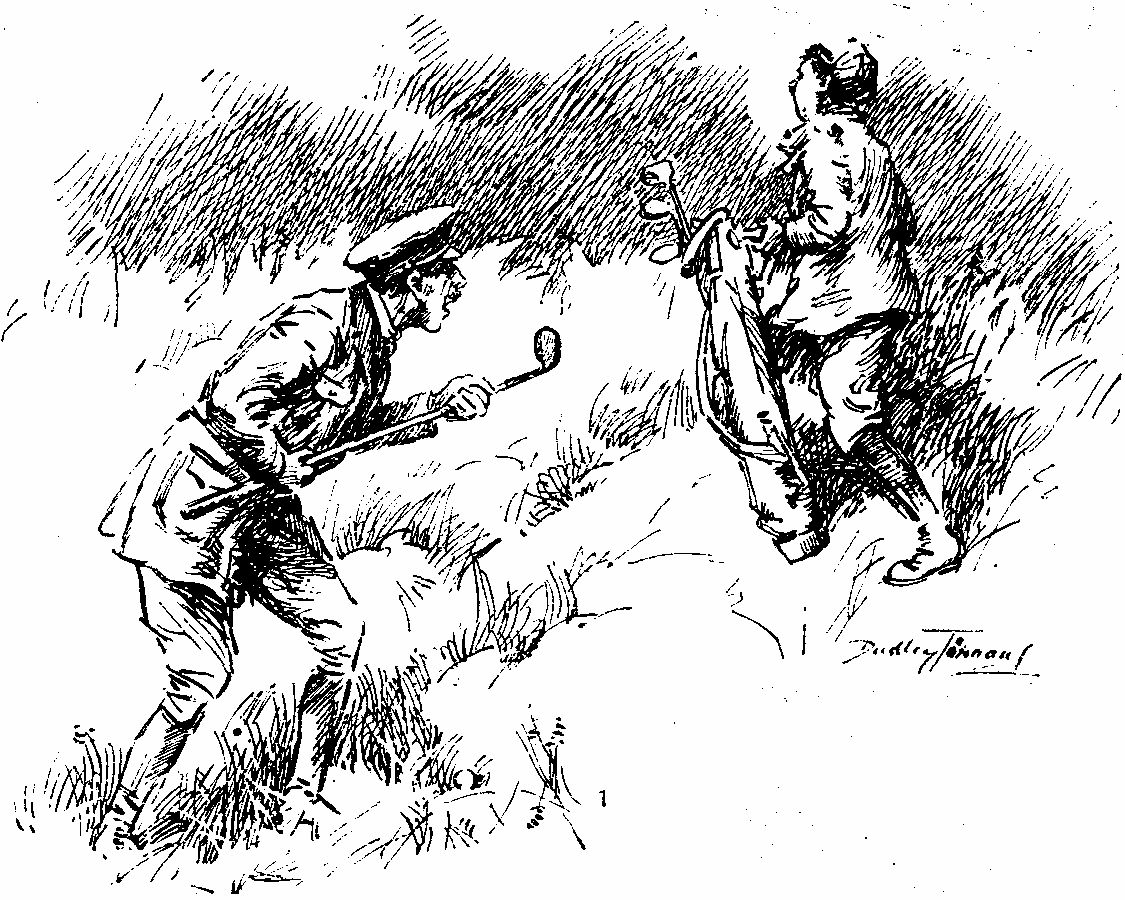
THE TRENCH TOUCH.
Warrior in bunker (to caddie, who is seeing if the course is clear). "Keep down, you fool!"
Had there been a scene, he could, he says, have endured the worst bravely, standing to attention and taking it as it came. Not so, however; his was the wrong sort of General for the purpose. As does the partner at the dance, over whose priceless gown you have upset the indelible ice, he said it didn't matter. He said he'd give the division a miss, and return whence they had come. This they began to do, when they had got the car out of the ploughed field, and this they went on doing until the sixth thing happened, which was a burst tyre.
Again, had there been a scene, my man could have explained that this wasn't his fault; but no one said it was his fault. Equally it was never openly alleged that he was to blame for the driver's not being prepared with a spare wheel ready for use. But his embarrassment was such that my man was grateful to heaven for reminding him at this juncture of the existence of R.F.C. Head-quarters, about a kilometre away. He said he'd run and borrow a wheel off them, and before the General could say him nay he'd started.... He ran all the way, and burst, panting, into the officers' mess, where he had the misfortune to strike another itinerant General.
It never rains but it pours, and the area seemed to be infested with Generals of quite the wrong sort. He couldn't have hit upon a more kind and genial and inappropriate one than this. No, he wouldn't allow a word of apology or explanation from this exhausted lieutenant until the latter had rested and refreshed himself with a cup of tea. No, not out of that pot; it had been standing too long. Tea which had stood should not be drunk, for reasons detailed at length. No doubt the Colonel, whose guest he was, would order some more to be made. It would take two minutes—it did take twenty. No, no; there was nothing to say and nothing need be said. It was this General's particular wish that he should be at peace and make himself at home. Let him make his explanations and apologies later.
Whatever you would have done, my overwhelmed friend temporized. He was just edging the conversation round to the other General, waiting alone in the dark wet road, when the General in the nice warm room rose to go, commanding my friend not to disturb himself on that account. Being a man of some years he was a slow goer; being a General, he was not to be interrupted in his going....
I don't know exactly how it all ended, nor, you may not be surprised to learn, does my friend, though he is always expecting to hear.
There was also on our boat a subaltern, coming to France for the first time. He wanted me to tell him all about it. How well I know these subalterns who want to know all about it. I was one myself once. Does he ask you what it's like in the mud? Does he listen if you give him details of bloodshed? Does he inquire about the food, the washing facilities, parapet or parados; what a time-fuse does when its time has expired, or even as to the use and abuse of the entrenching tool? No, he's for war only, and there's only one question in war: Do you or do you not need a Sam Browne belt in the trenches?
It is an old question; there is no solution. I told him that some say one thing and some say another, and, as both are authorities with whom you are not in a position to argue, the only way to get out of the difficulty is to keep out of the trenches.
Yours ever, Henry.
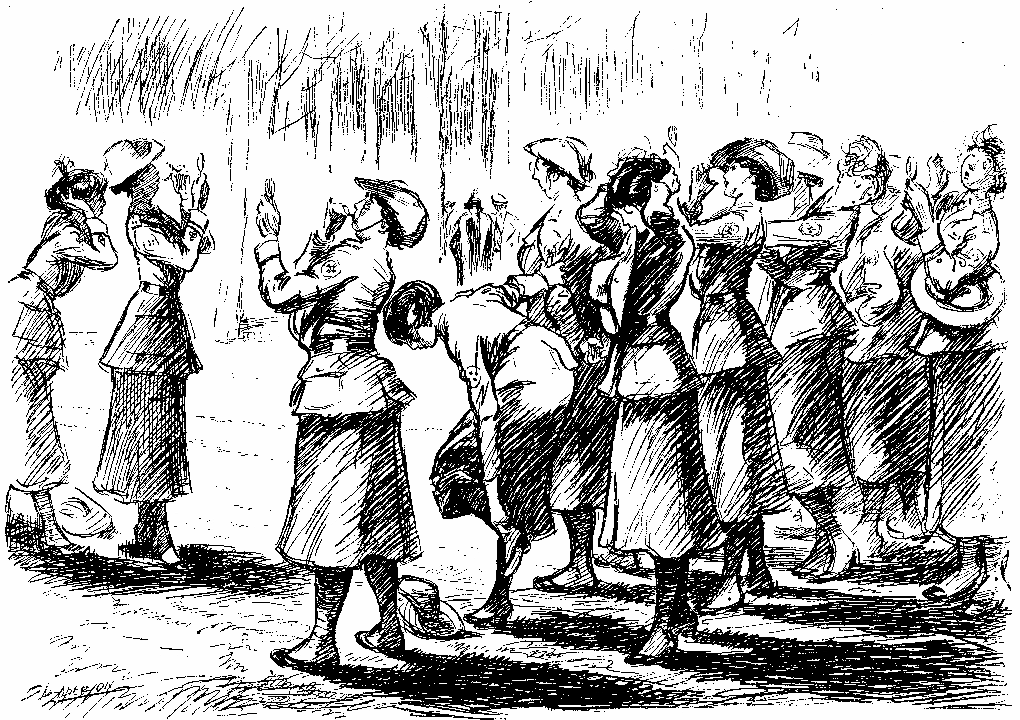
OUR AMAZON CORPS "STANDING EASY."
From a hotel advertisement:—
"Excellent Cuisine. Separate Stables."
West-Country Paper.
The Wise King must have had a presentiment of this arrangement when he wrote: "Better a dinner of herbs, where love is, than a stalled ox and hatred therewith."
"The Premier (Sir Alexander Peacock) said that many years ago, when the world rang with the atrocities of Turks, Rev. Dr. Parker startled the whole world when, in a fiery address on those awful atrocities which were visited on the Christians, he cried, 'Dod damn the Sultan.' Now, when they heard of the cruelties and indescribable sufferings which had been visited upon the innocent people in order to satisfy the ideas of one man they could say, 'Kod damn the Kaiser.' (Great cheers)."—Sydney Daily Telegraph.
Strong language for a Premier! But the printer has done his best to tone it down.