MR. PUNCH'S DICTIONARY OF PHRASES.
Reading edition
Theatrical Criticism.
"Mr. Ranter's Macbeth is too well known to all play-goers to need any special notice at our hands. Those who have not yet seen it should avail themselves of the present opportunity;" i.e., "Can't pitch into old Ranter, good chap and personal friend."
Diagnostic.
"I should say in your case, that the Digestion was a little upset;" i.e., "As gross a case of over-eating as I have ever come across in the whole of my professional experience. You must have been feeding, literally, like a hog, for years!"
Social.
"What I so like about dear Sibyl is her charming simplicity;" i.e., "The silliest little chit conceivable."
"His conversation is always so very improving;" i.e., "A pedantic prig, who bores you with Darwinism in the dance, and 'earnestness' at a tennis-party."

TOPPING THE TRIPOS;
Or, Something like a Score for the Sex.
[In the Cambridge Mathematical Tripos Miss P. G. Fawcett, of Newnham, daughter of the late Professor Fawcett, is declared to be "above the Senior Wrangler."]
Above the Senior Wrangler! Pheugh! Where now are male reactionaries Who flout the feminine, and pooh-pooh Sweet Mathematic Megs and Maries? Who says a girl is only fit To be a dainty, dancing dangler? Here's girlhood's prompt reply to it: Miss Fawcett tops the Senior Wrangler! Would it not have rejoiced the heart Of her stout sire, the brave Professor? Agneta Ramsay made good start, But here's a shining she-successor! Many a male who failed to pass Will hear it with flushed face and jaw set. But Mr. Punch brims high his glass, And drinks your health, Miss P. G. Fawcett!
TAKEN FROM THE FRENCH PLAYS.
Scene—Her Majesty's Theatre. Enter Mr. and Mrs. Brown.
Brown (to Boxkeeper, with the air of a Sovereign conferring an Order upon a faithful subject). There's sixpence for a programme.
Boxkeeper. Very sorry, Sir, but it isn't a programme; it's a Book of the Argument, and we have to pay that for it ourselves!
Brown (resenting the information). Oh, bother! Then I'll do without it.
Mrs. Brown (annoyed). Why didn't you get a book? You know we'll never understand it without one.
Brown. Nonsense, my dear! It's a distinct advantage to trust to one's own resources.
[Curtain goes up, and discovers a number of male characters, who come on and go off severally.
Mrs. Brown. What are they talking about?
Brown. Oh, all sorts of things. (Enter Mlle. Darlaud, as Lydie Vaillant.) Ah! you see this is the heroine.
Mrs. Brown. Is it? (Examining her through opera-glass.) Very simple frock. I think I shall have one like it.
Brown (dreading a dress-maker invasion). Oh, it wouldn't suit you at all. You always look better in silks and satins.
[Entr'acte over. Second Act, Madame Pasca appears, and is admirable.
Mrs. Brown (deeply interested). Charley, dear, she's wearing Russian net, and you know you can get it at——
Brown (hurriedly). Hush, you are disturbing everybody.
Mrs. Brown (at end of Second Act). What was it all about?
Brown. Oh, didn't you see. It was a castle, and a number of tourists were shown round the pictures by an old servant. Excellent!
Mrs. Brown. I do so wish you would get a book.
Brown. Oh, we can do without it now—the piece is nearly over.
[Third Act is played, and Curtain falls.
Mrs. Brown. Well, what was that about?
Brown. Oh, didn't you see they had breakfast—and with tea too, not with wine. Very strange how English customs are spreading.
[Tableau I. of Act III. is played. Considerable applause.
Mrs. Brown. I don't quite understand that.
Brown. You don't! Why, it's as simple as possible. Paul Astier arrived late, and dressed for dinner. Excellent!
Mrs. Brown. But what's the plot?
Brown. Oh, that's of secondary importance—the piece is a clever skit upon modern manners! (Tableau II. is played.) Capital! Wasn't Madame Pasca good when she wanted a glass of water?
Mrs. Brown. Quite too perfect! And her velvet and satin gown was absolutely lovely! (With determination.) I shall get one like it!
Brown (alarmed). I am not so sure! You look better in muslins.
[Last Act is played, and Paul Astier is shot dead.
Mrs. Brown (much affected). Oh! what did they do that for?
Brown. Don't you see—the reward of life. Hence the title. (Subsequently in the cab.) Wasn't it good? Didn't you enjoy yourself?
Mrs. Brown. Very much indeed, but I do wish you had got a book! (To herself.) Let me see—green velvet over white satin. (Aloud.) It will take about eighteen yards!
Brown (waking up). Eighteen yards of what?
Mrs. Brown. Oh, nothing! I was only thinking.
[Scene closes in upon a mental vision of the dress-maker from opposite points of view.
"Allowed to Starve."—To save time, contributions to the Balaclava Fund should be forwarded direct to the Editor of The St. James's Gazette.
THE OPERA-GOER'S DIARY.
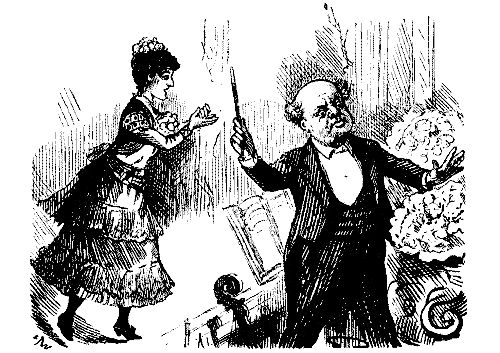
Poor little Zélie (beseechingly). O Mr. Randegger, do let me have my bouquets!]
Monday.—Don Giovanni. Ravelli the Reliable an excellent Don Ottavio, vocally; considered dramatically, he does as much as can be expected of a man of his inches. Zerlina and Masetto so pleased with his singing that they stop on the stage all through the tessoro song, for which he takes a hearty encore, whereupon Zerlina and Mazetto run off quickly. Having had enough of it, however, they do not return for the encore. Rather rude this. Dan Drady too sinister for gay Don Giovanni; and there is a villanous determination about his gallantry which would have frightened away the coquettish Zerlina, and have warned the more mature ladies of the world, Donna Anna and Donna Elvira, in time to prevent them from falling victims to his wiles. Otherwise a highly satisfactory Don. Signor Plunketto Greeno as the unfortunate Commendatore, who is first killed, and then executed in stone, as a statue to his own memory, was heard and seen to the best advantage. Zélie de Lussan, too Carmenish as flighty little Zerlina, but evidently a match for the sardonic Don Dan Drady. Madame Tavary has done well to quit the Hofoperahaus, Munich, and come to Covengardenhaus as Donna Anna,—a trying part that not Anna-body can play and sing as well as Madame Tavary. This lady and Lilian Nordica (pretty name Lilian) as Donna Elvira render the characters so charmingly, that they cease to be the funereal bores I have generally considered them. Ottavio, Anna, and Elvira, the trio with a grievance, are, usually, about as cheerful as the three Anabaptists in Le Prophète. Mais on a changé tout cela. Palladino, as the dancing guest—she is always small and early in every Opera now—delights everyone, and so does Conductor Randegger, who is determined that poor little Zélie de Lussan shall not receive the big bouquets which a mysterious man has brought to the orchestra; then one of the instrumentalists handed them to the leader, who, in order to take them, has been compelled to put down his violin, and, after looking about in a helpless and puzzled manner, holds them until further orders from his chief. Not receiving further orders, he occupies his time by sniffing at the flowers and making remarks sotto voce to his companion violinist on the botanical beauties of the flora. Conductor Randegger, apparently unaware of what has been taking place behind his back, turns round abruptly to inquire why leader is taking a few bars' rest. Leading violinist exhibits bouquet, and appeals in dumb show to conductor. The conductor's eye in fine frenzy rolling, says as clearly as fine frenzied rolling eye can say anything, "Remove that bauble!"—(Randegger would make up remarkably well as Cromwell)—and the leader, with a sympathetic and apologetic glance at Zélie as implying, "You should have had 'em if I could have managed it, but you see how I'm situated. Randegger's a hard man"—puts the bouquets on the floor of the orchestra, and, dismissing them by a supreme effort from his thoughts, betakes himself to his musical Paganinic duties. What becomes of the flowers that bloom in the orchestra, tra la! I don't know, I wish that Zélie may get them. Remembering the example set by "Practical John" at the Gaiety, of placarding up everywhere in the theatre "No Fees," Druriolanus, at the suggestion of Conductor Randegger, might "hang out a banner on the outer wall" of the orchestra, with the letters inscribed on it "N.B.—No Bouquets."
Tuesday.—The grandest night of the Season up to now, dear boys. Romeo Jean de Reszké, and Melba Juliette. What can you wish for more? Edouard de Reszké as the Frère Laurent a magnificent Friar, belonging to some one of the theatrical "Orders" "not admitted after seven." The talented Mlle. Bauermeister's Gertrude hardly a companion picture to her Martha in Faust. Signor Plunketto Greeno not quite every inch a Duke: about one inch in three Duke and the rest Democrat. When he has been Duke of Verona long enough, he'll be all right, and most likely
He'll be, this Mister Plunket Greene, The Dukiest Duke that ever was seen.
A word to the wise. Whenever this Season Romeo and Juliette is played with this cast, go and see it. Don't hesitate. It's memorable. A feast for ear and eye. Ite ad astra-operatica. And at the same time, don't forget to honourably mention the founder of the feast, Augustus Druriolanus.
Wednesday.—Extra. Carmen. Derby Day. I have been at the Derby. Glad to get back again. As to "back again," I don't "back again" anything for a long time. But, à nos moutons. Toreador evidently has had his money on Sainfoin. Never sang better. Glad to see the simple Scotch lassie, Maggie McIntyre, once more as the village maiden. Charming. Zélie de Lussan as wickedly attractive as ever. What a collection such a gipsy would make on a Derby Day—a fine Derby Day—among the "pretty gentlemen" whose fortunes she would tell. Extra night this, and extra good.
Thursday.—A Wagner Night. Crowded to see Jean de Reszké as another Wagner Knight. Neddie de Reszké as the King Henry—every inch a King, and something to spare. Freddy Telramondo suits Dan Drady better than Don Giovanni. Madame Fursch-Madi as the wicked Ortruda,—("Never saw ought ruder than her conduct to Elsa," observes the irrepressible Mr. Wagstaff,)—And Maggie MacIntyre as the virtuous but unhappy Elsa. The stranger in the land of Wagner begins to wonder at the continuous flow of the melody, not one tiny cupful of which can he take away with him, until with joy he hears the Bridal Chorus at the commencement of the Third Act, and for a few moments he rests dans un pays de connaissance.
Friday.—Lucia di Lammermoor. Great night for Madame Melba. Recalled three times before Curtain after each Act. Living illustration of once popular romance, "Called Back." Great night, too, for Harpist and Flutist. Both gentlemen highly applauded, and would have been recalled, but for the fact of their not having quitted the orchestra. Harper plays solo from Harper's Miscellany, arranged by Donizetti. Ravelli the Reliable recalled also.
Saturday.—Brilliant house. Royal Highnesses early to come and last to go. Magnificent performance of Die Meistersinger. M. Isnardon very comic as Beckmesser, Lassalle a noble Hans Sachs ("the shoemaker who sings a sole-o," says Mr. Wagstaff), Jean de Reszké a grand young Walther, Montariol (as before) a capital silly idiot David, Mlle. Bauermeistersinger very lively as Magdalena, and Madame Tavary a skittish young chit in the somewhat trying and rather thankless part of Eva. The tenor's song to her ought to be, "Eva, of thee I'm fondly dreaming," if Wagner had only thought of it. Opera too long; but Wagnerites don't complain, and certainly to-night they get their money's worth and something over, from 7.30 till past midnight.
A SWEET THING IN CRITICISM.
Cardinal Manning, apparently having been invited by its author to express an opinion upon Mr. Wm. O'Brien's "When we were Boys," writes:—"When I got to the end, I forgot the book, and would only think of Ireland—its manifest sufferings, and its inextricable sorrows." His Eminence then continues:—"I hope to see the day break, and I hope you will see the noontide, when the people of Ireland will be readmitted, so far as is possible, to the possession of their own soil, and shall be admitted, so far as is possible, to the making and administration of their own local laws, while they shall still share in the legislation which governs and consolidates the Empire. Then Ken and Mabel shall be no more parted."
No doubt this excellent critique will be followed by the publication of letters somewhat similar to the following:—
Dear Mr. Apples,—I promised to write to you after I had used your Soap. When I had finished washing my hands, I forgot everything but gallant little Wales. I hope to see the morning, and trust you will see the evening, of that time when the bold sun of freedom will shine over a land true to itself, as far as possible, and rejoicing in the name of the country without stain. Then will we all say, "Good afternoon," followed by the customary inquiry. Believe me,
Always yours very faithfully,
W. E. Gl-dst-ne.
Should this mode of criticism be extended, the benefit to those who have to review without knowing what to say will be obvious.
A New Heading of an Old Epitaph.
"A remarkable coincidence has attended the drawings of two of the principal Club Derby Sweepstakes. As we stated yesterday, the Garrick Club Sweepstakes, of the value of £300, has fallen to Mr. Henry Irving. We now learn that Mr. Toole benefits to the extent of £75 out of the Sweepstakes of the Devonshire Club."—Daily News.
Lovely in Life, they were Both There when the Sweepstakes were Divided.
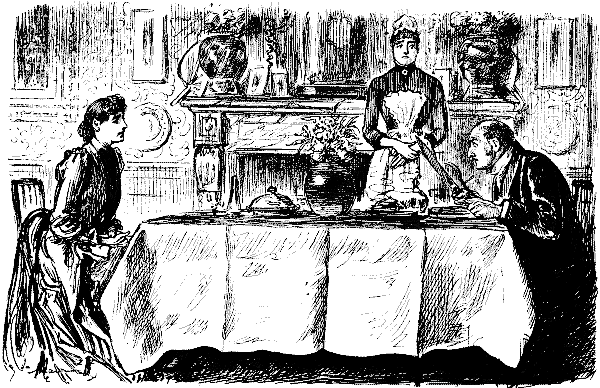
A SEVERE SENTENCE.
She. "Yes, dear, I'm afraid Cook wants Judgment." He. "Judgment! She Wants Execution!"
"THREE FISHERS."
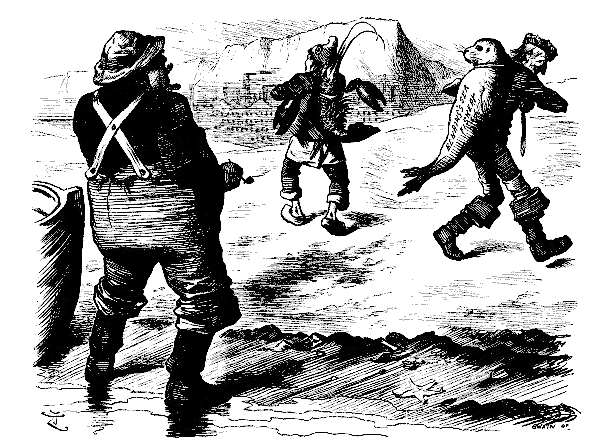
Three fishers went fishing North-east and North-west (Like the trio from Kingsley familiarly known). Each thought himself, doubtless, the bravest and best, And held the good "swims" should be mainly his own. There was Johnny the Briton, and François the Frank, And Jonathan also, the artful young Yank, An expert at "bouncing" and "boning." And François the Frank, who went fishing for cod, Nicked lobsters as well, and he stuck to them too; He declared they were all the same thing, which seemed odd, The result being anger and hullaballoo, And rows about Bounties, and shines about Bait; For ructions all round are as certain as fate, When parties go "bouncing" and "boning." And Jonathan, well, he went fishing for seals, And he wanted the fishing grounds all to himself. When the Russ had done ditto, the Yank had raised squeals (How consistency's floored in the struggle for pelf!) And Jonathan took a most high-handed course; For greediness mostly falls back on brute force, When parties go "bouncing" and "boning." And Johnny the Briton, a sturdy old salt, Had been a sea-grabber himself in his time; Some held that monopoly still was his fault, Others swore that his modesty verged upon crime, Nor is it quite easy to say which was true, For so much depends on a man's point of view, When parties go "bouncing" and "boning." But when Johnny the Briton caught sight of the Frank Making tracks with a lobster—the whoppingest one— And when he perceived the impertinent Yank With the seal—such a spanker!—skedaddling like fun, He stood and he shouted, "Stop thief! Hi! Hold hard!" For language does not always "go by the card," When parties go "bouncing" and "boning." "Now then, you sea-grabbers," he bellowed, "Belay! I suppose you imagine I'm out of it quite. But you're not going to have it just all your own way. Fair dues! my dear boys. After all, right is right! Big Behring is no mare clausum, young Yank, And cold Newfoundland is not yours, my fine Frank, In spite of your 'bouncing' and 'boning.'" Well, he of the Lobster and he of the Seal Have rights of their own, which old John won't deny. But he has some too, and Punch hopes they will feel That they should not grab his, and had better not try. Some modus vivendi no doubt can be found, To make the Three Fishers quite friendly all round, And good-bye to all "bouncing" and "boning!"
ELCHO ANSWERS.
Q. What loves "The Country" more than Tithes Bills tracing? A.Racing! Q. And what than "Compensation's" doubtful courses? A.'Orses! Q. Than Bills of Irish Tenants poor to favour rights? A.Favourites! Q. What does it find as profitless as St. Stephens? A."Evens!" Q. What more exciting than "The Pouncer's" nods? A."Odds!" Q. What does it love far more than Labby's jokes? A."Oaks!" Q. And what beyond all Elcho's quirks and quips? A."Tips!" Q. What would it call him who of "Sport" turns squelcher? A."Welsher!!!" Q. Who finds the "Derby" closing satisfactory? A. Hack Tory! Q. What's the protesting Puritan Gladstonian? A."Stony 'un!"
German Motto in Africa.—"For Farther Land!"