Volume 93 — WHAT WAS IT?
Reading edition
I had been reading a lot of "Letters to the Times." That may account for any little confusion in the details of the subsequent events.
My interlocutor was tall and thin, and looming up lanky against a dusky sky, reminded me equally of an attenuated M.P., a phantom telegraph-pole, and Peter Schlemil, the Shadowless Man.
"Tyndall is quite right," murmured he.
"Glad to hear it," said I, earnestly. "I had been thinking lately that the distinguished savant was going decidedly wrong."
"Ah! he understands me!" sighed the Spectre.
It was more than I did; and I said so.
"Who and what are you, anyhow?" I inquired.
The lines of Long-thin-and-hungry seemed to shift and reshape.
"Ah!" came his voice, the same yet not the same, "elevation does not always give coolness, and one may be torrid and tempestuous even among the Alps."
Somehow this statement, though a truism, did not seem to fit on to previous remarks.
"I was once said to be 'Up in a balloon,'" continued Proteus (now looking rather like the Ancient Mariner,) "long and lean and brown, but letters written to the Times even from the utmost height lately attained by the French Aëronauts—to say nothing of the top of the tallest Lightning Conductor—would, I fear, be hot and ill-balanced. Look at Mr. H. O. Arnold-Foster!"
"Perhaps—in a sense—we are Lightning Conductors, you know," pursued my companion.
"As how?" I asked vaguely.
"Well we attract, and carry off harmlessly—it doesn't hurt us you see—the accumulated political electricity, which otherwise might rend and rive the State about which these Angry Amateurs are so passionately anxious."
I felt more mystified than ever.
"Tyndall, Grimthorpe, and Symons, F.R.S., are entirely right," continued old Length-without-breadth; "A Lightning Conductor which does not conduct lightning, like a Leader who cannot lead, or a Follower who will not follow, is worse than a nullity, it is a nuisance and a danger."
"Quite so," I rejoined, grasping eagerly at something which seemed definite and comparatively relevant.
"Lightning Conductors are, in their way, as essential as Law and Order. But as Tyndall says, in one case, and as I should say in the latter, all depends upon quality, efficiency, accurate adaptation to ends. Would you say, Oh! never mind about their quality or fitness, the first duty of the Executive is to maintain its Lightning Conductors?"
I replied that it really had not occurred to me to make any such statement, but I dared say I should.
"The Times said of the 'Report of the Lightning Rod Conference,' 'The book is one of the highest practical value, and all who are responsible for the preservation of public buildings should endeavour to render themselves familiar with the contents.' How true! That's my find old temperate 'Thunderer.'"
"Who are you who are so down upon Tyndall?" I asked.
"I down on the learned Professor?" retorted my companion, shifting, dislimning, and elongating singularly. "On the contrary, I am grateful to him for being 'down upon' the incompetent architects and careless surveyors who would make of me a pitiful sham. Only" (here another phantasmagorical shift) "when he angrily declares a certain prominent political personage, who shall be nameless, to be also 'a pitiful sham,' why, then I think, like so many other and unscientific 'writers to the papers,' he needs the Conductor of cool Common Sense to divert, carry off, and disperse his too furious fulminations."
"Then you are only a Lightning Conductor, after all?" I queried, with some sense of being disappointed, not to say "sold."
"Only!" retorted my spectral and shifting visitant, again shifting spectrally. "Why, I'm thinking of writing, for the Nineteenth Century, an article on 'Political Lightning Conductors,' which, I rather flatter myself, will comprehend everything, convince everybody, and conciliate even Professor Tyndall. If you like I will read, from the advance-sheets, a few passages which——"
But here I roused myself to determined resistance, and—awoke.
On the Wing.
In getting fair hold of the Coburg, Prince Ferdinand, Bulgaria palpably thought she'd a "bird in hand," But the Prince and the Bulgars, when put to the push, Will probably wish the "bird" back in the bush.
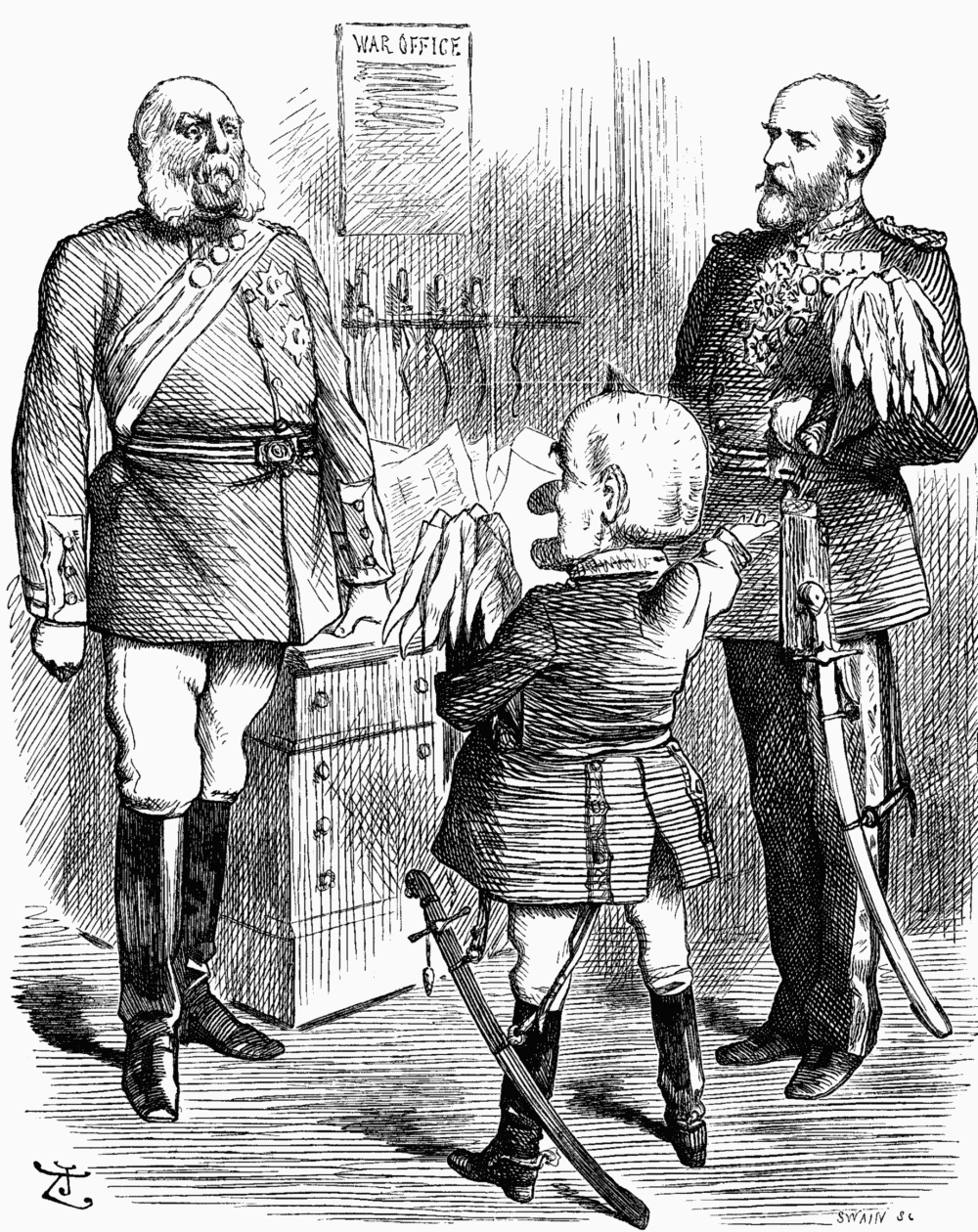
"OVERLOOKED!"
Field-Marshal Punch (to H.R.H.). "REALLY, YOUR ROYAL HIGHNESS, IN THE PRESENT STATE OF OUR DEFENCES, IS SIR EDWARD HAMLEY QUITE THE SORT OF MAN TO BE SHELVED?"
[Sir Edward Hamley served in the Eastern Campaign of 1854-55, including the affairs of Bulganac and McKenzie's Farm, the Battles of the Alma (horse shot), Balaklava, and Inkerman (horse killed), the Siege and Fall of Sebastopol, and repulse of the Sortie on the 26th October, 1854 (mentioned in Despatches, Medal with four clasps, Brevets of Major and Lt.-Colonel, Knight of the Legion of Honor, Sardinian and Turkish Medals, and 2nd Class of the Medjidie and C.B.). Sir Edward Hamley is the Author of The Operations of War, a work that may confidently be characterised as one of the most valuable modern Military books extant—"There exists nothing to compare with it in the English language for enlightened, scientific, and sober teaching in the general art of war"—vide the Times of 1st November, 1869. Served in the Egyptian War of 1882, in command of the 2nd Division, and was present at the Battle of Tel-el-Kebir, where he led the Division (received the thanks of both Houses of Parliament, twice mentioned in Despatches, K.C.B., Medal with clasp, 2nd Class of the Osmanieh, and Khedive'sStar).—Hart's Army List, July 1, 1887.]