Volume 93 — "TO TEAPOT BAY AND BACK."
Reading edition
Londoners who like but are weary of the attractions of Eastend-on-Mud, and want a change, can scarcely do better than spend twenty-four hours in that rising watering-place Teapot Bay. I say advisedly "rising," because the operation has been going on for more than forty years. In these very pages a description of the "juvenile town," appeared nearly half a century ago. Then it was said that the place was "so infantine that many of the houses were not out of their scaffold-poles, whilst others had not yet cut their windows," and the place has been growing ever since—but very gradually. The "ground plan of the High Street" of those days would still be useful as a guide, although it is only fair to say that several of the fields then occupied by cabbages are now to some extent covered with empty villas labelled "To Let." In the past the High Street was intersected by roads described as "a street, half houses, half potatoes," "a street apparently doing a good stroke of business," "a street, but no houses," "a street indigent, but houseless," "a street which appears to have been nipped in the kitchens," "a street thickly populated with three inhabitants," and last but not least, "a street in such a flourishing condition that it has started a boarding-house and seminary." The present condition of Teapot Bay is much the same—the roads running between two lines of cellars (contributions to houses that have yet to be built) are numerous and testify to good intentions never fulfilled. There is the same meaningless tower with a small illuminated clock at the top of it, and if the pier is not quite so long as it was thirty or forty years ago, it still seems to be occupying the same site.
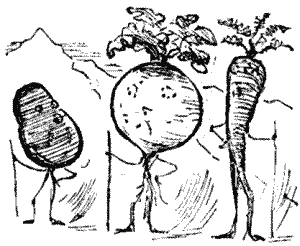
Cheap and Picturesque Roots for Tourists.
The means of getting to Teapot Bay is by railway. Although no doubt numbered amongst the cheap and picturesque routes for tourists, the place is apparently considered by the authorities as more or less of a joke. Margate, Ramsgate, Westgate and Broadstairs, are taken au sérieux, and have trains which keep their time; but Teapot Bay, seemingly, is looked upon as a legitimate excuse for laughter. If two trains are fixed to start at 12, and 12.30, the twelve o'clock train will leave at 12.30, and the 12.30 at 1. The authorities endeavour to have a train in hand at the end of the day, and I fancy are generally successful in carrying out their intentions. But between London and Teapot Bay there are many slippery carriages, which stop at various Junctions, and refuse to go any further in the required direction. When this happens, the weary traveller has to descend, cross a platform, and try another line. If he is a man of determination, and is not easily disheartened, nine times out of ten he ultimately reaches Teapot Bay, where his arrival causes more astonishment than gratification.
When I got to this "rising watering-place" the other day, I found an omnibus in waiting, ready to carry me to the town, which is some little distance from the station. We travelled by circular tour, which included a trot through many of the fields of my boyhood, now, alas! potatoless, and covered with weeds! In one of these fields I noticed a canvas booth, three or four flags, and a group of about twenty spectators, inspecting a gentleman in a scarlet coat, mounted on rather a large-boned horse.
"They still have a country-fair here?" I suggested to the person who had collected my sixpence.
"That isn't a fair, Sir—them's the Races," was the reply.
"Not very well attended, I fear?" I observed.
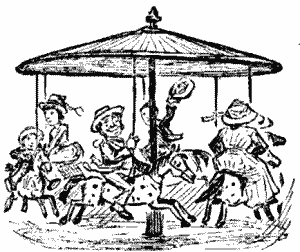
A Circular Tour.
"Better than they was last year—why the whole town has gone to see them this time."
A little later we reached the principal inn of the place, which was described in a local Handbook as "an old-established hotel, but comfortable." Rather, to my annoyance (as I was anxious to preserve my incognito), I was received by the landlord with respectful cordiality. "Glad you have honoured us, Sir—proud of your presence."
I made a sign to him not to betray me, and asked for my room.
"Well, Sir, we must put you into the Rotunda."
Again by a gesture inviting silence as to my identity, I mounted a flight of stairs, and found myself in a room that once, I think, must have been entirely arbour. Much of the arbour still remained, but a large slice had been partitioned off affording space for a chimney-piece, two chairs, a washstand and a bed. By opening a window which reached to the ground, I found myself on a balcony covered in with creepers, and beneath which was a gas-lamp labelled "Hotel Tap." In front of me was a field with the foundation (long since completed) for some houses at the end of it. On my left another field in the same state of passive preparation, and on my right a side view of the Ocean. It was growing dark, so after an "old-fashioned but comfortable" dinner, I went out for a stroll.
"Pleased you should honour us," said the landlord, as he opened the door to allow me to pass. Again to my annoyance, as it was vexatious to be thus identified in this out-of-the-way place as one of the celebrities of the hour.
The visitors and other inhabitants of Teapot Bay had returned from the Races, and were walking on the pier listening to the band. The gentlemen were in flannels, the ladies decorated with yards of white ribbon. The band was more select than numerous. Its conductor beat time with his left hand, while with his right he played the "air" of the tune at the moment attracting his attention upon an elaborate instrument that looked like a cross between a clarionet and an old-fashioned brass serpent. There was not much drumming, because the drummer spent nearly all his ample leisure on more or less successful efforts to vend programmes. The band was in a gusty alcove at one end of the pier, a small room covered with placards of a Wizard who, after making the acquaintance of "The Crowned Heads of Europe," was to perform there "to-night," was at the other. Having soon exhausted the pleasure derivable from listening to the band, I sought out the wizard.
"Oh, he ain't going to do it again until next Saturday," was the answer of a little girl who had charge of a turnstile, when I asked for a ticket. "But you can see him then."
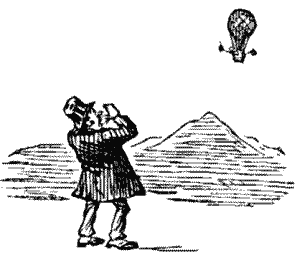
"You're up!"
I retired. As all the shops (possibly a couple of dozen) were closed, I returned to my hotel—really a very comfortable one. In the morning I thought I would have a sea-bath. There were a few machines, which were manipulated with ropes and windlasses. There was an elderly man in charge, who informed me that he could not lower one of these vehicles until his mate returned.
"Gone to breakfast?" I suggested.
"Breakfast—no one here has time for breakfast!" was the reply.
When I left, the landlord again murmured his thanks for the honour I had done him by patronising his hotel. Still anxious to preserve my incognito, in bidding him adieu I begged him not to allow my name to appear in the Visitors' List.
"You may be sure I won't Sir," said he with a bow as he opened the door, and a tip-inviting "boots" put my portmanteau on the omnibus starting for the station,—"as I don't know it!"
On the whole I prefer Eastend-on-Mud to Teapot Bay!