Volume 159 — AT THE PLAY.
Reading edition
"The Prude's Fall."
Though the hero is French and takes up his residence in an English cathedral town in order to rectify our British prudery and show us how to make love, there is practically nothing here that is calculated to bring a blush to the cheek of modesty. It is true that from time to time Captain le Briquet kisses various outlying portions of his "ange adoré," but it is all very decorous and his ultimate intentions are strictly respectable.
You see, he was really just playing a game. Big game was his speciality (Africa) and this one was to be as big as an elephant. It consisted in the correction of a flaw which he had found in the object of his worship, the lovely young Widow Audley, who had refused in his very presence to receive a woman, an old friend of hers, who had preferred love to reputation. He, the gallant Captain, proposed to amend this error. By his French methods he would reduce the Widow to such a state of helplessness that she would consent to become his mistress. The fact that he happened to be a bachelor, and perfectly free to marry her, should not be allowed to stand in the way of his scheme. He would explain that the exigencies of his vocation as a hunter of big game demanded a greater measure of liberty than was practicable within the bonds of matrimony. He would be "faithful but free."
In the course of a brief month (the interval between the First and Second Acts, for we are not permitted to see how he does it) she has become as putty in his hands. She consents to be his mistress, and is indeed so determined to adopt this informal style of union that when he produces a special marriage licence she is indignant at such a concession to the proprieties. But once again the Captain proves irresistible with his French methods and all ends well.
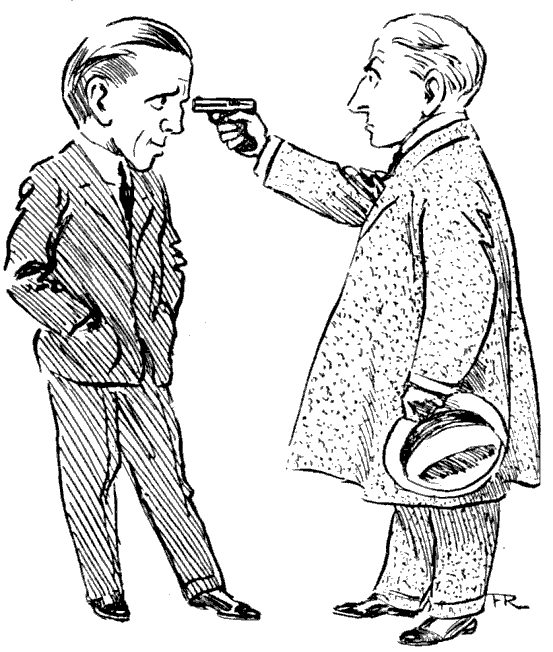
THE CAPTAIN "EXAMINES ARMS."
Captain le Briquet ... Mr. Gerald du Maurier.
Sir Nevil Moreton, Bart. ... Mr. Franklin Dyall.
Mr. Gerald du Maurier was the life and soul of the play, which would have been a dullish business without him. His reappearances were always hailed as a joyous relief to the prevailing depression. Even Dean Carey—most delightful in the person of Mr. Gilbert Hare—became at one time a gloomy Dean; and Miss Lilian Braithwaite, who played very tenderly in the part of Mrs. Westonry (the lady who had lost her reputation), could not hope to be very entertaining with her reminiscences of a lover whom we had never had the pleasure of meeting.
Mrs. Audley again (treated naturally and with a pleasant artlessness by Miss Emily Brooke) did not take very kindly to the conquest of her scruples and gave little suggestion of the rapture of surrender. Further, the authors paid a poor compliment to English gentlemen by providing the Captain with a dull boor for his rival. The contrast was a little too patent. Even so Mr. Franklin Dyall might perhaps have made the rôle of Sir Nevil Moreton appear a little less impossible. But, however good he may be in character parts or where melodrama is indicated, he never allowed us to mistake him for a British Baronet. The only person (apart from le Briquet) who contributed nothing to the general gloom was the Dean's wife, played with the most attractive grace and humour by Miss Nina Boucicault.
A note of piquancy was given to Mr. du Maurier's part by his broken English. "Broken" is perhaps not quite the word, unless we may speak of a torrent as being broken by pebbles in its bed. There were momentary hesitancies, and a few easy French words, such as pardon? pourquoi donc? c'est permis? alors, were introduced to flatter the comprehension of the audience; but for the rest his fluency—and at all junctures, even the most unlikely—was simply astounding. Few people, speaking in their native tongue, can ever have commanded so facile an eloquence. What chance had a mere Englishman against him?
The action of The Prude's Fall was supposed to take place in 1919, but its atmosphere was clearly ante-bellum. Anyhow there was no sign of the alleged damage done to our moral standards by the War. But nobody will quarrel on that ground with Mr. Besier and Miss Edginton, the clever authors of this very interesting play. And if we have to be taught how to behave by a Frenchman, to the detriment of our British amour propre, there is nobody who can do it so nicely and painlessly as Mr. du Maurier.
"Wedding Bells."
I begin to suspect that the possible situations of marital farce are becoming exhausted. Certainly we have lost the power of being staggered by the emergence of an old wife out of the past. But Mr. Salisbury Field, who wrote Wedding Bells for America, is not content with a single repetition of this ancient device; he must needs give us these intrusions in triplicate, showing how they affect the career of (1) the hero, (2) his man-servant, (3) a poet-friend. True he only produces two old wives; but one of them, being a bigamist, was able to intrude "in two places" (as the auctioneers say).
The wife of Reginald Carter (Mr. Owen Nares), having first run right away from him and then apparently divorced him for desertion (I told you the play was American), turns up on the eve of his marriage to another. He has barely recovered from his failure to keep his future wife in ignorance of his past when he has to start taxing his brains all over again in order to keep his past wife in ignorance of his future.
The First Act went well enough and was full of good words—not very subtle perhaps, but the kind that invites intelligent laughter. Later the play degenerated into something too improbable for comedy and not boisterous enough for pure farce. The two most disintegrating elements were furnished by a love-sick poet (a figure that should have been vieux jeu in the last century) and an English maid who could never have existed outside the imagination of an American. I make no complaint of the fact that in a chequered past she had married both Carter's man-servant and the antiquated poet; but I do complain that her Cockney accent was imperfectly consistent both with her rustic origin an apple-cheeked lass, we were told, from somewhere in Kent) and her situation as maid to a very smart American.
You will naturally ask what Mr. Owen Nares was doing in this galley; and I cannot tell you. I can only say that he was very brave about it all. In a sense it was a serious performance, the only one of its kind in the play; yet not serious enough to serve as a foil for the general frivolity, for he was constantly bringing his own high sentiments into ridicule, and so burlesquing the Owen Nares that we love to take seriously.
On the other hand, Miss Gladys Cooper, as Rosalie, his late wife, was untroubled by high sentiment; she was content to be wayward and unseizable, confident in the obvious power of her charm to retrieve him from the very altar-rails. Her own heart never seemed to come into the question, and her motive in setting herself to recover him was not much clearer than her reason for deserting him.
Some of the minor characters gave good entertainment. There was a dude (is that what they call them now in America?) who dressed very perfectly and said a great many funny things all well within the range of his own, and our, intelligence. Mr. Deverell played the part with admirable restraint. And we could ill have spared the humours of Carter's man Jackson (Mr. Will West), whose wide experience in matrimony, resulting in an attitude alternately timorous and prehensile towards female society in the servants' hall, was the source of many poignant generalisations. Miss Edith Evans, as a mother-in-law manquée, showed a touch of real artistry; and Mr. George Carr had no difficulty in getting fun out of the part of a Japanese house-boy, almost the only novelty which we owed to the American origin of the play.
When Carter was turned down by a clergyman who refused to perform the marriage rites for a divorced man, there was something very attractive (to a golfer) in his protest against these "local rules." This was one of many good things said; but the play had its dull times too, and there were one or two lapses made in the pursuit of the easy laugh. For instance:—
Carter. "Do you believe in God?"
Wills. "Good God!" (laughter).
[Carter here kneels down to get something from under the sofa.
Wills. "Are you going to pray?" (laughter).
Personality, of course, counts for much, and both Miss Gladys Cooper and Mr. Owen Nares have enough admirers to ensure a success for this rather moderate farce. But not a triumph, I fear; for, after all, the play counts for something too and, though all the Faithful may be trusted to put in one appearance, I doubt if many outside the ranks of the Very Faithful will turn again at the sound of these Wedding Bells.
O.S.
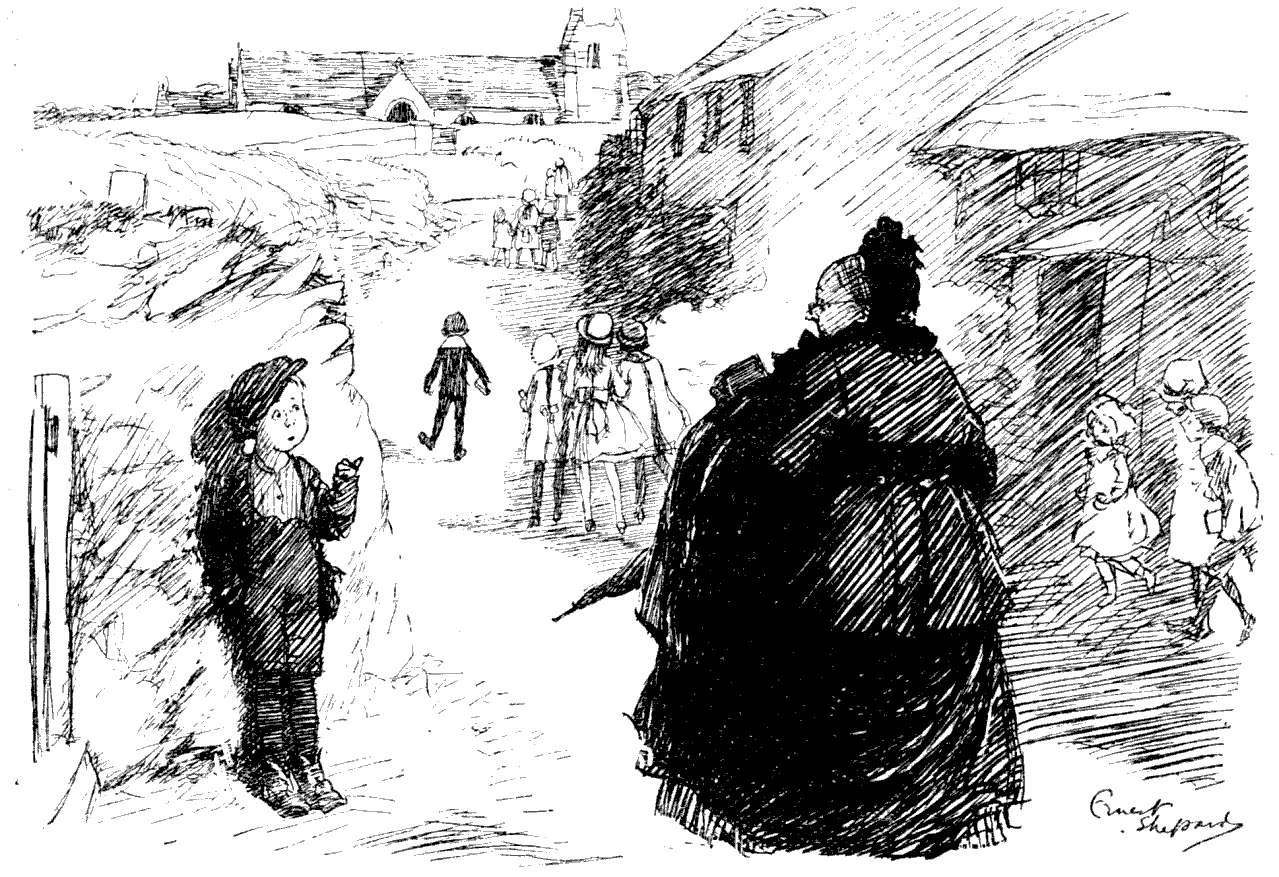
"And why aren't you going to Sunday School?"
"'Cos it's 'Arold's turn for the collar."
More Direct Action.
"Northumberland Miners' Executive have decided to have Mr. Robert Smillie's portrait painted in oils for Burt Hall, Newcastle.
Other matter relating to the coal crisis appears on Page Eleven."—Daily Telegraph.
"DAY BY DAY.
Well, did you get your gun and have a shot at the pheasants and the partridges yesterday?"—Scotch Paper, Sept. 2nd.
Naturally; the same gun with which we knocked the grouse over in July.
"Temp. in Shade.—Max. of past 24 hours. Hyderabad (Sind) ... 941·2."—Indian Paper.
Good for the Sinders.
"One Dog with fairy tail came to my house, ——, Srimanta Dey's Lane, may be restored to the owner on satisfactory proof."—Statesman (Calcutta).
The evidence of a dog like that would of course be useless.
"The Cathedral Choristers received a flattening reception."—Provincial Paper.
That should "learn" them to sing sharp.
There was a young man of Combe Florey Who wrote such a gruesome short story, The English Review Found it rather too blue And Masefield pronounced it too gory.
TO GENERAL OI.
(The Japanese Commander-in-Chief.)
The famous commanders of old Were highly and duly extolled, But their names, as recorded in song, As a rule were excessively long— Unlike that new broth of a boy, The Japanese General Oi. For we've bettered in numerous ways Those polysyllabic old days, And the names that confounded the Bosch Were monosyllabic—like Foch; But for brevity minus alloy Give me Generalissimo Oi. Napoleon now is napoo; Alexander, Themistocles, too; And you could not find space on the screen For Miltiades, plucky old bean, Or the names of the heroes of Troy; But there's plenty of room for an Oi. I picture him frugal of speech, But in action a regular peach— A figure that might be compared With a Highlander, chieftain or laird, Like The Mackintosh, monarch of Moy, Redoubtable General Oi. Anyhow, with so striking a name You'd be sure of success if you came To our shores, and might get an invite To Elmwood to stay for the night, And sit for your portrait to "Poy," Irresistible General Oi. So here's to you, excellent chief, Whose name is so tunefully brief. May your rule be productive of peace, Like that of our good Captain Reece, And no murmur, no οτοτοτοι Be raised over General Oi!
THE BRITISH TARPON.
By our Piscatorial Expert.
I have read with great interest, tempered by a little disappointment, the article of Mr. F.A. Mitchell-Hedges on "Big Game Fishing in British Waters," in The Daily Mail of September 1st. He tells us of his experiences in catching the "tope," a little-known fish of the shark genus which may be caught this month at such places as Herne Bay, Deal, Margate, Ramsgate, Brighton and Bournemouth, where he has captured specimens measuring 7½ feet long within two hundred-and-fifty yards of the shore.
Personally I have a great respect for the tope and for the topiary art, but I cannot help regretting that Mr. Mitchell-Hedges has omitted all mention of another splendid fish, the stoot, which visits our shores every year in the late summer and may be caught at places as widely distant as Barmouth and Great Yarmouth, Porthcawl and Kylescue.
The stoot, be it noted, is a cross between the porpoise and the cuttle-fish; hence its local name of the porputtle. It is a clean feeder, a great fighter and a great delicacy, tasting rather like a mixture of the pilchard, the anchovy and the Bombay duck.
For tackle I recommend a strong greenheart bamboo pole, like those used in pole-jumping, about eighteen feet in length, and about three hundred yards of wire hawser, with a Strathspey foursome reel sufficiently large to hold it. Do not be afraid of the size of the hook. The stoot-fisher cannot afford to take any risks. I do not wish to dogmatise, but it must be big enough to cover the bait. And the stoot is extremely voracious. Almost anything will do for bait, if one remembers, as I have said above, that the stoot is a clean feeder. At different times I have tried a large square of corridor soap, a simulation pancake, three pounds of tough beefsteak or American bacon, or a volume of Sir Henry Howorth's History of the Mongols, and never without satisfactory results.
On arriving at the feeding ground of the stoot, cast your line well out from the boat with a small howitzer. You wait anxiously for the first bite; suddenly the hawser runs taut and there is a scream from the reel. But do not be afraid of the reel screaming. In the circumstances it is a very good sign. Plant the butt of your rod or pole firmly in the socket fitted for the purpose in all motor-stooter boats and let the fish run for about a parasang, and then strike and strike hard. The battle is now begun. Be prepared for a series of tremendous rushes. You will see the stoot's huge bulk dash out of the water; you will hear his voice, which resembles that of the gorilla. This may go on for a long time: if the stoot be full-grown it will take you quite an hour to bring him alongside the boat. Then comes the problem of how to get him in—the hardest of all. The gaff, if possible a good French gaffe, is indispensable, but the kilbin, a marine life-preserver resembling a heavy niblick, is a handy weapon at this stage of the conflict. Strike the fish on the head repeatedly—but never on the tail—until he is paralysed and then grasp him firmly by the metatarsal fin or, failing that, by the medulla oblongata, but keep your hands away from his mouth. The teeth of the stoot are terribly sharp and pyorrhœa is not unknown in this species.
Having got the fish on board you will need a spell of rest. An hour's battle with a stoot is the most sudorific experience that I know, even more so than my contests with red snappers at Mazatlan, in Mexico, or bat-fish off the coasts of Florida. A complete change is necessary.
I have already spoken of the eating qualities of the stoot, which exceed those of the tope. One is enough to provide sustenance for a small country congregation. Cooked en casserole, or filleted, or grilled and stuffed with Carlsbad plums, it is delicious.
And lastly it lends itself admirably to curing or preserving. Bottled stoot is in its way as nutritious as Guinness's.
FLOWERS' NAMES.
London Pride. There was a haughty maiden Who lived in London Town, With gems her shoes were laden, With gold her silken gown. "In all the jewelled Indies, In all the scented East, Where the hot and spicy wind is, No lady of the best Can vie with me," said None-so-pretty As down she walked through London City. "Our walls stand grey and stately; Our city gates stand high; Our lords spend wide and greatly; Our dames go sweeping by; Our heavy-laden barges Float down the quiet flood Where on the pleasant marges Gay flowers bloom and bud. Oh, there's no place like London City, And I'm its crown," said None-so-pretty. The fairies heard her boasting, And that they cannot bear; So off they went a-posting For charms to bind her there. They wove their spells around her, The maiden pink and white; With magic fast they bound her, And flowers sprang to sight All white and pink, called None-so-pretty, The Pride of dusty London City.
"A City pigeon swooped down suddenly out of nowhere and all but took the cap off a bricklayer at the rate of forty miles an hour."—Daily Paper.
It will be observed that the speed was that of the bird and not the bricklayer.
"At —— Church, on Monday last, a very interesting wedding was solemnised, the contracting parties being Mr. Richard ——, eldest son of Mr. and Mrs. ——, and a bouquet of pink carnations."—Welsh Paper.
There has been nothing like this since Gilbert wrote of—
"An attachment à la Plato For a bashful young potato."
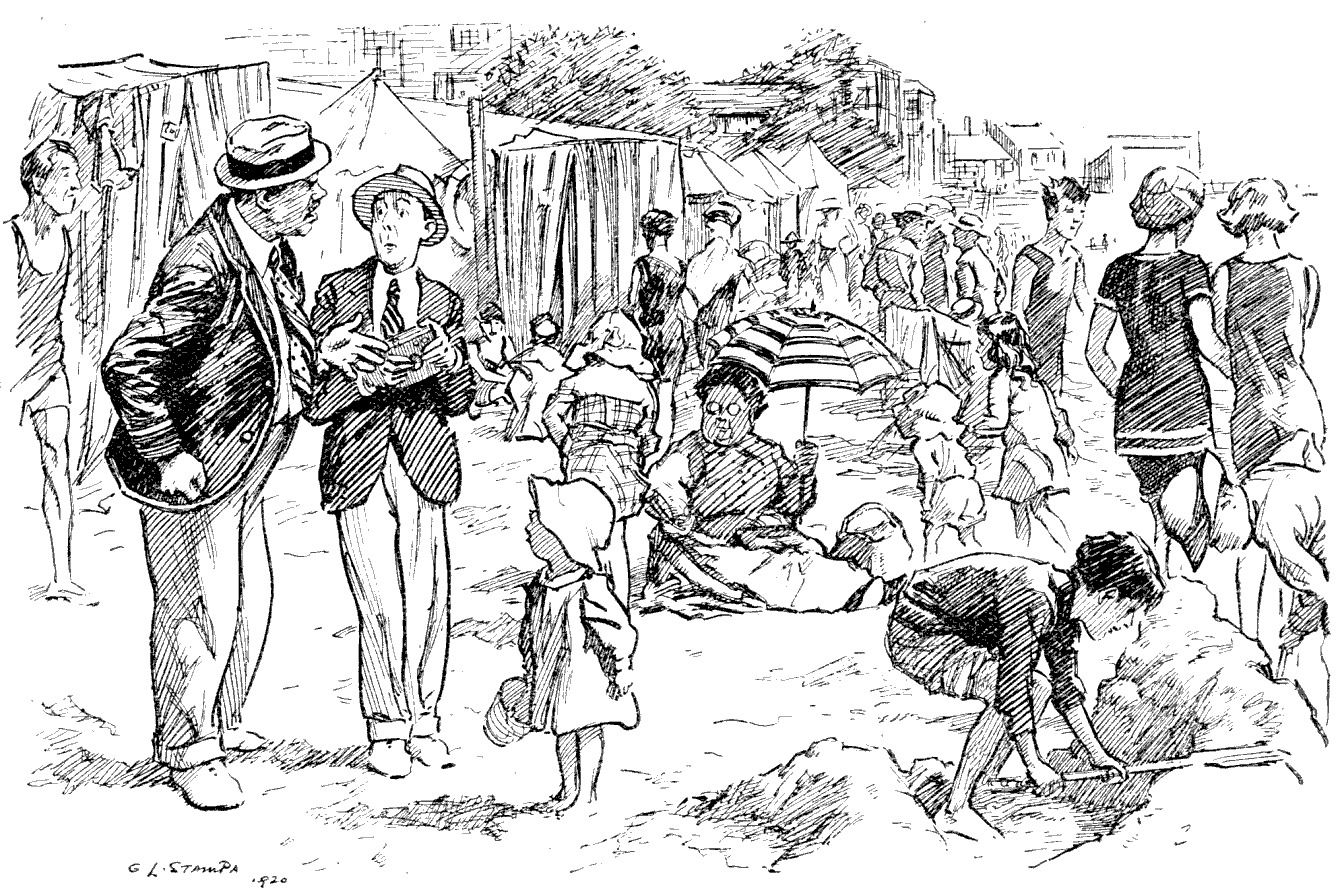
"Wot yer mean photographin' my wife? I saw yer."
"You're quite mistaken; I—I wouldn't do such a thing."
"Wot yer mean—wouldn't? she's the best-lookin' woman on the beach."