THE LIMIT—AND BEYOND.
Reading edition
Germany. "THEY TELL ME I'VE GOT TO MAKE UP THIS COLOSSAL SUM."
Turkey. "IT'S WORSE FOR ME. I'VE GOT TO MAKE UP MY MIND!" (Swoons.)
ESSENCE OF PARLIAMENT.
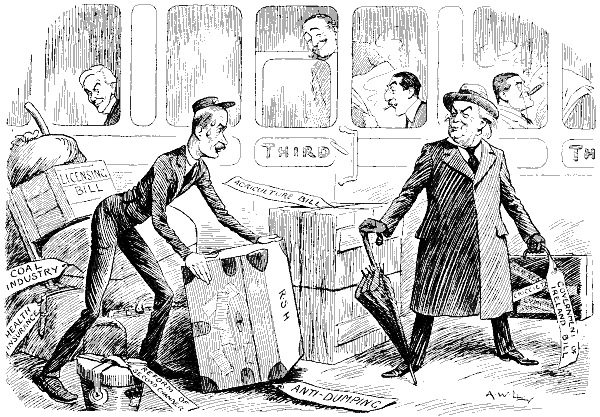
THE PARLIAMENTARY TRAIN.
Porter Law. "Some of this stuff will have to be left for the relief train—if we have one."
Mr. Lloyd George. "That's all right so long as you can carry my little lot."
Monday, May 17th.—In theory the business of a Second Chamber is to revise calmly and dispassionately the legislation which has been scamped by the First. In practice what happens in our Parliament is that the Peers, after killing time with academic debates for two or three months, are suddenly called upon, whenever a Recess is in contemplation, to pass three or four Bills through all their stages in as many days. At the invitation of Lord Crawford (Lord Salisbury perfunctorily protesting) they entered upon one of these legislative spasms this afternoon, and within less than an hour gave a second reading to two Bills, and a third reading to two others, besides listening politely while Lord Newton (with him Lord Lamington) bewailed the sad fate of certain German "Templars" (a species of Teutonic Quaker and quite harmless, we were told) who, having been evicted from Palestine, are now threatened with compulsory deportation to a Fatherland which they have no desire to visit. "Some hustlers, your Peers," remarked a visitor fresh from Washington.
That distinguished seaman, Lieut.-Commander Kenworthy, would never think, I am sure, of speaking disrespectfully of the Equator, but he has no compunction in abusing the Poles. He regards their recent advance into the Ukraine as an unprovoked assault upon the poor innocent Soviet Government, and is shocked to think that it should have even the negative approval of His Majesty's Ministers. Mr. Bonar Law's assurance that the military stores despatched to Poland from this country were the Poles' own property, and that the fact that they were embarked upon a vessel called the Jolly George had no ulterior significance, quite failed to convince him.
According to Sir Robert Horne the price of a best quality worsted suit, as made by a high-class tailor in this country, is approximately sixteen to eighteen guineas, and is still rising, though he thinks it should not be more than twenty guineas next winter. His remark that quite good suits could be procured at much lower prices prompted Sir F. Hall to call attention to the wares of a fellow-Member, upon which Mr. Whitley who was occupying the Chair, observed, with a touch of Mr. Speaker's humour, that Question-time must not be used for advertisement.
The approach of the holidays gave point to Mr. Forrest's complaint of the inefficiency of the present arrangements for conveying passengers' baggage by rail. Mr. Neal expressed a rather faint hope that the system of "luggage in advance" might be reintroduced. There are signs, however, that the Parliamentary train is already overloaded and that a good deal of Ministerial impedimenta will have to be left behind.
Tuesday, May 18th.—Our ancestors, generous fellows, considered British citizenship such a fine thing that they sought to extend its benefits as widely as possible. Under the existing law the child of British parents born in Canton and the child of Chinese parents born in Stepney are equally entitled to boast "Civis Britannicus sum." Lord Stanhope, regarding this as an objectionable anomaly, brought forward a Bill designed to restrict British nationality to persons of British blood. But, though he did this with the object of enabling the Government to fulfil one of their election pledges, "Britain for the British," he received scant sympathy from the Lord Chancellor, who declared that, far from making for simplicity, the Bill would produce a state of things "partly overlapping and partly contradictory."
Although close upon a hundred Generals have been demobilised since the Armistice, there is no immediate danger of this interesting race disappearing altogether. Twenty-six of the finest specimens are specially maintained at the War Office, at the comparatively trifling cost of sixty-two thousand pounds a year.
Viscount Curzon has many times both on sea and land shown himself the possessor of a fine nerve, but never more so than this afternoon, when he contrasted the activity of the police in apprehending infringers of the Motor-Car Acts with their alleged failure to capture really dangerous criminals. Mr. Shortt gave the figures of the motor-car prosecutions, and resisted the temptation to point out the extent to which they had been swollen by the noble Lord's own delinquencies.
A listless House resumed the discussion of the Government of Ireland Bill. Mr. Fisher declined to accept a proposal to include nine counties, instead of six, in the Northern Parliament, the view of the Government being that they must cut their legislative Ulster according to their Protestant cloth. Mr. Clynes announced the intention of the Labour Party to wash their hands of the Bill, which he regarded as a sheer waste of time. Undeterred by the prospect of this calamity the House passed Clause I. by a majority of 152.
Wednesday, May 19th.—Mr. Bottomley obtained leave to introduce a Bill to create a Public Defender, in spite of an attempt by Lieut.-Commander Kenworthy to strangle the bantling at its birth. He did not succeed in making clear his objection to the measure, and it is thought that he may have confused it with Sir Robert Horne's Bill to regulate the Supply of Gas.
When the Committee-stage of the Home Rule Bill was resumed the subject of debate was the Irish Council, the pivot on which all hopes of unity are centred. Exactly fifty Members were present to listen to this epoch-marking discussion, carried on entirely by a few English enthusiasts and the Members from Ulster. They differed profoundly on most of the details of the Council's constitution, but were unanimous in expressing the belief that nothing much mattered since it would never work. Lord Winterton indeed prophesied that if it is composed, as seems probable, of a solid bloc of Sinn Feiners from the South and another of Unionists from the North there would be a free fight at every meeting. In that case it may become a popular body after all.
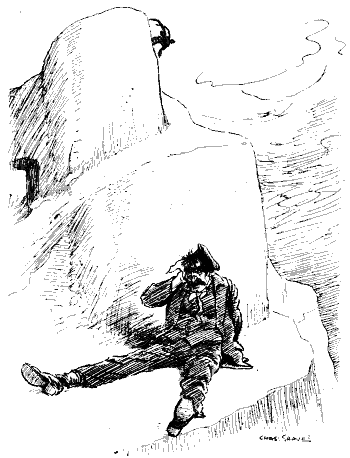
Keeper at the Zoo (exhausted with efforts to catch refractory ibex). "Well, they can 'ave their fancy Mappin terrisses. A cage for me every time."
Commercial Candour.
"Dry Old Chickens, 50s. to £4 4s. per doz."
Local Paper.
Our Musical Athletes.
"Double action Gothic Harp (by Erard), suitable for a lady in perfect condition."
Provincial Paper.
For Domestic Interiors.
"For the Blood, Stomach, and Liver, there is nothing to compare with Cork Linos. 800 rolls to choose from"
Provincial Paper.
Buttered rolls, we trust.
UNIVERSAL "TRAINING."
The Great Eastern have inaugurated a new plan for helping food-producers. They are sending out an instructional train, manned by experts and full of live stock—poultry and rabbits and goats—which is to traverse their system for two months. The contents will be on view and lectures will be given to cottagers, artisans, clerks—to all in fact who are interested in the breeding of the lesser live-stock, apple-growing, etc. The plan is so excellent that we feel sure it is bound to lead to further developments in regard to the industries and pursuits that really matter.
The rural districts, it may be safely assumed, already know something about agriculture. But many areas are still in a state of benighted ignorance about the results of intensive culture applied to the arts. There are parts of the Cornish Riviera, for example, in which you may travel for miles and miles without hearing a syncopated orchestra. Here is the opportunity of the Great Western—to equip and despatch a train band or band train, with a personnel carefully selected from the best negro performers (of whom there are now several thousands in London), with the view of brightening and enlightening the existence of those unfortunate villagers hitherto beyond the range of the beneficent dominion of din. As an antidote to agricultural discontent we can conceive nothing more salutary.
Again, there are portions of the Black Country where the very names of the leading Georgian poets are unknown. A troupe of poets, personally conducted by Mr. Edward March or Mr. Edmund Gosse, or both, should without delay be organized and sent forth by the North-Western and Midland Railways to give recitations over every portion of both systems. The effect on the output would be instantaneous. London should not be allowed to monopolize this stimulant to activity. Minstrelsy should be mobilized. It is true that a small group are interested in rotary motion, but we want to see all the Georgian poets on "Wheels." If we cannot have a free breakfast-table, at least we ought to be in a position to indulge without any control the appetite of our people for free verse.
Lastly, the plan of the instructional train might be applied with the most beneficial results to spreading the taste for the Russian Ballet. We do not hope to detach such bright particular stars as Pavlova or Karsavina from the London stage, but at the present moment, according to the latest statistical returns, there are several hundred Russian premières danseuses and thousands of coryphées of all grades congregated in the Metropolis, many of them without engagements, and reduced to giving dancing lessons to the daughters of profiteers, Crypto-Semites and other unpropitious persons. The organisation of a Russian Ballet train would therefore serve the double purpose of freeing these gifted performers from an ignoble use of their talents and at the same time initiating the provinces in the poetry of motion.
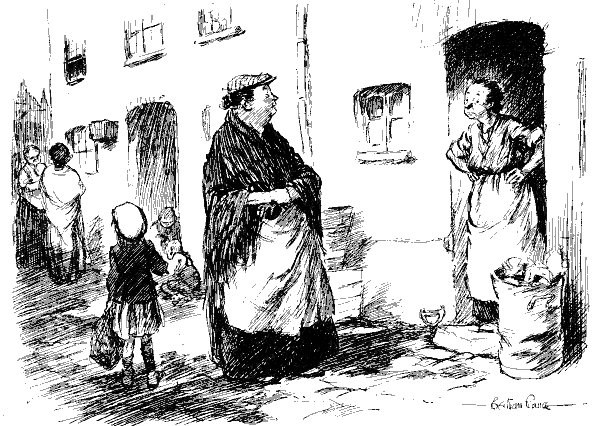
"I've just 'eard, Mrs. 'Uxtable, as 'ow my Ned is behavin' so well that 'is sentence is bein' redooced by six months."
"You don't say so! Well, reelly, Mrs. 'Arris, wot a comfort it must be to you to 'ave a son what does you so much credit."
"Oxford University.—First Innings. R. H. Bettington, dun out ... 12."
Daily Paper.
The batsman himself, we understand, expressed the opinion that he had been "done in."
HIGH FINANCE.
[Lines written at Geneva, with the rate of exchange standing at about twenty francs to the pound in Switzerland and about fifty francs to the pound in France. French and Swiss franc-pieces are good currency in both countries.]
Now here's a thing which makes me laugh And in a bitter way: The egg, that once was twopence-half, Is fivepence net to-day. It needed but this final woe To fill the wretched cup, That Hecuba, the hen, should go And put her prices up. This Hecuba, her pride is such She'll only do her job For pay in francs; she will not touch The honest British bob. Thus I, who have not got the dash To borrow, steal or beg, Have first of all to buy the cash Wherewith to buy the egg. And when I go to buy some francs To see the matter through I find that hereabouts the banks Have raised their prices too.... The farm is Swiss; but then, suppose You place yourself by chance Upon the southern edge, your nose Is trespassing in France. 'Tis here that Hecuba, the hen, In solitude sublime Does business every now and then At half-a-franc a time. Then ought she not (of course she ought) To pause and shift her ground, And lay my egg where francs are bought At fifty to the pound? Henry.
From a music-hall advertisement:—
"IMPORTANT NOTICE! OWING TO THE ENORMITY OF THIS PRODUCTION, FIRST HOUSE COMMENCES ... 6.15."
Provincial Paper.
The licensing authority seems to have been caught napping.
"The interesting announcement is made that Finchale Priory has been handed over to the care of the Society for the Prevention of Ancient Monuments."
—Provincial Paper.
It is suggested that some of the London statues might profitably be handed over to the same body.
THE PERFECT SCULLERY.
I was more than interested in the article "About Bathrooms" which appeared in the columns of Punch of March 31st last, because I too always smoke a pipe in a hot bath, to which I add the habit of reading, not books—they are too sacred to risk—but newspapers. I also frequently indulge in a further luxury at this time, a cup of coffee, which rests on the sponge and soap bridge between sips. Of course the soap sometimes falls into the coffee, and if this is undetected in time a slight frothing at the mouth occurs, but no really serious harm ensues.
I tried the effect of pictures round the bath—pictures with a shiver in them that made me pull the water up closer round my neck. But I found that they were being ruined by the steam, so I removed them and am now looking for some undraped but respectable statuettes that will give the same result.
I have not tried the rich rug stunt. The only rug we possess which might be so described is a Persian one, and is on our cat at present. When she has done with it I intend to spread it over the only part of the bathroom floor which is permanently dry. And, suffering as our bathroom does from that lack of space which the writer on bathrooms so justly laments, the "profound chair" is out of the question.
While his views on bathrooms are sound it seems evident to me that the writer of the Punch article lives in pre-war style—with servants. We don't. Our last maid left us to be a Waac and has not been seen since in the precincts of domestic servitude. I did hear something about her approaching marriage to a Colonel of Hussars, but don't know whether it came off or not.
It seems to me that what is chiefly wrong with houses, at any rate with our house, is the scullery. It is smaller than most bathrooms, and, though it is anything but bare, the furnishings of it are not intriguing to one who, like myself, spends therein such an undue proportion of the twenty-four hours.
Our present char comes three days a week, about eleven o'clock, has a look round with a duster in one hand till thirteen o'clock, then lunches and (probably) has a cigarette. She leaves at fifteen o'clock. This means that I help with the washing-up of the breakfast, tea and dinner things on char days, and of luncheon things as well on non-char days. My share of the task is generally the wiping. This is not such an engrossing occupation as to prevent one from thinking great thoughts at the same time, thoughts worthy to be committed to paper afterwards. Now, as a song-writer, I ask how can one get inspiration while gazing at a row of saucepans, a cullender, a bottle of metal paste, one ditto knife polish and a plate-rack?
If any room in the house should be luxuriously furnished it is the scullery. But what is even more important, I think, is that the whole game of scullerying should be revolutionised. The implements still in use are worthy of the Stone Age. The rules should be so framed that there should be little or no washing-up, in the ordinary acceptation of the term.
Let me put before you a pen-picture of the scullery of my dreams. A cosy pleasant room, the whole length of the house in fact, with a south aspect, full advantage of which is secured by a long window filled with leaded lights of opalescent glass (in order that the Hilary-Tompkins next door, who have two servants, may not grow too ribald). On the western wall is a rich mosaic depicting Hercules cleansing the Augean stable, and below this a fountain of clear limpid water, warmed to at least twenty over grease-proof, gushes forth and flows in a pellucid stream, between banks of marble, to the eastern end of the chamber. At the fountain head reclines Euphemia, my wife, arrayed and fructed proper, who leisurely drops the crockery into the stream. At the other end of the room, seated in a "profound chair" by the estuary, where the waters of the River Plate fall into the Sink Basin, behold me lazily watching the cups and platters as they glide gently down the rippling flood towards me, dexterously fishing out each fresh arrival and depositing it in a hot-air receptacle conveniently placed for its accommodation.
Such, I say, is the scullery of my dreams, in which the washing up of a nine-hole-course dinner would be as pleasant as a round of golf. No unsightly pots, pans, brooms, tins or other junk pollute the apartment; they are in the dream ante-chamber, to be hereinafter described or not, if the Editor sees fit. [Ed.—He does not see fit.]
Shakspeare and Mr. Charles Chaplin.
Mr. Charles Chaplin writes from Los Angeles protesting against the allegation, made in our issue of March 31st, that "he does not like Shakspeare." Mr. Punch cannot accept responsibility for a statement quoted from the report of an interview, but he has no hesitation in expressing his profound regret for any wrong that he has inadvertently done both to Mr. Chaplin and Shakspeare.
THE GREAT DIVORCE QUESTION.
When I week-end with people I like them to be tactful. I thought Mrs. Benham lacked the tact essential to a hostess when she said, "We breakfast at half-past nine on Sundays. That will give us all ample time to get to church." She never seemed to contemplate the possibility of my having a Sunday morning indisposition.
Now there is no virtue in compulsory church-going, but as I was for it I accepted my fate cheerfully. I walked with Benham across the park to the church. He is the adopted Candidate for the division, and he took the opportunity of rehearsing to me a speech he was preparing which showed up Bolshevism in its true colours. Though no Sabbatarian I have the deepest objection to political speeches on a Sunday, and it was really a relief when I reached the gracious refuge of the church.
The family pew was a little too near the pulpit, but it was most comfortable. When the sermon came on I settled myself in a restful corner to listen to the Archdeacon. After a moment or two I felt he was on sound orthodox lines and needed no supervision of mine. I leant back and gradually dozed off.
Then in my sleep I became aware of a stern voice disapproving of something. It seemed to me that Benham was at a public meeting denouncing Bolshevism to a very lethargic audience. It was my bounden duty to support my host. "Hear, hear! Hear, hear!" I said most emphatically.
I woke up just as the last "Hear" left my lips. The choir-boys were sniggering—you can always trust them to do that. A large curate was eyeing me as if I were something between a leper and a dissenter. Mrs. Benham was looking indignantly down the pew at me; Benham was tactfully but ineffectively pretending not to have heard anything.
I went hot all over. What could I do? Should I be prosecuted for brawling in church? Could I possibly explain to the Archdeacon that I spoke in my sleep, and therefore was not responsible? There are some explanations that aggravate an offence.
There came a terrible moment when the service was over. The Archdeacon stepped deliberately towards our pew. I was tempted to bolt through a stained-glass window. And then, as he came near, he beamed on me.
"Don't apologise, my dear Sir, don't apologise. If you were so moved by the picture I drew of the inroads the new Divorce Law would make on the sanctity of our homes why should you not express your indignation? Enthusiasm is far better than lethargy."
"Mr. Johnson feels very strongly on the subject," said Mrs. Benham. I had never said a word about it before her in my life.
That night she surveyed me carefully. "I can see you've a headache, Mr. Johnson," she said. "You had better not go to church; there is nothing worse than a hot church for headache."
After all, Mrs. Benham is not without tact.
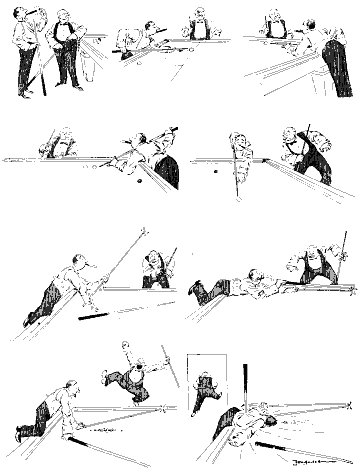
TRAGEDY OF A CIGAR-ASH.
Another Impending Apology?
"The Bank now gives employment to 6,000 persons, 2,000 of whom are women. In order to accommodate them outside premises have been acquired from time to time. The chief of these new establishments is St. Luke's Hospital for Lunatics."
—Sunday Paper.
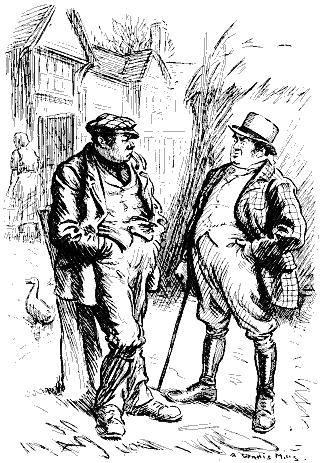
Farmer. "So you want a job of work, eh?"
Applicant. "I said a job. I never said a job o' work."
MAGNANIMOUS MOTTOES.
A writer in The Evening Standard calls attention to the latest ornamentation of the fine old Elizabethan Hall of Gray's Inn, in the shape of the arms of Lord Birkenhead, who as a past Treasurer of the Inn is entitled to this armorial distinction in his lifetime. But, he goes on, "it was not so much the arms as their motto which attracted me—the motto of a man who began his brilliant career as plain Mr. F. E. Smith. Now the Latin for 'smith,' as an artisan, is faber (artificer or fabricator in the primal sense); so, with a fine democratic courage, Lord Birkenhead has chosen as his family motto: 'Faber meæ Fortunæ' (Architect of my own Fortune)."
We agree; but it must not be supposed that Lord Birkenhead has an entire monopoly of this frank spirit. Other eminent men who have recently been ennobled or decorated have shown a similar frankness. Thus it may not be known that Lord Riddell has adopted a motto which reveals the comparatively modest beginnings of his greatness. Lord Riddell was, and we believe still is, the proprietor of The News of the World. Now the Latin for news or newness is novitas (novelty or unfamiliarity in the primal sense); so with a noble democratic courage he has chosen as his family motto: "Sæculorum vetustati præstat novitas mundi" (The news of the world surpasses the antiquity of the ages). It is rather a long motto, but it is eminently Ciceronian in its cadence.
Then there is the case of Lord Northcliffe, who began his brilliant career as simple Mr. Harmsworth. Now the Latin for "harm" is damnum (loss or sacrifice in the primal sense), and for "worth" dignus. So, with a fine loyalty to his antecedents, Lord Northcliffe has adopted the heroic and pleasantly alliterative motto: "Per damna ad dignitatem" (Through sacrifices to worthiness).
Even more ingenious is the motto chosen by Lord Beaverbrook, who began his coruscating career as a native of New Brunswick. Now the Latin for "beaver" is castor (not to be confounded with the small wheels attached to the legs of arm-chairs), and in Greek mythology Castor was the brother of Pollux, who was famed as a boxer. "Boxer" is a synonym for "prize-fighter"; "prize-fighter" recalls "Wells"; "wells" contain "water," and "water" suggests "brook." So Lord Beaverbrook, with a true allegiance to Canada, coupled with a scholarly mastery of the niceties of Classical etymology, has chosen for his family motto: "E Castore Pollux" (Brook from the Beaver).
THE DEVIL IN DEVON.
The Devil walked about the land And softly laughed behind his hand To see how well men worked his will And helped his darling projects still, The while contentedly they said: "There is no Devil; he is dead." But when by chance one day in Spring Through Devon he went wandering And for an idle moment stood Upon the edge of Daccombe wood, Where bluebells almost hid the green, With the last primroses between, He bit his lip and turned away And could do no more work that day. R. F.
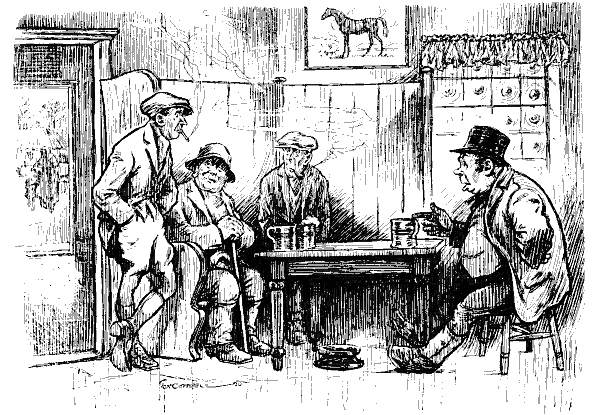
THE HEDGER.
"Wot be goin' to win the two-thirty race, varmer?"
"Well, young feller, there be nine 'osses runnin', and I 'as three fancies an' four sneakin' fancies. But, mark my words, I shan't be a bit surprised if one o' they other two don't do the trick."
OUR BOOKING-OFFICE.
(By Mr. Punch's Staff of Learned Clerks.)
There has recently been a notable output of books of "personalities" and critical appreciations, contemporary, historical and (for the most part) iconoclastic. One may therefore say that Mr. Horace G. Hutchinson is distinctly of the movement in compiling his Portraits of the 'Eighties (Unwin). This is certainly a volume that anyone can dip into with instruction and entertainment, even if (to be quite honest) the former is likely to predominate. The fact is that one has become so used to the satirical method in portraiture, in which the attack is all and the subject emerges only as a beriddled target, that an ordinary pen-picture, however faithful, is apt to seem heavy by contrast. Mr. Hutchinson certainly is not of the slingers; he will just "tell you about" the notable persons of his period, setting down nothing in malice, omitting little however banal, and rejecting no aphorism or anecdote as outworn. Perhaps his nearest approach to the popular method is a very occasional touch of gentle irony, as when he permits himself to say of G. W. E. Russell (to whose Portraits of the Seventies the present volume is intended as a sequel) that he "used to drive about London in a carriage picked out in colours that did not suggest that he sought seclusion." I have no space for the barest list of the sitters in Mr. Hutchinson's crowded picture of a time rich in character, his treatment of which aims rather at covering a wide ground than at intimacy of detail. To mention but one, it is interesting to compare his General Gordon with the recent presentment of him by another hand. If the result is more creditable to Mr. Hutchinson's kindliness than to his wit, it may serve as an apt comment on the whole book.
Beauty and Bands (Constable) is not, as you might excusably suppose, a treatise on syncopation or the decline of Jazz, but takes its title from a verse in the Book of Proverbs. Really what the story most illustrates is the extent to which a clever and experienced writer can clothe a wildly impossible plot with some aspect of reality. Miss Ellen Thorneycroft Fowler assuredly does not lack courage; having thought out a "good situation" (which it certainly is) she was not going to be put off by any considerations of probability. I can't resist some sketch of it, even at the risk of spoiling your pleasure. Suppose a lovely but selfish wife, bored to the point of flight from a well-intentioned husband, then involved in a railway smash which disfigures her beauty, destroys her memory and incidentally reforms her character; let her by plausible circumstance be mistaken for another traveller in the wrecked train and under a new name and personality meet her husband, fall in love with him, but be compelled to reject his suit by the presumption that his vanished wife may still be living—as I hinted, the result in situations is enough to satisfy the most exacting, the only real drawback being that not all Miss Fowler's pleasantly persuasive efforts can make me believe a word of it. If she had dared a little more, and inflicted the husband with blindness, impaired hearing and slight mental decay, I would have stretched a point and supposed that, during a protracted courtship, he might never have recognised his own wife. Lacking these concessions I can only report an entertaining but preposterous absurdity.
Those of us who read With the Persian Expedition know something about the Hush-Hush Army; enough, at any rate, to whet our appetites for more. Let me then recommend The Adventures of Dunsterforce (Arnold) to your notice, and assure you that it is a most lively account of as strange an enterprise as any that the War brought forth. Briefly, the object of General Dunsterville's mission was to prevent German and Turkish penetration in the area of the Caucasus, Baku and the Caspian Sea. In January, 1918, he set out from Baghdad with what he calls "the leading party." Continually hampered by lack of men, the mission failed to achieve its original object; but what it accomplished in most difficult circumstances was of great value to the Allies. The conditions at the time when the author sailed from Enzeli with his "Dunsterforce" to raise the siege of Baku were delightfully cosmopolitan. He describes himself as "a British General on the Caspian, the only sea unploughed before by British keels, on board a ship named after a South African Dutch President and whilom enemy, sailing from a Persian port under the Serbian flag to relieve from the Turks a body of Armenians in a revolutionary Russian town." "Let the reader," he adds, "pick his way through that delirious tangle, and envy us our task who may." After pursuing the tricky course of this astounding adventure I confess myself lost, not in its mazes, thanks to an excellent map, but in profound admiration for "Dunsterforce" and its leader.
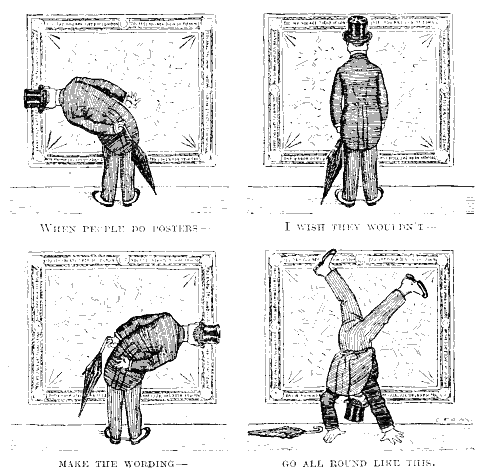
When people do posters— I wish they wouldn't— make the wording— go all round like this.
In A Merchant Fleet at War (Cassell) it takes nearly a hundred pictures to illustrate the fighting effort and experiences of the Cunard Steamship Company. Quite a lot of them are from snap-shot photographs actually taken while in action with submarines, and where through an unfortunate oversight these have not been available someone with vivid brush and imagination has done wonders to fill the gap. Certainly such a subject as the passing of the Lusitania, her decks still packed though her great bulk is three-quarters gone, the sea crowded with boats and, presumably, drowning Englishmen, is perhaps a little poignant to be handled in this fashion; but no one can object to seeing a U-boat nose-diving at the instance of S.S. Phrygia, or another being messed up by a shell from the Valeria; while the historic fight between Carmania, in Prussian blue, and Cap Trafalgar, mostly crimson, competes for lurid splendour with the Mauretania in "dazzle" costume, staged with a sky to match. Incidentally Mr. Archibald Hurd has acted as showman for the collection. One might have found his exposition rather more substantial but for Sir Julian Corbett's first volume of Naval Operations, which has set an uncomfortably high standard in sea history. Frankly, the deeds of the men of our merchant fleets, of the Cunarders no less than others, were so magnificent that a book to be worthy of them must be in itself as modest and unpretentious as they were. This book is not.
The Tall Villa (Collins), by "Lucas Malet," has a strange theme—no less than the deliberate wooing, by a sensitive unhappy woman, of a more unhappy ghost. Lord Oxley had lived in this odd villa on Primrose Hill a hundred years ago with a noted stage beauty who had finally jilted him. One of his descendants, Frances Copley, banished from Grosvenor Square by her husband's financial failure and conscious of the growing rift between them, detaches herself more and more from the world of sense till she is—well, till she is in just the right mood for seeing ghosts. First it is a mere shadow that stands by her piano; next a faceless figure, exquisitely dressed, sits brooding in her chair; then she hears a pistol shot; later—but this will spoil your entertainment. I cannot say I was quite convinced, but I certainly was held to the end by a tale very skilfully, almost too carefully, told, and by the cleverness of the four portraits—Frances herself, the adorable Lady Lucia her cousin, Charlie Montagu the passionate bounder, and, a little less definite, Morris Copley the stockbroking husband.
Messrs. Hodder and Stoughton have beaten up various American magazines and shepherded a few Waifs and Strays of short stories by the late "O. Henry" (William Sydney Porter) into a final volume of their excellent edition of his works. They have also included appreciations by various American and British critics of the author's achievement, together with some sparse biographical details. The stories are of varying value, exercises on a sentimental motive cloaked by humorous or bizarre exaggeration of language, with those unexpected but ingeniously plausible endings which are of the essence of "O. Henry's" method. Of the criticisms, English readers will be most affected by Mr. Stephen Leacock's "The Amazing Genius of O. Henry," an analytical appreciation in the most handsome terms, deploring English neglect of this master of one of the most difficult of art-forms—a neglect which we have done something of late to remedy.