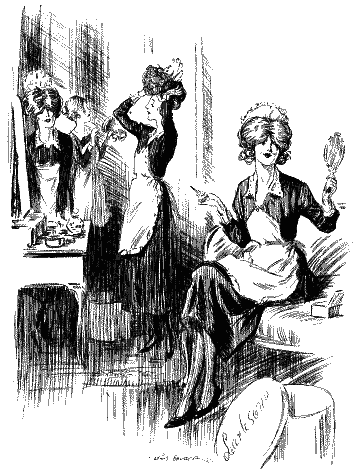
MORE HASTE, LESS MEAT.
Reading edition
The Calf (to the Butcher of the Exchequer). "OH, SIR, IT SEEMS SUCH A PITY TO KILL ME. YOU'D GET SO MUCH MORE OFF ME LATER ON."
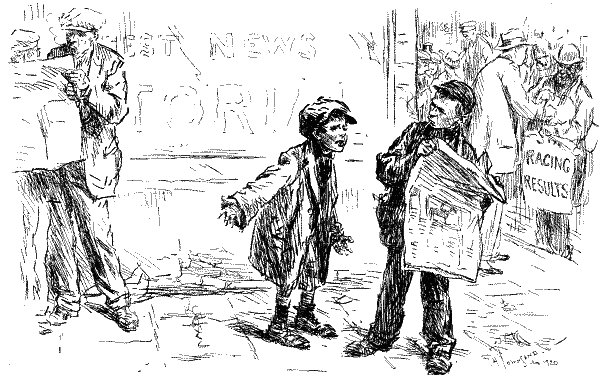
WHEN EXPERTS DIFFER.
Junior Partner (in syndicate whose operations on the 2.30 race—six furlongs—have gone wrong). "There—didn't I tell yer Diamond's Pride was a five-furlong 'orse?"
ON APPROVAL.
John looked up from his paper.
"Ah!" he sighed loudly, "how the world progresses."
There was silence. John sighed again.
"How the world progresses," he said a shade louder.
Cecilia and I continued reading.
"Can't anyone ask a question?" asked John peevishly.
"Where do the flies go in the winter-time?" murmured Cecilia without looking up.
I was weak enough to laugh. For some reason it annoyed John.
"Go on, go on, laugh!" he spluttered; "you're a good pair, you and your sister. Say something else funny, Cecilia, and make little brother laugh. What a crowd to have married into! Shrieks of laughter at every feeble joke, but as for intelligent conversation——"
"Well, we're reading," said Cecilia; "we don't want intelligent conversation."
"There's no need to tell me that. I know it only too well. I haven't been married to you for all these years without seeing that."
"'All these years,'" repeated Cecilia, aghast. "The vindictive brute."
"And," continued John bitterly, "I say again what I said just now: How the world progresses."
"Well, there's no need to keep on saying it, dear old cauliflower," I said; "we know it progresses. What are we expected to say?"
"I know," said Cecilia brightly. "Why?"
John pulled himself up.
"Because," he said, "they are proposing in the paper here to start a system of temporary marriages which can be dissolved if either party is dissatisfied after a fair trial. I only wish somebody had thought of it—how many?—eight years ago."
Cecilia's jaw dropped. I chuckled.
"You certainly bought that one all right, Cecilia old dear," I said. "Can't you manage a witty retort? Try, sister, for the honour of the family."
Cecilia pulled herself together.
"Retort?" she said in surprise. "Why on earth a retort, my dear Alan? When my husband makes his first really sensible remark for years I don't retort, I applaud. If only I had known the sort of man he is before I tied myself to him for life! What an actor he would have made! Why, before we married——"
"'Nothing was too good for you,'" I encouraged. "Go on, Cecilia."
"Don't interrupt, Alan—nothing was too good for me. Afterwards——"
"Last year's blouses and a yearly trip to the Zoo. Shame!" I said.
"And what about me?" said John. "Haven't I been deceived? Didn't you all conspire to make me think she was sweet and good? I remember somebody telling me I was a lucky man. I realise now you were all only too glad to get rid of her."
"Alan! How can you let him?" said Cecilia with a small scream of rage.
"Come, come," I said, "this family wrangling has gone far enough. You are married and you can't get out of it. Make the best of it, my children, and be friends."
"Yes," said John sadly, "it is too late now. I must try to bear up; but it is hard. If only this scheme had been started a few years earlier. If only I could have taken her on approval."
He paused a moment and smiled softly.
"Imagine the scene," he resumed. "'Cecilia,' I should say, 'I have given you every chance, but I am afraid you don't suit. For eight long years I have suffered from your rotten cooking, your ... extravagance ... and so on ... et cætera ... and I regret that I must give you a month's notice, to take effect as from four o'clock this afternoon. You have good qualities. You are honest and temperate and, to some extent, not bad looking—in the evening, anyway. Your idea of keeping household accounts is atrocious, but, on the other hand, you look rather nice in a hammock on a hot summer day. But that is all I can say for you. You have not given me the wifely devotion I expected. Only last week, when I came home feeling miserable, you sat at the piano playing extracts from some beastly revue, when a true wife would have been singing "Parted" or even "Roses of Picardy." Again, you invariably put our child in front of me in all things, such as the last piece of cake or having an egg for tea. I am not jealous of the boy, mind you, but I hate favouritism, and I won't play second fiddle to Christopher or anyone else.
"'In fact, my dear Cecilia (I use the phrase in its formal sense only), not being satisfied that you do all that was promised in the advertisement, I have decided to return you without further liability and ask for a refund of the cost of carriage. That will be all, thank you. You may go.'"
There was a few moments' ominous quiet, and then Cecilia went over the top with a roar of artillery and the rattle of machine guns. John put up a defensive barrage. Cecilia raked him with bombs and Lewis guns. He replied with heavy stuff. The air grew thicker and thicker.
"Shush!" I shouted through the din of battle. "Man and wife to wrangle like this! Think of your good name. Think of the servants. Think of the child."
Cecilia caught the last phrase and the noise subsided.
"Yes," she said, breathless but calm, "there's the hitch in your plans, Master John—the child. If I go I take Christopher with me."
"That you don't. Christopher belongs to me. He is part of my estate—in law. You can't take him."
"Can't I?" said Cecilia. "Am I his mother or am I not?"
"Who pays his school-fees?" said John. "What's his name? Whose house does he live in?"
Cecilia was gathering herself for another offensive when the door opened and Christopher came in.
We looked at him and he paused in embarrassment.
"What are you all looking at me for?" he asked, smiling uneasily; "I haven't done anything."
"He belongs to me," said Cecilia suddenly.
"He belongs to me," said John with decision.
Christopher knows his parents fairly well. "Whatever are you doing?" he asked with a chuckle.
"Come here," said John.
Christopher advanced and stood between his mother and his father.
"I don't know what I'm inspected to do," he said.
"Christopher," said John, "to whom do you belong—to your mother or to me? Think well, my child."
Christopher wrinkled his nose obediently and thought for a moment.
"Why," he said, his face clearing, "we all b'long to each other."
"'The Heart of a Child,'" I said; "the beautifullest love-story ever told. Featuring Little Randolph, the Boy Wonder."
They took no notice. They were all three busy rehearsing the final reconciliation scene.
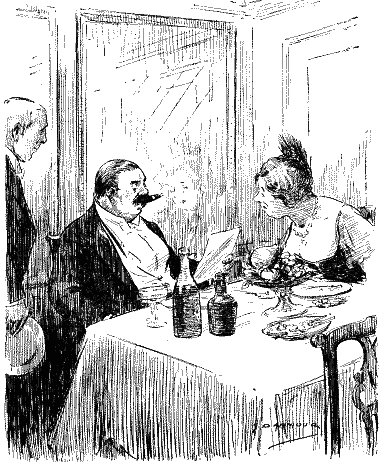
The Wife. "Must we always 'ave champagne, 'Arry? It don't reely suit me."
The Profiteer. "Of course we must. They might think we couldn't afford it."
Our Erudite Contemporaries.
From a special golf correspondent:—
"I cannot remember the Latin for a daisy, but most emphatically 'Delanda est.'"
Daily Paper.
O Carthego!
"'Pol-u-me-tis.' The Greek brings back the thundrous verse of Virgil. Echoes from the twilight of the gods."—Daily Paper.
Poor old Götterdämmerung.
Another Sex-Problem.
"White Milking Shorthorn Bull for Sale, £50."—Farmers' Gazette.
"A Good Canvasser wanted for Credit Gentlemen's wear; ready to wear and made to measure clothing."—Daily Paper.
"One," in fact, "that was made a shape for his clothes, and, if Adam had not fallen, had lived to no purpose."
"To-morrow afternoon, the Dansant, 3 p.m. to 6 p.m. Tickets inclusive 3s. 6d. Dansant (only) 2s. 6d."—Provincial Paper.
The "the" seems cheap at a shilling.
THE ART OF POETRY.
II.
In this lecture I propose to explain how comic poetry is written.
Comic poetry, as I think I pointed out in my last lecture, is much more difficult than serious poetry, because there are all sorts of rules. In serious poetry there are practically no rules, and what rules there are may be shattered with impunity as soon as they become at all inconvenient. Rhyme, for instance. A well-known Irish poet once wrote a poem which ran like this:
"Hands, do as you're bid, Draw the balloon of the mind That bellies and sags in the wind Into its narrow shed."
This was printed in a serious paper; but if the poet had sent it up to a humorous paper (as he might well have done) the Editor would have said, "Do you pronounce it shid?", and the poet would have had no answer. You see, he started out, as serious poets do, with every intention of organising a good rhyme for bid—or perhaps for shed—but he found this was more difficult than he expected. And then, no doubt, somebody drove all his cattle on to his croquet-lawn, or somebody else's croquet-lawn, and he abandoned the struggle. I shouldn't complain of that; what I do complain of is the deceitfulness of the whole thing. If a man can't find a better rhyme than shed for a simple word like bid, let him give up the idea of having a rhyme at all; let him write—
Hands, do as you're TOLD,
or
Into its narrow HUT (or even HANGAR).
That at least would be an honest confession of failure. But to write bid and shed is simply a sinister attempt to gain credit for writing a rhymed poem without doing it at all.
Well, that kind of thing is not allowed in comic poetry. When I opened my well-known military epic, "Riddles of the King," with the couplet,
Full dress (with decorations) will be worn When General Officers are shot at dawn,
the Editor wrote cuttingly in the margin, "Do you say dorn?"
The correct answer would have been, of course, "Well, as a matter of fact I do;" but you cannot make answers of that kind to Editors; they don't understand it. And that brings you to the real drawback of comic poetry; it means constant truck with Editors. But I must not be drawn into a discussion about them. In a special lecture—two special lectures—— Quite.
The lowest form of comic poetry is, of course, the Limerick; but it is a mistake to suppose that it is the easiest. It is more difficult to finish a Limerick than to finish anything in the world. You see, in a Limerick you cannot begin:—
There was an old man of West Ham
and go on
Who formed an original plan,
finishing the last line with limb or hen or bun. A serious writer could do that with impunity, and indeed with praise, but the more exacting traditions of Limerical composition insist that, having fixed on Ham as the end of the first line, you must find two other rhymes to Ham, and good rhymes too. This is why there is so large a body of uncompleted Limericks. For many years I have been trying to finish the following unfinished masterpiece:—
There was a young man who said "Hell! I don't think I feel very well——"
That was composed on the Gallipoli Peninsula; in fact it was composed under fire; indeed I remember now that we were going over the top at the time. But in the quiet days of Peace I can get no further with it. It only shows how much easier it is to begin a Limerick than to end it.
Apart from the subtle phrasing of the second line this poem is noteworthy because it is cast in the classic form. All the best Limericks are about a young man, or else an old one, who said some short sharp monosyllable in the first line. For example:—
There was a young man who said "If——
Now what are the rhymes to if? Looking up my Rhyming Dictionary I see they are:—
cliff hieroglyph hippogriff skiff sniff stiff tiff whiff
Of these one may reject hippogriff at once, as it is in the wrong metre. Hieroglyph is attractive, and we might do worse than:—
There was a young man who said "If One murdered a hieroglyph——"
Having, however, no very clear idea of the nature of a hieroglyph I am afraid that this will also join the long list of unfinished masterpieces. Personally I should incline to something of this kind:—
There was a young man who said "If I threw myself over a cliff I do not believe One person would grieve——"
Now the last line is going to be very difficult. The tragic loneliness, the utter disillusion of this young man is so vividly outlined in the first part of the poem that to avoid an anticlimax a really powerful last line is required. But there are no powerful rhymes. A serious poet, of course, could finish up with death or faith, or some powerful word like that. But we are limited to skiff, sniff, tiff and whiff. And what can you do with those? Students, I hope, will see what they can do. My own tentative solution is printed, by arrangement with the Editor, on another page (458). I do not pretend that it is perfect; in fact it seems to me to strike rather a vulgar note. At the same time it is copyright, and must not be set to music in the U.S.A.
I have left little time for comic poetry other than Limericks, but most of the above profound observations are equally applicable to both, except that in the case of the former it is usual to think of the last line first. Having done that you think of some good rhymes to the last line and hang them up in mid-air, so to speak. Then you think of something to say which will fit on to those rhymes. It is just like Limericks, only you start at the other end; indeed it is much easier than Limericks, though, I am glad to say, nobody believes this. If they did it would be even harder to get money out of Editors than it is already.
We will now write a comic poem about Spring Cleaning. We will have verses of six lines, five ten-syllable lines and one six-syllable. As a last line for the first verse I suggest
Where have they put my hat?
We now require two rhymes to hat. In the present context flat will obviously be one, and cat or drat will be another. Our resources at present are therefore as follows:—
Line 1— —— " 2— ... flat. " 3— —— " 4— ... cat or drat. " 5— —— " 6—Where have they put my hat?
As for the blank lines, wife is certain to come in sooner or later, and we had better put that down, supported by life ("What a life!"), and knife or strife. There are no other rhymes, except rife, which is a useless word.
We now hold another parade:—
Terumti—umti—umti—umti—wife, Terumti—umti—umti—umti—flat; Teroodle—oodle—oodle—What a life! Terumti—oodle—umti—oodle—cat (or drat); Teroodle—umti—oodle—umti—knife (or strife); Where have they put my hat?
All that remains now is to fill in the umti-oodles, and I can't be bothered to do that. There is nothing in it.
A. P. H.
"Will any gentleman requiring a House-keeper accept two decently brought up boys, age 12 and 8 years? Excellent cook and housekeeper; capable of full control."
Daily Paper.
Someone really ought to give these young sportsmen a trial.