Volume 158 — ON THE WESTERN FRONT.
Reading edition
Once again we are "for it." It is that heavy hour between five and six when the vitality is all too low for the ordeal that awaits us. On either side the far-flung battle line of clustering figures stretches away into the gloom. It is an inspiring sight, this tense silent crowd of men of every class and vocation, united by a common purpose, grimly awaiting the moment when as one man they will hurl themselves into the fray.
Is it the mere lust for fighting that has brought them here? Or is it the thought of the home that each hopes to return to that steels their courage and lends that élan to their resolution without which one enters the struggle in vain?
In the dim half-light I furtively scan the set faces around me and find myself wondering what thoughts those impassive masks conceal. Are they counting the cost? Most of them have been through the ordeal before. Pale faces there are—small wonder when one thinks of what lies before them. Here and there a man is puffing at his beloved "gasper" with the nonchalance that marks your bull-dog breed when stern work is afoot.
Yet one cannot keep one's thoughts from the tremendous possibilities of the next few minutes. Where shall we be a few minutes hence? Some, one knows, will have gone West—and the others? Would they effect a lodgement, or be hurled back baffled and raging and impotent, as, alas! had too often been the case before?
And what of those who were even now maybe preparing against our onslaught? Their intelligence could hardly have failed to warn them of our intentions. The position would be occupied, never fear, and in force, with seasoned men from the East.
At last a stunning roar that seems to shake the very ground, rising to a shriek. Now it is each man for himself. The long line surges forward, looking eagerly for a breach. Now we can see our opponents—hate in their eyes—as they brace themselves for the shock. Now we are into them, fighting silently, with a sort of cold fury save where a muttered curse or the sharp cry of the injured bears testimony to the fierceness of the struggle.
But see, they turn and waver. One more rush and we are through, driving them before us. The position is won.
Breathing hard we look around at the havoc we have wrought, and suddenly the glamour of victory seems to fade and one loathes the whole senseless, savage business. We do not really hate these men. After all, they are our fellow-creatures.
But what would you? One cannot spend the night on Charing Cross District platform.
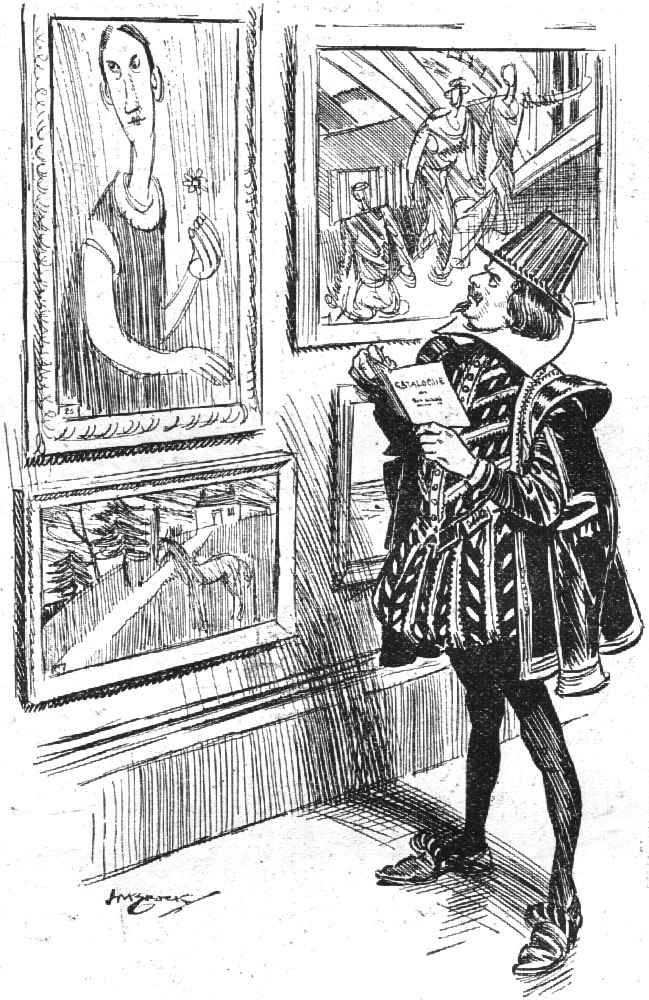
SHAKSPEARE AND THE NEW ART.
"What's here? The portrait of a blinking idiot?"
Merchant of Venice, Act II. Sc. 9.
From a drapery firm's advertisement:
"WE NEVER ALLOW
DISSATISFIED CUSTOMER TO LEAVE THE PREMISES IF WE CAN AVOID IT.
IT DOESN'T PAY!"
Scotch Paper.
Suspiciously like a case of "Your money or your life!"
BY THE STREAM.
(Featuring the Premier.)
Mr. Lloyd George has returned from a visit to the haunts of his youth with renewed health and reinforced Welsh accent. The last day of his holiday was spent in fishing in the company of two friends; but unfortunately the newspapers failed to supply any details of the scene, a lack of enterprise which it is difficult to understand, especially on the part of the journals known to employ Rubicon experts on their staff. Happily we are able to give information which we have reason to believe will not be officially contradicted.
From his childhood Mr. Lloyd George has known intimately the romantic stream, named, for some unexplained reason, the Dwyfor river. To its musical murmur may be traced the mellifluous cadences of the statesman's voice employed so effectually in his appeals to Labour and the Paris Conference. Who can say what influences this little Welsh river, with its bubbling merriment, the flashing forceful leap of its cascades, its adroit avoidance of obstacles, may have had upon the career of the statesman of to-day, as through the years it has wound its way from the springs to the ocean? The senior fish of the Dwyfor are well known to him, and they gather fearlessly in large numbers to smile at his bait and to point it out to their friends.
Towards the end of the day a humorous incident occurred. A keeper appeared on the opposite bank of the river and excitedly warned the party that they were trespassing, requesting them to retire. To his amazement his demands were ignored, and the trespassers replied to his protests by singing "The Land Song," the Premier's rich tenor voice being easily distinguished above the roar of a neighbouring cascade.
"Lieut —— proposed that Mr. ——, our present vice-chairman, be elected to the chair until the usual election of officials took place, by that time a capable member would probably be found willing to accept the position.
Mr. —— thanked the proposer and seconders for their compliment."—Service Paper.
The new chairman seems to be easily pleased.
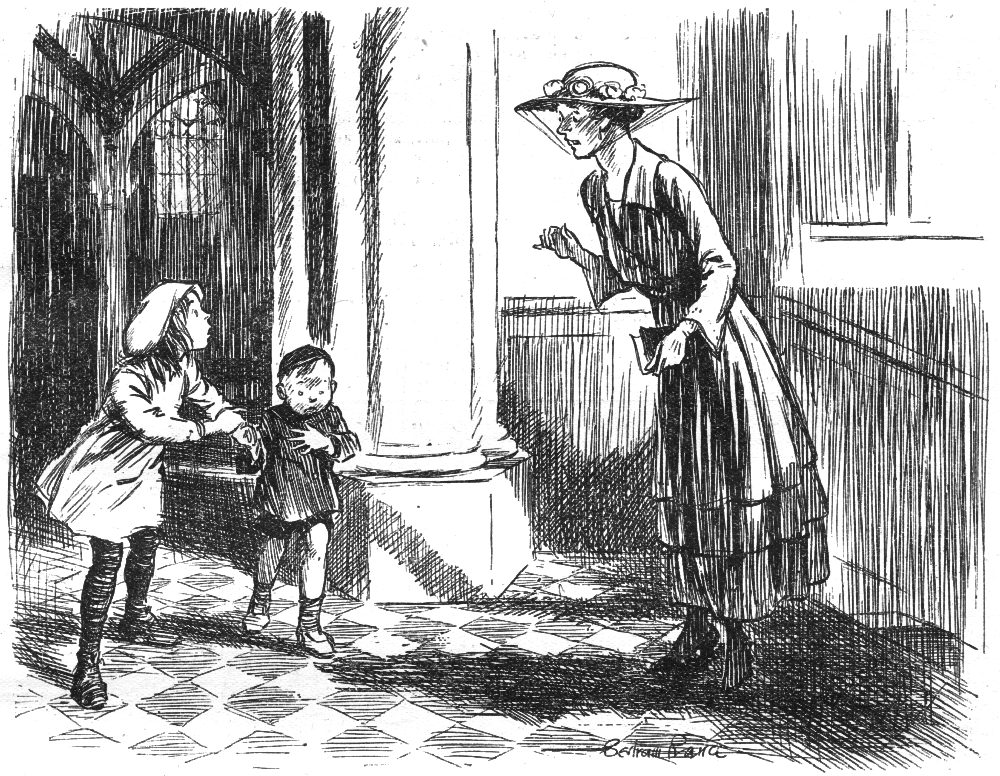
Sunday School Teacher. "Dear me, Maggie, you're not going away before the service is begun?"
Little Girl. "It's our Freddie, Miss. 'E's swallowed the collection."