Volume 158 — THE BEST OF THINGS.
Reading edition
"The New Poor?" said Holder, like myself, one of them. "Nonsense. There are none. There are people who will not use their imaginations, of course. They are poor, but not newly so. This so-called new poverty doesn't touch me. True, the money I make will not go so far as it used to, but my imagination goes very much farther. I have trained it, encouraged it, my wife's and boy's too. We have cast off the absurd restraints imposed by the law of probability. In the old days, when I used to think, say, of motors, I was invariably badgered by the spectre of improbability. I used to think of a four-hundred-pound car, or perhaps, in a daring moment, my thoughts would creep timidly, like mice out into a still kitchen, on to the six-hundred-pound plane, only to scurry back to the lower plane almost instantly. Now I've thrown all that overboard. Rubbish! When I think of motors I think in terms of Rolls-Royces. Why think cheaply? It's a poor imagination that won't run to a six-cylinder car at least. Strictly, I shall never own a real motor scooter. What of it? In my mind I use Rolls-Royces. We've rather worked the thing up at home. Come and dine with us and see for yourself."
We had sausages and mashed potatoes, with water. And I may say that never have I enjoyed a meal more. You see, Holder kept on telling us all the time about the famous dinner which now, owing to the War, we should never really eat, but which we were at perfect liberty to imagine we were eating. I am sorry you were not there. The hors d'œuvres! Holder describes hors d'œuvres better than any man I know. Oh, masterly, the colour ... Ruskin, perhaps. Anyhow, he carried us quite away.
His wife chose oysters. His description of oysters, instantly furnished, was a little gem—a pearl, silver-grey, so much so that I too chose oysters. His little boy, Dickie, chose caviare; but he really did not care for it. He bit on a piece of button in his sausage, poor child. That was why he did not appreciate the caviare. But Holder distracted his mind with some very remarkable mushroom soup—potage de champignons—a brilliant word-sketch. We all chose it.
For fish there was saus—pardon me, sole. The little lad, Dickie, chose salmon; but Holder reminded him that he had had salmon the previous evening; it was out of season in any case, and he described how the sole tasted that probably Dickie will never touch. The boy appeared to enjoy it immensely.
I think it was the game, simple roast partridges, exquisitely cooked, which Mrs. Holder enjoyed most. Her eyes were frankly shining as she pensively chewed the third quarter of her sausage, and she thrilled to the juices of the partridge of the dinner she could no longer hope really to eat, but which Holder, thank God, would often describe, at any rate until a tax is put on conversation. Even then something might be done—deaf and dumb language, possibly—an evasion, I admit, but even the New Poor must eat occasionally.
We all enjoyed the game course most, with the exception of Dickie. The lad had finished his sausage, and mashed potato alone is not inspiring. But that great man, Holder, noticed it in time, and he satisfied the child with a word-painting of the brown crisp skin of cooked goose. Then we drank some magnificent wine. Holder ransacked the English language for it. A vivifying champagne.
But enough of food, or you will think we were gourmands. None of us cared for any sweets after such a meal. And that is what I like about the Holders: with them enough is as good as the feast they will never have.
After dinner we smoked a very fine cigar in the imaginary conservatory which Holder has just run up, and I have rarely, if ever, heard a better description of men smoking cigars in a conservatory. Next, Holder played me a fast game of billiards. He allowed me to choose my own table, and I picked the most expensive in the catalogue. Dickie marked for us. Then he went to bed. I heard his father whisper a most convincing description of eiderdowns and real wool blankets when he kissed him. He is only a very little boy—big blue eyes, you know, like a girl's; they watered a little. Excitement....
It was a clear moonlit night with a touch of frost in the air, so Mrs. Holder rang for the visionary footman, a good-looking, most willing, sensible man, according to Holder's quick portrait of him, who piled up some great logs on a bank of coals of a positively fantastic size, and we gathered round to enjoy a run in the brand-new, latest model Rolls-Royce which is one of the special things which Holder will never possess in this world. Ah, but she was a queen of cars, and the best of cars always run better at night. I wonder why. So smoothly silky, so dreamily sweet-running, a pouring of cream! I wish I could convey to you the satin sound of her transmission, the low golden purr of her gears, the fanning of her velvet wings—wheels, that is. I would sooner ride in that verbal car of Holder's than walk round the real backyard that is my own, unless I fall behind with the rent, as I begin to fear I shall....
Down the dreamy moon-drenched highways, across the magic silver-flecked moors, we climbed on the wings of the peregrine to the keen, cold uplands, soared awhile, then dropped to the warm and sheltered valley and so home again. We felt the radiator, Holder and I, and it was quite cool. She will never boil on a stiff hill. Mrs. Holder was glowing from her ride; for an instant she looked pink and pretty; she had lost that wistful pinched look.
I went inside for a phrase or so of Holder's admirable idea of what cherry brandy should be. We chatted for a little about the estate that he will never purchase, and then I left, having promised to go round there to-morrow for a little shooting. It will be hot work among the pheasants if Holder has not lost his voice.
He and his wife came down the drive to the entrance-gates with me.
"Good-night," they said; "we're glad you've enjoyed yourself."
Holder was a little hoarse, for he is a generous host. I think too the motor run had tired them both, for their faces were again a little haggard; and the wind had brought tears to the eyes of Mrs. Holder.
So I said good-bye to them—and to Jack, their elder boy, whom they will never see again. He lies in France. But, you understand, it was as if he had been with us all again for a little while that evening.
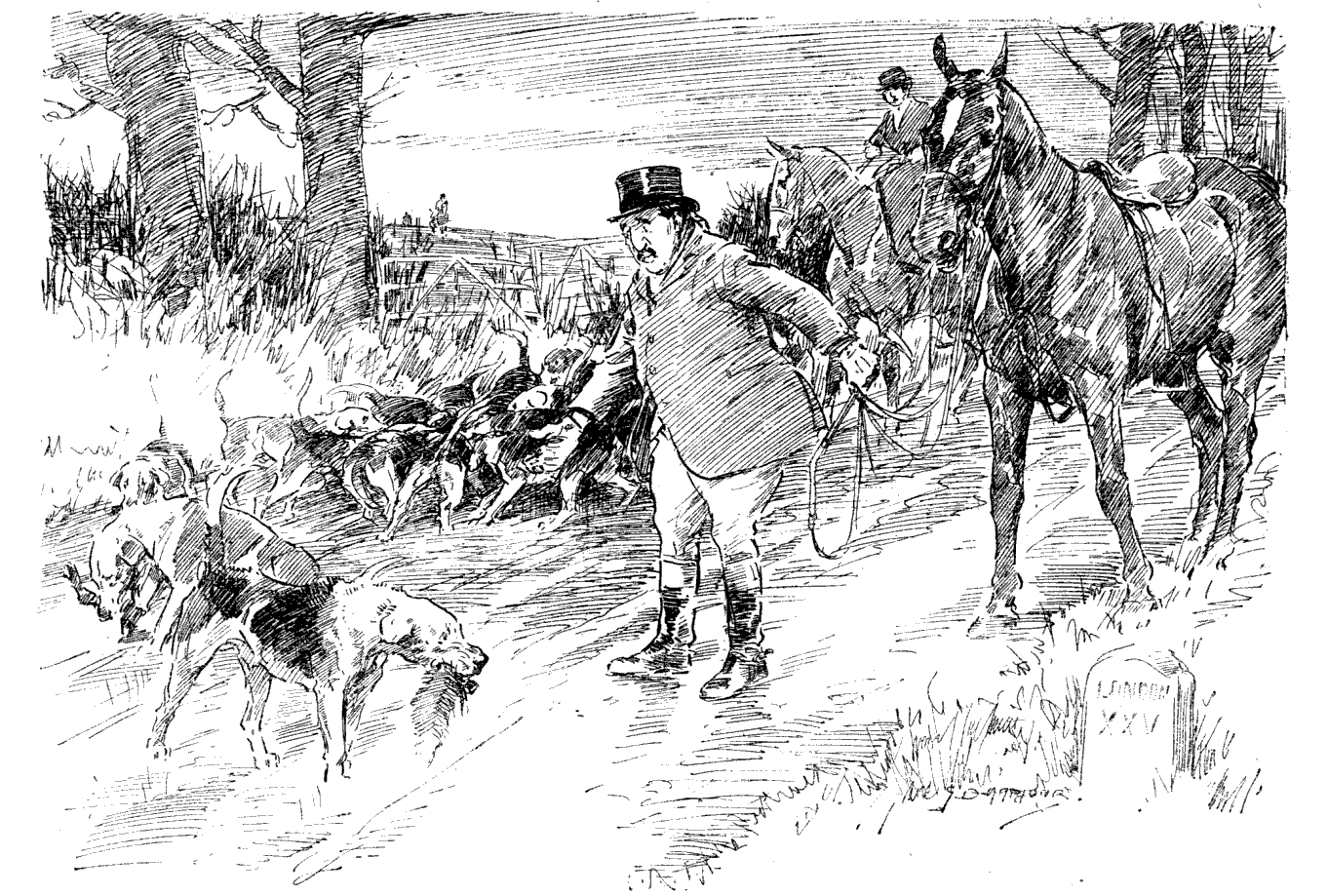
MORE ADVENTURES OF A POST-WAR SPORTSMAN.
CHANCING, ON THE WAY HOME, TO COME UPON HOUNDS WHEN THEY HAVE JUST KILLED, HE PROPOSES TO SECURE THE BRUSH FOR MRS. P.-W.S., BUT CONCLUDES THAT UPON THE WHOLE IT WOULD BE BETTER TO BUY ONE IN TOWN.
HOPE FOR POSTERITY.
Full many a year has waxed and waned And sunk into its shroud Since that first day that I obtained A diary and vowed To keep (as I informed my wife) "The Records of a Simple Life." Within it I resolved to state, Like Mr. Pepys of yore, The things that I, for instance, ate And she, my Mary, wore, Facts that would have a curious worth When I was famed and—under earth. And generations yet unborn Would feel a thrill to note How I upon an April morn Left off my overcoat, Or showed a pardonable spleen At having missed the 9.16. Nine volumes I've commenced at least To write with eager pen; The first, I note, abruptly ceased On January 10, While yesteryear the break occurred, I think, upon the 23rd. But this year, I am proud to see, Stands not as others stood; The prospects of posterity Are really rather good, Now that my zeal (not on the ebb) Has borne me safely into Feb.
MUSICAL AMENITIES.
The connection of occultism with music was recently discussed by Mr. Cyril Scott in his interesting volume on Modernism in Music. It is satisfactory to know that the subject is not to be allowed to drop. Grave discontent is rife in orchestral circles at the monopoly enjoyed at spiritualist séances by the tambourine, and it is reported that Mr. Ernest Newman, the distinguished and outspoken musical critic, will shortly deliver a public lecture on behalf of the admission of other instruments to these mysteries, and in particular the tuba. The claim of the tuba, Mr. Newman holds, is not only based on the profundity of its tones, but upon long literary tradition. Nothing could be more conclusive than the reference in the old Latin hymn:—
"Tuba mirum spargens sonum Per sepulcra regionum."
It is anticipated that the discussion will be attended by Signor Marconi, Lord Dunsany, Mr. Yeats and Lieutenant Jones, the author of The Road to En-Dor.
Meanwhile the conflicting current of musical materialism is running strong. The Daily Mail, always in the van of artistic progress, has espoused the cause of the insurgent Georgians with intrepid zeal. Mr. Julius Harrison is extolled in a leading article for finding a theme for an orchestral work, not in any of the misty or metaphysical abstractions which appealed to the effete Victorian composers, but in plums. And, mind you, not Carlsbad, but honest Worcestershire plums, without any Teutonic taint. Mr. Julius Harrison's patriotic example is not likely to be lost on his brother composers. Indeed it is asserted on credible authority that Mr. Granville Bantock, who has completely forsworn all Oriental and exotic subjects, is engaged on a gigantic symphony, with choral interludes, entitled "Yorkshire Pudding;" and that Mr. Josef Holbrooke is collaborating with Lord Howard de Walden in a romantic historical opera in fifteen Acts called "From Woad to Broadcloth."
Mr. Bernard Shaw, who, it may be necessary to remind youthful readers, was a musical critic on The Star and The World before he achieved fame as a dramatist, has been causing his friends and admirers serious misgivings by his article on Sir Edward Elgar in a new musical journal, Music and Letters. Sir Edward Elgar has a great following; he has written oratorios; he is an O.M.; yet Mr. Shaw salutes him as the greatest English composer, the true lineal descendant of Beethoven, one of the Immortals and the only candidate for Westminster Abbey! To find Mr. Shaw taking a majority view is bad enough; it is a case of proving false to the tradition of a lifetime—a moral suicide. But why drag in Beethoven? So left-handed a compliment prompts the suspicion that, after all, what appears to be eulogy is in reality nothing more than an essay in adroitly dissembled obloquy. Mutatis mutandis, Mr. Shaw would not thank Sir Edward Elgar for calling him, for example, the Voltaire de nos jours. What he does enjoy is the frank disparagement of Mr. Wilfrid Blunt, who describes him in the second volume of My Diary, just published, as "an ugly fellow, his face a pasty-white, with a red nose and a rusty red beard, and little slaty-blue eyes."
An interesting but, we regret to say, decidedly hostile estimate of Mr. Lloyd George as a musician appears in the columns of a leading anti-Coalition daily. The critic discusses the Premier both as vocalist and instrumentalist, and in both capacities finds him sadly wanting. The volume of his voice is small, the timbre is unpleasant, the production faulty and the intonation far from pure. Admitting that Mr. Lloyd George has a certain flexibility and facility common to all Welsh singers, the critic condemns his habit of resorting to an emotional tremolo which frequently degenerates into a mere "wobble." The Premier, he continues, shows agility and spirit in florid passages, but his declamation lacks dignity and his articulation is often indistinct. As a pianist he is equally unsatisfactory; his repertory is extremely limited and he is quite unable to interpret the complex harmonies of the Russian School.
A painful example of Mr. Lloyd George's ignorance is forthcoming in the astounding fact that he is, or was, under the impression that Karsavina was the name of a town, and that the only musician of the name of Corelli was the author of The Sorrows of Satan. The critic concludes with a masterly analysis of the results of these short-comings on the vitality of the Coalition Cabinet, already weakened by the withdrawal of Mr. Balfour, a very sound and accomplished musician of the old school.
THE EXILE.
Now I return to my own land and people, Old familiar things so to recover, Hedgerows and little lanes and meadows, The friendliness of my own land and people. I have seen a world-frieze of glowing orange, Palms painted black on a satin horizon; Palm-trees in the dusk and the silence standing Straight and still against a background of orange; A gorgeous magical pomp of light and colour, A dream-world, a sparkling gem in the sunlight, The minarets and domes of an Eastern city; And, in the midst of all the pomp of colour, My heart cried out for my own land and people, My heart cried out for the lush meadows of England, The hedgerows and the little lanes of England, And for the faces of my own people.
"The Viceroy, fishing in the Kabini river yesterday, caught a mahseer weighing 77 pounds. This is the best fish so far caught in one day."—Weekly Rangoon Times.
We gather that the giant would not have allowed any less august angler to land it except by instalments.
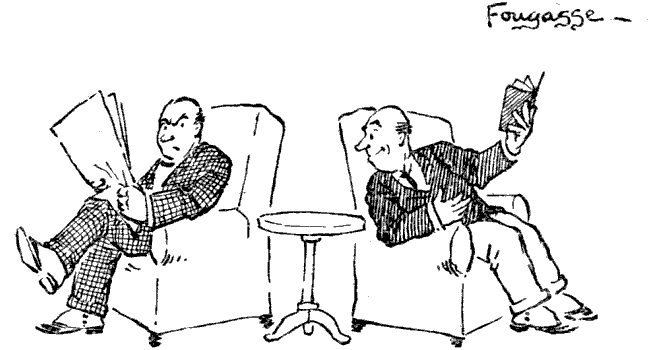
"Splendidly written."
"Yes, I've read it."
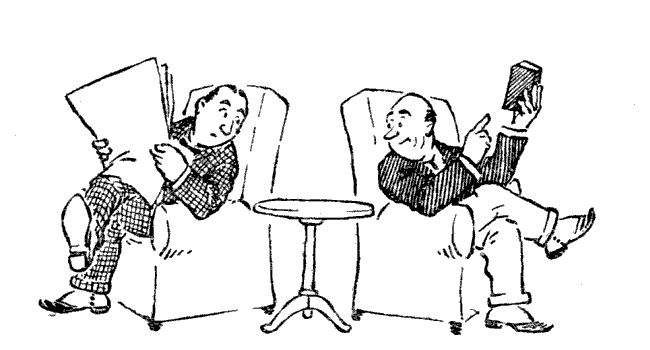
"Rattling good book this, Courtship and Crime."
"Yes, I've read it."
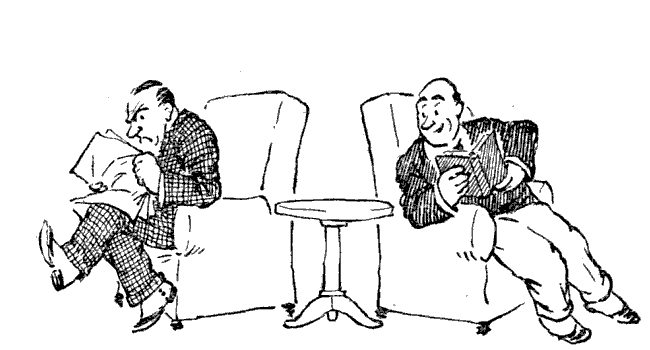
"There's one thrilling bit where—"
"Yes, I've—"
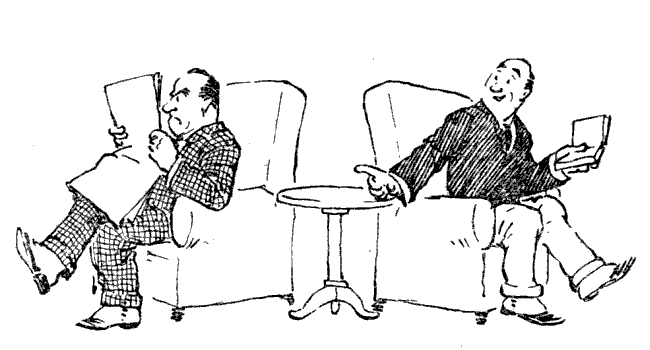
"By Jove, it's exciting!"
"I've read it."
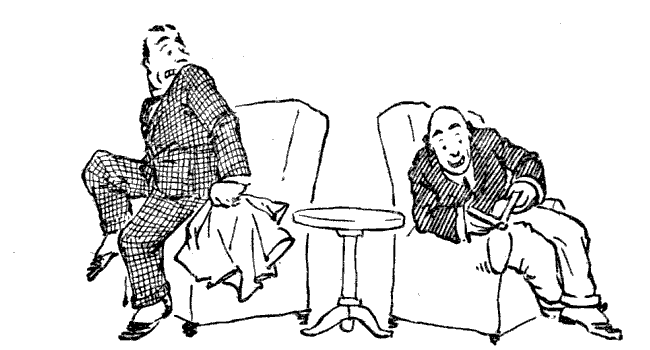
"—but I must read it to you."
"I've read it."
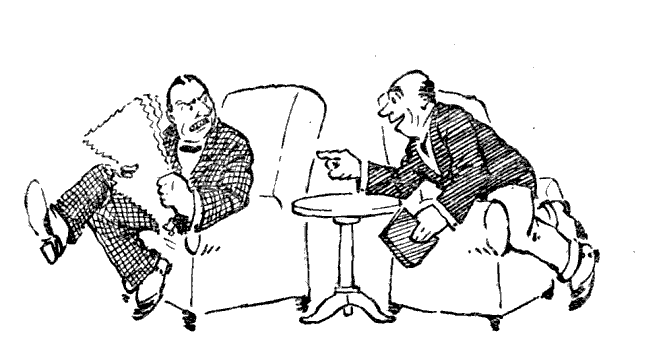
"—the hero—"
"—read it."
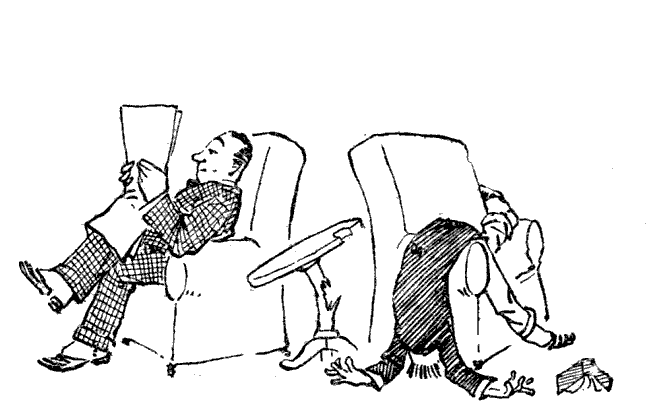
"—enjoy it."
"I've read it."
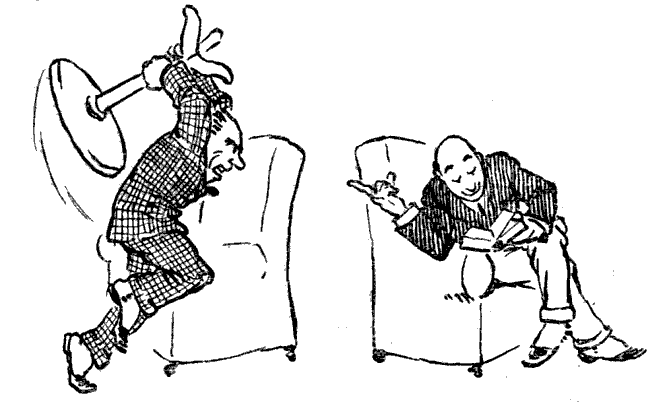
"I know you'll—"
"I've read it."