Volume 158 — THE BURIAL OF DUNDEE.
Reading edition
"Dundee is dead," said my wife, returning from her morning visit to the kitchen.
"I am very sorry to hear it," I replied, laying down the newspaper on the breakfast-table, at which I still lingered; and indeed I was sorry. Dundee had been our household cat from the earliest days of our married life, from the time when he was a tiny kitten the colour of marmalade, which had earned him his name.
"Cook is very much upset," my wife continued.
"Her distress does her credit," I answered.
"She talks of leaving."
I must confess with shame that a pang acuter than the first went through me at the news, for Cook was one of those rare artists who understands the value of surprise and never rides success to death.
"Ask her to reconsider her decision," I said.
"I have," said my wife, "and she remained immovable."
"Perhaps when the first shock has worn off?"
"There is just a chance."
"Yes, I am sure you can persuade her," I concluded, preparing to leave for my office.
"Before you go," interrupted my wife, "what are we going to do about the burial?"
"How does one usually dispose of dead cats?" I asked. "I thought the dustman—"
"Out of the question."
"I know it is forbidden by the by-laws of the Corporation, but a shilling——"
"How stupid you are! If anything were to decide Cook to go it would be handing over Dundee's remains to the dustman. You know how particular Cook is about funerals."
I knew indeed. The rate of mortality among her friends and relations was abnormally high, and on account, as I suspect, of her skill in cookery she was in frequent demand as a mourner. By continual attendance she had cultivated a nice sense of what was fitting on these occasions and posed as an authority on the subject.
"Very well, then, let's have him buried," I said.
"Where?"
"In our garden."
"Who by?"
"Palmer or Emily."
Palmer and Emily are respectively the parlour- and house-maid.
"Both would say it was not the work for which they were engaged. They would leave at the same time as Cook, if I asked them."
"Who else can we get?" I asked.
"Yourself," my wife made answer.
"Me? But I can't be seen by all the street burying a cat." I should explain that our only garden is in front of the house.
"If you wait till it is dark you needn't be afraid of anyone seeing you," protested my wife.
"And run the risk of being detected by some suspicious policeman. No, thank you."
"Then if you won't do it yourself you must find someone who will. It is our last hope of persuading Cook to stay."
"By heaven!" I cried, looking at my watch, I am a quarter-of-an-hour late. I must run."
This was my customary device to evade the embarrassing dilemmas which my wife not infrequently thrust upon me at this hour. So for the moment I escaped. All day in the office I was fully occupied. From time to time the memory of Dundee lying stark in the basement obtruded itself upon my thoughts, but I dismissed the vision as one does a problem one has not the courage to face.
The problem remained unsolved when I stepped out of the train on my return from the City. To gain time for reflection I resolved to make a détour. As I struck into an unfamiliar side street, I looked up, and there in front of me stood an undertaker's shop.
The inspiration! I entered. From the back premises advanced to meet me the undertaker, with a visage tentatively wobegone, not yet knowing whether I was widower, orphan, businesslike executor or merely the busybody family friend. I unfolded my difficulty. Beneath the outer crust of professional melancholy there evidently seethed within the undertaker a lava of joviality.
"Certainly, Sir, certainly," he said. "It is not perhaps strictly in my line, but one of my assistants will be delighted to earn an extra shilling or so by obliging you. What name and address?"
I joyfully gave both and made my way home.
Midway through dinner came a ring at the front-door bell. Palmer interrupted her service to answer, and returned to me with a card on a salver.
"A gentleman to see you, Sir," she announced.
"How strange, at this hour! Who can it be?" asked my wife.
"The gentleman to bury Dundee," I explained in a lowered voice, as I passed the visiting-card, deeply edged with black, across the table to her.
Next morning my wife was able to announce that Cook had consented to stay. The burial of Dundee by a real undertaker had gratified her sense of the correct. I departed to the City filled with self-complacency.
For a month I dwelt in this fool's paradise. Then one evening my wife gently broke the news.
"I have something serious to tell you. Cook has given notice."
"Who is dead now?" I asked.
"No one. She is engaged to be married."
"Married?"
"Yes, to the young undertaker."
"What young undertaker?"
"The one who buried Dundee."
It was too true. At supper, after the inhumation, a mutual esteem had sprung up that rapidly ripened into love. The enterprising young journeyman, so enamoured of his calling that he consented to inter dumb creatures in his leisure time, had evidently discerned in Cook, with her wealth of funeral lore, a helpmeet worthy of himself; while Cook on her side, conquered by his diligence and discretion, considered she had secured a respectable settlement for life, with the prospect of obsequies of the highest class for herself.
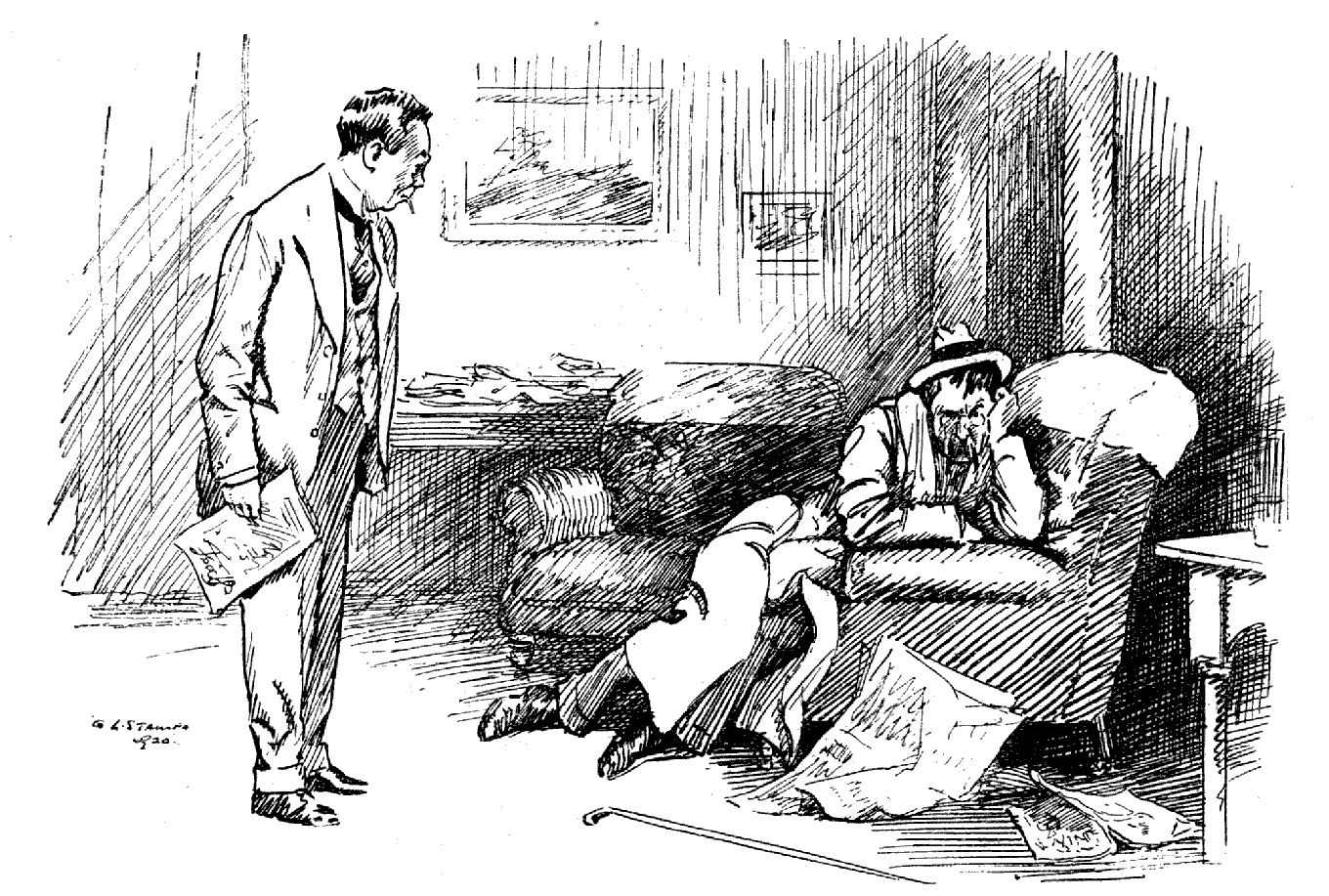
Cheery Member (to Club pessimist). "Hullo, old chap! Having a bad crossing?"
CLERICAL EDUCATION.
[The Rev. Kennedy Bell, in The Daily Sketch, deplores the dreariness of parish magazines and suggests, with a view to brighten their contents, that clergymen should serve an apprenticeship on the daily Press.]
The Reverend Mr. Kennedy Bell Is wholly unable to say all's well With the state of our parish magazines, And is moved to indicate the means Of making their pages bright and snappy And bored subscribers cheerful and happy. Now the most original of his hints For galvanizing these dreary prints Is this: That every parson, before He aspires to be parish editor, Should join the staff of a leading daily And learn to write genially and gaily. It may be a counsel of sheer perfection, And yet, perhaps, on further reflection, We may admit that something is gained By the plan of having clergymen trained In the very heart of the Street of Ink To paint their parish magazines pink. So generous laymen may haply decide That it may be worth their while to provide Each Kennedy Bell with stepping-stones To rise to the height of a Kennedy Jones. But others, a small and dwindling crew, Possibly fit, but certainly few, And cursed with a most pronounced capacity For suffering from inept vivacity, Would gladly be reckoned as unenlightened Could they keep one class of journal un-"brightened."
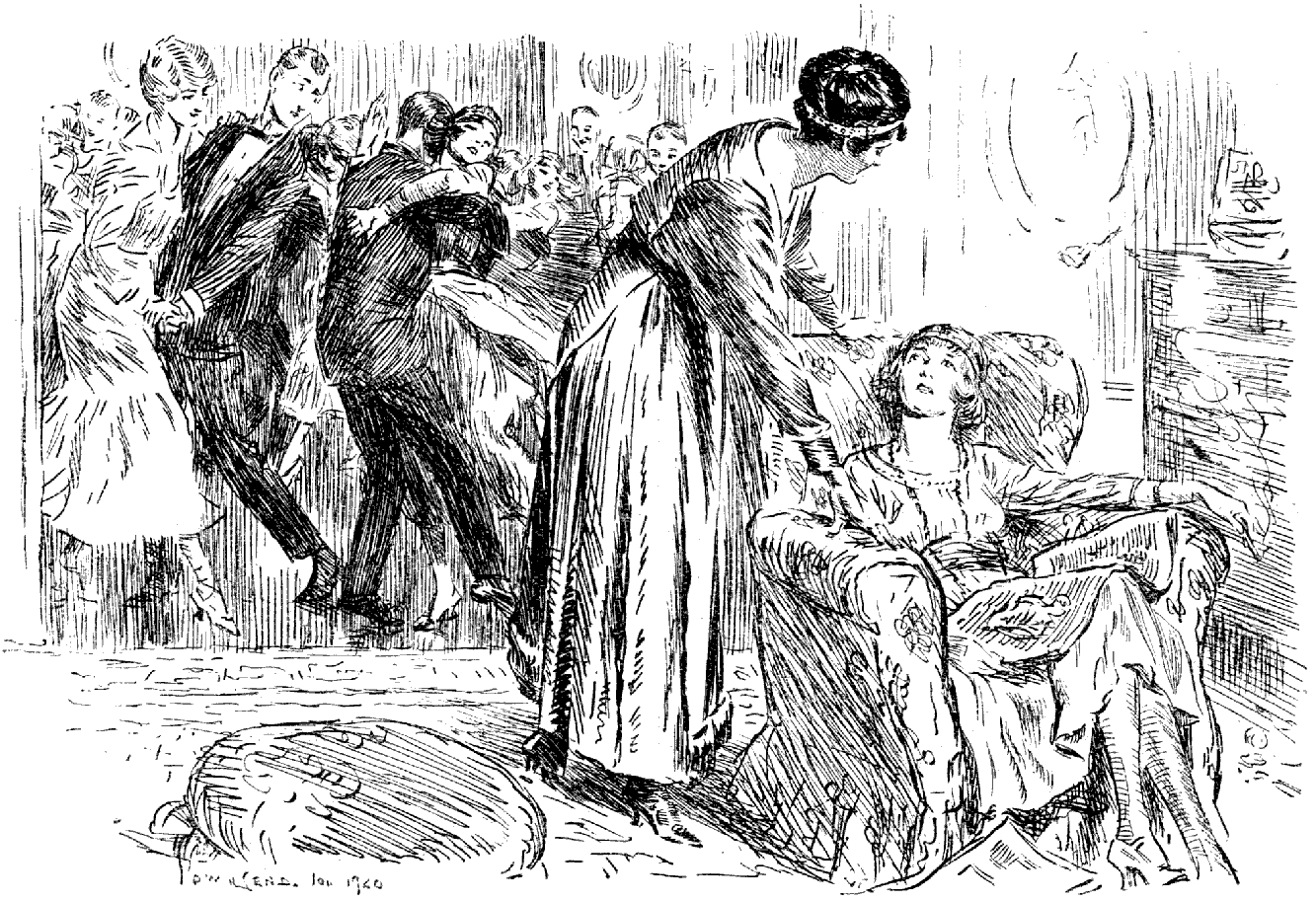
"My dear, you are not dancing."
"No—most provoking. I mislaid my partner at Paddington, and he hasn't the faintest idea where the dance is."
THE PASSING OF THE LITTER.
It happened only a couple of weeks ago, but the horrible memory comes back to me as if it only happened yesterday. It was my own fault, because with a telephone loose about the place one ought not to encourage other pets.
"Well," I said to Sibyl, "there we are, and we must make the best of them."
Sibyl sniffed as she usually does when these periodical occurences happen in our house.
"Which of them are you going to keep?" she asked, "and is it really necessary to keep any of them?"
"Well," I said; "but——"
"What I mean to say," said Sibyl, "better do away with them when they are quite young. It would be far more humane."
"I am with you up to a point," I said; "I admit they are not a very prepossessing lot."
"How they came to be born at all is what I cannot understand," said Sibyl, who is always like that when trying to be serious.
"Well," I said, "I have decided to keep one of them—No. 1."
"But surely," said Sibyl, "that the most delicate one of the lot."
That, I well knew, was quite true. Whether I should ever rear No. 1 was a matter for time to prove. It was so delicate that once or twice already it had been on the verge of collapse, but I had rallied it each time.
"As for the others," I said, "we shall have to get rid of them."
I need not go into painful details, but the thing was easily done. That very evening, unfortunately, through an oversight, No. 1 perished also.
For this I blame McWhirter.
"The number of my bus is 21," he said in the theatre buffet that night; "by the way what's yours?"
"Whisky," I said absent-mindedly, "and not much soda."
And it was only after I had drunk it that I realised my error. It was then too late.
And that is how New Year Resolution No. 1—the most delicate of the litter—passed away at the early age of one week.
Our Plutocratic Sportsmen Again.
"Wanted, set of gold clubs, with bag, for lady."—Local Paper.