Volume 150 — AT THE PLAY.
Reading edition
"Fishpingle."
Sir Geoffrey Pomfret, "that almighty man, the county god," claimed to exercise the same divine right over the souls of his village that he exercised, in the matter of breeding, over the bodies of his cattle and pigs. Nothing, I think, has brought the present War more closely home to my bosom than the humours of this feudal relic—taken in all seriousness by everyone, including the author. It seems almost inconceivable that Mr. Vachell's play deals with conditions that still survived only a few years ago. Yet the Squire's devotion to the science of eugenics establishes its date as quite recent. It was his sole taint of modernity; and indeed where his own son's marriage was concerned he omitted to apply his scientific principles, and made a choice for him in which no regard was paid to eugenics, but only to established social traditions.
At first the play opened up prospects of a pleasant gaiety. A love scene, conducted in a rich Western brogue, between the Squire's footman and his still-room maid, and the embarrassment caused by her eagerness to learn the philosophy of "eujanics," were full of promise. It was confirmed by the appearance of Mr. Ainley, whose manner reminded us of his many triumphs in the art of eccentric detachment. His part—the title-rôle—was that of Sir Geoffrey's faithful butler, on such familiar, though respectful, terms with his master that the two sipped port together in the former's room in broad daylight while discussing family matters. They took an unconscionable time about it, but, as I said, it promised well. However, Mr. Vachell had other designs than our mere amusement. We were not to have our comedy without paying for it with our heart's blood. Very soon the shadow of melodramatic pathos and mystery crept over the sunny scene. Fishpingle takes a box from a cupboard and glances at a miniature and a bundle of letters. There is illegitimacy in the air, and a lady near me in the stalls confides to her neighbour that "he's the Squire's half-brother." I can't think where she got her information, for the rest of us never learned the facts of the mystery till the very end of the evening, and even then the details of Fishpingle's origin only transpired (as they say) under extreme pressure arising out of his dismissal by his master on the strength of a violent disagreement about fundamentals.
Sir Geoffrey's father, it seems, had before his marriage run away with a girl not of his own rank, who had generously refused to spoil the family tree by marrying him; and Fishpingle was the result. You might judge from the peculiarity of his surname that the matter was taken lightly by his parents. But you would be wrong. His mother died when he was born, and his first name (for I cannot call it a Christian name) was Benoni, which, being interpreted, means "the child of sorrow." Sir Geoffrey's grandmother, who had discouraged the legal adjustment of the relationship between the lovers, had tried to repair matters by educating Fishpingle above the obscurity of his irregular birth; hence his comparative erudition, rare in a butler.
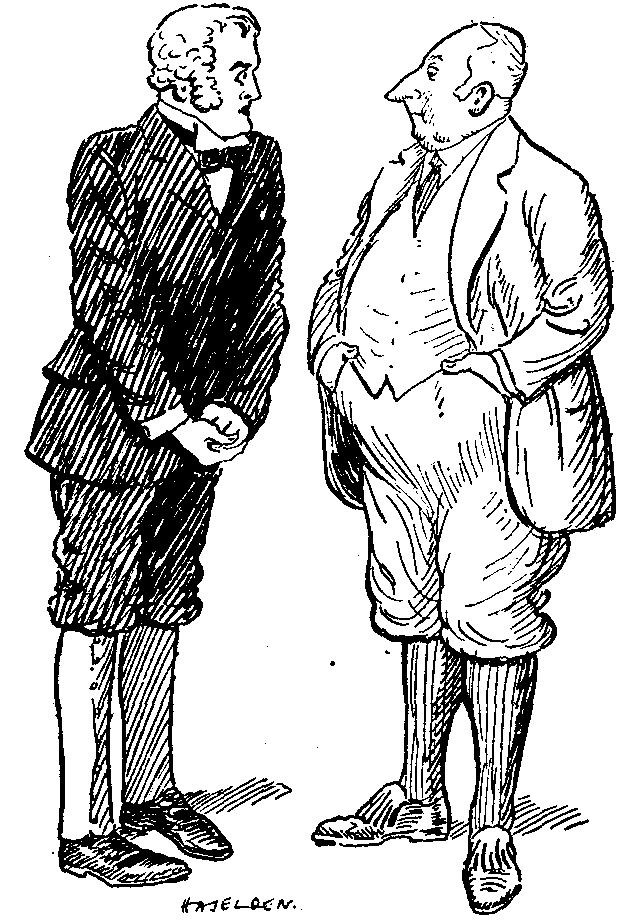
THE BREED OF THE POMFRETS.
Fishpingle (to himself). "How anybody can fail to see the extraordinary family likeness between us I cannot imagine."
Fishpingle.... Mr. Henry Ainley. Sir Geoffrey Pomfret. Mr. Allan Aynesworth.
Now the opening of the play had put me into a mood which was not the right one for the reception of this extract from a deplorable past. Some comedies would be all the better for a little tragic relief; but this was too much. Mr. Vachell had no business to give his play a title like Fishpingle. He should have called it "Nature's Nobleman, or The Tragical Romance of a Faithful Butler's Birth," and then I might have known what to expect. As it was I felt aggrieved. It was not, of course, a question of asking for my money back at the doors (critics, to be just to them, never do this in the case of a complimentary seat), but I felt I had a right to protest against this attempt to harrow my heart-strings, attuned as they were to the key of comedy, with a painful drama dating back to more than half a century before the rise of the curtain, and with its chief actors all dead. And the irritating mystery in which it was wrapped only made things worse. Further, I suffered a considerable strain on both my head and my heart in consequence of obscure hints (vaguely involving a photograph on his mantelpiece) as to the reason why Fishpingle remained a bachelor to the bitter end.
But I am ashamed to appear flippant, for Mr. Ainley played with exquisite feeling and a fine sincerity. And I have to thank Mr. Vachell for giving us some excellent studies of character—not character developed before our eyes by circumstance (except perhaps a little at the last), but admirably observed as a kind of fixture to be taken with the house.
And if the play is not quite on the high level of Mr. Galsworthy's The Eldest Son, which it faintly recalls, it is much more worthy of Mr. Vachell's gifts than the poor thing, Penn, which died so young. Also he is very much more fortunate this time in his cast. Miss Marion Terry, as Lady Pomfret, was a pattern of sweet graciousness; and Mr. Allan Aynesworth was at his happiest as Sir Geoffrey. And the two pairs of lovers, Mr. Cyril Raymond and Miss Maud Bell above stairs, and Mr. Reginald Bach and Miss Doris Lytton below (they were really all of them on the ground floor, the butler's room being the common trysting-place), served as delightful examples of natural selection—both on their own part and that of the management—and were as fresh and healthy as the most eugenical could desire.
O. S.
"Daddy Long-Legs."
Daddy Long-Legs is a pleasant American sentimental comedy made by Jean Webster out of her very jolly book, and not so sticky as some of our importations of the same general type. The four Acts are phases in the development of Judy (or Jerusha) Abbott, orphan; and, as normally happens in book-plays, development is extremely abrupt. Act I. shows us Judy as the drudge of the orphanage breaking into flame of rebellion on the day of the visit of the trustees. Naturally the trustees are all trustees pour rire, except one real good rich man, Jervis Pendleton, who admires the orphan's spirit, and decides that she is to have her chance at his charges; but is on no account to know her benefactor.
In Act II., a year later, Judy is not merely the most popular but the best dressed girl in her college. She still dreams about her unknown benefactor, whom she calls Daddy Long-Legs, and assumes to be a hoary old man. Pendleton comes to Commem., or its equivalent, to have a peep at his ward, and loses his heart. In the Third Act, three years later, our heroine is a famous author, and Pendleton, coming (still incog.) to propose, is refused by a Judy who has taken to worrying unduly (and not altogether convincingly, if you ask me) about her lack of family. And, of course, in Act IV., wedding bells.
Miss Renée Kelly has a charming personality, and a smile which alone is worth going to see. She trounced the matron and the incredible trustees with a fierce fury, and seemed to have easy command of the changes of mood and tense which her fast-moving circumstances required. A pretty twinkling star. Mr. Charles Waldron is a skilful actor. If he, perhaps, grimaced a little too much by way of not letting us miss the obvious points of the little mystery, he made as admirable a proposal of marriage as I have ever heard on the stage (or off it for that matter, with perhaps one exception); but to suppose that so accomplished a lover would accept a mere mournful shake of the head as a final refusal is simply too absurd. Miss Fay Davis made quite a little triumph of gentle gracious kindliness out of one of those potentially tiresome explanatory parts without which no mystifications can be contrived. Miss Kate Jepson is a comédienne of rich grain, and gave a very amusing study of the hero's old nurse. Miss Jean Gadell, that clever specialist in dour unpleasant stage women, made a properly repulsive thing out of the matron of the orphanage. Mr. Hylton Allen scored his points as a comic lover with droll effect. If the distinctly clever children of the home (Judy excepted) had been effectively put on the contraband list I should not have worried. They were unduly noisy (for art, not for life perhaps), and they overdid their parts, being not only rowdy in the absence, and abject in the presence, of authority, but different kinds of children—not merely the same children in two moods.
Altogether a pleasant play pleasantly and competently performed.
T.
"Cabinet Leekage."—Daily Paper.
Now why, we wonder, do they spell it that way?
Alleged Cannibalism in the German Navy.
"The prisoners got the same food as the submarine crew. Here is the bill of fare: Breakfast consisted of coffee, black bread, submarine commander and he pilot."
Provincial Paper.
"Jimmy Wilde, the fly-weight champion, took part in two contests at Woolwich on Saturday, winning them both with great ease. Darkey Saunders, Camberwell, was beaten in three months."—Burton Daily Mail.
The reporter also seems to have been knocked out of time.
"If the area of the garden cannot be increased, the quantity and quality of the crops should be improved by the extra hour of daylight."—The Times.
For this discovery our contemporary is hereby recommended for the famous Chinese Order of the Excellent Crop.
"A letter sent on Friday saying, 'We are starting a central mess for 1,200 men on Monday,' and asking: 'Can you send cooks?' brings as a reply 24 trained women cooks, who roll up their sleeves and cook breakfast for the number stated inside 12 hours!"
The Times.
What was breakfast to some must have been supper to others.