Volume 150 — Field-Marshal Earl Kitchener.
Reading edition
Born June 24th, 1850. Died on Service June 5th, 1916.
Soldier of England, you who served her well And in that service, silent and apart, Achieved a name that never lost its spell Over your country's heart;— Who saw your work accomplished ere at length Shadows of evening fell, and creeping Time Had bent your stature or resolved the strength That kept its manhood's prime;— Great was your life, and great the end you made, As through the plunging seas that whelmed your head Your spirit passed, unconquered, unafraid, To join the gallant dead. But not by death that spell could pass away That fixed our gaze upon the far-off goal, Who, by your magic, stand in arms to-day A nation one and whole, Now doubly pledged to bring your vision true Of darkness vanquished and the dawn set free In that full triumph which your faith foreknew But might not live to see. O. S.
HEART-TO-HEART TALKS.
(Herr von Bethmann-Hollweg and Frau von Bethmann-Hollweg.)
She. You are late again, Theobald. How often must I——
He. Oh, please do not worry me, my dear Martha. After what I have been forced to go through it is a wonder that I am here at all.
She. What—have you been seeing him again? I thought he was away with one of the armies and you would be having a holiday.
He. So did I think; but it was not to be. Holiday, indeed! When do I ever get even a moment in which to think my own thoughts?
She. At any rate I hope he acknowledged what Germany owes to you. Where would he have been, I wonder, if it had not been for your constant devotion to his service throughout this terrible time? Does he realise what that has meant for him and his?
He. Kaisers never realise anything. That's my experience of one of them, at any rate. If you flatter them they smile on you and take all the credit of your work. But I am not cut out of that sort of wood, and the result is that he looks at me as if he had bitten into a lemon by mistake. You know that look, don't you?
She. Yes, my poor Theobald, I know that look. It makes everything black and uncomfortable. But if he is like that and does not consider your feelings, why do you continue to serve him? You should assert yourself, and if he does not improve you should send in your resignation. After all there are better things in the world than to be Chancellor to a man who does not appreciate your work.
He. Of course I have thought of that, but I have put the idea aside. If I were to resign now it would only give joy to my enemies, and they are the last people in the world to whom I wish to give joy. He won't get rid of me just yet, for he finds me too useful as a lightning-conductor. Still, I know that some day he'll give me a push by sending me a letter condoling with me on the state of my health, and then good-bye to the office of Chancellor.
She. And, for my part, Theobald, I hope that time will come soon, though I shudder to think what will become of the country when you go. However, we won't talk of that any more. Tell me rather what he has been saying to you to-day.
He. Oh, to-day he was displeased with my speech in the Reichstag.
She. Displeased with that beautiful speech so sun-clear and patriotic! Why, the man must be mad. Never in all my life have I read anything so patriotic and convincing. What does he complain of?
He. What does he not complain of? First, he is angry that I defend myself against attacks made in an anonymous pamphlet.
She. Then I am sure he wrote it himself or inspired it.
He. I have not the evidence to prove that, but it is, of course, possible. It would be just like him to play me a trick like that. But what chiefly provoked his anger was what I said about the naval battle.
She. Yes, I remember you said that England was not thereby defeated. If you will pardon me, Theobald, I myself thought that this was a rash statement.
He. So you're going to turn against me too, are you? It was a true statement, whatever he or you may say. They lost ships, yes, and we lost ships too, and we can afford to lose ships much less that the English can. What is the use of pretending that we've won the War and beaten down England because our sailors shot straight and fought bravely? So did the English, and they've got more ships left than we have, more's the pity.
She. But he has made a glorification speech about it, hasn't he?
He. Yes, he has. In another day or two he will have worked himself up to the point of believing that he commanded our ships in the battle. I know him; but he needn't think I'm going to encourage him in this laughable pretension.
She. Do not think about him any more, but go to bed and have a good sleep.
He. I will try, but the telephone will ring, I am sure, and he will command me to come and see him. (The telephone rings.) There, I told you so.
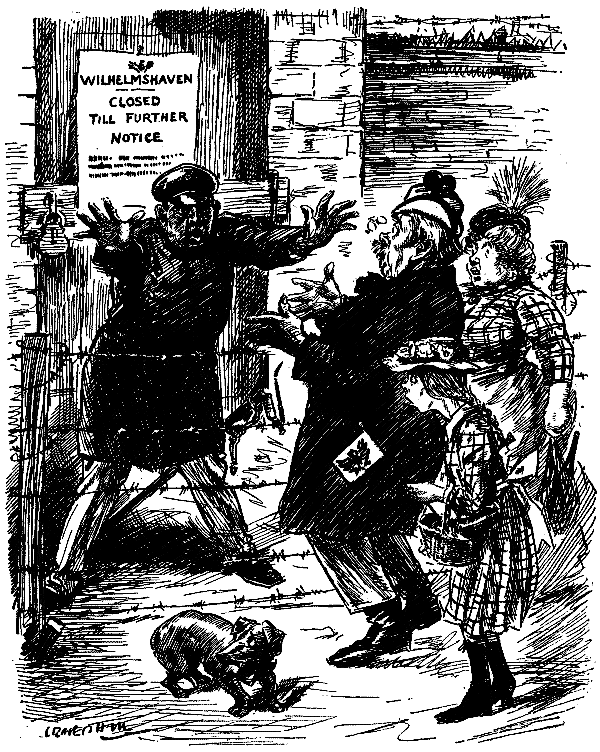
Is it true that the Kaiser intends to confer upon Admiral von Scheer the title of Baron von Sheer-off?
Our Classicists.
"Another relic was a torpedo propeller. 'It came from a German submarine that got into an awkward place rather foolishly—but de mortibus, and the rest of it.'"—Provincial Paper.
Never mind about the rest of it. "De mortibus" is enough, thank you.
"Deep down in the ship I came across a strange sight. Some twenty or thirty boys, seated at desks, were being taught the mysteries of compound fractures by a petty officer."—Liverpool Daily Post.
As a preliminary to teaching the German Fleet the art of recurring decimation?
"Private Willie——has returned from France looking extremely robust and well. He will, I understand, enter for a course of instruction at Baal College, Oxford, before proceeding again to the front."—Irish Paper.
As this new foundation, originally intended no doubt for the German Rhodes Scholars, has apparently been diverted to better use, the authorities might now alter the name.