Volume 150 — STUDIES IN FRUSTRATION.
Reading edition
I.
The scene was the comfortable spacious breakfast-room in the Bishop's Palace. His lordship sat nearest to the fire; the bishop's wife presided over the fragrant coffee-pot, and the curate, their dine-and-sleep guest, sat opposite the bishop and farthest from the warmth. As a curate this position was his due. Some day he also would be a bishop, and then he too would know what it was to intercept the glow.
The curate was looking dubiously into the recesses of an egg. His fine Anglican features underwent a series of contortions.
"I am afraid," said the bishop, "that that egg is not a good one."
"You are right, my lord," said the curate. " It is not only bad, it's alive. I think it's the worst egg that was ever offered me."
II.
The wounded soldier lay in his deck-chair placidly smoking his hundredth cigarette that day. He was not naturally a smoker, but cigarettes arrived in enormous numbers and something had to be done with them.
His visitor sat beside him, note-book in hand. "Yes?" he remarked.
"And then," said the soldier, "came the order to charge. We fixed bayonets and rushed at the Bosches like mad. It was glorious—like the best kind of football match."
The visitor took it all down, and more.
"I remember bayonetting two men," said the soldier, "and then I remember nothing else. And that's six months ago. Still, I'm getting well, and then there's only one thing on earth that I really want with a passionate desire ..."
"I know! I know!" said the visitor, moistening his pencil.
"Never to see any more war as long as I live," the soldier continued.
III.
The aged artist sat in his luxurious studio surrounded by his masterpieces—that is, by the pictures he had never been able to sell.
The gem of the collection stood on an easel in the middle of the room; while a connoisseur, hat in hand, inspected it closely, enthusiastically, breathlessly. Then, coming over to where the artist was resting, he sat down opposite to him and in a voice trembling with emotion asked, "Tell me, how do you mix your colours?"
There was a deep silence, almost painful in its intensity. A drawing-pin fell with a deafening crash.
The venerable painter stood up with a calm and leonine expression. "I use an ivory palette knife," he said.
IV.
The shadows were lengthening in the beautiful garden. It was a warm spring evening. The old sun-dial had just struck seven.
The poet threw aside his book and called his Airedale terrier; the dog, responding in time, eventually reached his master's knee.
Seizing his opportunity, the representative of the Press observed, "You are, I see, fond of dogs."
"Fond of dogs?" replied the poet. "I? I detest them;" and so saying he kicked the Airedale a distance of several feet into the air, so that, falling immediately on the sun-dial, it was transfixed by the gnomon.
As he watched its struggles, thus impaled, the poet laughed the hearty resonant laugh for which he was famous.
V.
The Civil Service clerk so famous for his drollery was entering the office doors at half-past ten in the morning, or exactly sixty minutes past the appointed time. By an unfortunate chance his principal met him, as, alas! he had too often done, at the same tardy hour. "Late again," said the great man, consulting his watch. "I believe that you get here later every day." "Yes," said the clerk, "I do. But then I always stay on and work overtime."
VI.
The eminent publicist replaced his glass on the table and turned to the lady who sat beside him. "My business," he said, "is the manufacture of mustard. I have made a vast fortune out of it."
"How very interesting," the lady replied absently; but the next moment, inspired by a hidden thought, she added with quickened interest, "Please don't think me inquisitive, but how can a fortune be made out of a thing like mustard? People take so little of it."
"Madam," answered the mustard magnate deliberately, "we do not make our fortunes from the mustard that people eat"—
"Yes, yes?" cried the lady eagerly.—"but," he continued, "from what they spill in mixing poultices."
VII.
The famous money-lender one evening arrived as usual at the Casino, but this time only to bid his friends good-bye.
"Not leaving Monte?" they asked.
"Yes, I am," he replied; "I'm going to Rome."
"Rome?"
"Yes, why not? I'm told it's wonderful. I shall be there a month;" and so saying he hurried to his hotel.
Three days later he walked into the Casino again.
"What," cried his friends—"you here? We thought you were going to be in Rome a month."
"So I am," said the money-lender, "and more. I came back for my things, most of which I left here, as it had occurred to me I might not like it. But I adore it. Rome is beautiful, august, sublime. The simple severe beauty of the Vatican, the vast solemnity of the Campagna! It is indeed the eternal city. Let me keep Rome!"
And again he hurried away.
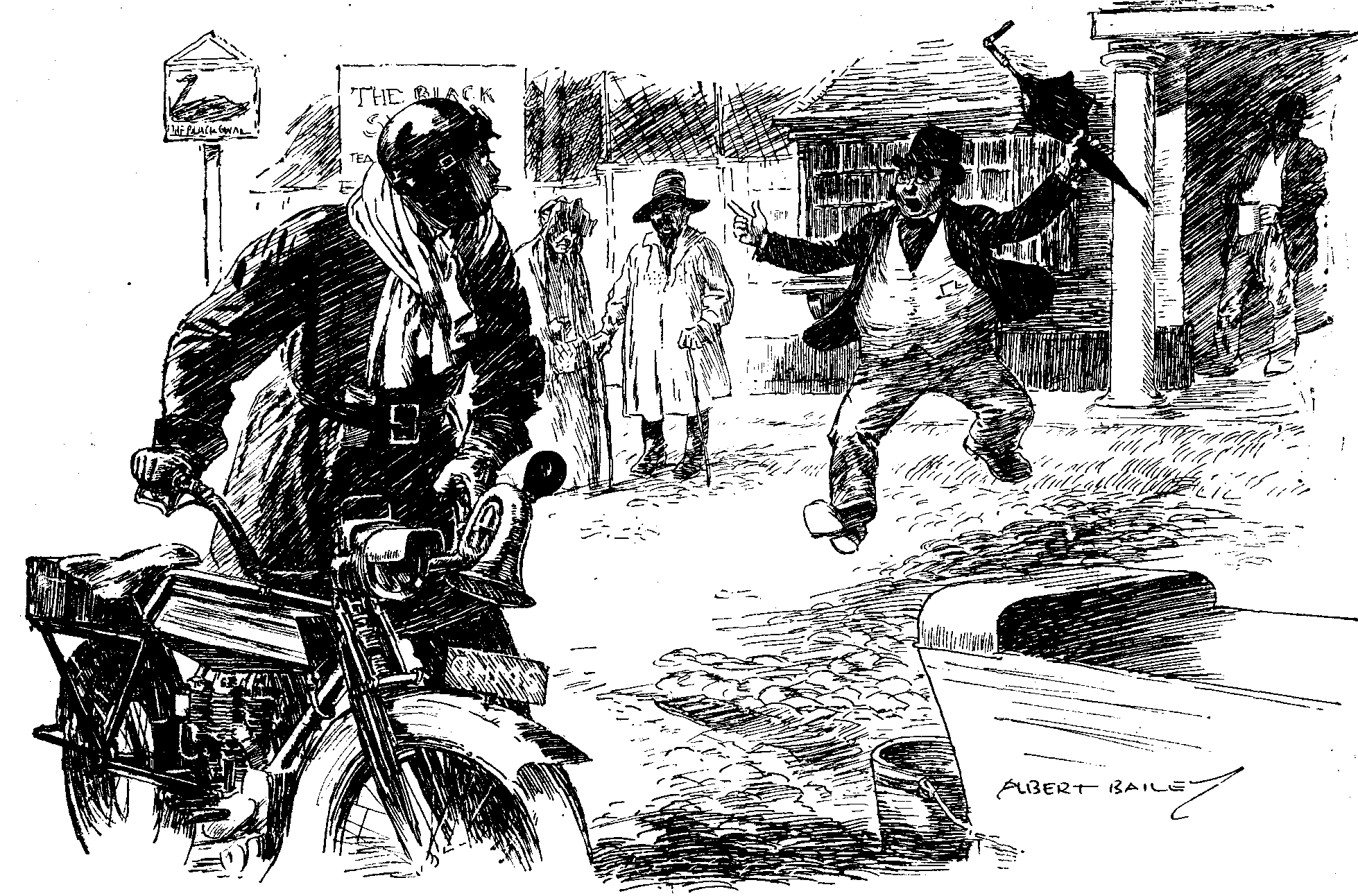
Excited individual (who has picked up umbrella left in bar, to despatch rider just leaving). "Hi! Mister. Is this your umbrella?"
A Long Turn.
"To-morrow evening Miss Phyllis Bedells makes her final appearance at the London Empire, where she has danced without interruption for nine and a half years."
Bristol Times and Mirror.
De Mortuis....
"Tired of this much worn physical life Chief George Moshesh bursted the bands of morality as under Tuesday, November 2nd."
South African Paper.
"Tenders invited for alterations and additions to the late Mr. Waata W. Hipango, Pitiki, are hereby cancelled."—New Zealand Paper.
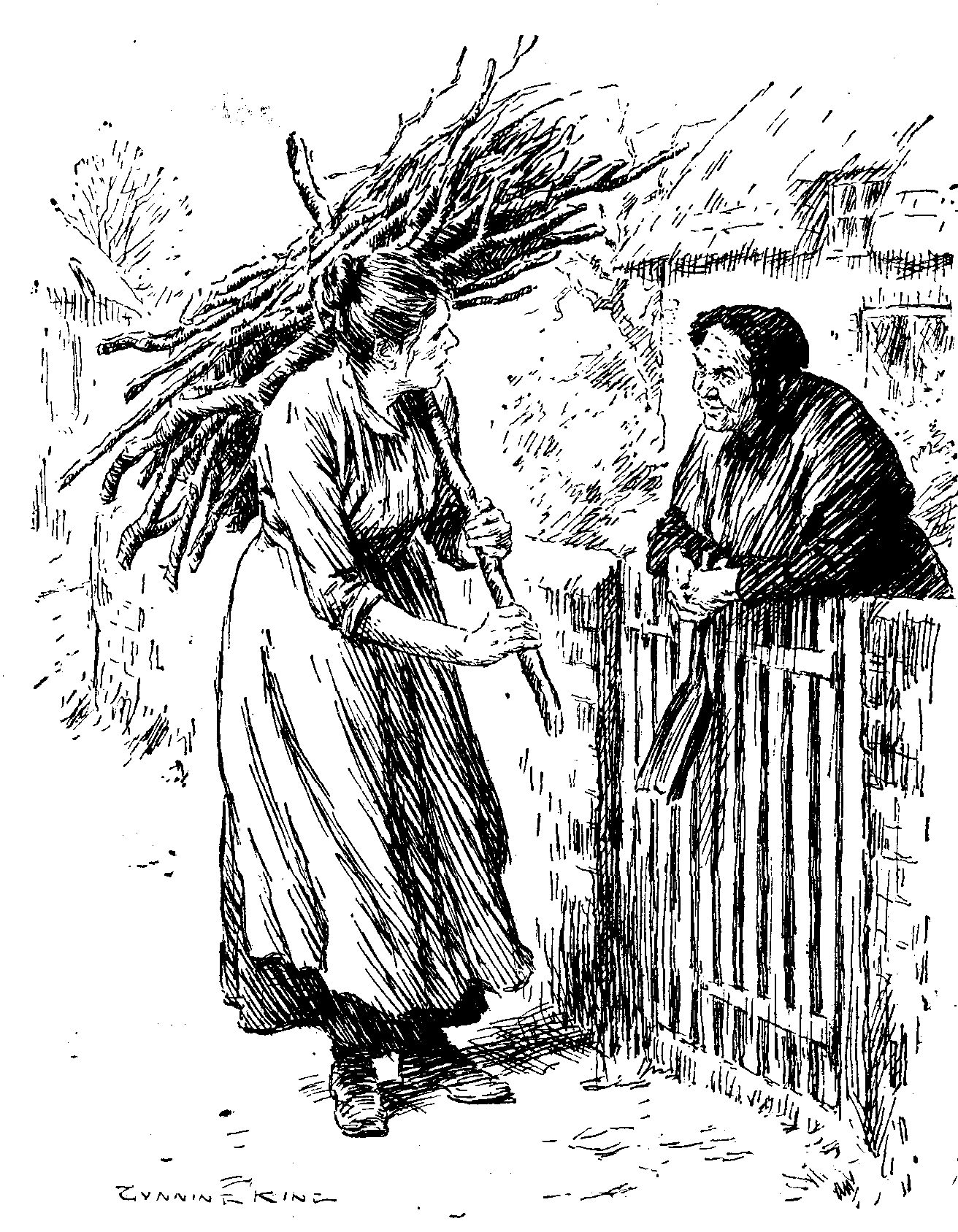
Neighbour. "And how does your son like his training?"
Proud Mother of Recruit. "Oh, he's very happy. But he says they do take him very long walks."