Volume 150 — ESSENCE OF PARLIAMENT.
Reading edition
(Extracted from the Diary of Toby, M.P.)
House of Commons, Monday, January 17th.—To-day's sitting included episode justly described by Redmond as miraculous in relations between Ireland and her sisters in the family of the Empire. In Committee on Military Service Bill question promptly raised on exclusion of Ireland. Amendment moved by Unionist Member for Belfast to make Bill operative in the three Kingdoms.
Significant note struck at outset by Prime Minister. Overwhelmed with work, unable to take personal charge of Bill in Committee, he deputed task, not to Home Rule Irish Secretary, to whom it officially belonged, but to the Unionist Colonial Secretary.
In delicate position, Bonar Law acquitted himself with excellent taste, unerring tact. He did not disguise fact that as a Unionist his sympathies were with the Amendment. But he insisted that more would be lost than gained by trying to enforce Military Service on country divided upon the question.
"To anyone who knows the history of Ireland," he said, "who knows the history in our own lifetime, and the part which has been played by Nationalist Members in this House and Nationalist Members in Ireland—to anyone who recalls the state of this country during the whole of the Napoleonic Wars, when Ireland was a constant source of danger to Great Britain, it is not a small thing, it is a very great thing, that for the first time in our history the official representatives of the Nationalist Party are openly and avowedly on the side of Great Britain."
Carson patriotically responded to this harmonious call, rare in discussing Ireland across floor of the House. Regretfully but uncompromisingly advised withdrawal of Amendment moved by Ulster Member.
John Redmond, in speech pathetic in its plea, besought the House to refrain from effort to drive Ireland. The part her people have taken in the War side by side with British comrades was splendid.
"I am," he said, "as proud of the Ulster Regiments as I am of the Nationalist Regiments. If five years ago any one had predicted that in a great war in which the Empire was engaged 95,000 recruits would have been raised from Ireland and that there would be 151,143 Irishmen with the colours, would he not have been looked upon as a lunatic?"
One note of discord came from little group below Gangway on Liberal side. Unable to withstand temptation to obtain mean little triumph, they refused to permit withdrawal of Amendment, as suggested by Bonar Law and accepted by Carson, and it was perforce negatived.
ALL FOR IRELAND—A WAR-TIME HARMONY.
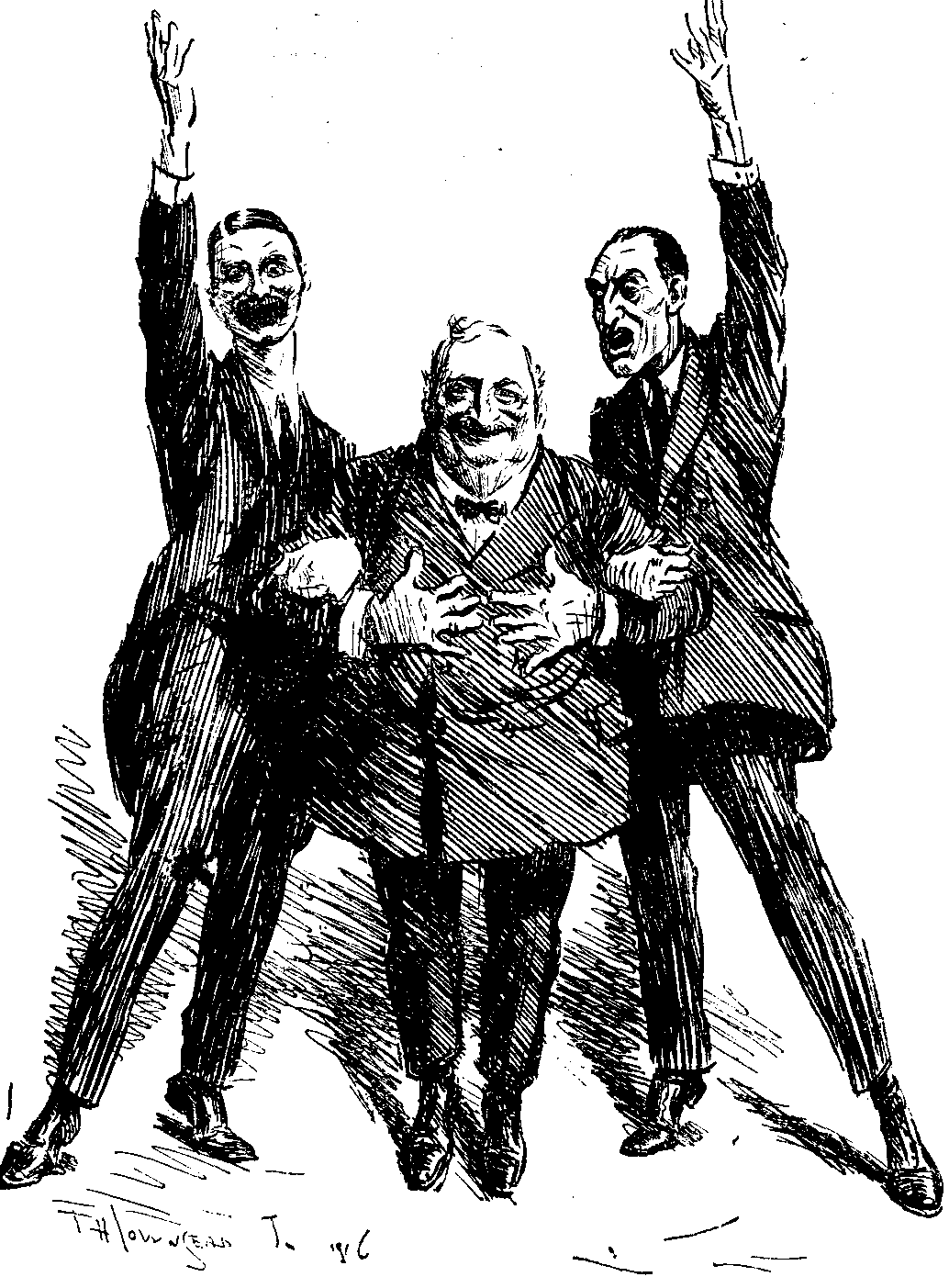
Mr. Bonar Law, Mr. Redmond, Sir Edward Carson.
Business done.—Military Service Bill in Committee.
Wednesday, 2.10 A.M.—House adjourned after ten hours' wrestling with Military Service Bill.
Once upon a time, not so far back, there was an Irish Member who, on his triumphant return to Westminster, took the oath and his seat at 4 o'clock in the afternoon, delivered his maiden speech at 6.50, and on the stroke of midnight was suspended for disorderly conduct.
That a record difficult to beat. The Member for Australia (London address, St. George's, Hanover Square) with characteristic modesty diffidently approached it. Taking his seat last Wednesday, he to-day delivered his maiden speech. It was risky in face of the sound axiom, adapted from nursery discipline, that new Members should (for a reasonable period) be seen, not heard. As a breaker of unwritten law Sir George has extenuation of success. This due to intrinsic merits of speech. Foremost of these was brevity. Furthermore, it was in the best sense a contribution to debate, arising directly out of question sprung upon Committee. No asphyxiating smell of the lamp about it. Sound in argument, felicitous in phrase.
Ivor Herbert had moved amendment to Military Service Bill, bring within its purview all unmarried men as they attain the age of eighteen years. The Bill calls to the colours only those who on 15th August last had reached that age.
"When the flames of destruction are approaching the fabric of our liberties," said Sir George Reid by way of peroration, "let us save our house first and discuss our domestic rearrangements afterwards."
The new Member rose in nearly empty House. Members already aweary of ineffectual talk round foregone conclusion. News that he was on his feet signalled throughout the precincts, Members hurried in to hear. Amongst them came the Prime Minister. Amendment withdrawn.
Business done.—Committee sat far into foggy night, driving Military Service Bill through Committee against obstruction on the part of at most a score of Members.
Thursday.—Both sides unite in welcoming Jack Pease back to Ministerial Position. (Mem.—Commonly called Jack because he was christened Joseph Albert). After filling in succession offices of Chief Whip of Liberal Party, Chancellor of Duchy and Minister for Education, in each gaining general approval and personal popularity, he was one of the sacrificial lambs cut off by reconstruction of Ministry on Coalition principles.
Took what must have been bitter disappointment with dignified reserve.
Having made the personal statement common to retiring Ministers, he did not seat himself on the Front Opposition Bench on the look-out for opportunity to "hesitate dislike" of policy and action of former colleagues. Seeking for chance to do his bit in connection with the War, at request of Army Council he undertook unpaid post of Civil Member on Claims Commission in France. Comes back to Treasury Bench as Postmaster-General, in succession to the Infant Samuel, who, in accordance with the tradition of early childhood, has, since first promoted to Ministerial office, been "called" several times to others.
Sark, always considerate of convenience of public, thinks it may be well to state that it will be no use anyone looking in at Post Office and crying, "Pease! Pease!" Not because there is no Pease, but because there are two—Jack, the Postmaster-General, and his cousin Pike Pease, formerly a Unionist Whip, who has for some months served as Assistant Postmaster-General.
Business done.—In Committee on Military Service Bill.
Thursday.—Fourth night of debate in Committee on Military Service Bill. Concluded a business that might have been as fully accomplished at one sitting. Save for a few immaterial amendments; of the verbal kind, Bill stands as it did when introduced. Scene closed with exchange of compliments between Bonar Law and little band who have succeeded in keeping talk going. He expressed satisfaction, "or perhaps something rather stronger" (this a little dubious), at the way in which opposition had been conducted. They protested it was all due to his conciliatory manner.
And so home to bed as early as eleven o'clock.
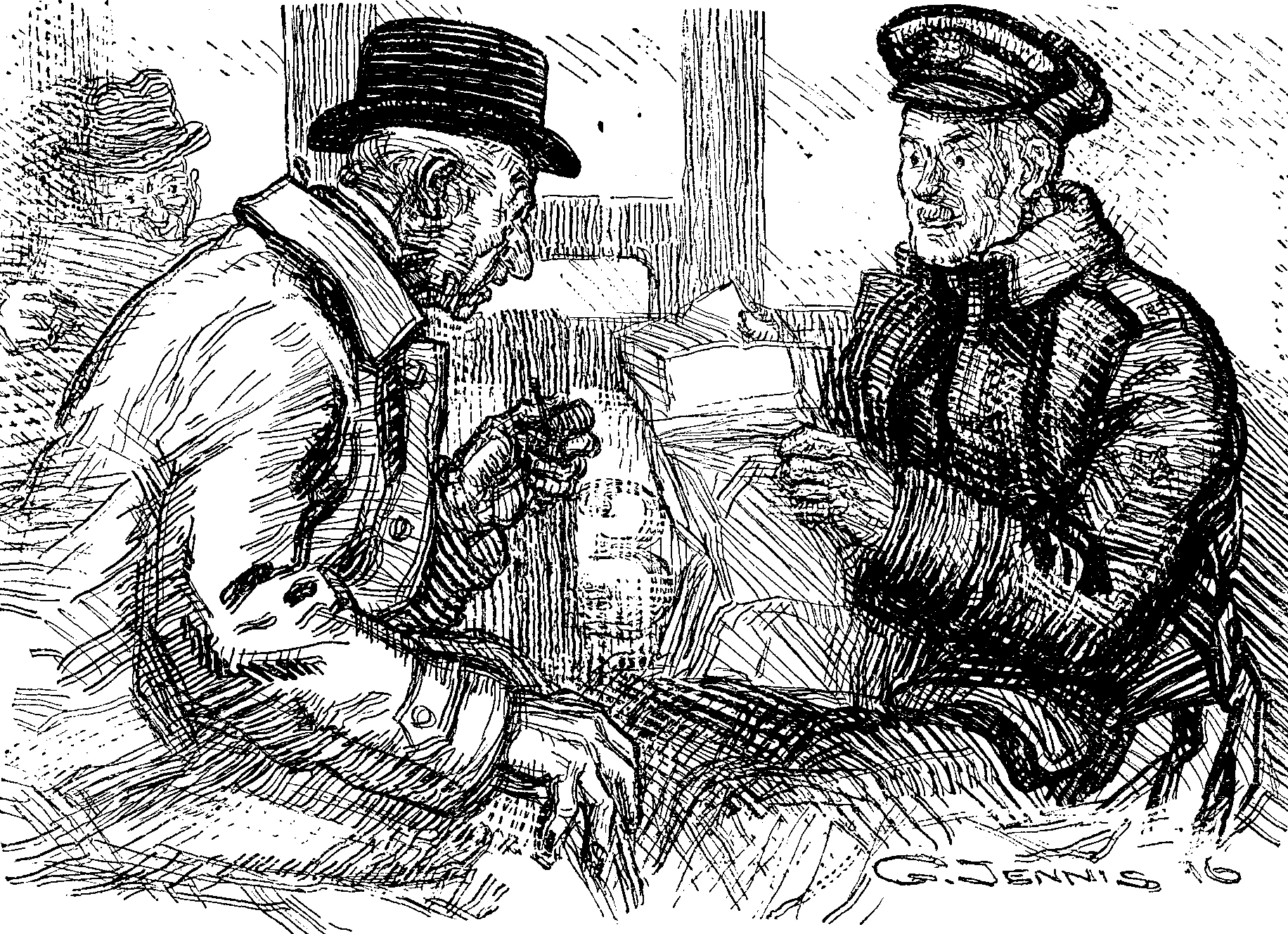
Inquisitive Party. "Ye'll likely be gaun tae Elie?" N.C.O. "No!"
Inquisitive Party. "Than ye'll be gaun tae Pittenweem?" N.C.O. "No!!"
Inquisitive Party. "Then ye'll shair tae be gaun tae Crail?" N.C.O. "No!!!"
Inquisitive Party. "Dae ye think a care a dom whaur ye're gaun?'
Delhi-on-Sea.
"Delhi, Monday,—The P. and O. Steamer Arabia, with the outward mail of the 22nd, arrived here at 1-30 p.m. to-day (Sunday)."
The Beharee.
"Commencing on December 1st the London banks will close at three o'clock, except on Saturday at one o'clock, with a view to assisting recruiting by realising a number of clerks."
Bay of Plenty Times.
Financially and otherwise the bank-clerk is one of our best securities.