THE ROLLING STONE.
Reading edition
At Cambridge, where on field or flood He shone like a Goldie or a Studd, He was an intellectual "blood." He made the grimmest dons unbend, And missed his First, right at the end, For he cut his Tripos—to nurse a friend. Then he wrote a novel. The weekly press Declared it was worthy of R.L.S.; But it wasn't a great financial success. So, after a spell at the Bar, he flew To the rubber-fields in remote Peru, But stayed there only a month or two. For he suddenly conceived a plan Of studying music at Milan, Where he sang in the style of the great god Pan. I heard him sing in the Albert Hall In the chorus of Mendelssohn's St. Paul, And his voice was the loudest of them all. Next he leased a Colorado mine, And dealt in Californian wine, And rented a ranche in the Argentine. But whatever the job and whatever the pay I certainly never knew him to stay Anywhere as long as a year and a day— Except one job, which is not yet done, Though twenty months ago begun, Of holding and hammering the Hun. His horoscope I have never scanned, But as long as there's any fighting on hand The rolling stone has come to a stand.
Irreplaceable.
Evidence of a conscientious and candid objector:—
"I am sure the Rector could not get anyone to take my place, as Cowley is now empty, and there are no loafers about."
Gloucester Citizen.
"The first cases to come before the tribunal were appeals from three Thirsk butchers, for the exemption of their respective slaughtermen. Mr. Johnson said he killed himself about 20 years ago. He thought he would start again."—Darlington and Stockton Times.
Very difficult to repeat the first fine careless rapture of a successful suicide.
"No, while it is a crime to spend money extravagantly on dress, it is just as emphatically one to abstain from it altogether."
Daily Chronicle.
If The Daily Chronicle says so, we accept it. There is no paper for whose judgment we have a more profound regard.
MR. PUNCH'S POTTED FILMS. THE DRAMA OF STUDIO LIFE.
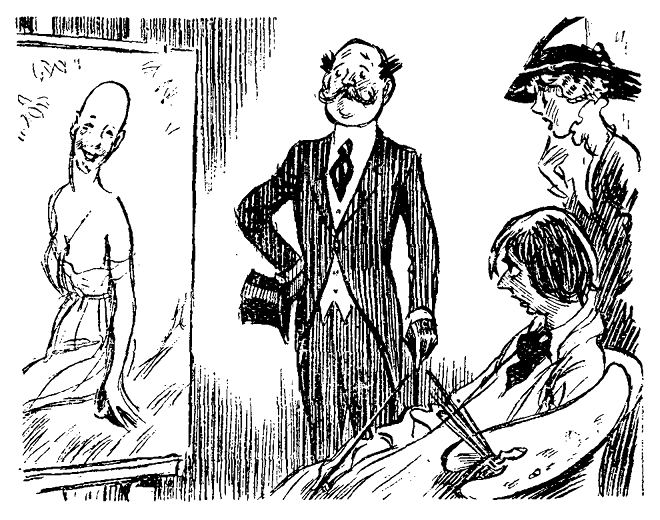
Clarence Allardyce, the rising young artist, cannot in all London find a model worthy to pose for the hair in his masterpiece, 'The Wood Nymph.' On the eve of the exhibition he tells his trouble to his friend, Charles Carfax, who, with his fiancée, has visited the studio.
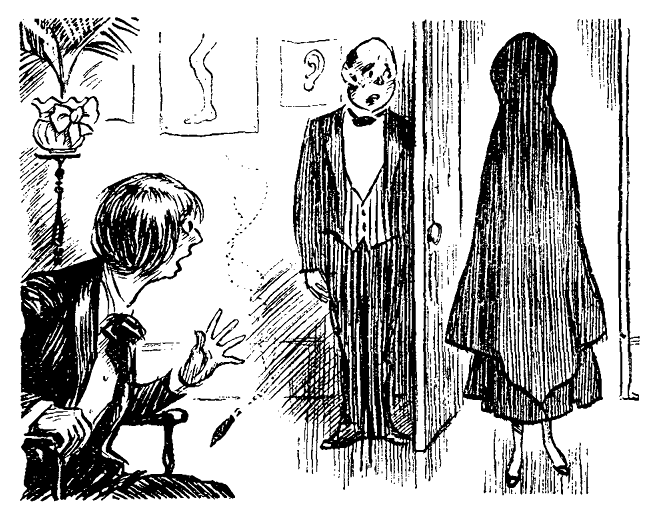
That evening, as he sits in his studio bewailing his lot, a mysterious visitor is ushered in.
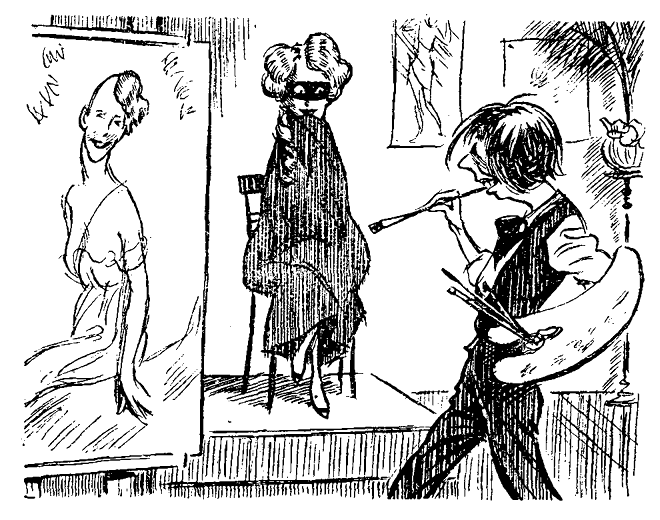
She unveils her head, and in due course the masterpiece is finished.
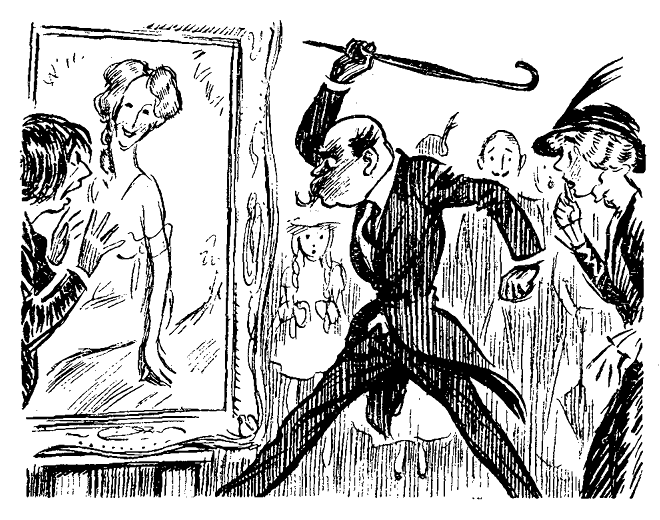
The next day a fashionable crowd throngs Allardyce's studio to view the picture before its departure to the exhibition. Among them is Carfax, who, recognising his fiancée's hair, is overcome with rage and threatens to destroy the picture.
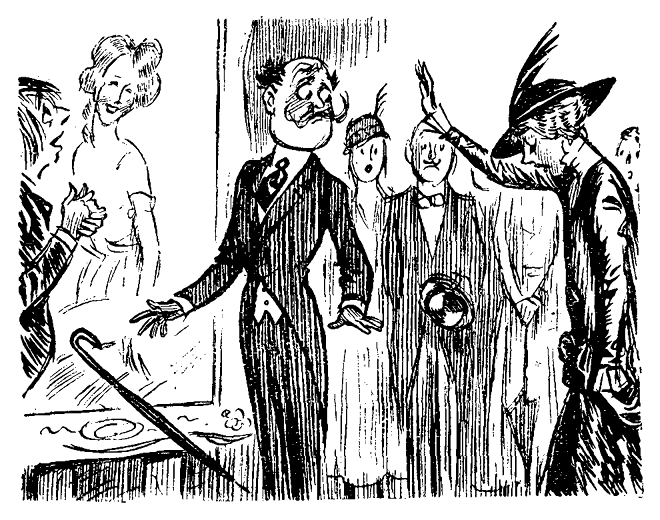
As he is about to execute his fell purpose he is stopped by his fiancée. 'Stay!' she cries. 'It is not as you suppose. It is my hair, but—I wear a wig. I sent it to him by post.' By this noble lie she saves the picture at the cost of her matrimonial hopes.
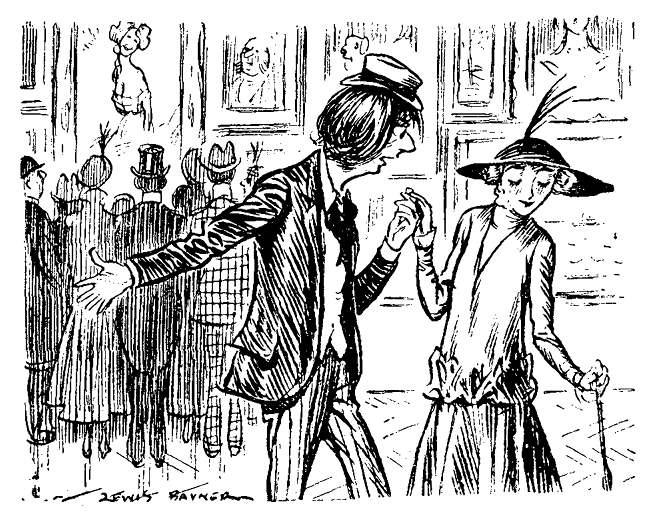
Cast off by Carfax, the heroine visits the exhibition alone. There she is found by Clarence, who asks her to share with him the fame and fortune which she has brought him.
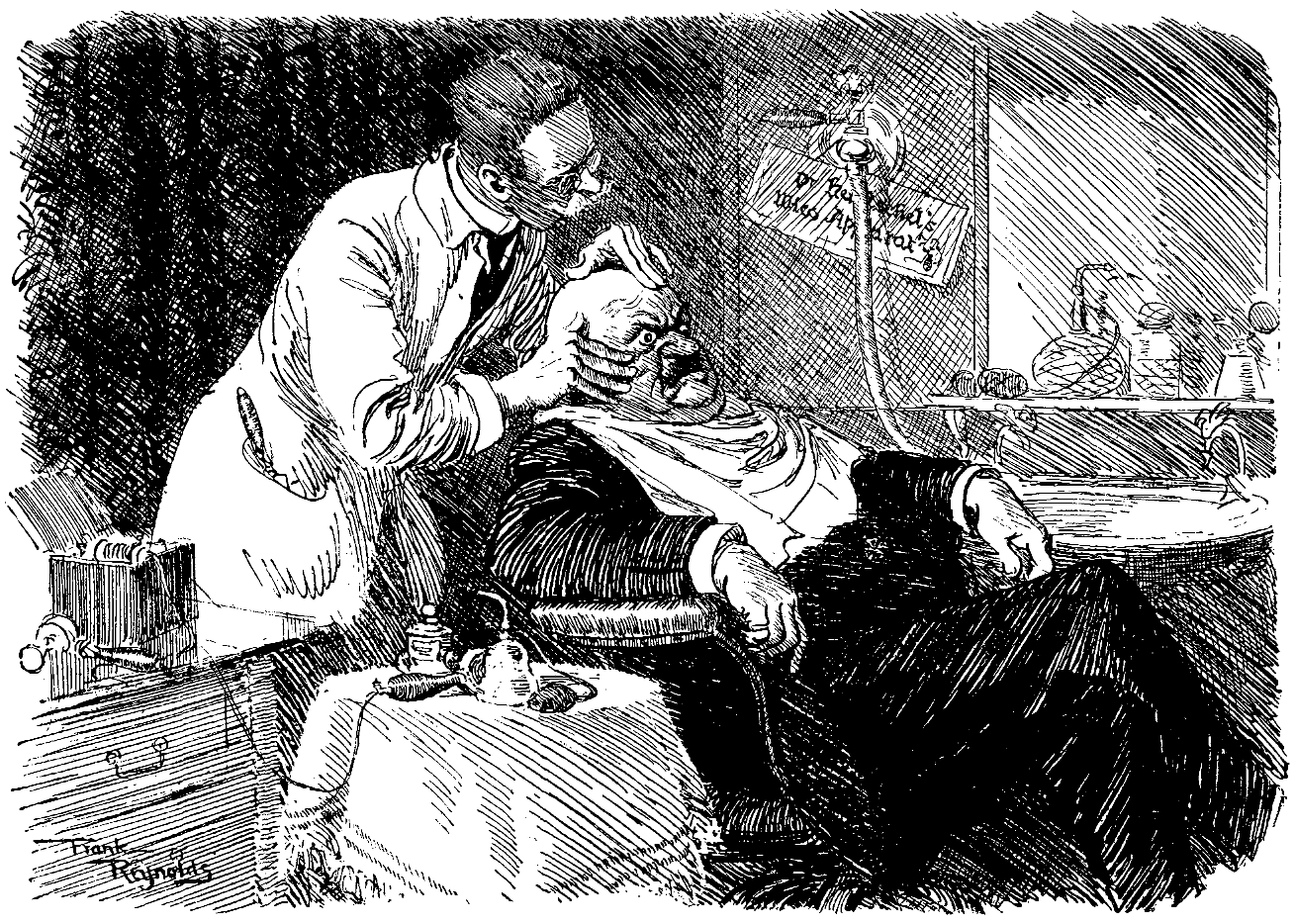
Face Massage Specialist. 'No doubt, Sir, your speeches on Frightfulness have affected your expression.'
Prussian Orator. "Well, you must do the best you can for me. To-night I have to speak on 'Our Love for the Smaller Nations.'"