Volume 147 / Part 1 — OUR NATIONAL GUESTS.
Reading edition
II.
The truth is that the Belgians in Crashie Howe are enjoying a succès fou. There is the enterprising Marie, who thinks nothing of going off on her own, on the strength of an English vocabulary only a fortnight old, overwhelming the stationmaster and boarding an ambulance train full of wounded Belgians at the local station to ask for news of her brothers. (We were all delighted when an adventurous letter miraculously arrived from the Pas de Calais on Saturday and reported that both brothers were well and unwounded.) There is Victor, who, although only thirteen, is already a pupille d'armée and has a uniform quite as good as any fighting man. I can tell you he has put our Boy Scouts in the shade. But Victor is afraid the war will be over before he is old enough to get at it.
Then, again, there is the small Juliette, who is dark, with a comfortable little face constructed almost entirely of dimples, and, at the age of eight, has been discovered knitting stockings at a prodigious pace while she looked the other way. I am afraid Juliette is being held up as an example to other children of the neighbourhood, but I think her great popularity may well survive even that. And there is Louis, who is a marvel at making bird-cages, and Rosalie, whose pride is in the shine of her pots and pans. They are all doing well.
Rosalie, it is true, has had a fearful bout of toothache, so bad that she had to retire to bed for a day. When Dr. Anderson, whose French is very good, had successfully diagnosed the trouble and told her that the only cure was to have the tooth out, she plaintively replied that she had thought of that herself, but, alas, it was impossible, for "it was too firmly implanted." For my part I sympathised with Rosalie—I have often felt like that.
The grandmother rather likes to sit apart, beaming, far from the general throng, and it was for that reason that I selected her at the very outset to practise on in private. I tried her more than once in my sadly broken French; I even went further and tried her in rapidly-improvised Flemish. Whenever I felt I was at my best I used to go and have a turn at her, and, although she smiled at me like anything and was awfully pleased, I never elicited the slightest response. Now I know that she is almost stone deaf and hasn't heard a word I have said. As I came sadly away after this discovery there occurred to my mind the story of him who undertook to train a savage in the arts of civilization, only to learn, after some years of disappointing, unrequited toil, that his victim was not only a savage but also a lunatic. I don't mean that to be disrespectful to Grandmère—it is only a parallel instance of good work thrown away.
We are learning a good deal that is new about the art of knitting. One thing is that the Flemish knitter cannot get on at all comfortably unless the needles are long enough to tuck under her arms. I may safely say that I never dreamt of that. At first they fumbled about unhappily with our miserable little needles, but the ship's carpenter—who makes the bird-cages—has found quite an ingenious way out. He has mounted all the needles at the end of a sort of stilt or leg of cane (like a bayonet), and since this innovation they are working at a speed which, even in these days of universal knitting, would be pretty hard to beat.
The children are really getting on famously at school. A very touching little romance was enacted there one day. Eugène and Pierre, belonging to different families, arrived in our midst on different days and did not chance to meet each other at first. At school they happened to be put, away from their compatriots, in the same room. Eugène is eight and Pierre seven. It was, you may well guess, pretty lonely work for a small Belgian in a roomful of Scotch boys, but both bore up bravely. The subject, as I understand, was simple addition (which knows no frontiers and looks the same in any language), and there is no whispering or secret conversation in our school, I can tell you. There they sat side by side for two hours, each contemplating the other as an alien, each smothering pent-up feelings of home-sickness. And then suddenly, at a single Flemish word from the schoolmaster, the moment of revelation came; it dawned on both of them at once that they were not alone, and, rising to their feet, they embraced with tears of joy.
"Broeder!" cried Eugène.
"Broeder!" echoed Pierre.
That was nearly a week ago. By now Pierre is beginning to treat Eugène in a slightly off-hand manner. He has hardly time for him. He has so many Scotch friends.
"During the night a terrific gale raged in Manchester and surrounding districts, hail and sleet being accompanied by a torrential rainfall varied by Pendleton, Eccles, Seedley and other lightning."—People.
"Eccles lightning is the best."—(Advt.).
THE IMMORTAL LEGEND.
In the House of Commons on November 18, Mr. King asked the Under-Secretary for War whether he could state, without injury to the military interests of the Allies, whether any Russian troops had been conveyed through Great Britain to the Western area of the European War.
Mr. Tennant's reply:—"I am uncertain whether it will gratify or displease my hon. friend to know that no Russian troops have been conveyed through Great Britain to the Western area of the European War."
The firm and faithful believers in this beautiful tale are not to be put off so easily as that, and there are so many thousands of faces to be saved, and such numbers of ear- (if not eye-) witnesses of the undying exploit, that we really must see if there is not after all some loophole in the official pronouncement. Let us pause for further scrutiny and meditations.
Why, of course, here it is. The Under-Secretary merely states his imperfect knowledge of the bias of Mr. King. He does not know whether his questioner is one of the ardent souls who are ready to pass along and adorn the latest legend from the Clubs, or a cold-blooded sceptic fit only to be a Censor.
No, we are not to be done out of our Russians by any mere Under-Secretary for War; certainly not one who is capable of such prevarication. And anyhow, why should the Germans do all the story-telling?
THE WILD AND WOOLLY WEST END.
"A Protest.—Is there any reason why the War should be made an excuse for the abandonment of the niceties of life? Dining at a West-End restaurant nowadays one might well imagine oneself in America, from the variety and incongruity of the dress of the male patrons."—Advt. in "The Times."
We fear that the protest is only too well justified. Indeed, much more might be revealed were it not for the heavy hand of the C——r. Our special representative reports:—
To the O.C., Punch Battalion, Bouverie Brigade, Fleet Division, E.C., of London Reserves.
A City on the river T——s. Nov. the —teenth.
Carrying out your order No. 69a, I made a night reconnaissance in force. I have the honour to report that at dinner at a certain hotel two hundred yards east by north of railway base C——g X, I counted only five boiled shirts. Have reason to suspect that they were subsidised by the management, and were worn by Stock Exchange members thrown out of employment by the War and endeavouring to supplement their private incomes.
The rest of the male costumes were mainly khaki. One man entered dining-room with Buffalo Bill hat decorated with maple-leaf and A.M.S. (Athabasca Mounted Scalpers), which he deposited on chair next to him. The only nut present endeavoured to remove this object. The A.M.S. man touched his hip-pocket significantly, and said: "The drinks are on you."
At the table next to him was a group of South American magnates in tweed suits decorated with large buttons reading: "No me habla de la guerra!" If the man from Athabasca should start conversation with them about the war, it seemed probable that gun-fighting would ensue. I therefore enfiladed the position and took cover. However, the sergeant-waiter tactfully shifted a palm into screening position between the two tables, and thus averted the spreading of the War to Latin America.
Similar state of affairs existed in stalls of certain theatre within outpost distance of P——y C——s. Ladies were openly knitting socks and intimate woollen garments between the Acts. Management seemed powerless to restore the conventions of peace-time.
At the C——n Tavern the bar-tender had pasted notice on mirror behind him: "This Saloon closes at ten sharp. Gents are kindly requested not to start nothing here." The announcement seemed to have been effective, for very few bullet-marks were to be noted.
By midnight, L——r S——e and R——t S——t were comparatively clear of dagos. This was due to efforts of street-cleaning corps (3rd County of L——n Light Hose).
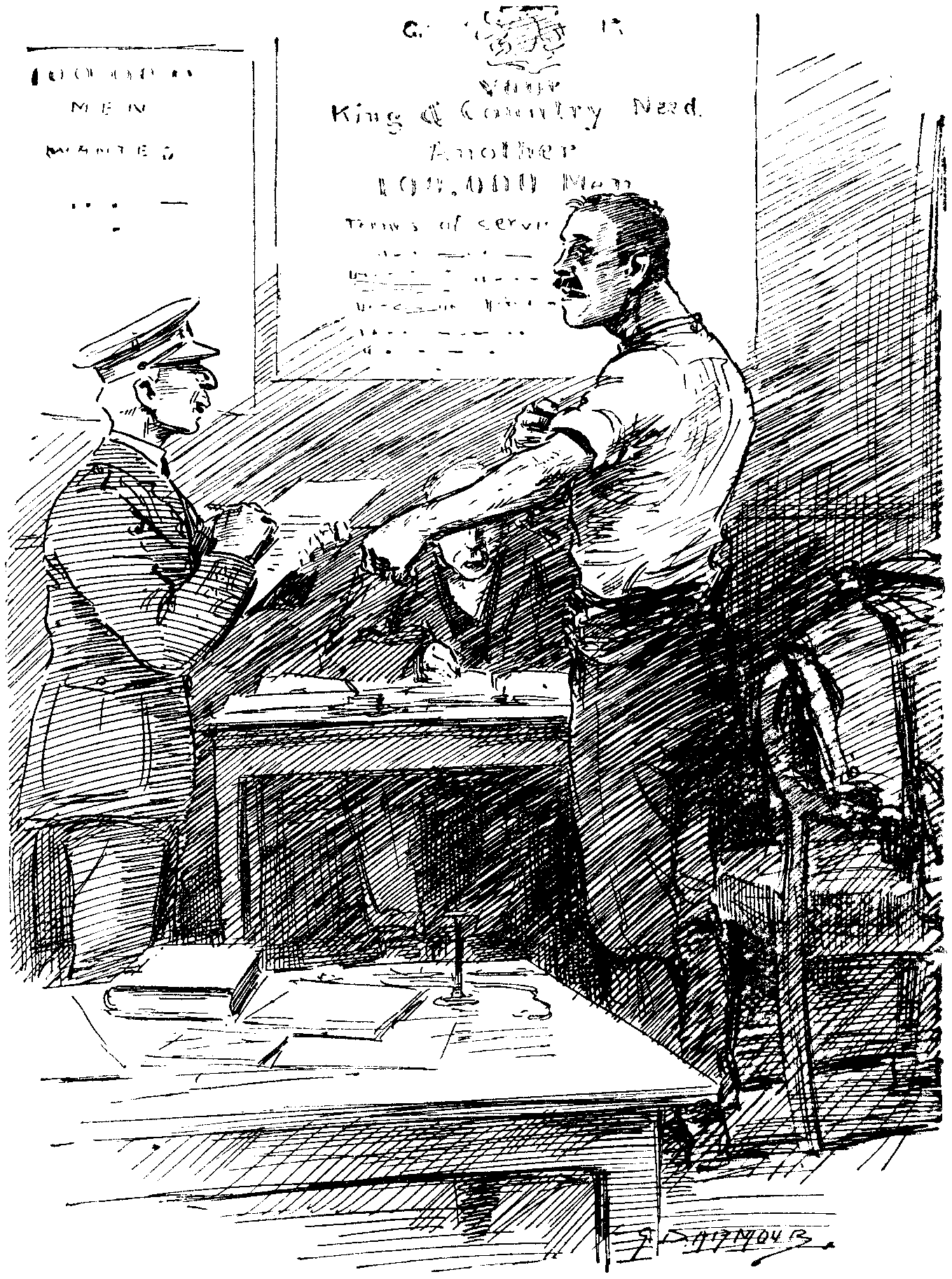
Recruiting Officer (to brawny pitman who has just passed his medical examination). "What regiment do you wish to join?"
Pitman. "I don't care."
Officer. "Sure you have no preference?"
Pitman. "Well, put me in one o' them that spikes the beggars."
THE NEW ANÆSTHETIC.
Remarkable Discovery. Medical Science Superseded.
A correspondent in whose accuracy we place the highest trust informs us of very remarkable results which have been achieved by the adoption of a new means of alleviating pain and suffering invented by a lady in London. This lady being suddenly taken with lumbago was in great agony until she remembered our soldiers at the front, and thought how much worse was a wound, and instantly, our correspondent is informed, some of her own distress left her. The case has been investigated by several eminent inquirers and they are satisfied with her story.
Meanwhile evidence of a similar nature comes from other parts of the country, in every case recording a sense of personal well-being, though only comparative, and an increased disinclination to complain, upon the realisation of what it must be to be a soldier just now—whether up to his knees in a flooded trench, or sleeping on the wet ground, or lying in agony waiting to be picked up and taken to a hospital, or being taken to a hospital over jolting roads, or going without meals, or having to boil tea over a candle-flame, or awakening from the operation and finding himself maimed for life.
Nor is the lenitive of this little effort of imagination confined to bodily ills; for a well-authenticated case reaches us of a notoriously mean man of wealth who was not heard to utter a single word of grumbling over the new war taxes after realising what the soldier's burden was too. Hence Mr. Punch is only too happy to give publicity to the discovery.
The Spy Danger.
Extract from a letter written by an East Coast resident:—
"The authorities are now looking for a grey motor-car, driven by a woman, who is thought to have a wireless apparatus inside."
R.A.M.C. forward, please.
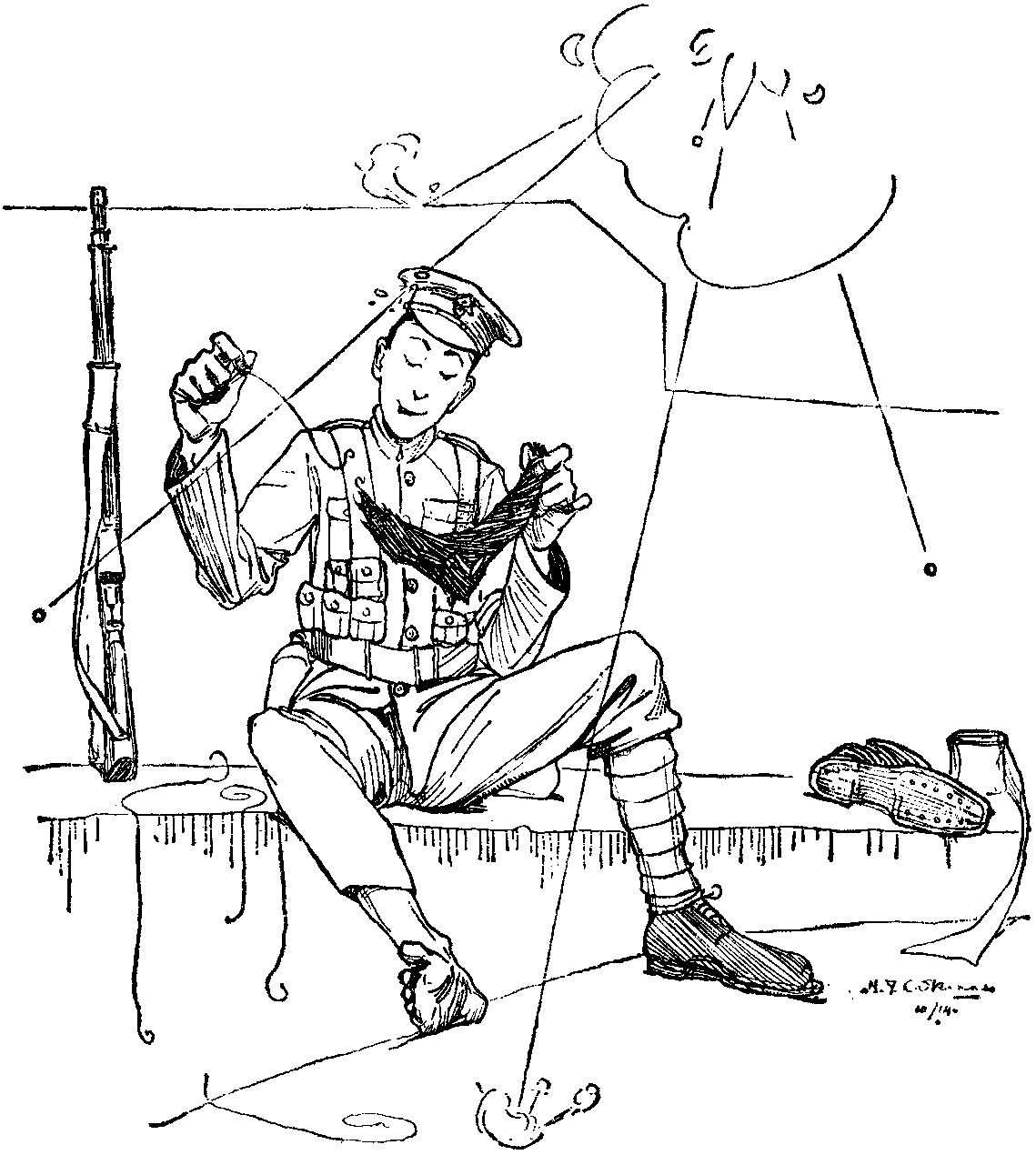
The Sentimentalist (who has received socks from England). "She loves me; she loves me not."