INTERVIEWING FATHER.
Reading edition
Sir George is not a nice man. He is a mercenary, narrow-minded person. I never really liked him, but then he never really liked me. However, he is Miranda's father, so I decided to interview him. The interview took place at his office. He waved me to a chair, and, as it seemed all that I was likely to get, I took it.
"Well?" Sir George grunted.
His tone indicated an unfriendly spirit, so I retorted, "Well."
There was a slight pause. Then he said, rather aggressively. "I never lend money."
"I suspected it," I replied; "I practically never borrow money, but that is my misfortune and not my fault."
"Then what can I do for you?"
"You have a daughter——"
"I have," he interrupted.
"I knew we should find a common basis of agreement. Miranda is unmarried; I am unmarried."
"You suggest marrying my daughter?"
"I make no suggestion, but the idea had crossed my mind."
"Can you keep a wife?"
"I never lost one yet. I think that with a little tact——"
"I mean, have you any money?"
"Eighteen shillings and fourpence," I answered, producing that sum as evidence of my bona fides.
"That is not a very large capital on which to start married life."
"True, but I'm not mercenary. Yet perhaps, as we seem to have drifted on to the question of money, I might mention that I have property—house property."
"I don't believe much in house property in these days."
"I don't either. Though I lay no particular stress on the matter, I also have some mortgages."
"I don't care much about mortgages."
"I agree with you. Beastly things, I call them."
"What income do you derive from the property and the mortgages?"
"I don't exactly derive any income from either. You see, the two things go together—I mean the property and the mortgages. I don't fancy the mortgagees get much income from the property, though I suppose they try their best. Perhaps, strictly speaking, I can hardly call the property mine since the mortgagees took possession. The mortgages however are undoubtedly mine. I created them, you know."
Sir George rose pompously, so I went on at once:
"I have some shares. I should like your opinion on them."
"What kind of shares?"
"The usual kind—paper, but quite nice artistic designs on them."
"In what companies?"
"I forget the names of the companies, but I think that they had something to do with rubber."
"Then you can take my advice and sell them."
"Thanks awfully," I said, "if that means that you'll buy them. I always thought that I should eventually find someone to help me out."
"I will not buy your shares. But before I finally close this interview I should like to know, as a matter of curiosity, on what you live?"
"Meat and things, like other people. I'm no vegetarian."
"I mean, how do you obtain food and clothes? I see that you do wear clothes. At present I'm a little puzzled."
"It's a matter which has often puzzled me. I get them somehow. Sometimes I work and sometimes, but not very often, I get paid for my work. I believe that if I were married I could earn more."
"What makes you think that?"
"Well, you see, I couldn't very well earn less."
"Then am I to understand that you have practically no income?"
"If it comes to that, has Miranda any income?"
"My daughter will have what I choose to allow her."
"And I shall have what I choose to earn, so it seems that we should be fairly well matched."
"Sir, I consider your request to marry my daughter an impertinence, and the flippancy with which you have conducted this interview an insult."
"Sir George," I said impressively, "be just before you are generous. If you think over the matter calmly you will recognise that I have made no such request. You are an older man than I, so I pass over anything that you may have said in the heat of the moment. I am willing to part friends."
For a moment I thought he would burst. He ignored my outstretched hand and almost shouted, "I don't care how we part, so long as we do part. You will oblige me by not seeing or communicating with my daughter again."
As I was passing through the door I remarked, "Without making any rash promises, I will endeavour to oblige you. I gather, as much from your demeanour as anything else, that you do not favour me as a suitor for your daughter's hand. As a matter of fact, I look with equal disfavour on you as a possible father-in-law. My real object in seeking this interview was to remove any misapprehension you might have on the subject."
When I was well outside the door, laughter really took hold of me for the first time since Miranda refused to marry me.
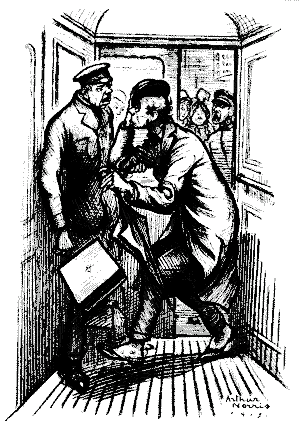
Underground Train Conductor (sulkily to passenger jumping in after train has started). "Nah then! if you'd ha' fallen dahn and broke yer neck I should 'ave been the one to suffer."
"Mr. Hartley is the proud possessor of the English championship belt for running broad jump, having cleared something over 45 feet."
The Morning Albertan.
His pride is very excusable.
"In our day when many women consider the art of managing a home beneath the dignity of their supposed sex, not everyone knows how to make a pancake."
Liverpool Daily Post and Mercury.
"Supposed" is good.
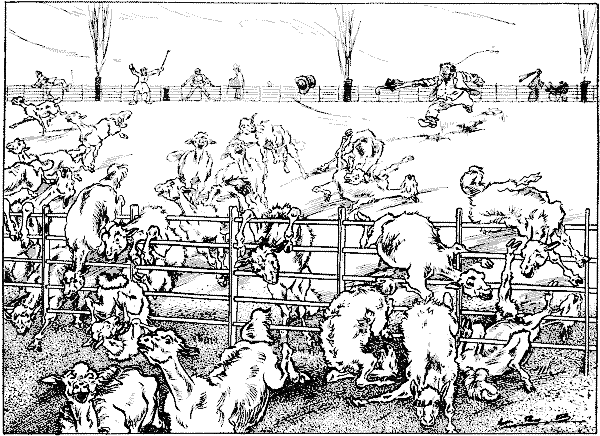
MARCH WINDS.
Short-sighted Official (to gentleman pursuing hat). "Call your dog off, Sir, call your dog off," etc., etc., etc.
MOVING.
(A Suburban Elegy.)
When I remember I shall tread no more In such a short time now the well-known street, And never to these ears shall sound the roar Of Perkins' cart-wheels, dangerously fleet, Bringing the boon of Ceres to the door, Nor those of Batson (Batson is the meat);— When I recall that in the hours to come My eyes may never see the shape of Pott Planting his fish down, then methinks it's rum That mortal men should move and be forgot By those that serve their household daily, some Sending the right delivery, some not. Full often on my homeward way I pause Where Jones is standing at his shop-front trim; We pass remarks about the nation's laws And how it still keeps up, though skies are grim; And Jones is most polite to me, because We've always got our groceries from him. But the old orders soon shall cease to be, And I must pass into an unknown land, And at the corner by The Holly Tree Where now he lifts a ceremonious hand Yon constable shall scarce remember me, Not that he ever——Quite. You understand. And alien lips from mine must move to swear Over the mangled remnants of a shirt Brutally done to death with fiendish care By yon steam laundry. Last I come to Bert; Bert's is the best known face in all the Square, Being the milk, and something more—a flirt. Yes, for not only bleeds this heart of mine; There shall be tenderer spasms when we shift, Such bits of cheek, such observations fine, Such honied whispers have been heard to drift From Susan at the casement of her shrine To Romeo managing the tradesmen's lift. Hers shall be all the loss; he'll soon forget. Others shall ope accounts when we are gone; Movings are all too frequent for regret; Yet one methinks there is shall dream upon Our name with soft remembrance, guard it yet Like some pressed violet. I refer to John. I know our postal service, know full well, Though we have told them to what bourn we flit, How many a missive shall obey the spell Of the old false address inscribed on it. And John shall bring them. And John's heart shall swell For Harriet while he stuffs them through the slit. Evoe.