Volume 146 — OUR BOOKING-OFFICE.
Reading edition
(By Mr. Punch's Staff of Learned Clerks.)
Mr. Henry Holiday's Reminiscences of my Life (Heinemann) will show you a kindly simple soul who had an extraordinarily nice time, met all kinds of interesting folk, and had a generous devotion to any number of unpopular causes, such as Women's Suffrage, the futuristic socialism of Bellamy's Looking Backward, Home Rule in Ireland, healthy and artistic dress, good music, the abolition of war. Whatever capacity of expression his successful and not undistinguished career as a painter (amongst other things, of Beatrice cutting Dante on the bridge), stained-glass worker and mural decorator proves him to have had in his proper medium, the gift of pointed literary expression and appropriate selection seems to have been withheld from him. But he has little reason to complain. Some, at least, of his causes are appreciably nearer victory than when he espoused them; we are even a little nearer looking backwards. One small point in these discursive memoirs will especially delight the mildly cynical—that this worthy pre-Raphaelite, who with his friends had suffered so much from the limitations of view of a mid-Victorian Royal Academy, should be so maliciously ready to have all modern rebels in paint, their milestones hung about their necks, sunk in the nethermost deeps with all their works! One can find diversion, too, in the decorous story of Mr. Holiday's nude statue of Sleep, rejected (according to a message from G. F. Watts) on account of its nudity in 1879 by that same Academy, and accepted in 1880 when the artist with laborious modesty had modelled for it a plaster-of-paris nightgown. The author claims some share, through the Healthy and Artistic Dress Union, in the changes towards rational beauty which women's dress has lately shown. And that surely, is by no means to have lived in vain!
There are few Memsahibs who know India and can write about it as well as Mrs. Alice Perrin, so that when she calls her new book The Happy Hunting Ground (Methuen) she sets you thinking. And when you begin to think, you see that that really is the meaning of those tearful farewells at Victoria and Charing Cross, that heavy-hearted cheering and waving of handkerchiefs as the liner puts off from the docks, which are for us who stay at home the symbol of our share in the burden of empire. When our sisters and our daughters (and our cousins and aunts) sail away to Marseilles and the East they go to find husbands, largely because for many of them there is in this country little prospect of marriage with men of their own class. But that is only half the story. They go in search of mates. They stay to play, as helpmeets, the woman's part in carrying on the high tradition of the British Raj. With this fundamental truth as her background, Mrs. Perrin has drawn, simply but with practised skill, the picture of a young girl who leaves the dull security of Earl's Court to go a-hunting in the plains and the hills, obedient to the call of India, which is in her bones. There, like many another before her, she loves and suffers, and makes sacrifices and mistakes, and (I am glad to say) finds happiness at the last. The strength of Mrs. Perrin's book, apart from the value of its background, lies in the reality of its characters. If you have a drop of Anglo-Indian blood in your veins you will know what it means. You will greet them as blood relations, and take a kinsman's interest not only in their joys and sorrows, but in their whole attitude towards life, and even their little tricks of thought and speech.
About a year ago Mr. Joseph Knowles began to think that "the people of the present day were sadly neglecting the details of the great book of nature," and asked himself if he could not do something to remedy matters. His answer to this question was to take off all his clothes, and, on August 4, 1913, to enter the wilderness of Northern Maine, and live like a primitive man for two months. On page 12 of Alone in the Wilderness (Longmans) he is to be seen taking off his coat (and posing, I feel bound to add, very becomingly), and eight pages farther on you can see him divested of his clothing and "breaking the last link." As used to enforce a primitive ideal, the modern art of photography seems, if I may say so, a little out of this picture; but, anyhow, into the forest Mr. Knowles went with "nodings on," and there he stuck out his time, speaking to no one, scarcely seeing a human being, and proving—well, I don't honestly think that he proved much. But at least he was not what he calls a quitter, and as more than once he had an intense desire to return to civilisation, he deserves much credit for carrying out his resolution. But, difficult as he found it to remain for the two months, he has found even greater difficulty in writing interestingly about his experiment. Apart from his account of a great moose-fight, the fascinating scenes in his book are those in which his former experiences as a trapper and hunter are described. But Mr. Knowles has not finished with his adventure; he is going to live stark-naked in the wilderness for another two months, but this time under inspection, so that the unbelievers can be convinced. I am not among the unbelievers—indeed, I am convinced of the absolute truth of every statement he makes—but I doubt if a repetition of his performance is the best way to help on the College of Nature which he hopes to start. Why, in short, pander to the unbelievers?
OUR CURIO CRANKS.
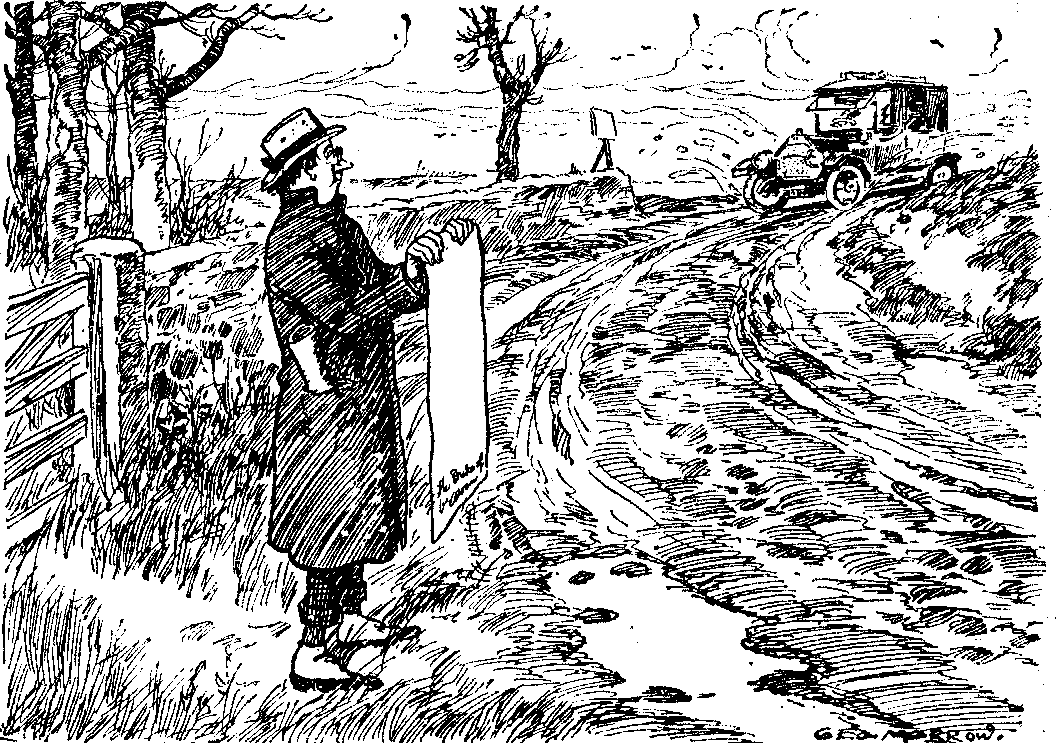
The man who collects mud-splashes from the wheels of the exalted great.
A period so bygone as that of His late Majesty King Henry II. (of whose exact date you will scarcely need to be reminded) has not an immediate and irresistible attraction for every novel reader, and it may take much to persuade some that they will ever become really concerned with the deeds and destinies of such people as Jehane the woodward's daughter, Edwy the tanner of Clee, and Lord Lambert do Fort-Castel, be their deeds and destinies never so adventurous or romantic. Further, the juvenile manner of the pictorial cover attached to Jehane of the Forest (Melrose) is not calculated to whet the appetite of the adult public, and the eulogy of a well-known author, appended on a printed slip, lacks the essential glow of the effective advertisement. It misses the point; it is pedantic, and pedantry is the one thing for which wary readers are on the look out in stories of antiquity. It is first important, then, to acquit Mr. L. A. Talbot of every offence of which, in the blackness of the outward circumstances, he might be suspected—affectations, anachronisms, excess of local and contemporary colour, absence of humour or human touches, any tendency to bore. The book presents a charming picture of the counties on the Welsh Border and unravels a delightful tale in which the characters talk the language peculiar to their time, but are controlled by the everlasting motives of human nature. Though the times were harder than ours the people seem to have been neither better nor worse than we are; and, when approached from such a point of view as Mr. Talbot has taken, there is nothing to be said against, but very much to be said for, the period of 1154-1189, which, as every schoolboy is punished for not knowing, covers the reign of Henry II.
Miss Mills Young does not, I think, improve as an artist. The Purple Mists (Lane) is her latest book, and it is not so real and satisfactory a piece of work as Grit Lawless or Atonement. The theme of her new novel is the coming of love to two people who married without any other emotion than restrained but unmistakable antipathy. Why people should do these things so often in novels I do not know, but on the present occasion Euretta (Euretta is not an attractive name) and John Shaw (you can tell by his name that he is a strong silent man who is deep in his work and has no time to bother about women) are driven into matrimony by Miss Mills Young. After a while it appears that Mr. Shaw is beginning to care for Euretta very much, but he shows his affection for her by avoiding her as much as possible and snarling when she speaks to him. It is obvious that a more kindly figure must be somewhere close at hand eager to console Euretta. Miss Young discovers him, finds that he is precisely the deep-drinking, warm-hearted rascal necessary for this kind of occasion, and provides him with the inevitable situations proper to the tertium quid. The defects of The Purple Mists all arise from the fact that Miss Mills Young has been told by her friends that she tells a good story. If, next time, she thinks first of her characters and then chronicles their logical development, instead of forcing them into a threadbare plot, she will give us the fine book of which I am sure she is capable.
"According to the Jewish Chronicle, the number of Jews in the world now exceeds 13,000: to be exact, 13,052,840."
Family Herald (B.C.)
Our contemporary should cultivate the large tracts of truth which lie between the extreme vagueness of the first estimate and the pedantic accuracy of the second.
"Rokeby Venus in Ribbons."—Globe.
Are we becoming prudish?
"Breezes between North and South."—Cork Examiner.
This is the weather forecast for Ireland, and at first sight seems obvious; but "in view," as our penny contemporary says, "of the grave importance of the present political situation," we suspect a deeper meaning.