Volume 146 — OUR BOOKING-OFFICE.
Reading edition
(By Mr. Punch's Staff of Learned Clerics.)
Has Mr. W. J. Locke's hand—the hand that created vagabond Paragot for tears and laughter, and the resourceful Aristide—has it lost its particular cunning that he should begin his romance of The Fortunate Youth (Lane) in a mood of heavy and misplaced facetiousness, and drift by way of Family Heraldry into an atmosphere of sham politics and a bright general glow of ineffectual snobbery? Paul Savelli, the fortunate youth, with his incredible beauty, his dreams, his accomplishments beyond all discernible cause, his faintly Disraelian airs, never once carried me out of my chair. And to what other end is romance ordained? Nor did his Princess, with her mastery of the easier French idioms; nor Barney Bill, the kind-hearted stage-tramp. Indeed, I found Mr. Locke constantly making statements about his people that were not substantiated, as about Ursula Winwood, the egregiously competent, the confidante of troubled ministers, bishops and generals. Jane alone, an early simple friend of Paul, I found credible and charming, and thanked heaven for her sake that Paul married his Princess. It is indeed a romance gone wrong. Perhaps it is a more difficult thing plausibly and readily to sustain one's fancy in a modern setting, with modern folk, than in the fair realm of Tushery with rapier-wielding demigods. Yet I think that the dead Harland and the living Hope (himself no mean Tusher) might have brought off their Paul. As a matter of fact, so I believe could Mr. Locke; that is just the pity of it. I merely record the fact that he has not done so.
There are, of course, short stories and short stories. On a perusal of those that Mr. Richard Dehan has collected in volume form under the title of The Cost of Wings (Heinemann), I am bound to record my conviction that most of them are profoundly unworthy of the author of The Dop Doctor. Few of them even aspire to anything beyond "first serial" quality; and though there is often present a certain easy flippancy of phrase it impressed me only as the crackling of thorns in a pot-boiler. Perhaps the best is the first or title tale, which tells of a young wife goaded to hard words by her constant anxiety for an aviator-husband. There is some genuine feeling here; but the climax, in which the pair decide only to fly in company, was dangerously like the end of a stage duologue. Moreover, so swift now-a-days is the flight of time—or the time of flight—that aviation stories very soon come to sound antiquated. Still, after all, there is at least plenty of variety in this volume, and it will be hard if, in a collection of twenty-six brief tales, you do not come upon something to your individual taste. But one word of gentle protest. I fancy the stage has at last agreed upon a close time for supposed infants, against whose arrival from India nurses and rocking-horses are engaged, and who turn out on appearance to be young persons of mature years. Well, I am convinced that it is high time for a similar prohibition in fiction. Mr. Dehan at least has proved himself far too clever for me to tolerate this threadbare theme, not very illuminatingly treated, from his valuable pen.
Mr. Anthony Venning was a young man of remarkable tact. Taking advantage of his position as a consultant engineer, at the beginning of The Sentence Absolute (Nisbet), he pocketed an advance commission for recommending the tender of a certain firm of contractors to the Welsh mill-owner who was employing his professional services. Whether this practice is common amongst engineers, as the authoress would seem to suggest, I cannot say, but at any rate it was hardly to be expected in the circumstances that Mr. Venning should not fall in love with Mr. Powell's extremely beautiful daughter, or that the boilers in Mr. Powell's mill should hesitate in the fulness of time to explode. But the lover had the native good sense to be present at the moment of the inevitable catastrophe and to be the only person seriously damaged; and since it was his first real lapse from the paths of rectitude, and he was otherwise amiable, athletic, presentable and brave, who shall complain if, after confessing in a manly way and being put into a state of thorough repair, he found happiness in the end? Miss Margaret Macaulay tells her story in a pleasant enough way, and describes with some skill its idyllic setting (for Mr. Powell was first a country squire, and only secondly a manufacturer); but since she neither indulges in satire, social and economic speculation, nor any pretence of subtlety in psychological probings, there is a curiously old-fashioned air about her novel. And when I mention that Mr. Venning and Miss Powell were actually cut off by the tide on a treacherous reef of the Cambrian coast it will be realised that The Sentence Absolute is a book for one of those softer moods in which we do not desire to be startled or stung to profound meditation on the meaning of life.
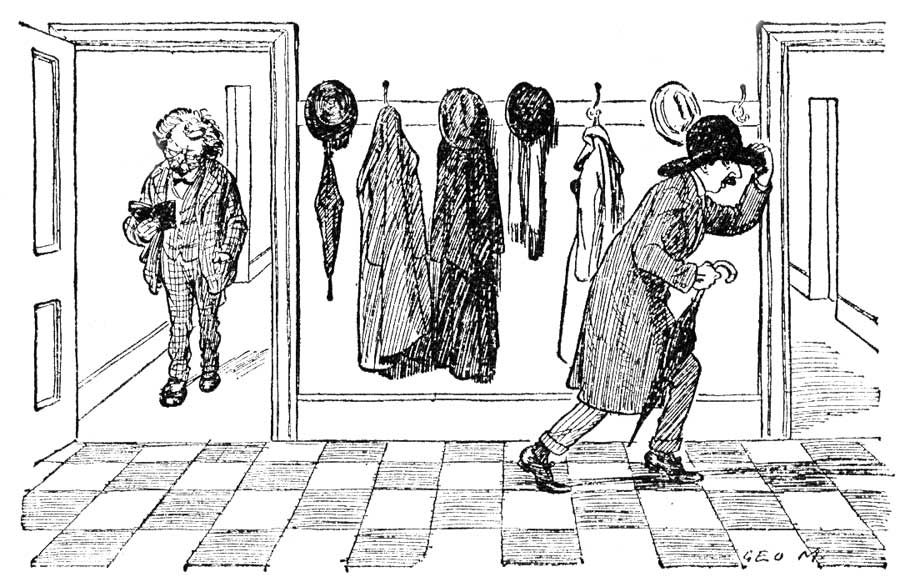
OUR CURIO CRANKS.
The man who takes every opportunity of adding to his gallery of Hats of Famous Men.
I hope that Mr. Vaughan Kester, author of John o' Jamestown (Hodder and Stoughton), is innocent of intent to do the dreadful thing that he has done. With the book itself I have no fault to find; it is quite a good historical novel, and tells with a fair amount of excitement the story of Captain John Smith and the early settlers in Virginia, not omitting Pocahontas. Mr. Kester's crime consists not in his novel, but in the fact that he has probably plunged America into all the horrors of a new outbreak of historical fiction. A few years ago every adult in the United States was writing historical novels. Those were the black days at the beginning of this century, still spoken of with a shudder from Maine to Tennessee. Gradually the horror spent itself; the country became pacified. Except for an occasional sporadic outbreak, the plague was stamped out. It got about that the historical novel was "a dead one," and young America turned to something else. Now you begin to see what Mr. Kester has done. While Messrs. Hodder and Stoughton are publishing John o' Jamestown over in England, another firm is flooding the States with it. Mr. Kester is a confirmed "best-seller" on the other side of the Atlantic. Probably his American publishers have issued a first edition of a hundred thousand of this story. The result may be imagined. Wild-eyed literary agents will carry the fiery cross throughout the country, crying that the historical novel is not dead after all, that there is still money in it; and thousands of estimable young men who might have been turning out quite decent stories of American life will thrust paper into their typewriters and begin, "Of the days when I followed my dear lord through many a hard-fought fray it ill becomes me, plain rude man that I am, to speak...." And it will be Mr. Kester's fault. It would not matter so much if the great army of American writers could do the thing even half as well as he has done it in John o' Jamestown; but they cannot. I know them, and that is why a great trembling runs through me so that I can scarce hold my pen to complete this review.
The name of Mr. Gordon Gardiner is unfamiliar to me; but I have little doubt that if The Reconnaissance (Chapman and Hall) is a first novel its author will improve upon work that struck me as at present somewhat ingenuously conventional. There are two parts to the tale; the first shows how Leslie earned popular applause and the V.C. by remaining with a wounded comrade whom he was actually too frightened to leave. That was a good beginning, and I said to myself that Mr. Gardiner was of the right stuff; he had a vigorous, incisive style that suited well the matter of pain and anguish that he had in hand. But, alas! in its hours of case the story became much more uncertain. All the characters, including the involuntary hero and the man he rescued (now a lord), turn up at an hotel on the Lake of Como. There is some mild word-painting that may remind you pleasantly of pleasant places; and a disproportionate pother because in one of the sudden lake storms Leslie dashes for shelter into what he supposes to be his own bedroom (actually the heroine's) and is imprisoned there by the sticking of a shutter. An awkward incident, of course, especially as it occurred in the dead of night, but scarcely enough to make half a novel out of. Naturally, in the end Leslie owns up about the heroism, and goes away to justify his unearned credit upon the stricken field; but I am afraid I must confess that the prospect of his return left me indifferent. I understand that The Reconnaissance originally appeared in The Daily Telegraph; this being so, the persistence with which its characters quote extracts from The Times savours almost of filial ingratitude. Seriously, the first part of the novel was a promise which the second left unfulfilled. Mr. Gardiner is still in my debt.