Volume 108 — ESSENCE OF PARLIAMENT.
Reading edition
Extracted from the Diary of Toby, M.P.
House of Commons, Monday, March 18.—Navy Estimates on again, with the First Lord listening patiently from otherwise empty Peers' Gallery, and Robertson making admirable play from Treasury Bench. Chivalrous soul of Cap'en Tommy Bowles moved to admit that, after all, there had been worse First Lords than Spencer, and more uncivil Lords than Robertson. Private Hanbury thinks this is weakness. If his colleague in charge of the Navy is to talk like that, he (the Private) will be expected, when the Army Estimates came on, to say something nice about Cawmell-Bannerman, to acknowledge Woodall's keen grip over the business of his department, and the courtesy with which he discharges his Ministerial duties.
Allan o'Gateshead on again with more "Rough Castings." Last time House in Committee on Navy Estimates he spread feeling of genuine alarm by denouncing the British boiler. "Who," he thundered, "is responsible for the engines of the Royal Navy? Where is the Hornet you trumpeted so loudly a year ago? Where," he continued, bending beetling brows on Civil Lord of the Admiralty, "are her boilers?"
"Bust," said Gorst, with guilty look. Not that he had had anything to do with the business, but because at this moment Allan o'Gateshead chanced to fix a pair of flaming eyes upon his shrinking figure, seated almost immediately opposite at end of Front Bench.
"Where is the Hornet now? Why, lying in Portsmouth Yard, with her boilers out of her, a useless hulk."
Allan is so big, so burly, wears so much hair, writes poetry, is understood to be in the boiler business himself, and, withal, addresses the Chairman with such terrific volume of voice, that a panic might have ensued only for John Penn. Penn head of great engineering firm of old standing and high repute. Understood to have engined fleet of five ships with which Drake made things hot for Spain along the coasts of Chili and Peru. However that be, Penn now made it hot for Allan o'Gateshead. Showed in quite business-like fashion that Allan's poetic fancy had run away with him. Convinced grateful Committee that British boiler, on which safety of State may be said to rest, is all right. A model speech, brief, pointed. A man with something to say, who straightway sits down when he's said it. As the poet (not Allan o' Gateshead) says,
He came as a boon and a blessing to men, The modest, the lucid, clear-pointed J. Penn.
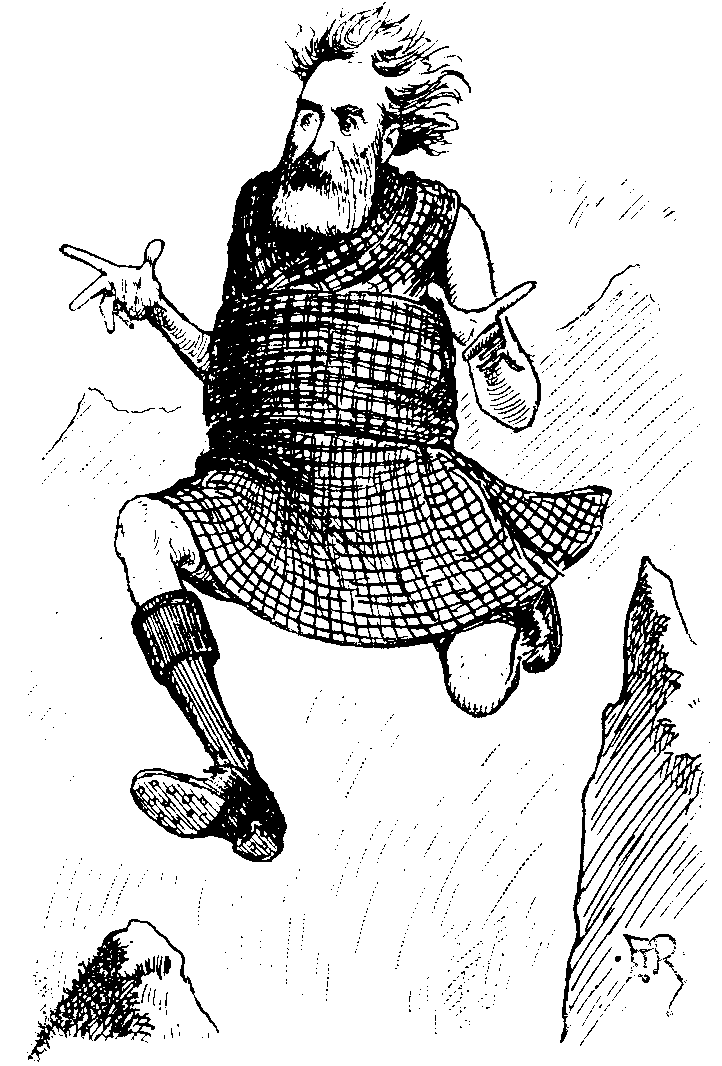
MacGregor (as "The Dougal Creature"). "I'll pass from that point."
Business done.—Committee voted trifle over four millions as wages for Jack.
Tuesday.—Alderman Cotton, once Lord Mayor of London, a prominent and popular member of the Disraeli Parliament, left behind him the memory of one of those things we all would like to say if we could. In the long series of debates on resolutions moved from Front Opposition Bench challenging Jingo policy of the day, the Alderman interposed. "Sir," he said, "this is a solemn moment. Looking towards the East we perceive the crisis so imminent that it requires only a spark to let slip the dogs of war."
That was, and remains, inimitable. But to-night the MacGregor came very near its supreme excellence. Stirred to profoundest depths by demands upon Naval Expenditure. Popping up and down like piston in the engine-room of Clyde steamer; wrath grew as Mellor, failing to see him, called on other speakers. The MacGregor knew all about that; a reckless corrupt Government, afraid of hearing the voice of honest criticism, had suborned Chairman of Committees to prevent his speaking. But they didn't know the MacGregor. After something like two hours physical exercise in the way of jumping up and down he caught the Chairman's eye, and (in Parliamentary sense, of course) punched it. Then "passing from point to point," as he airily put it, he went for Robertson. Asked the appalled Civil Lord of the Admiralty what he supposed his constituents in Dundee would say when they read his speech, in which bang went millions as if they were saxpences? "What will the worthy citizens say, Mr. Mellor?" he repeated. "Why they will say, 'Ma conscience!'"
Never since Dominie Sampson made this remark has so much fervour and good Scotch accent been thrown in. "Where's the Chancellor of the Exchequer?" MacGregor presently asked, evidently eager for fresh blood.
"That has nothing to do with the question," said the Chairman, severely.
"Oh, hasn't it?" jeered the MacGregor. "I want to ask him what he has done with our money?"
Vision instantly conjured up before eyes of Committee of Squire of Malwood prowling about town with his pockets loaded with £4,132,500. voted to defray the charge for wages in the Navy, flinging the cash about like Jack ashore, making the most of his time before Local Veto became the law of the land.
It was later that the MacGregor came in unconscious competition with Alderman Cotton. Leaving the Navy for a moment he surveyed the Continent of Europe peopled with armed men. "Why!" he cried with comprehensive sweep of his arm, "these great armies are like fighting cocks. The least spark blows them up like magazines of powder."
Not quite so good it will be seen as the Alderman, but good enough for these degenerate days. Effect on Admiral Field so exciting that he was presently discovered chasing the Sage of Queen Anne's Gate all over House, desiring, as he said, to "pin him to his words."
Business done.—Supplementary Estimates voted.
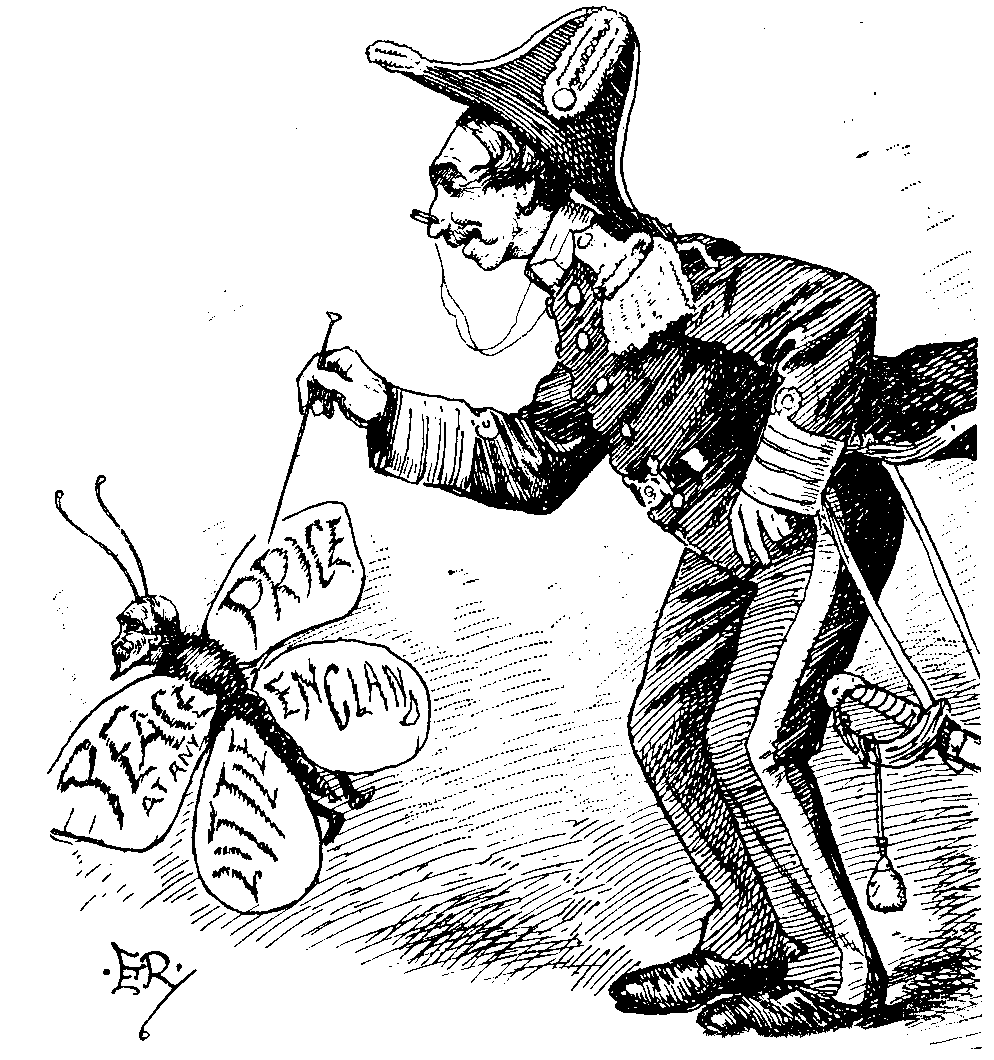
Admiral Field pinning the Hon. Member to his words.
Thursday.—Curious to note the coyness with which House approaches real business. To-day Welsh Disestablishment Bill comes on for Second Reading. Its passing this stage a foregone conclusion. The work of criticism, correction, possible re-moulding, will be done in Committee. Committee is the Providence that shapes the ends of Bills, rough hew them how we may in the draughtsman's hands or on the second reading. For all practical purposes second-reading debate might be concluded at to-night's sitting. It extended over seven clear hours. Given twenty minutes per speech, the maximum length for useful purposes, twenty-one members, more than the House cares to hear, might have spoken. The time saved, if necessary, added on to opportunity in Committee.
That, however, not the way we do business here. Disestablishment Bill a measure of first importance; must be treated accordingly. So after Asquith talks for an hour and a quarter, Hicks-Beach caps him by speech hour and half long, which nearly empties House. Afterwards a dreary night. Papers on subject read by Members, who rise alternately from either side. Few listen; newspaper reports cruelly curt; nevertheless, it's the thing to do, and will go on through at least four sittings. On last night men whom House want to hear will speak, as they might have spoken on first night. Then the division, and minor Members who have missed their chance will endeavour to work off their paper in Committee.
Business done.—Second reading Welsh Church Disestablishment Bill moved.
Friday.—Shall M.P.'s be paid out of public purse? Dividing to-night 176 say Yes, 158 stern patriots say No. George Curzon, fresh from the Pamirs and still later from a sick bed, leads opposition. Squire of Malwood is in favour of payment: darkly hints that when the time comes he will find the cash. This, though a little obscure, looks like business.
"I expect," said the Member for Sark, "we shall live to see the day when, on Friday afternoons, Palace Yard will be crowded with Members waiting to take their weekly money. Suppose they'll go the whole hog, give us what the navvies call a 'sub,' that is, let us draw in middle of the week something on account. Of course we shall have the full privilege of strikes. We'll 'go out' if we think our wages should be raised. Sure to be some blacklegs who will skulk in by central lobby and offer to do a day's talking on the old terms. But we'll have pickets and all that sort of thing. Sometimes we'll march in a body to Hyde Park, and Baron Ferdy will address us from a waggon on the rights of man and the iniquity of underpaying M.P.'s. I see a high old time coming. Shall put in early claim for a secretaryship. Always a good billet."
Business done.—Welsh Disestablishment Bill threw a gloom over morning sitting. George Osborne Morgan, supporting Bill, mentioned that in episcopal circles he is regarded as "a profligate"! There is, sometimes, a naughty look about him. But this is really going too far, even for a bishop.