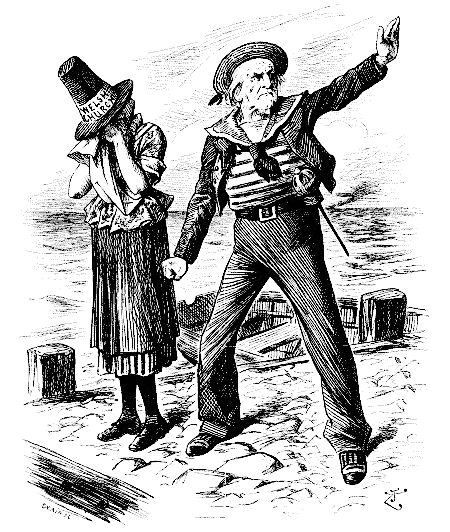
Volume 108 — BUBBLES from the BALTIC.
Reading edition
BLOWN from the PIPE of TOBY. M.P.
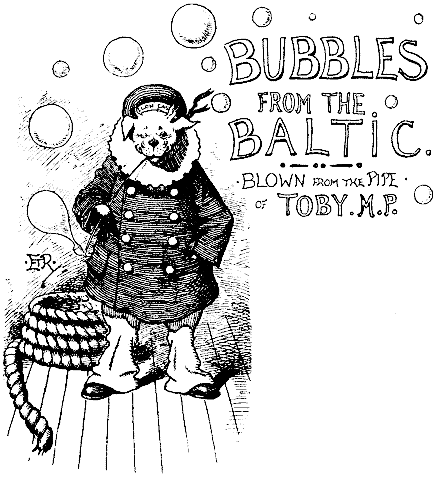
Off the Elbe, Wednesday Afternoon.—Got up steam, weighed anchor and laid our course East by North half South for Hamburg. Don Currie, whose knowledge of ocean life is extensive and peculiar, tells me no well regulated ship puts to sea without first ascertaining the weight of her anchor. Much interested at this peep into nautical life. But what has the weight of the anchor to do with the voyage of the Tantallon Castle, or even with the opening of the Baltic Canal? Well, the Don is not sure. Anyhow, it is an old custom. Sailors are superstitious, and if this preliminary to a voyage were omitted, they would turn rusty, and might even want to throw someone overboard. So, to prevent possible unpleasantness, the anchor is weighed—"To an ounce," Don Currie says severely.
Suppose before we turn in we shall be told how much it weighs. Wish I knew what is the average weight of a really good anchor. So awkward if a man comes upon you suddenly, and says "The anchor weighs just over a ton"; or "What do you think? the anchor turns the scale at fifty-two lbs. ten dwt." Is one too much, and is the other surprisingly little? Haven't the slightest idea. Shall, in either case, say "Ha!" That is, at any rate, noncommittal.
Mr. G. will know what an anchor ought to weigh in given circumstances. He knows everything. Shall try and find opportunity of asking him.
Hamburg, Friday, 5 A.M.—"I am very fond of the German tongue," said the Member for Sark, paying me an early morning pyjama-call. "The language in which Goethe wrote and Heine sang is sacred. Still, when it is emitted from the throats of half a score of steam-whistles, one feels there are limits to passionate desire. Have often heard siren song of steam-whistle in and about the Thames. That's bad enough for the sensitive ear. But when it comes to steam-whistling in German, you begin to understand why people sometimes commit suicide."
For my part, I like it. Few things more charming than to be wakened at daybreak by a steam-whistle spluttering in your larboard ear. Before you have quite drank in the fulness of the music, another shrieks in your starboard ear. Then, far and near, all round the harbour, they pop off in different keys. Some angry; some whining; some in anguishing pain; some mocking; some wailing; one ingenious contrivance, moved by a master-hand, managing to imitate a burst of maniacal laughter, in which, if you didn't bury your head in the pillow, you feel you must join.
Then there's the effect on the man on deck. Don't know who he is; fancy he must be the Supercargo. At first shriek of the earliest whistle, he puts on the heaviest boots (those with the clump of steel at the toes, the wedges of iron at the heel, and fat-headed nails all over the sole). He gives preliminary stamp precisely over your head; all right; steam-whistle shrieks; others respond; Supercargo is off; stamps to and fro just the length of the deck immediately over your berth; leaps up height of two feet; drops exactly over your head; steam-whistles go faster; Supercargo clatters off; fetches from somewhere a plank, a rough-hewn plank studded with nails; this he dashes on the deck over your head; got the range to a nicety; never misses; steam-whistles go off simultaneously; maddening effect on Supercargo; he rages to and fro, charges over your berth, banging the plank with mad delight. You get out of your berth, dash to side; just going to plunge over; when Quartermaster seizes you and leads you back to cabin, locking you in.
And Sark says he doesn't care for early morning effects in Hamburg harbour!
Saturday Morning.—Steaming down Elbe, meaning to anchor at its mouth. (Not at its elbow, as Sark told the pilot. Pilot didn't see joke. Stared at him, and said, "Hein?" which made Sark look foolish.) Last night citizens of Hamburg entertained us at dinner. Banquet spread in what they call the Zoologischer Garten. Odd how the way of pronouncing a familiar word grows upon some people after dinner.
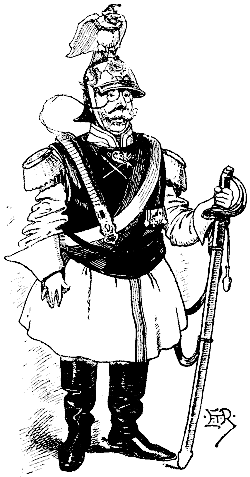
Mr. Punch regrets to hear (from a thoroughly [un]reliable source) that some confusion has been caused at Keil owing to the great physical resemblance between his representative on the Tantallon Castle and His Imperial Majesty the German Emperor!! In fact, some doubts are expressed as to which of the two it was who opened the Baltic Canal!
Feeding time seven. No extra charge to the public, who are kept outside. Excellent dinner; but general arrangement more suited to time of Methuselah than our shorter-lived day. Sat down at 7.30; finished by 11.30. Peculiarity of menu was the interpolation of cold speeches among the hot dishes. As soon as we swallowed our Klare Schildkrötensuppe, and toyed with our Forellen, blau mit Butter, Chairman rose and proposed toast to Emperor. Next came on the table (sideways, of course) Helgoländer hummer auf amerikanische Art. Before the dish was removed, another gentleman on his legs proposing health of Mr. G. So on through the meal: first a bite and sup, then a speech. Practice interesting, though apt to induce a coolness on part of some of the dishes. Suppose cook calculates that gentlemen proposing particular toast will speak for ten minutes; he takes twenty, or, if of a fearless nature, half an hour. Where's your next dish? Why, cold or burnt. Nor can system be recommended on score of economy. Consequence of sitting through four hours dining off sort of speech-sandwich, is that you begin to get hungry again. The absent-minded man, offered an ice, says he usually begins his dinner with soup. If two hundred follow his example, and insist upon going all through the dinner again, it is not only embarrassing, but becomes costly.
Off Jutland, Sunday.—Don Currie last night gave return banquet on Tantallon Castle to Hamburgers. Done in princely style. Over two hundred sat down in brilliantly lighted saloon. Had our speeches, as usual with nous autres, served with the dessert instead of as entrées. Few, short, pithy, and one historical. Don Currie proposed toasts to his fellow Sovereigns, the Queen of England and Emperor of Germany. Burgomaster of Hamburg toasted Mr. G., who responded in speech, lofty in sentiment, eloquently simple, admirable in delivery. Dog and pup, I have, during the last twenty years, heard nearly every one of his great speeches in the House and out. Declare that in all the qualities that go to make a perfect oration, it would be hard for even his record to beat this impromptu speech, delivered amid such strange surroundings.
After dinner, a dance on deck. The waltzing and polkaing commonplace enough. But pretty to see John Leng, M.P., and the Lord of the Isles do a sword dance, whilst Ramsay, M.P., like them, clad in national garb, played the bagpipes. This struck the German guests more than anything. Their papers full of it.
Copenhagen, Tuesday.—King and Queen of Denmark, with rest of Royal Family, had day out to-day. Came aboard Tantallon Castle for luncheon.
"You talk about your Roshervilles, cher Tobee," his Majesty said, as we smoked cigars with our coffee; "but to my mind, the place to spend a happy day is the Tantallon Castle."
"There is," I said, "the drawback of the absence of shrimps. But then even kings cannot have everything."
"True, Tobee," said the grandfather of our kings-to-be and of other people's. And for a moment the royal brow was "sicklied o'er with pale cast of thought."
It cleared as he caught sight of our two rival Kodakesses, who had simultaneously got him in focus. Pretty to see King arrange his hair, give little twist to moustache, and assume look of abstraction, just as common people do when they suspect someone is taking a snap-shot at them. As Sark says, "One snap of the Kodak makes the whole world kin."
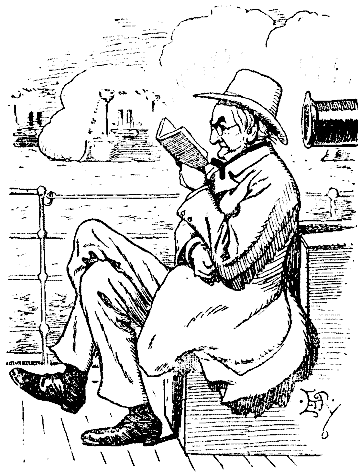
An admirable spot for a little quiet reading, although perhaps the firing does make it a leetle difficult to concentrate one's thoughts wholly upon the matter in hand.
Oddly enough, there were speeches at the luncheon. Mr. G. having got his hand (or rather his voice) in at mouth of the Elbe, delivered two charming addresses. One in proposing health of King and Queen of Denmark, the other in responding to toast to his own health, given by King. A new thing this for Old Parliamentary Hand to serve as after-dinner speaker. Listening to his graceful, gracious phrases, one almost regrets he should have given up so much time to Irish Land Bills, Home Rule, and the like.
After luncheon a stroll on deck, and, incidentally, a memorable scene. In addition to the Kodakesses, who have taken everyone on board, except each other, we have a regular artist with a camera. Don Currie, having a moment to spare, thought he would have his likeness taken. Got into position; operator's head under the cloth fixing him; in another moment it would have been done. As Shakspeare wrote long ago, "Nothing escapes the eye of royal Denmark." The King, seeing what was going on, quietly led up the Queen, and stood by her in focus; the rest of the Royal Family, as our toast lists have it, closed in, forming a group near the Don; and when the astonished operator removed the cap and exposed the plate he found upon it the Royal Family of Denmark and one simple Highland gentleman distinguished in such company by his plain estate.
In afternoon, Don Currie having entertained Kings and Queens and Crown Princes, threw open all the gangways of the ship to the people of Copenhagen. They flocked in by hundreds, increasing to thousands. In endless streams they passed along the decks peering and poking their noses into every nook and cranny. On upper deck they had a great find. Sitting in his state cabin, with door open, was Mr. G. reading about the Vikings in their own tongue, which he has lately added to his list of acquired foreign languages. The Danes, men, women, and children, stood there at gaze. Mr. G., with his back turned to door, read on, unnoticing. Crowd growing unmanageable with ever-increasing numbers, a handy quartermaster rigged out ropes, and made sort of handrail, guarding either side of cabin, keeping back crowd. But it filled the deck all through the afternoon, ever changing, but ever one in its passionate, yet patient desire to catch a glimpse of that figure in the cabin, that went on reading as if the world outside were a mere wilderness.
Wednesday.—At Kiel. Harbour and approaches filled with fleets of all nations, every ship bristling with guns, and longing to be at somebody. For the closing years of the nineteenth century of the Christian Era, this is, as Sark says, most encouraging. It is the completest achievement, the proudest thing civilisation has to show us.
From the Manchester Guardian:—
SIR CHARLES HALLE'S CHOIR PICNIC. FINAL REHEARSAL and for TICKETS at Messrs. &c.
How is a picnic rehearsed?
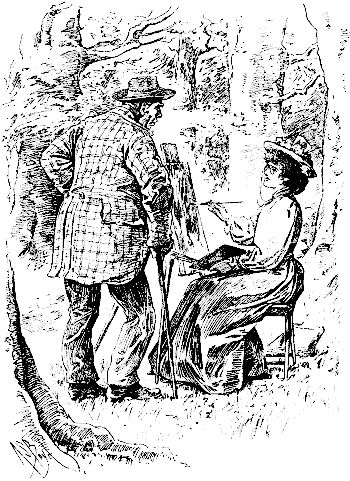
HIS IDEA OF IT.
Native. "Is't no a daft-like place this tae be takin' a view? There's no naething tae be seen for the Trees. Noo, if ye was tae gang tae the tap o' Knockcreggan, that wad set ye fine! Ye can see Five Coonties frae there!"
THE LEADING MOTIVE OF THE "W. O.," WITH VARIATIONS.
The General Idea (supplied at Pall Mall). That, although the British Army costs (exclusive of extras) £57 per man, the War Office is the best bureau in the world. The establishments over which the Secretary of State and the Commander-in-Chief preside, are necessarily incapable of improvement, as they are absolutely perfect. This being so, nothing more need, can, and should be said.
Commentary No. 1 (supplied by Printing House Square). That the General Idea of the War Office is ridiculous. That were Pall Mall to be occupied by the staff of a merchant's office, the nation would be saved millions, and the £57 (exclusive of extras) per man arrangement would soon be regarded as an extravagant product of the wasteful past.
Commentary No. 2 (supplied by a military writer). That civilians cannot possibly know anything about the working of a Government Office. As Pall Mall says it is perfect, it is to be presumed that it is. Why not leave well alone? And as for £57 (exclusive of extras) per man, why, is not that arrangement less than £60?
Commentary No. 3 (supplied anonymously). Opinion of military writer not worth the paper containing it. Look abroad. Does the foreign service cost £57 per man, exclusive of extras? Not at all. Then what can be done on the Continent, can, and should be done in England.
Commentary No. 4 (supplied by the working-classes). What! pay, £57 (exclusive of extras) for a soldier? Much better abolish the Army, and reduce the price of beer!
Commentary No. 5 and last (supplied by Private Thomas Atkins). What, I cost £57 a year, exclusive of extras! Well, all I can say is, that precious little of the money or the perquisites gets into my pockets! Worse luck to it!
Mrs. R. on the Political Situation.—"What's this I hear about Mr. G.?" inquired Mrs. R. "That he is returning to the House in town, and giving up his Villiers in the country?"
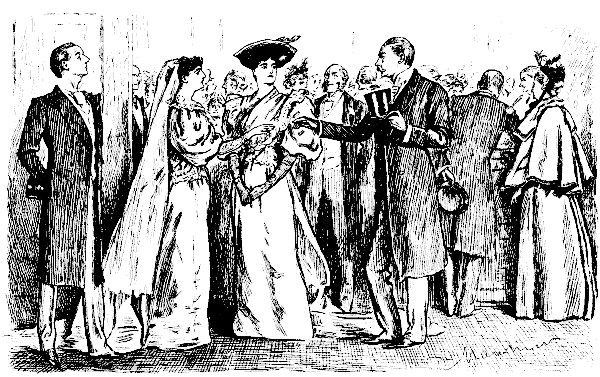
UNLUCKY SPEECHES.
"Many Happy Returns of the Day!" says the bashful Jones to fair Bride on the occasion of her Third Marriage.
ARS EST CELARE NATURAM.
The German Emperor having expressed a wish to visit a non-existing island at Hamburg, the tasteful citizens have constructed one by means of wirework, canvas, plaster, and cement.
It is stated that the Sultan is bored by the Bosphorus. The whole surface of the water will therefore be covered with planks, painted green, to represent meadows.
The King of the Belgians is said to have remarked that Brussels would be improved by a distant view of the sea. The municipal authorities propose to cover the high ground, seen from the palace windows, with tin-foil. It is hoped that this will give the effect of the sea gleaming in the sunshine.
The President of the French Republic having thought that it would be a pleasing compliment to Russia if some specimens of Russian architecture could be erected in Paris, it is believed that the Commission des Monuments Historiques will cover the Louvre with laths and canvas, painted to represent the Kremlin, and by similar means will transform the Champs Elysées into the Nevsky Prospect, and will give to Notre Dame the appearance of the forts at Cronstadt.
The Khedive has expressed an opinion that the Pyramids look old and shabby. If the English and French government will authorise the expenditure, the whole surface of the stone will be made perfectly smooth, will be painted and grained in imitation of oak, and will finally be varnished. The face of the Sphinx will be washed, and will then be used for an advertisement of an English soap. The enormous rent paid for this will be added to the Khedive's pocket money.
The Queen of Holland is dissatisfied with the flat surroundings of the Hague. It has been pointed out to Her Majesty that the city contains a hill, called, we believe, the Vijverberg, which rises at least three feet above the level of the sea, but she has replied that this is not enough. It is therefore proposed to surround the whole city with a gigantic panorama of the Bernese Oberland.
The other day the King of Spain perceived a reflection of the moon in a pond, and was much annoyed when his attendants failed to bring it to him. It has now been arranged that all the ponds in the neighbourhood shall contain an aluminium moon, which can be pulled out by a specially appointed Grandee of Spain, if commanded by His Majesty.
"B-O-M-B—BOMB!"
Friday, June 21. The Duke of Cambridge resigned his Commander-in-Chieftaincy, and the Government was suddenly scattered by a "Brodrick Patent Cordite Exploder," which reduced the Secretary of War's salary by a hundred pounds.
"A hundred pounds! Ha! Thou hast touched me nearly." The Critic.
The Witness Protection Society and General Legal Reform Union has been holding its Annual General Meeting. Among the numerous objects of this estimable body the chief appears to be to protect witnesses in law courts from insult by counsel. Captain Parkis, having expressed himself as willing, was voted to the chair, and the members settled down to have a good time. "Heated discussion," "further disturbance," and a well-sustained fire of "protests," lent an air of gaiety to the proceedings, which culminated in "various gentlemen abusing one another across the table." With such excellent practice, the members of the W. P. S. G. L. R. U. should be able to hold their own in court. The Bar trembles. Even the Bench feels a little uneasy.
L-ckw-d, no longer drawing, will be drawn, Even the piercing eye of Cl-rke will quail, C-rs-n be "spacheless," G-ll will almost fawn, And sturdy W-bst-r falter and turn pale, Because the witness, taking heart of grace, Will "go for him" with candour strangely new, And brandish, cross-examined, in his face The W. P. S. G. L. R. U.!
"Memorable Sayings and Historical Events."—There must now be added to the long list Sir William Harcourt's languidly jocose remark on Friday night last. "Thank Heaven," he is reported to have said, "there is one night on which we need not fear a crisis." And while yet the laugh was on their lips, the bells rang, and subsequently the Four Tellers announced what could not have been Fore-told. And who laughs last?