Volume 108 — OUR BOOKING-OFFICE.
Reading edition
"Who won the battle of Tel-el-Kebir?" "I, said Cock Hamley, I won Tel-el-Kebir with my Highland Brigade." Mr. Innes Shand's life of General Sir E. B. Hamley (Blackwood) is obviously published with chief intent of placing in permanent form Hamley's claim in respect of this engagement. It is not a new story. It was published to the world soon after the event in the pages of a monthly magazine. The article, a model of terse, lucid, yet picturesque writing, is reproduced in these volumes. Whether accurate in detailed assertion and induction, or coloured by strong feeling, it is a melancholy story. Either Hamley was deliberately ignored in the Commander-in-Chief's despatches after Tel-el-Kebir, or he was under a remarkable hallucination. The affair is all the more curious since Sir Garnet Wolseley, as soon as he was appointed to the Egyptian command, sought out Hamley and offered him the command of one of the divisions of the expeditionary force. The secret of the estrangement which soon developed between the two soldiers is, my Baronite suspects, to be found in the characteristic fact that the very day the ship conveying Sir Garnet Wolseley arrived at Alexandria, Hamley went on board and proposed to show his chief how the enemy should be attacked. "He did not seem to wish to pursue the subject," Hamley writes in his diary, "and I soon after took leave." Other incidents, which Hamley hotly resented, culminated in the despatch to the War Office reporting the fight at Tel-el-Kebir, and ignoring the Highland Brigade, which, in the view of its commander, had borne the brunt of the battle. Some day Lord Wolseley may give his version of the affair. Meantime it gloomily stands forth in this record of a strenuous but, on the whole, a disappointed life. It is pleasant to learn that Hamley gratefully recognised in one of Mr. Punch's Cartoons a powerful incentive to the course of public feeling which postponed his being shelved under the operation of the scheme of compulsory retirement by reason of age. The most charming passages in the book are the correspondence with the late Mr. Blackwood, who opened to General Hamley the avenue to literary fame.
One of my Baronites of Irish extraction writes thusly:—"A Tale of the Thames is the title of the Summer Number of The Graphic. It is written by J. Ashby-Sterry, and illustrated by William Hatherell. The course of the story—or, rather, the watercourse of the story—covers a good deal of ground, embracing as it does, on both sides, most places of interest between the Source in Trewsbury Mead, Gloucestershire, and Hampton Court." Quoth the Baron, "I am all anxiety to see this tale of the Thames uncoil itself."
The Baron welcomes a comparatively "handy" volume ("handy" relative term, depending on size of hand) of reference, entitled, Men and Women of the Time, new edition, brought out by Messrs. George Routledge, edited by Mr. Plarr of Oxford; and the plat that is set before the public and the Baron appears to be a thoroughly satisfying one. "The first name for which I naturally looked," quoth the Baron, "was that of Routledge himself, but searching from Rossi, through Roumania, to Rowbotham, nowhere did I light upon the name of Routledge. Master Millais is here, also Miller, likewise Mills; but I do not see the name of the author of the 'Arry Papers, the inventor of 'Arry in these columns, of immortal fame. "Name him!" In every other respect the compilers and publishers are to be congratulated, and do hereby stand congratulated, on their work by the ever-appreciative
Baron de B.-W.
THE TWO GRACES.
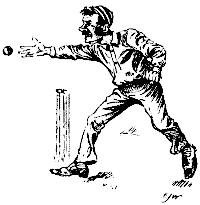
["There was something pathetic in seeing old W. G. and young W. G. at the wicket together. It is not often we see father and son together at the wicket in first-class cricket."—The Star on the M. C. C. v. Kent match at Lords.]
Air—"The Two Obadiahs."
Tom Bowling.
Says the old W. G. to the young W. G., "Pat your wicket, dear son William, pat your wicket! In the pitch there are bad patches, that may lead to bowls or catches; And you're now in first-class cricket, first-class cricket. I've already topped my fame; you have got to make your name. I should like to see us both make a 'century' this time!" Says the young W. G. to the old W. G., "'Twould be prime, Father William, 'twould be prime!" Says the young W. G. to the old W. G., "How I wish that I could time and place like you! I should like to hear them clap me, but my gig-lamps handicap me; Still I'll do my little best to pile a few." Says the old W. G., "Run for all you're worth, like me! You must always 'play the game.' You must ever 'look alive.'" Groans the young W. G. to the old W. G., "Caught—for Five! Father William, only Five!" Says the old W. G. to the young W. G., "Bother Hearne, dear son William, Jones and Hearne! But don't you get in a pucker! Caught and bowled for Fives's a mucker, But be patient, and you're sure to get your turn. I am going to have a shy for another Cen-tu-ry. You must help me by-and-by to keep up the family name!" Says the young W. G. to the old W. G., "Right you are, dad! Wish you luck, and a good game!"
"Three Which's?"—Will Sara B., Eleanora Duse, and Miss Ada Rehan be playing individually and separately at different theatres all at the same time? Were this concatenation to occur, the playgoer, at the height of the season, would be as puzzled as was the "anxious cit," who "each invitation views, And ponders which to take and which refuse." The "stayer" will win. Fly away, Sara, fly away, Nora—and so from three take two, and only Ada Rehan remains, which is a simple sum in subtraction, though Miss Rehan herself is always a most welcome Ada-ition to the English-as-she-is-spoken Drama in London. The Augustinians of Trafalgar Square return to their Daly avocations on the 25th.
UNDESIGNED COINCIDENCE.
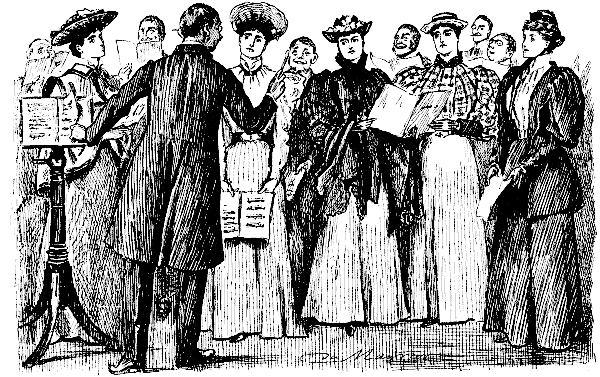
Curate (to Parish Choir, practising the Anthem). "Now we'll begin again at the 'Hallelujah,' and please linger longer on the 'Lu'!"
THE GRACEFUL TRIBUTE.
Sir,—Being "stumped," alas I can only send Dr. Grace my best wishes, and a round 0, which is good for naught.
Yours, Run Out.
Sir,—To encourage "Our Boys" in the National Game, I am heartily glad to see the daily (Telegraph) increasing list of subscribers to the testimonial. Had poor H. J. Byron been alive—the mention of "Our Boys" of course recalls him to our minds—he would no doubt have sent a coin, and further subscribed himself
Perkyn Middlewick-et.
Sir,—The present enthusiasm for cricket and its distinguished Professor will spread to France. There le cricquet has already been introduced, and, when no misadventure occurs, the batsman, returning triumphant and grateful, records his "actions de Grace."
Yours, Homme d'une Chauve-souris.
P.S.—Je fais le cricquet, autrement je m'enGRAISSE. (See?)
Sir,—I miss one important name from the Telegraph list of subscriptions to Grace Testimonial. What is Grace the Batsman without T. G. Bowles?
Yours, Batter Pudding, M.P.
Sir,—Here's something original. Lay out some of the coin subscribed in purchasing for Dr. W. G., the champion "Willow-wielder," a set of "Willow-pattern plates."
Old China.
P.S.—I happen to have by me a rare, almost invaluable set, which I can dispose of at a certain figure.
Sir,—Dr. Grace is now getting on for fifty. In another four years he will complete his half century. Therefore he is no chicken. Ergo, he may one day have a duck's egg. I withhold my subscription, to accumulate with interest, till that occurs.
A Wicket Girl.
An Ardent Admirer.
Sir,—Ah me! and well-a-day! it is the grand sorrow of my life! I cannot subscribe to this fund for Dr. Grace. I dare not, except you allow me to send it confidentially through you, Sir, ever the Ladies' friend. Ah Sir! long ago my heart "went out"—to whom? no matter. It was a cricketer. I never told my love! I long-stopped! But never, never, shall I forget that memorable day when he was there, and when someone, Dr. G. will remember who it was, bowled a maiden over! I am not a heroine, but I may sign this (as I address it fervently to)
"Grace Darling!"
The Lighthouse, A Little off—the Coast.
Sir,—I belong to an "Impi" tribe—with "cunious" added. Otherwise would I contribute what I did to the first cricket-match I ever played, when, as the ball was thrown at me, to save my head I gave a bob. I cannot even do that now. But as a lover of the game I hope that there are many youthful Britons eager to follow "Exemplum Gratiæ."
Yours, Stump Orator.
Dear Sir,—I think you are quite right to encourage cricket, as it is a noble game. The Duke of Wellington ones said that Trafalgar was won on the Eton Playing-fields. I don't think he was quite right there, as I have always been told that the battle was fought abroad. I am last in my class, but I'm in the second Eleven. I'm often "not out," and to-day I've had to "stay in" all the time during the match, because I had a saying-lesson to write out and translate. The other day I made 27, including three fourers, against the United Thingummies.
I remain, yours enthusiastically, Tommy.
The Only College.
P.S.—I will send my shilling as soon as I can get it from Batley mi. He owes it me for birds' eggs.
Sir,—I am only too happy to contribute my mite, for though it's some while—alas! how time flies—since I handled the willow, I well remember playing in the early forties against Alfred Pitcher and John Tosser. Ah, they were heroes in those days. I myself was no mean performer. I tell you, Sir, many's the time I have made double figures against the underhand bowling of Jimmy Trundler, and he could bowl, too! before the round-arm style came in. I never took kindly to that, but these fifty years I have been an ardent looker-on, and I must tell you, &c. &c.*
Jno. Wardle. (Late Member of All-Muggleton C. C.)
* "No you mustn't." Caught out by Editor.
"A FLYING VISIT."
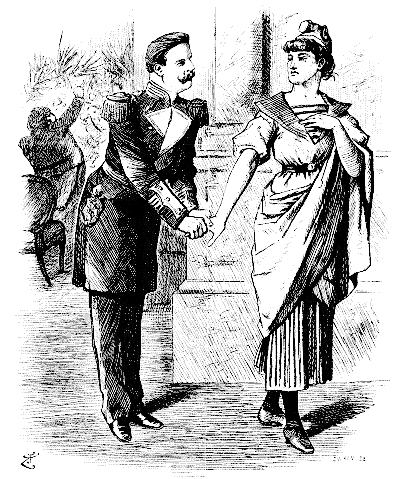
Emperor William (to Madame la République leaving Kiel after very brief stay). "MUST YOU REALLY GO? SO SORRY!"
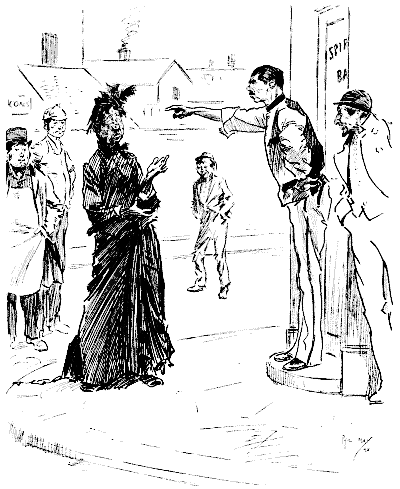
"Perfeck Lidy" (who has just been ejected). "Well, next time I goes into a Publickouse, I'll go somewhere where I'll be respected!"
PROVERBS BY AN ILLUSTRIOUS FOREIGNER ON TOUR.
The time of special trains was made for slaves, not Asiatic Princes.
You may take an Eastern Magnate to a manufactory, but you can only with difficulty get him to lunch with the local Mayor.
There is many a slip between the Prince and the lift.
A view of machinery in motion in hand is worth two invitations to receptions in prospective.
Cocked-hats of a feather flock together.
You cannot make pleasure out of the address of a corporation.
All roads lead to turtle soup.
It is an ill wind that causes a swell on the Ship Canal.
People who live in mosques ought not to throw sticks at the Derby.
A programme kept to time is not worth nine.
The early mayor has to wait longest.
Give a Highness a wrong title and report him.
Enough at a factory is better than a feast in a Town Hall.
It is a long explanation that has no turning.
A jerk is as good as a nod to a bowing multitude.
When a person of the first importance enters by the door all settled arrangements disappear through the window.
The Representative of an Illustrious Race laughs at Traffic Managers.
The English Public enjoys a sensation, but the Indian Empire pays for it.
When the Prince is away, to fill up the time the band will play.
The son proposes but the father disposes.
The autocrat through the telegraph waits for no one.
Welcome the coming quiet and speed the exhausted guest.
An Opportunity not to be Missed.
Tired Reviewer (to Anxious Author). Ah! old fellow! I'm fagged out! Come and dine with me to-night? Sorry to give you such short notice.
Anxious Author. "Short notice!" Oh, please, never do that.
[Exeunt together.
"A SALE! A SALE!"
The Price Sale of pictures on Saturday last at Christie's will be ever memorable as "The Highest Price Sale." "'What's the demd total?' was the first question Mr. Mantilini asked." To which the present answer is £87,144. A nice little sum to go on with, or off with. One of the incidents was most dramatic. Gainsborough's "Lady Musgrave" was put up to be purchased. Then stood forward bold William Agnew with eight thousand guineas in his best gossamer. "The lady is mine!" he exclaimed, rapturously, and was advancing with arms outstretched to seize his prize, when suddenly his path was crossed by one Campbell "of that ilk," who cried aloud, "Here are ten thousand golden sovereigns plus ten thousand silver shillings, all glittering on a tray! Advance no further!" And bold William advanced no further. For once he was taken aback. "I didna ken the Campbell was coming!" muttered William A-bashed. And ere he could recover from his surprise, and while yet his frame was quivering with excitement, his picture, the Lady that should have been his, was gone. "They have given her to another!" he sang sadly, but the next moment he pulled himself together, and "taking heart of Grace" William made such running, off his own bat, as would have astonished even the eminent cricketer just mentioned. And the last of the "Reynolds' Miscellany" in this collection succumbed to William the Conqueror for 450 guineas. Sic transit gloria Saturday!
New Name.—The Imperial Institute henceforward to be known as "The Somers Vinery."