Volume 108 — AT A YEOMANRY REVIEW.
Reading edition
Scene—An open space near Baymouth, the watering-place at which the County Yeomanry have been going through their annual training. Along one side of the ground is a row of drags and other carriages, occupied by the local magnates; along another, the less distinguished spectators stand in a thin line or occasional groups, waiting for the review to begin. In the centre, the inspecting officer is judging the best turned-out troop, while the remainder of the regiment are doing nothing in particular.
Yeomanry Non-Com. (who is leading an officer's horse and talking to a female friend of his and her brother with the sense of conferring a distinction upon them). Ah, 'tis not all play this yere trainin', I do assure ye. I've been so 'ard-worked all the week, with all the writin' I've had to do at the orderly room and thet, I've 'ardly 'ad time to live! But I like it, mind ye, I like it more every year I come out and so does my old 'errse, a' b'lieve. And there's this about it too—the girls don't come errfter a feller!
The Young Lady. Well, I'm sure! Now I should have thought when you're in the Yeomanry, it was just what——
The Y. N.-C. Tain't so—not in my case—that's all I can tell ye.
The Y. L. (with coquettish incredulity). Oh, I daresay. With that uniform, too! Why, I expect, if the truth was told, you know more than one young lady who's glad enough to be seen about with you.
The Y. N.-C. (complacently). More than one! Why, theer wurr eight I took out in a boat for a moonlight row on'y lawst night—nawn o' my seekin', but they wouldn't take no denial. I didn't want to be bothered with 'en. I've got other things to do besides squirin' a passel o' wimmin folk about, I hev.
The Y. L. You conceited thing, you! If that's the way you go on, I shan't talk to you any more!
The Y. N.-C. Well, you won't hev th' opportunity, for theer's the Captain calling me up. So long—and take care o' yerselves!
[He trots off, feeling that he has sufficiently impressed them.
The Y. L. (to her brother, with the superiority that comes of a finishing school with all the extras). Distinctly "country," isn't he?
Her Brother. Well, he can't help that. And he rides as straight as any chap I know.
The Y. L. Oh, he's a real good fellow, I know that; still he is just a little —— I did hope I'd polished him up a little while we were at the farm last summer; but there, I suppose you can't put refinement into some people!
Another Young Lady (to her Admirer). I can't make George out yet among them all—can you?
Her Admirer (and George's rival). Cawn't say as I've tried, partickler. But there's one there in the rear rank that hes a look of him; that one settin' all humped up nohow on his 'errse.
The Adored One. Oh, of course, if you're going to make out as George can't sit on a horse!
Her Admirer (sulkily). Well, I'd back myself to ride 'cross country agen Garge any day.
The Adored One. Then why don't you join the Yeomanry, like he has?
Her Admirer (who would if he could afford it). Why? 'Cause 'taint worth my while, if you want to know!
The Adored One. I'm sure it's a smart enough uniform—at least George looks quite 'andsome in it.
Her Admirer. He didn't look very 'andsome when I see him on parade this marnin'; the sun had peeled his nose a treat!
The Adored One. It's well there are some who are willing to make sacrifices for their country!
Among the Carriages.
Mrs. Prattleton. Yes, so sad for him, poor dear; but of course whenever his father dies, he'll be quite comfortable. (Recognising a military acquaintance.) Oh, Captain Clinker, do come and tell me what they're supposed to be doing out there, and whether they've begun yet.
Capt. Clinker (R.A.). Nothin' much goin' on at present. Ah, they seem to be wakin' up now a bit. (As the band strikes up.) There's the general salute; now they're goin' to make a start.
Mrs. Pratt. Who is that little man in the baggy black frock, rather like a dressing-gown, and the cocked hat; and why is he galloping out here?
Capt. C. He's the inspectin' officer; takin' up his position for the march past, don't you know.
Mrs. Pratt. Oh; and they're all going to march past him. How nice! But there's another officer in a cocked hat; is he inspecting, too?
Capt. C. Only their tongues; he's the regimental Pill—the doctor, you know.
Mrs. Pratt. (disenchanted). I quite thought he must be a general at least. Dear me, there's one man in a red coat and a helmet. What is he doing here?
Capt. C. That's the adjutant.
Mrs. Pratt. Oh; and the adjutant always wears a helmet. I see. They've hung red silk round the kettledrums; (pleased) that's real soldiering, isn't it?
Officers (as the regiment marches past by squadrons). Right whe-eel! Eyes right! For-ward! Dress up to your leaders there!
Capt. C. (with languid approbation). The dressin's not half bad.
Mrs. Pratt. No, they're dressed very like Hussars—or is it Artillery I mean? I always had an idea the Yeomanry wore comic uniforms—with shirt-collars, you know, and old-fashioned milk-pail hats with feathers and things. But (disappointedly) there's nothing ridiculous about these. What a frisky animal that trumpeter is riding; look at him caracoling about!
Capt. C. Trumpeters and serjeant-majors always the best mounted.
Mrs. Pratt. Are they? I wonder why that is. (As the regiment ranks by in single file.) But they've all got beautiful horses.
Capt. C. (critically). H'm, they're a fair-lookin' lot. Fall off a bit behind, some of 'em.
Mrs. Pratt. Do they? Then they can't be very good riders, can they?
Capt. C. These fellows? They ought to be; most of 'em, you see, hunt their horses regularly.
Mrs. Pratt. (with a mental vision of dismounted troopers chasing their chargers about the ground). What fun! I should like to see them do that. (As the regiment trots past in sections.) But they don't seem to come off over the trotting.
"'Twas onfortunate fur Garge, him bein' th' only man as fell arf."
Capt. C. Not quite; the leaders don't keep their distance, so the men can't keep up. Still, considering how short a time they've been out, you can't expect——
Mrs. Pratt. No; and they haven't tried to gallop yet, have they? Some of the horses are cantering now, though; it looks so much nicer than if they all trotted, I think.
Capt. C. Don't fancy their Colonel would agree with you there.
Mrs. Pratt. What a shame to keep those poor soldiers out there all by themselves; they don't have any fun, and they only get in the way of the others when they turn round. Oh, look at them now—they're all coming straight at us, and waving their swords!
Capt. C. Pursuin' practice at the gallop; doin' it rather decently, too.
Mrs. Pratt. But do you think we're safe just here? Suppose they can't stop themselves in time!
Capt. C. No danger of that; too heavily bitted to get out of hand.... There, you see, they're all wheelin' round. That'll be the wind up. Yes, they're drawn up in line; officers called to the front. Now the inspecting officer is makin' a few remarks, butterin' 'em up all round, you know. It's all over.
Mrs. Pratt. Really? It's been a great success, hasn't it? I enjoy a review so much better when they don't have any horrid firing. Don't you?
[Captain Clinker assents, to save trouble.
On the Way Home.
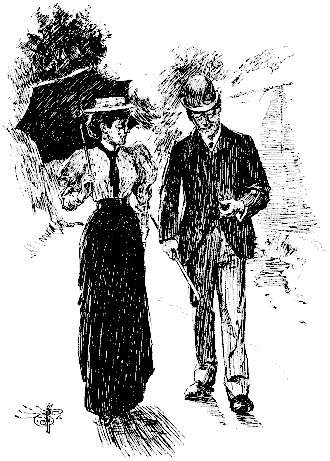
George's Rival (reflectively). 'Twas onfortnate fur Garge, him bein' th' only man as fell arf, so 'twas.
The Adored One. He didn't fall off—he only fell out. Didn't you hear him tellin' me the buckle of his stirrup broke?
George's Rival. Buckle or nawn, he come arf; that's all I'm sayin'. An' showed his sense, too, by keepin' out o' th' rest on it. But Garge was allays a keerful sart o' chap.
SCRAPS FROM CHAPS.
["At the Ludlow County Police Court, on May 27, Sir Charles Rouse Boughton, Baronet, of Downton Hall, a Justice of the Peace, applied for a protection order against Mr. John Baddeley Wood, of Henley Hall, a Justice of the Peace. The parties had a dispute over a waterway, and on leaving Middleton Church on Sunday, Mr. Wood, it was alleged, used coarse language to Sir Charles, and called him a liar three times. Sir Charles said he was in bodily fear of Mr. Wood, and thought if sureties to keep the peace were applied for he should be safer. The Bench granted the summons."—The Sheffield and Rotherham Independent.]
Sure, Wood and Boughton might full well By closest ties be knit; But water's caused them both to swell, And brought about a split. And now within their bosoms housed Blind anger courses madly, Sir Charles's temper has been Roused, And Wood has lost his, Baddeley.
Mr. T. Dolling Bolton, M.P. for N.E. division of Derbyshire, has been explaining to his constituents at Eckington the reason for his voting against the Government on Mr. Lloyd-George's amendment to the Welsh Church Bill. He was under no obligation to party leaders or party as a party. There was no subsidy by the party, no assistance given by party speakers, and he had to rely upon the electors alone. These elementary political principles endorsed by unanimous vote of continued confidence in esteemed member. Vote moved in eloquent speech by Mr. Boden. No party assistance, no party voting, manly independence the thing for Boden. Leaders say it ought to be a thing "verboten," and Mr. T. E. Ellis filled with foreboding by latest revolt. Bolton voting blue bad enough, but the enthusiastic approval of his constituency quite a bolt from the blue.
TO A LADY-JOURNALIST. (Written by Request.)
Coming for an Interview.
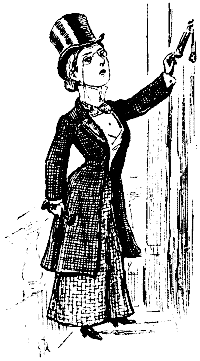
Great heav'ns! Here, where's my paper, pen, and ink! How is it all this while I have omitted you? For her I've rhymed, and Her, and Her; don't think, I beg then, that I'll from my duty shrink, A duty to a lady smart and witty due. I'm really sorry for this painful lapse Of etiquette—'twas careless, now you mention it. I thought—let's see, what did I think?—perhaps You'd hardly time to read poetic scraps; Your leisure's precious, and I dared not trench on it! Then ladies of the Press bar compliments (At least I seldom find they will permit any!), So I'm impelled to write plain common sense, As near as may be, and on no pretence Aspire to high-flown ode or "lover's litany"! But still you've asked me, and I'd much regret Not to oblige you promptly, if I know a way; The more so, as you've just dropped in to get A cup of tea and smoke a c-g-r-tte. (By Jove, I hope I haven't giv'n the show away!) Well, I've not said much, but I've thought the more: If I were fulsome in your praise, why, "Drat it!" you'd Most probably remark, or "What a bore!" So, therefore, please between the lines explore— 'Twas you who bade me thus descend to platitude!
'Arry says he was "much interested in 'earing of a nartickle in the St. James's Gazette last week, 'eaded The 'Aunt of the Otter. He 'opes the writer will next give us The Uncle of the Coolie."