Volume 108 — "LONDON AND LIVERPOOL—LITTLE AND GOOD."
Reading edition
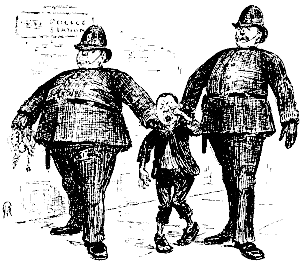
It appears that the very excellent proposal of amalgamating all the local branches of the Society for the Prevention of Cruelty to Children in one national association is meeting with some opposition in Liverpool. Says the Courier of that important locality, "It was Liverpool which educated London in the matter of child-protection, and probably the Londoners could still learn in Liverpool many practical lessons. And just when Liverpool is about to be trebled in extent, and have its population largely increased, seems a singularly inappropriate time to subordinate the city to London." From this it would appear that Liverpool in its growth is becoming, to use a colloquialism, "too big for its boots." Surely the benefit of the children should be the first consideration. What the size of either Liverpool or London has to do with that matter, it is difficult to say. No doubt Londoners could learn much from their Liverpool brothers. But the lesson for the moment is to discover how to best protect the little ones. And that subject can only be mastered by a display of goodwill and unselfishness on both sides.
SIR JOHN FRANKLIN.
[May 20, 1895: Fiftieth Anniversary of the Day when the Franklin Expedition set Sail.]
The North returned thee not to British earth. Whence on that splendid quest thou didst go forth; But when our British hearts, in sordid dearth Of pride, forget thy valour and thy worth, Those hearts must be yet colder than the North.
TURF CUTTINGS.
"Taken and Off"
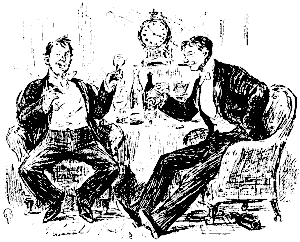
"Getting on" at 6 to 4.
A BAS "THE CLUB SWEEP."
Dear Mr. Punch,—Although you are a humorist, there is a serious side to your character. I want to appeal to that serious side. I wish to complain of the prevalence in all our West-End Co-operative Palaces of that annual pest, appropriately called "the Club Sweep." Why should it be allowed to prosper? It is a disgrace to civilisation. I know of no more painful sight than the picture of old Crœsus paying the hall-porter to put him down for a dozen places. I am delighted when those twelve positions end in blanks, or starters out of the running. And nearly as unpleasant an incident is the tableau of young Jones taking a pound chance at the same fatal lottery. Put it down, Mr. Punch; put it down. I repeat, "the Club Sweep" is unworthy of the civilisation of the close of the nineteenth century. Once more, Sir, put it down.
Yours, most truly,
An Old Member of the Hercules Club.
P.S.—I am sure the thing is a mistake. Will you believe it, I have put into my own sweep for the last thirty-five years, and have never drawn a starter! Same luck this season!
From the New Sarum Note-Book.
[Lord Salisbury "believes the Sultan to be a humane man."—Speech at Bradford.]
Lord Salisbury believes—
That Richard the Third was a remarkably amiable man; especially kind to children.
That Nero was the gentlest creature that ever breathed, except Caligula.
That Henry the Eighth was a gentle, unassuming person; most religious and domesticated; in fact, a model husband, and the sort of man that "wouldn't harm a biby."
ROUNDABOUT READINGS.
The Hon. George Curzon and Miss Leiter (U.S.A.) have been married. The State of Illinois is indignant. The two facts are more intimately connected than might be supposed. Four days after the wedding a resolution was introduced into the State Legislature of Illinois by a Mr. McCarthy, requesting the daughters of Illinois "not to accept the hand in marriage of any person who is not a citizen of the United States, as we are of opinion that the daughters of Illinois should be patriotic in their views, and should disregard the title of any foreigner, and marry none but a citizen of the United States." It is stated that the resolution "was referred to the Committee on Federal Relations." Surely a Committee on domestic relations or on titled relations would have been more appropriate.
The Illinois State Legislature obviously has novel ideas of its legislative duties. Imagine an English County Council treating seriously such fantastic rubbish as Mr. McCarthy brought before the law-makers of his State. Would it not be more to the point to look after the sons of Illinois, and to keep the hue of their resolution up to the mark? If they are laggards in love, who shall blame the British aristocrat for wooing with success the daughters of Illinois, whom their compatriot suitors abandon? Or again, if titles are so irresistible an attraction to the fair, why not establish titles in Illinois, and thus give the Earl of Bangs or the Marquis Saltontale that seductive influence which is apparently lacking to plain Zedekiah B. Bangs, and to the unadorned Jonathan K. Saltontale. For it is obviously better that the daughters of Illinois should marry than that they should waste away with an unbridaled (let the spelling pass) desire for a title.
At Oxford on Wednesday last the University beat Somerset by one wicket, mainly owing to the admirable batting of Mr. H. D. G. Leveson Gower, popularly known as "The Shrimp."
To the batsmen of Oxford, who looked very limp, Father Neptune was kind when he gave them a Shrimp: For a Shrimp on the grass is most worthy of rhyme, When he makes a firm stand, but gets runs all the time.
The inhabitants of Christmas Street in Bristol want to have their thoroughfare laid with wood paving. At present, according to an indignant correspondent, "the pitching in the street is so bad that it is positively dangerous for vehicular traffic ... but the risk to life and limb are entirely subservient to the parsimonious policy of our Bristol Sanitary Authority." Might I suggest Yule logs as an appropriate pavement for Christmas Street? Certainly this accident policy of the Bristol Sanitary Authority ought to be allowed to lapse.
I gather from a letter in the Freeman's Journal that Bray is not being well treated by the Bray Township Commissioners. "If Bray is to march with the times," says the writer, "and keep pace with the laudable efforts of our Tourist Development Association," something must be done to improve the walk round Bray Head. The picture of Bray keeping pace and marching with the times by walking round its own head is too confusing for the intelligence of the dense Saxon.
An article in the Scotsman declares that "a great laxity of costume is characteristic of modern Oxford." Straw hats and brown boots appear to abound everywhere. It is added that "Bowlers are already beginning to be preserved as relics of a bygone race." This will be glorious news for the Cambridge Eleven, for a merely preserved bowler cannot be very dangerous.
From a recent issue of the Freeman's Journal I extract the following letter, which, it must be admitted, "makes both sides right" with a clearness that leaves nothing to be desired. Note, too, the writer's natural vexation at the idea that he "assisted the constable":—
TO THE EDITOR Of THE FREEMAN.
114, Lower Clanbrassil Street, Dublin, May 14, 1895.
Sir,—With reference to your issue of the 13th inst., and the stolen tea from one of the London and Northern-Western vans, I beg leave to state that I in no way assisted the constable in the arrest of the prisoner, as you state; neither was there any necessity for me doing so, as he had sufficient help along with him at the time. But I did help the driver of the waggon when on the ground to recover his feet and get back to his waggon with the tea in question. My reasons for doing so were as follows—first, being a van driver myself, and I might say has been such all my lifetime, and knowing that when goods are stolen from any van in nine cases out of every ten the driver of such a van has to make good the same and be put under stoppages although no fault of his. Secondly, when I came on the scene the driver of the waggon seemed to be getting the worst of it, as the offender had two others helping him. If someone did not interfere, therefore, under those circumstances and to protect the interest of my fellow-workers, as I am always ready to do, I interfered, and under no other.—Hoping you will kindly insert this in your next issue and make both sides right, and thanking you for the same, I remain your humble servant,
Henry Prendergast.
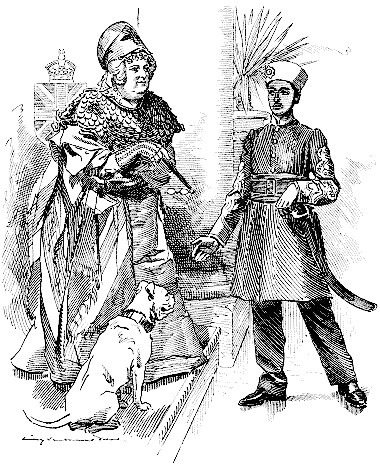
ALL THE COMFORTS OF A HOME.
Britannia (to His Highness Nasrulla Khan). "Delighted to see you, for your dear Father's sake!"