Volume 108 — LETTER TO A DÉBUTANTE.
Reading edition
Dearest Gladys,—I have been compiling a sort of dictionary for you, with a view to your second season. I send you a few selections from it—with notes of advice.
Art. A subject of discussion; mild at tea-time, often heated after dinner.
[Note.—Do not take sides. Mention that Whistler has a picture in the Luxembourg, or say—with a smile or not, as the occasion may suggest—that Sir Frederic is the President of the Academy.]
Altruism. Boring some people about other people.
[Note.—Never encourage Views. They take up too much valuable time.]
Beauty. An expensive luxury.
Boy. If "dear," any effective man under forty. If "horrid," about twelve, and to be propitiated with nuts, knives and ships.
[Note.—Do not offend him.]
Blasphemy. Any discussion on religion.
[Note.—Look shocked, but not bored.]
Coquetry. A manner sometimes assumed by elderly ladies and very young gentlemen.
Cynicism. Truthfulness.
Duty. Referred to by relations who wish to be disagreeable.
[Note.—Change the subject.]
Divorce. The occasional result of friendship.
[Note.—But you must not know anything about it. Read only the leading articles.]
Eccentricity. Talent.
Etiquette. Provincialism.
Flirtation. Once a favourite amusement, now dying out; but still surviving at Clapham tennis-parties and Kensington subscription balls.
Foreigners. Often decorative; generally dangerous.
Friendship. The mutual dislike of people on intimate terms. Or, a euphuism for love.
Failure. An entertainment to which one has not been invited.
Goodness. The conduct of one's mother.
Hygiene. Never bothering about one's health.
Idiocy. The opinions of those who differ from one.
Justice. Enthusiastic praise of oneself.
Kleptomania. Stealing things one doesn't want.
Love. A subject not without interest.
Moonlight. Depends on the other person.
Marriage. The avowed and justifiable object in life of young girls. The avowed and justifiable terror of bachelors.
Nature. It has gone out of fashion, except in novels you must not say you have read.
Obviousness. To be guarded against.
Philosophy. An innocent amusement.
Palmistry. Only if he is really very nice.
Quarrel. A proof of love, or of detestation.
Quixotism. Defending the absent-minded.
Romance. Friendship in London.
[Note.—Do not be so absurdly credulous as to believe there is no such thing as Platonic affection. It is extremely prevalent; in fact, there is hardly anything else.]
Sincerity. Rudeness.
Toleration. Culture.
[Note.—You may as well begin to be tolerant at once, and save trouble. It is sure to come in time.]
Ugliness. Rather fashionable.
Untidiness. The picturesque way in which the other girl does her hair.
Vanity. Self-knowledge.
Wilfulness. A desire to give pleasure to others.
Youth. Appreciated in middle-age.
Zoological Gardens. Of course not. Nobody goes there now. Besides, you never know whom you may meet.
There, Gladys, dear! Write soon, and let me know when you are coming back to London. Sleeves are larger than ever, and chinchilla—— But I daresay you have heard.
Ever your affectionate friend,
Marjorie.
"My Old Dutch!"—See Exhibition of Old Masters' Works, Burlington House.
A RENCONTRE.
(For investigation by the Psychical Society.)
The way was long, the train was slow, As local trains are wont to go, A feeble ray of glimmering light Strove vainly with the darkling night, And scarce enabled me to see The features of my vis-à-vis. Pale was his brow: no paler grow The snowdrops lurking in the snow; Hollow his cheeks, and sunk his eyes That gazed on me in mournful wise. So strange a man I ne'er had seen, So wan a look, so weird a mien, And, as I eyed him, I confess A feeling of uncanniness Crept slowly over me and stole Into the marrow of my soul. Awhile we sped, nor spake a word; Nought but the droning wheels was heard; But as we journeyed on together, By tentative degrees we fell From observations on the weather To talk of other things as well. "I had a few hours off," said he; "So I just ran across to see The last inventions——I refer To Kensington Museum, Sir. You know it? What a grand display! A splendid exhibition, eh? I never saw so fine a show Of coffins anywhere, you know! And there is one that's simply sweet, With handles, knobs, and plate complete!" "A coffin!"—Cold a shudder ran Adown me as I eyed the man. "Aye, to be sure. What else?" he said. "The one that's just been patented. Why, my good Sir, I will engage It is the marvel of the age; For, mark you, they no longer use Your clumsy, antiquated screws, But just a simple catch and pin That may be managed from within!" He ceased, for we had reached a station That chanced to be his destination. "My home!" he murmured, with a sigh. "Home—home! Sweet home!—Good-night!—Good-bye!" "Good-night!" I answered; and my heart Leaped when I saw his form depart. But as we slowly glided past The spot where I had seen him last, Upon the station lamps, methought, The letters of a name I caught. I looked again.—My hair uprose, The very soul within me froze, For lo! upon the lamps was seen The curdling legend—Kensal Green!
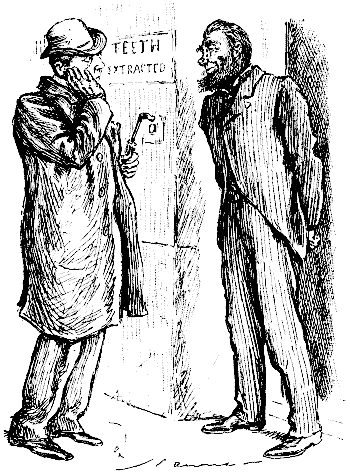
AT LITTLE PEDLINGTON.
Jones. "Do you use Gas?"
Village Operator. "Yes, Sir. But I much prefer Daylight!"
Suggestions to the Niagara Real Ice Skating Hall Manager.—The floor is perfect for skating, but, as there are many who do not skate, why not have a "sliding roof"? and visitors to the latter not to be charged full price, but admitted on a sliding scale. Nice to see Mr. Edward Solomon, who, as conductor of the band, cuts a very pretty figure. Dangerous, though, to the real ice, to have "Sol" so close to it; that is, if there could be "melting moments."
THE LAUREATE SOCIETY.
The annual general meeting of the Amalgamated British Society for the Supply of Laureates to the public was held yesterday. There was a numerous attendance of authors and reviewers with a sprinkling of publishers. Mr. Grant Allen was moved to the chair. The Chairman in presenting the report of the Directors regretted that he was unable to congratulate the Society on having accomplished the primary object of its existence, the filling up of the vacant laureateship. He himself, he said, had done his best. He had discovered a new sun in the firmament of poetry at least once a month, and had never hesitated to publish the name of his selection in one of the reviews. He was still willing to take seven to four about Mr. John Davidson and Mr. Francis Thompson, Mr. William Watson barred. The balance-sheet of the Society did not show a very flourishing state of affairs. As assets they could enter fifteen sonnets, twelve irregularly rhymed odes (one by Mr. Richard le Gallienne), twenty-four volumes of a strictly limited edition issued from the Bodley Head, four tons of the Yellow Book, and an unpublished selection of manuscript poems written by a victim to delirium tremens whose name he was not at liberty to mention. On the other side, however, they had to face the fact that their expenses had been heavy. It was becoming more and more costly and difficult to feed the public on geniuses, and he was inclined to advise the discontinuance of this branch of the Society's operations.
At this point some commotion was caused by Mr. Le Gallienne and Mr. Arthur Waugh, who rose simultaneously to protest against the Chairman's remarks. Mr. Le Gallienne was so far carried away by his agitation as to hurl a pamphlet at Mr. Grant Allen's head. In the uproar which ensued, Mr. Le Gallienne could be heard ejaculating "beautiful phrases," "richly-coloured musical sentences," "ideal and transcendental," "nothing finer since Lamb," "all for eighteenpence," and "a genius who sleeps below the wood-pigeons." The pamphlet thus discharged proved to be by a Mr. John Eglinton, and Mr. Le Gallienne was removed in the custody of a police-inspector, who was described by Mr. Waugh as a Philistine.
When calm had been restored, Mr. Alfred Austin asked where he came in. He had never allowed a birth, a wedding, or a death in the upper circles of Royalty to pass unsung; and though he had been a constant subscriber to the Society it didn't seem to have done him any good. Besides, he had discovered Ireland last year. Mr. Lewis Morris and Mr. Eric Mackay made similar complaints. The latter offered to write patriotic poems with plenty of rhymes in them against any other living man. Would the meeting allow him to recite——?
At this point the Chairman interposed, and said that the Directors had decided against recitations—a statement which provoked loud murmurs of dissatisfaction. Eventually, Mr. Le Gallienne (who had returned, disguised in proof-sheets), proposed a vote of thanks to Mr. John Davidson, who proposed a vote of thanks to Mr. Grant Allen, who proposed a vote of thanks to Mr. Francis Thompson, who proposed a vote of thanks to Mr. Arthur Waugh, who proposed a vote of thanks to Mr. John Lane, who proposed a vote of thanks to Mr. Le Gallienne. All these having been unanimously passed, the meeting broke up.
QUEER QUERIES.—War of Words.—À propos of Mr. Plowden's decision in the "Flannelette case," can that worthy magistrate have foreseen some of its effects? For instance, wanting to buy a sideboard, I went to a furniture-dealer's, and saw one, apparently made of the best mahogany, which took my fancy greatly. I casually asked of what wood it was composed and was astonished to have the answer given me, "Mahoganette," by the shop-walker. So I walked out of the shop. When I want painted deal I can inquire for that article. Again, I have noticed during the last few days a great falling-off in my butter (though not in its price). On my remonstrating, the seller frankly admitted that the article was "butterette," not butter. "What does 'ette' mean?" I asked him. He said it meant "little," adding, with a wink, that I should find "precious little butter, too." And this was the case. What are we coming to?—Indignant.
Oyster Bars."—The prohibitive price of natives and the typhoid scare.
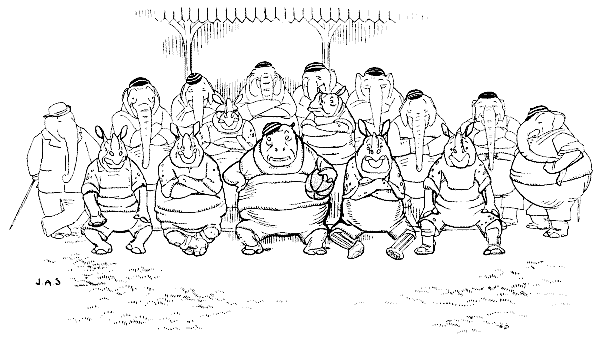
ANIMAL SPIRITS.
No. I—Football. "The Zambesi Scorchers."