A CABINET SECRET.
Reading edition
(Fragment for the Historian of the Future.)
[After the Cabinet several of the Ministers present took luncheon with the Chancellor of the Exchequer.—Daily Paper.]
There had been an exciting meeting of the Members of the Ministry. The gathering had taken place at noon, and after several angry altercations it had been adjourned. But the objector-in-chief had admirably kept his temper. He came of a gallant and illustrious race, and blood is thicker than water.
"I must not forget the teachings of my Uncle Dick," he had murmured, as it was suggested that two of his favourite projects should be slaughtered, like the infant Princes in the Tower.
Then, when there was an inclination on the part of his colleagues to quarrel amongst themselves, he cleverly fanned the fire, and increased the incipient strife.
"It was the mode adopted by my maiden Aunt, Queen Elizabeth, and it succeeded in her time. Why should the passing of three or four centuries make any difference? After all, human nature is—in fact—human nature!"
And so the dull minutes passed away. The time came for luncheon. Then he smiled a smile full of mystic hospitality.
"It will put the bloodhounds of the Press off the scent if I ask them to luncheon with me. It is sure to be reported in the papers, and who will imagine that I would willingly entertain a possible opponent to the coming Budget? Moreover, revenge is sweet; not that I would take it! not that I would take it!"
And then he entreated several of his colleagues to "crush a cup with him," using a phraseology that had found favour in the mouths of the Crusaders.
"And Rosey, will not you come?" The question was asked with much cordiality. The Premier did not reply. He merely smiled, and the smile seemed to be a sufficient answer.
* * *
Shortly afterwards (as subsequently reported in the newspapers) the noble Earl took luncheon at his own home.
"I wonder what wine he has given them?" And he smiled again.
"BOYS AND GIRLS COME OUT TO——PANTOMIME!"
Santa Claus, the afternoon pantomime at the Lyceum, is even better than Mr. Oscar Barrett's Cinderella of last year. There is plenty of splendour in the fairy piece, considered merely as a "spectacle," enough, indeed, to make a "pair of spectacles," and to cause much speculation as to how they manage to stow away all the scenery, properties, and costumes at five o'clock every afternoon, in order to make room for King Arthur, who, on the temporary abdication of Santa Claus (a part admirably acted and declaimed by Mr. William Rignold), reigns at the Lyceum from eight till eleven. But besides the dazzling brilliancy of fairy pantomime, there is in it not only real fun which delights the youngsters, for whom the entertainment is primarily intended, but also a touch of dramatic pathos, as shown in the death of the devoted dog Tatters, a dog who has his day and dies, whose cruel fate excites the compassion of old and young alike. All are rejoiced when they find out that clever Mr. Charles Lauri, of whom it can be complimentarily said that "he is a perfect beast," is restored to life, and that the Heavenly Twins are happily revived.
As the two toy soldiers Messrs. Harry and Fred Kitchen—the front and back kitchen—are first-rate. But where all are so good it is impossible, within the limits of a paragraph, to particularise. Messrs Barrett and Lennard are to be congratulated, and, as Hamlet says, "The Pantomime's the thing," and, as Shakspearian readers will remember, Hamlet's father went to matinées,—wasn't it "his custom always of an afternoon"?—only there's no sleeping here, but everyone very wide awake, and all "going home to tea" thoroughly satisfied with Santa Claus. Who says Le Roi Pantomime est mort, when the Lyceum is crowded for matinées, and, outside the doors of Old Drury, daily and nightly appear the placards, "House Full"?
A "Tit Bit."—When they speak of some one of the Baby Baronets, i.e. the recently created Baronets, they don't say he is among the Old'uns; but "He is among the New'nes."
"A PENNY PLAIN—BUT OSCAR COLOURED."
(An Entertainment Antagonistic to Amusement.)
Scene—Anywhere. Characters distributed about the Stage in more or less admired confusion.
Anybody. So we are living in a penny romance. And this is Society.
Charles his Friend. Society is everything but sociable.
Somebody. But why should the Prime Minister be threatened by a professional blackmailer?
Charles his Friend. In matters of this kind the Premier is the dernier.
Someone Else. But surely the same sort of thing has been done by Sardou in Dora?
Charles his Friend. Why not? A dramatist has only one virtue, he never invents a drama.
A Casual Visitor. Then we have only to regard the Adelphi as a model, and take the Wyldest license with the dialogue.
Charles his Friend. Quite so. After all, a paradox is merely a platitude.
A Caller. But do great men do these things?
Charles his Friend. The great do all things because they are little.
A Lady. Surely a wife should look up to her husband?
Charles his Friend. So she does—unless she wears high heels.
A Person. And a wife, if she found her husband in trouble, would surely cleave to him?
Charles his Friend. So she would, if she only knew where to find him.
Another Person. That reminds me that a play, to be successful, must have the plot of a shilling shocker—much diluted.
Charles his Friend. A shocker shocks no one save its—publisher.
A New Comer. Then the blackmailer was defeated in the end—as bad people invariably are when vice is at a discount and virtue at a premium.
Charles his Friend. Virtue never is at a premium, save when it is mistaken for vice.
A blasé Man of the World. And yet, in spite of all this, I have had a pleasant evening.
Charles his Friend. So has an author when he is laughing in his sleeve and confuses black with white.
Someone. But does the author never know the difference?
Charles his Friend. What does it matter? If he thinks himself right, everybody will know that he is wrong!
The Audience. All this is very clever because it is unintelligible.
The Author. So I believe. Only I stand upon my irresponsibility. But is anyone satisfied with anything in a playhouse?
Charles his Friend. Only with the fall of the curtain!
[Scene closes in upon nothing in particular.
INDUCTION.
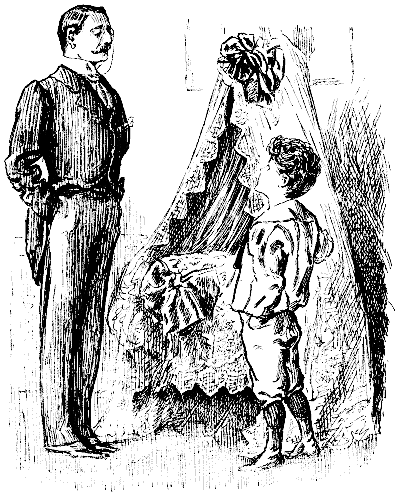
"Is this the New Baby, Daddy?"—"Yes, dear."
"Why, he's got no Teeth!"—"No, dear."
"And he's got no Hair!"—"No, dear."
"Oh, Daddy, it must be an Old Baby!"
THE REAL NEW WOMAN.
I own there are heights that she cannot attain. She is not at home with a gun. In pastimes where one living creature is slain She cannot perceive any fun; And never a poor feathered songster has died Her hat or her bonnet to grace; And after the hounds it were torture to ride, Lest Reynard should lose in the race. And much she ignores that New Women should learn, And still she refuses to smoke: One wine from another she cannot discern, But she's splendid at seeing a joke. Her love and her friendship no labour can fret, No jealousy seems to alarm. In truth, not a mortal could ever forget Her humour, her kindness, her charm. Though dozens of friends of her fealty boast, Her desk with epistles is packed, Her very own relatives love her the most— A somewhat remarkable fact! With bores and with fools she ungrudgingly bears, And though it may end in her loss, With cabmen she never can wrangle for fares, Or haggle a counter across. Her eyes, that are loyal and fearless and kind, At wrong or injustice will flame, But they never seem anxious a failure to find, They never are hasty to blame; And well she is loved by the best and the worst, For sympathy, courage, and truth, For friendship unfailing they love her, the first; The last, for her infinite ruth. Oh, what if she never should do or should dare In regions by Woman untrod? Yet, when her step passes, men turn from despair, And trust in the world and in God. Oh, what if no "record" she cares to eclipse, Nor manners nor morals defies? But pain she would face with a smile on her lips, And death with a light in her eyes!
"The Ghizeh Museum."—A question has been asked in the Times as to why the name of Professor Petrie has been omitted from the Commission for the Museum of Egyptian Antiquities. The answer, whether satisfactory or not, is that considering the overwhelming learning on this special subject of the distinguished Professor it is probable that the energies of the other members would be "Petrie-fied."
Motto for Horrid Cold Weather.—"Bed's the Best."
MRS. BLOOMER.
["The news of the death of Mrs. Bloomer, at Council Bluffs, Iowa, revives many memories of a distant past."—Daily Graphic.]
So Mrs. Bloomer's gone! but let her name Once more appear in Mr. Punch's pages. 'Twas long ago, almost the Middle Ages, That Leech's pencil advertised her fame! Her costume was unlovely—let it fade For ever from the ken of human vision! Though nowadays 'twould scarce provoke derision, If worn by pretty girls and tailor-made. For by the lady-cyclist, as she plies Her pedal, neatly clad in knickerbockers. See Mrs. Bloomer, first of Grundy-shockers. Now vindicated in Dame Fashion's eyes! But, not in dress alone a pioneer, She edited the temp'rance Water Bucket, And many a blow 'gainst drink with pluck hit; Then let us o'er her passing shed a tear!
At the Empire.—The celebrated chanteuse Mlle. Mealy is engaged. We've not yet heard her, but of course this lady's songs should be of a very delicate nature, as she herself must be "Mealy-mouthed."
Transcriber's Note:
Page 25: 'change' corrected to 'charge'.
"it was that last charge of yours at the head of your magnificent Thundershakers that has converted defeat into victory,..."
Page 27: 'The Dandy Afghan Khan': 'Dost Mohammed' in the first Chorus, becomes 'Dost Mahommed' in the last. Wikipedia gives 'Dost Mohammed.'
Page 28: 'Applebossom' corrected to 'Appleblossom'.
""Bless me, you have a treasure!" continued Appleblossom, Q.C.,..."
Page 29: 'seven-eights' corrected to 'seven-eighths.'
""An Old Boots!" cried my better seven-eighths,..."