Volume 3 — SITTING ON OUR SENATE.
Reading edition
Sir,—It struck me that the best and simplest way of finding out what were the intentions of the Government with regard to the veto of the Peers was to write and ask each individual Member his opinion on the subject. Accordingly I have done so, and it seems to me that there is a vast amount of significance in the nature of the replies I have received, to anyone capable of reading between the lines; or, as most of the communications only extended to a single line, let us say to anyone capable of reading beyond the full-stop. Lord Rosebery's Secretary, for example, writes that "the Prime Minister is at present out of town"—at present, you see, but obviously on the point of coming back, in order to grapple with my letter and the question generally. Sir William Harcourt, his Secretary, writes, "is at Wiesbaden, but upon his return your communication will no doubt receive his attention"—receive his attention, an ominous phrase for the Peers, who seem hardly to realise that between them and ruin there is only the distance from Wiesbaden to Downing Street. Then Mr. Morley "sees no reason to alter his published opinion on the subject"—alter, how readily, by the prefixing of a single letter, that word becomes halter! I was unable to effect personal service of my letter on the Attorney-General, possibly because I called at his chambers during the Long Vacation; but the fact that a card should have been attached to his door bearing the words "Back at 2 p.m." surely indicates that Sir John Rigby will back up his leaders in any approaching attack on the fortress of feudalism! Then surely the circumstance that the other Ministers to whom my letters were addressed have not as yet sent any answer shows how seriously they regard the situation, and how disinclined they are to commit themselves to a too hasty reply! In fact, the outlook for the House of Lords, judging from these Ministerial communications, is decidedly gloomy, and I am inclined to think that an Autumn Session devoted to abolishing it is a most probable eventuality.
Yours, Fussy-cuss Exspectans.
Sir,—The real way of dealing with the Lords is as follows. The next time that they want to meet, cut off their gas and water! Tell the butcher and baker not to call at the House for orders, and dismiss the charwomen who dust their bloated benches. If this doesn't bring them to reason, nothing will.
High-minded Democrat.
IN PRAISE OF BOYS. (By an "Old One.") ["A Mother of Boys," angry with Mr. James Payn for his dealings with "that barbarous race," suggests that as an amende honorable he should write a book in praise of boys.] In praise of boys? In praise of boys? Who mess the house, and make a noise, And break the peace, and smash their toys, And dissipate domestic joys, Do everything that most annoys, The Bobs and Billys, Ralphs and Roys?— Just as well praise a hurricane, The buzzing fly on the window-pane, An earthquake or a rooting pig! No, young or old, or small or big, A boy's a pest, a plague, a scourge, A dread domestic demiurge Who brings the home to chaos' verge. The only reason I can see For praising him is—well, that he, As Wordsworth—so his dictum ran— Declared, is "father to the man." And even then the better plan Would be that he, calm, sober, sage, Were—born at true paternal age! Did all boys start at twenty-five I were the happiest "Boy" alive!
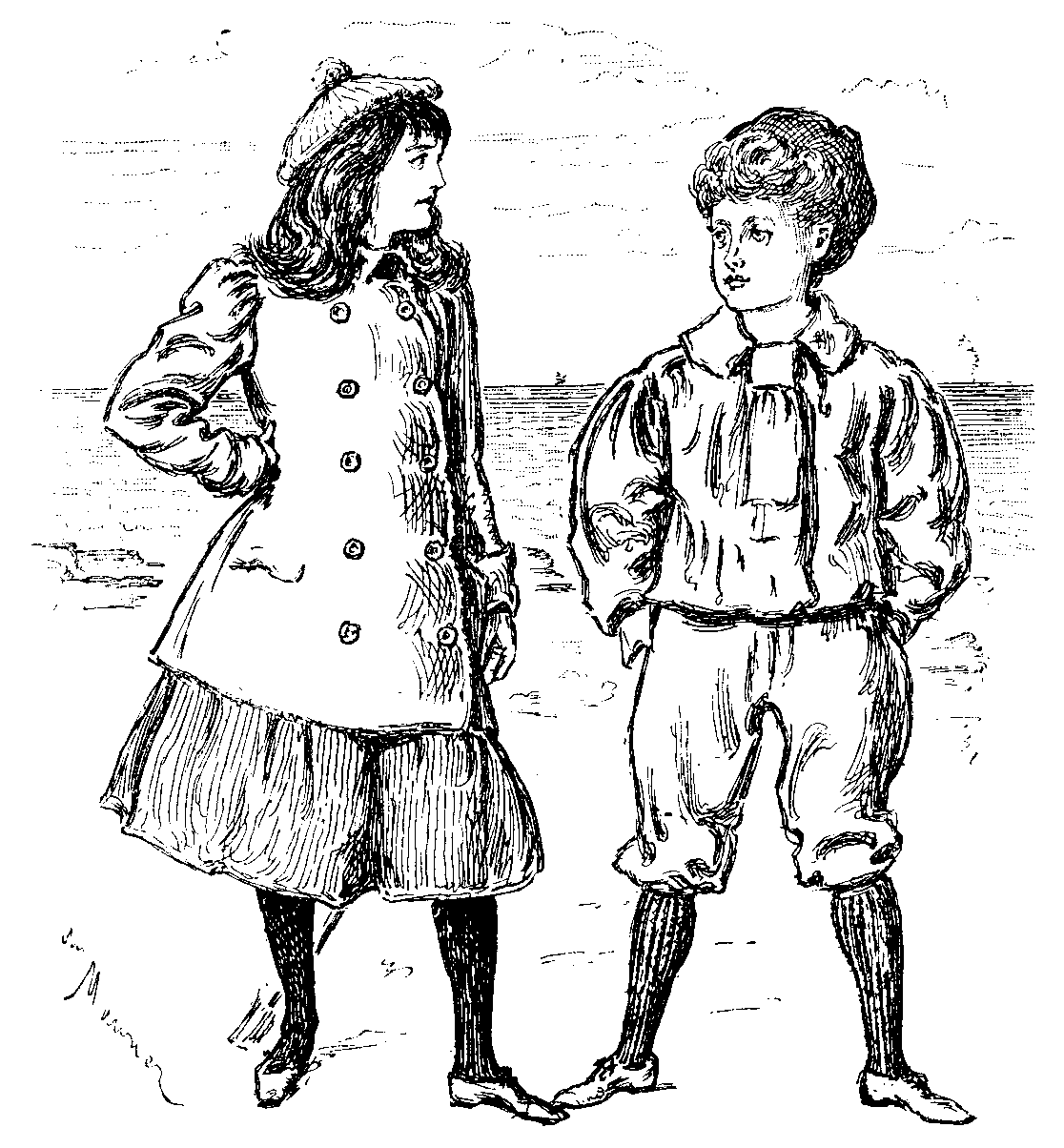
A LITTLE "NEW WOMAN."
He. "What a shame it is that Men may ask Women to Marry them, and Women mayn't ask Men!"
She. "Oh, well, you know, I suppose they can always give a sort of Hint!"
He. "What do you mean by a Hint?"
She. "Well—they can always say, 'Oh, I do Love you so!'"