Volume 107 — TO A LADY.
Reading edition
(Born so late in the Year, that she nearly missed having a Birthday altogether.)
Accept, dear girl, the season's compliments For Christmas and the twenty-ninth December, Your birthday—most auspicious of events— Is also Mr. Gladstone's, you remember. Yours was a close shave, but I'm bound to say That February the twenty-ninth far worse is, And worst of all, to come on All Fools' Day, Like Bismarck—or the writer of these verses!
The Real School-board.—Its Pupils.
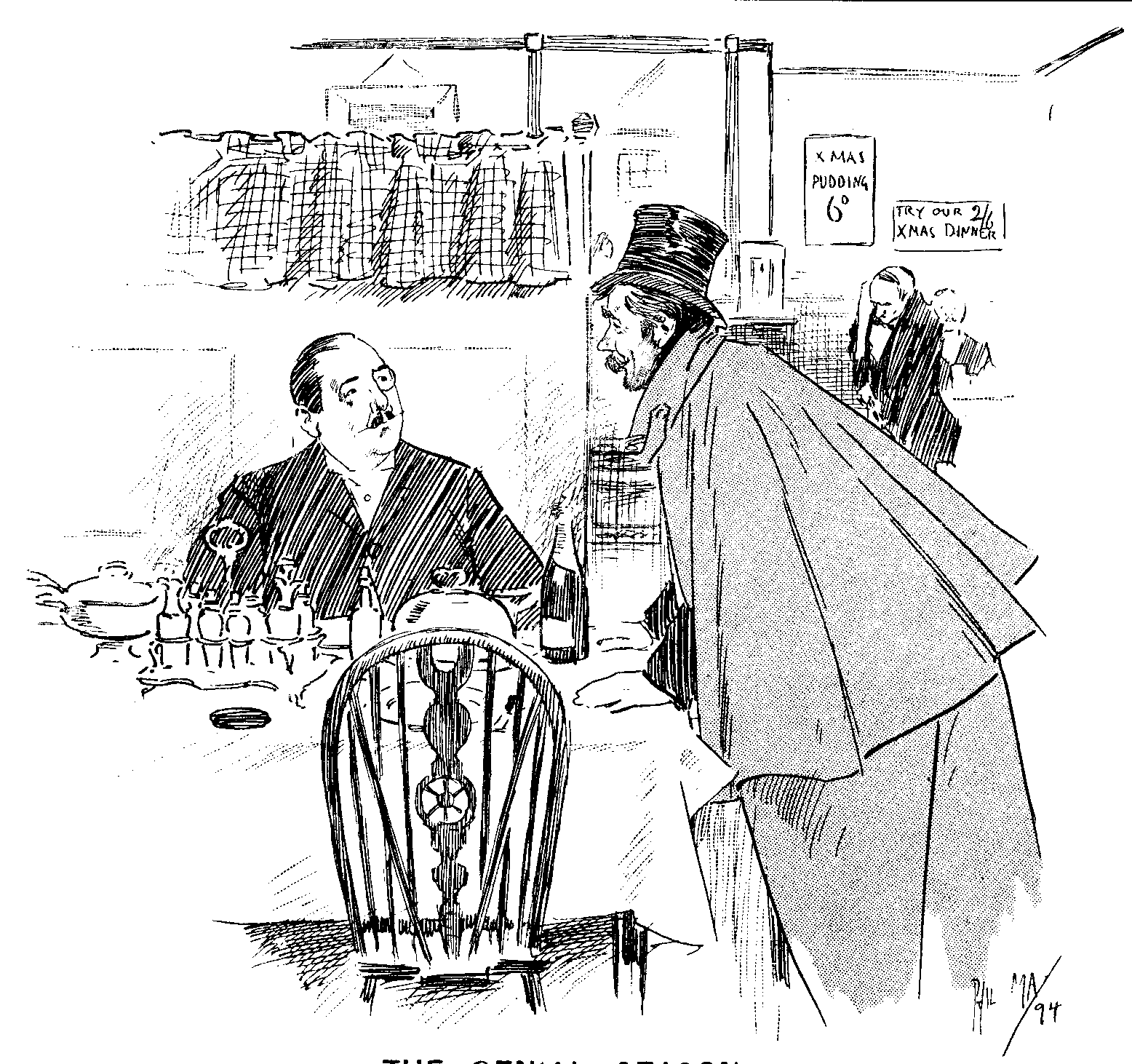
THE GENIAL SEASON.
Hungry-looking Acquaintance (with eye to invitation). "So glad to see you enjoying yourself!"
Fat Chap (evidently doing well). "Wrong again, old Man. I'm enjoying my Dinner!"
"THREE CHEERS FOR THE EMPEROR."
(Recommended for translation and use in the German Reichstag.)
For he's a jolly good fellow, And so say all of us. But "hochs" at all seasons to bellow Is sycophant folly and fuss. With a hip, hip, hip hooray, For that capital fellow, our Kaiser! If he'll let our cheers come in spontaneous way As loyal we'll be, and he wiser.
"COPY."
Some call the world a vale of tears, And some a haunt of bliss— "Copy" the world to me appears, And all that therein is. I loved, I hated, and desired, Despaired, like other men— And "copy" thus I have acquired, Which still informs my pen. Now, all the scenes whereon I look, All human joy and woe, Spontaneously as a book Into fresh "copy" flow. There is no pang too terrible, No rapture too sublime, To furnish forth an article Or to suggest a rhyme. I'd like a little while to break My fetters lucrative, To love again for Love's own sake, For Life's own sake, to live. To look upon the stars again With no ulterior view. Oh, aspiration wild and vain! But—it is "copy," too!
"ONE MAN ONE JOB."
A Christmassy Story for the Members of the L. C. C.
Mr. Blank Threestars was an eminent member of the London County Council, and had distinguished himself as a supporter of the cry, "One Man One Job." In his opinion a workman should stick to his work, and try no other. If he were a bricklayer, he should lay bricks; if he were a painter, he should daub doors with colour.
"We don't want one man interfering with another man's business," said Mr. blank Threestars. "Let the shoemaker stick to his last."
And this declaration of policy made him extremely popular in his own set. He was considered a sound reformer. "Sound" in more senses than one, as he happened to be particularly partial to the tones of his own voice.
One day about Christmas time, when the holly and mistletoe were much in evidence, Mr. Blank Threestars happened to be reading the reports of his own speeches at Spring Gardens, and unconsciously closed his eyes. When he reopened them, he found a gentleman in a black costume, who invited him to give his opinion on things in general and the London County Council in particular. Rather pleased to be asked to air his eloquence, Mr. Blank Threestars readily complied with the obliging request. He talked long and well, and the gentleman in black seemed never weary of listening to him. When he paused for a moment his attentive visitor put a question to him which "set him off" again. And this was repeated quite a score of times. At length, however, the orator became exhausted.
"Why do you cease speaking?" asked the gentleman in black rather impatiently.
"Because I am very tired," was the reply; "and now, with your permission, I will go for a turn on my bicycle."
"Not at all. Your job is to speak, and I cannot let you do anything else. So please continue your interesting remarks. What do you think of the report upon the City of London?"
Poor Blank Threestars attempted to give his views on the subject, but broke down. He was extremely exhausted; but the gentleman in black kept him going. He insisted upon being answered this, and answered that, until the eminent Member of the London County Council became almost senseless with fatigue. He closed his eyes once more, and when he reopened them, found that his own servant was standing by his side.
"Going to Spring Gardens, Sir?" asked the faithful adherent. "If you are it is time to be off."
"No," returned Mr. Blank Threestars; "never again. I shall resign. I have had enough talking to last me a lifetime."
From that moment Blank Threestars became a changed character. He goes in for all sorts of hard work—wood-cutting, cricket, football, and golfing—but he never approaches the L. C. C. In fact, he has only mentioned Spring Gardens once since his conversion, and then only to link with its name an expression usually represented by the fourth capital letter of the alphabet. And with this declaration his story must come to an end, as he declines to utter another syllable in explanation.