LYRE AND LANCET.
Reading edition
(A Story in Scenes.)
PAST XXIV.—THE HAPPY DISPATCH.
"Perhaps it was right to dissemble your love, but——"
Scene XXXV.—The Morning Room. Time—About 1 P.M.
Undershell (to himself, alone). I'm rather sorry that that Miss Spelwane couldn't stay. She's a trifle angular—but clever. It was distinctly sharp of her to see through that fellow Spurrell from the first, and lay such an ingenious little trap for him. And she has a great feeling for Literature—knows my verses by heart, I discovered, quite accidentally. All the same, I wish she hadn't intercepted those snowdrops. Now I shall have to go out and pick some more. (Sounds outside in the entrance hall.) Too late—they've got back from church!
Mrs. Brooke-Chatteris (entering with Lady Rhoda, Sir Rupert, and Bearpark). Such a nice, plain, simple service—I'm positively ravenous!
Lady Rhoda. Struck me some of those chubby choir-boys wanted smackin'. What a business it seems to get the servants properly into their pew; as bad as boxin' a string of hunters! As for you, Archie, the way you fidgeted durin' the sermon was down right disgraceful!... So there you are, Mr. Blair; not been to Church; but I forgot—p'raps you're a Dissenter, or somethin'?
Und. (annoyed). Only, Lady Rhoda, in the sense that I have hitherto failed to discover any form of creed that commands my intellectual assent.
Lady Rhoda (unimpressed). I expect you haven't tried. Are you a—what d'ye call it?—a Lacedemoniac?
Und. (with lofty tolerance). I presume you mean a "Laodicean." No, I should rather describe myself as a Deist.
Archie (in a surly undertone). What's a Deast when he's at home? If he'd said a Beast now! (Aloud, as Pilliner enters with Captain Thicknesse.) Hullo, why here's Thicknesse! So you haven't gone after all, then?
Captain Thicknesse. What an observant young beggar you are, Bearpark! Nothin' escapes you. No, I haven't. (To Sir Rupert, rather sheepishly.) Fact is, Sir, I—I somehow just missed the train, and—and—thought I might as well come back, instead of waitin' about, don't you know.
Sir Rupert (heartily). Why, of course, my dear boy, of course! Never have forgiven you if you hadn't. Great nuisance for you, though. Hope you blew the fool of a man up; he ought to have been round in plenty of time.
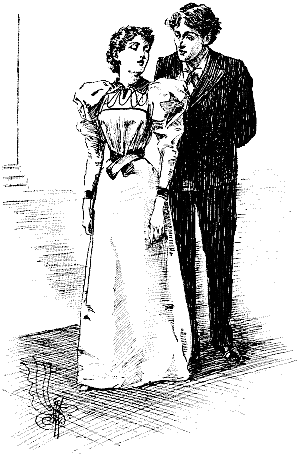
"Perhaps—when you come to think over it all quietly—you will."
Capt. Thick. Not the groom's fault, Sir. I kept him waitin' a bit, and—and we had to stop to shift the seat and that, and so——
Und. (to himself). Great blundering booby! Can't he see nobody wants him here! As if he hadn't bored poor Lady Maisie enough at breakfast! Ah, well, I must come to her rescue once more, I suppose!
Sir Rup. Half an hour to lunch! Anybody like to come round to the stables? I'm going to see how my wife's horse Deerfoot is getting on. Fond of horses, eh, Mr.—a—Undershell? Care to come with us?
Und. (to himself). I've seen quite enough of that beast already! (Aloud, with some asperity.) You must really excuse me, Sir Rupert. I am at one with Mr. Ruskin—I detest horses.
Sir Rup. Ah? Pity. We're rather fond of 'em here. But we can't expect a poet to be a sportsman, eh?
Und. For my own poor part, I confess I look forward to a day, not far distant, when the spread of civilisation will have abolished every form of so-called Sport.
Sir Rup. Do you, though? (After conquering a choke with difficulty.) Allow me to hope that you will continue to enjoy the pleasures of anticipation as long as possible. (To the rest.) Well, are you coming?
[All except Undershell follow their host out.
Und. (alone, to himself). If they think I'm going to be patronised, or suppress my honest convictions——! Now I'll go and pick those—— (Lady Maisie enters from the Conservatory.) Ah, Lady Maisie, I have been trying to find you. I had plucked a few snowdrops, which I promised myself the pleasure of presenting to you. Unfortunately they—er—failed to reach their destination.
Lady Maisie (distantly). Thanks, Mr. Blair; I am only sorry you should have given yourself such unnecessary trouble.
Und. (detaining her, as she seemed about to pass on). I have another piece of intelligence which you may hear less—er—philosophically, Lady Maisie. Your bête noire has returned.
Lady Maisie (with lifted eyebrows). My bête noire, Mr. Blair?
Und. Why affect not to understand? I have an infallible instinct in all matters concerning you, and, sweetly tolerant as you are, I instantly divined what an insufferable nuisance you found our military friend, Captain Thicknesse.
Lady Maisie. There are limits even to my tolerance, Mr. Blair. I admit I find some people insufferable—but Captain Thicknesse is not one of them.
Und. Then appearances are deceptive indeed. Come, Lady Maisie, surely you can trust Me!
[Lady Cantire enters.
Lady Cantire (in her most awful tones). Maisie, my dear, I appear to have interrupted an interview of a somewhat confidential character. If so, pray let me know it, and I will go elsewhere.
Lady Maisie (calmly). Not in the very least, Mamma. Mr. Blair was merely trying to prepare me for the fact that Captain Thicknesse has come back; which was quite needless, as I happen to have heard it already from his own lips.
Lady Cant. Captain Thicknesse come back! (To Undershell.) I wish to speak to my daughter. May I ask you to leave us?
Und. With pleasure, Lady Cantire. (To himself, as he retires.) What a consummate actress that girl is! And what a coquette!
Lady Cant. (after a silence). Maisie, what does all this mean? No nonsense now! What brought Gerald Thicknesse back?
Lady Maisie. I suppose the dog-cart, Mamma. He missed his train, you know. I don't think he minds—much.
Lady Cant. Let me tell you this, my dear. It is a great deal more than you deserve after—— How long has he come back for?
Lady Maisie. Only a few hours; but—but from things he said, I fancy he would stay on longer—if Aunt Albinia asked him.
Lady Cant. Then we may consider that settled; he stays. (Lady Culverin appears.) Here is your Aunt. You had better leave us, my dear.
Somewhat Later; the Party have Assembled for Lunch.
Sir Rup. (to his wife). Well, my dear, I've seen that young Spurrell (smart fellow he is too, thoroughly up in his business), and you'll be glad to hear he can't find anything seriously wrong with Deerfoot.
Und. (in the background, to himself). No more could I, for that matter!
Sir Rup. He's clear it isn't navicular, which Adams was afraid of, and he thinks, with care and rest, you know, the horse will be as fit as a fiddle in a very few days.
Und. (to himself). Just exactly what I told them; but the fools wouldn't believe me!
Lady Culverin. Oh, Rupert, I am so glad. How clever of that nice Mr. Spurrell! I was afraid my poor Deerfoot would have to be shot.
Und. (to himself). She may thank me that he wasn't. And this other fellow gets all the credit for it. How like Life!
Lady Maisie. And, Uncle Rupert, how about—about Phillipson, you know? Is it all right?
Sir Rup. Phillipson? Oh, why, 'pon my word, my dear, didn't think of asking.
Lady Rhoda. But I did, Maisie. And they met this mornin', and it's all settled, and they're as happy as they can be. Except that he's on the look out for a mysterious stranger, who disappeared last night, after tryin' to make desperate love to her. He is determined, if he can find him, to give him a piece of his mind.
[Undershell disguises his extreme uneasiness.
Pilliner. And the whole of a horsewhip. He invited my opinion of it as an implement of castigation. Kind of thing, you know, that would impart "proficiency in the trois temps, as danced in the most select circles," in a single lesson to a lame bear.
Und. (to himself). I don't stir a step out of this house while I'm here, that's all!
Sir Rup. Ha-ha! Athletic young chap that. Glad to see him in the field next Tuesday. By the way, Albinia, you've heard how Thicknesse here contrived to miss his train this morning? Our gain, of course; but still we must manage to get you back to Aldershot to-night, my boy, or you'll get called over the coals by your Colonel when you do put in an appearance, hey? Now, let's see; what train ought you to catch?
[He takes up "Bradshaw" from a writing-table.
Lady Cant. (possessing herself of the volume). Allow me, Rupert, my eyes are better than yours. I will look out his trains for him. (After consulting various pages.) Just as I thought! Quite impossible for him to reach North Camp to-night now. There isn't a train till six, and that gets to town just too late for him to drive across to Waterloo and catch the last Aldershot train. So there's no more to be said.
[She puts "Bradshaw" away.
Capt. Thick. (with undisguised relief). Oh, well, dessay they won't kick up much of a row if I don't get back till to-morrow,—or the day after, if it comes to that.
Und. (to himself). It shan't come to that—if I can prevent it! Lady Maisie is quite in despair, I can see. (Aloud.) Indeed? I was—a—not aware that discipline was quite so lax as that in the British Army. And surely officers should set an example of——
[He finds that his intervention has produced a distinct sensation, and, taking up the discarded "Bradshaw," becomes engrossed in its study.
Capt. Thick. (ignoring him completely). It's like this, Lady Culverin. Somehow I—I muddled up the dates, don't you know. Mean to say, got it into my head to-day was the 20th, instead of only the 18th. (Lamely.) That's how it was.
Lady Culv. Delightful, my dear Gerald. Then we shall keep you here till Tuesday, of course!
Und. (looking up from "Bradshaw," impulsively). Lady Culverin, I see there's a very good train which leaves Shuntingbridge at 3.15 this afternoon, and gets——
[The rest regard him with unaffected surprise and disapproval.
Lady Cant. (raising her glasses). Upon my word, Mr. Blair! If you will kindly leave Captain Thicknesse to make his own arrangements——!
Lady Maisie (interposing hastily). But, Mamma, you must have misunderstood Mr. Blair! As if he would dream of——. He was merely mentioning the train he wishes to go by himself. Weren't you, Mr. Blair?
Und. (blinking and gasping). I—eh? Just so, that—that was my intention, certainly. (To himself.) Does she at all realise what this will cost her?
Lady Culv. My dear Mr. Blair, I—I'd no notion we were to lose you so soon; but if you're really quite sure you must go——
Lady Cant. (sharply). Really, Albinia, we must give him credit for knowing his own mind. He tells you he is obliged to go!
Lady Culv. Then of course we must let you do exactly as you please. (All, except Miss Spelwane, breathe more freely; Tredwell appears.) Oh, lunch, is it, Tredwell? Very well. By-the-bye, see that some one packs Mr. Undershell's things for him, and tell them to send the dogcart round after lunch in time to catch the 3.15 from Shuntingbridge.
Pill. (sotto voce, to Archie). And let us pray that the cart is properly balanced before starting, this time!
Miss Spelwane (to herself, piqued). Going already! I wish I had never touched his ridiculous snowdrops!
Lady Culv. Well, shall we go in to lunch, everybody?
[They move in irregular order towards the Dining Hall.
Und. (in an undertone to Lady Maisie, as they follow last). Lady Maisie, I—er—this is just a little unexpected. I confess I don't quite understand your precise motive in suggesting so—so hasty a departure.
Lady Maisie (without looking at him). Don't you, Mr. Blair? Perhaps—when you come to think over it all quietly—you will.
[She passes on, leaving him perplexed.
Und. (to himself). Shall I? I certainly can't say I do just——Why, yes, I do! That bully Spurrell with his beastly horsewhip! She dreads an encounter between us—and I should much prefer to avoid it myself. Yes, that's it, of course; she is willing to sacrifice anything rather than endanger my personal safety! What unselfish angels some women are! Even that sneering fellow Drysdale will be impressed when I tell him this.... Yes, it's best that I should go—I see that now. I don't so much mind leaving. Without any false humility, I can hardly avoid seeing that, even in the short time I have been among these people, I have produced a decided impression. And there is at least one—perhaps two—who will miss me when I am gone.
[He goes into the Dining Hall, with restored equanimity.
THE END.
ROBERT ON HUNIFIKASHUN!
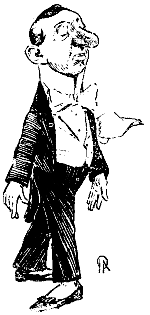
I have bin a having quite a long tork with a most respecful looking Gent who tells me he is a reel County Counsellor, and that they has a Gildhall of their own at Charing Cross, where they meets ewery week, the same as the Common Counsellors does at their reel Gildhall in the Citty, and that they has quite made up their minds to make the two Gildhalls into one and have them both for theirselves, and that that will be what they calls Hunifikashun, which means everything for them and not nothink for nobody else.
Not content with what they have got allreddy they means to have all the Citty Perlice, and the Manshun House, and all the Citty's Money, and the rite to all the Tems Water, and to the Lord Mare and Sherryfs Carridges, and to the Old Bayley, and to more other things than I can manage to remember! And he really speaks of all these warious matters jest as if he was quite in ernest, and acshally expected as it woud all be done by the next Parlement when they met next year! And when he found as I reelly didn't beleeve a word of his wunderful stories, he acshally arsked me to go with him to their Gildhall at Charing Cross, and there he put me in a nice seat, and then I heard em all torking away, jest as if they were quite in ernest, all about the many wunderful things as they was about to do soon! Oh, I wunders how long it will be before any on em reelly happens? Not in my life time I'll be bound, nor most likely in nobody elses! Did any reesonable man, woman or child ever hear such a pack of nonsense? To acshally defraud the grand old Citty of Lundon, that is only jest about seven hunderd year old, of all their priwileges and all their rites and all their money! and then I shoud like to know what is to become of me, and the duzzens like me? Nice lots of Lord Mares and Alldermen these County Counsellors woud make! Why I acshally douts whether they coud even manage to make up a decent lot of Common Counselmen under at least a year.
There was one thing as I heard them squabling about while I was there, and that was the nessessity of having some more lunatic asylums, which did not much surprise me, as I shoud think they will soon want a pretty good number for theirselves, if they continnes to go on as they are going.
Brown told me a rayther funny story about the dredful solemnity of these wunderful County Counsellors. He says they have by sum means or other got the right of insistin that there shall be no fun in the theaters, and no warking about between the hacts; and that the publick got so disgusted with the silly regerlations, that in many cases they left off going to them for ewer so long; but they are better now, and will most likely soon go back to their old armless jokes.
Robert.
AN EXTRACT.
(From some hitherto Unpublished Correspondence.)
["Photographs of ladies' feet are now taken in New York as souvenirs for their admirers."—Globe, Dec. 6.]
... It is real kind of you, dearest, to mail your own laddie those half-dozen lovely photographs, or should I call them footographs? I can't say right here which I like best—they're all just fetching, anyway. You bet, I'll treasure them some! I'll wear the midget profile as a chest-protector right along, and put the full-foot vignette under my pillow nights. And the three-quarter platino shall go on my chimney rack—there's a considerable saucy look about the big toe which I'm mashed on horrid. I guess you won't see such a number-one instep as yours any time on these effete old London side-walks. To look at the Britishers' foot-cases in Piccadilly makes me tired, when I think of you any. I'll send views of mine soon in exchange, but I reckon the naked truth might give you fits, so I'll just sit with my rubbers on, and get the camera-man to map you off a walking likeness of my right daisy-crusher. (My left is a trifle out of focus.) Kind regards to you, Poppa....
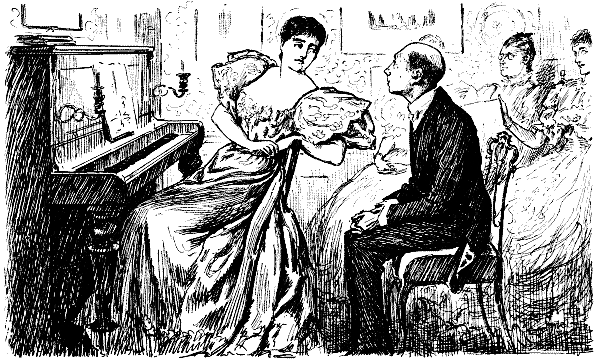
A BLOODTHIRSTY BARITONE.
Miss Maud. "Won't you sing something, Mr. Green?"
The Curate. "I haven't brought my Music. But, if you know the Accompaniment, and would play it, I think I could sing 'The Brigand's Revenge'!"
"AN OLD OFFENDER."
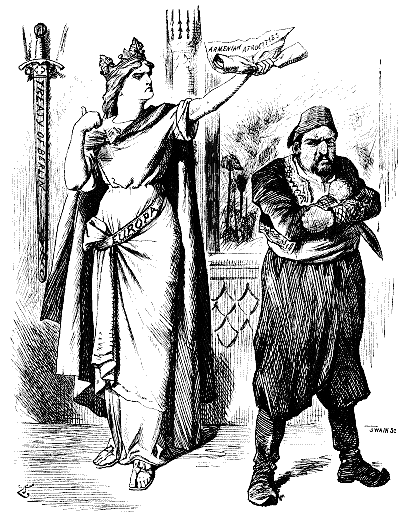
["It is impossible, we fear, to escape from the conclusion that there is a substantial basis of fact for the rumours ... of atrocities perpetrated by Turkish troops on the Christian inhabitants of Armenia.... By one of the Articles of the Treaty of Berlin the Porte undertook 'to carry out without delay the improvements and reforms demanded by local requirements in the provinces inhabited by the Armenians, and to guarantee their security against the Circassians and the Kurds.'"—"Times" Leader, December 4.]
Again! Is there nothing can humanise ever The heart of Islam, that red-ravening wolf? Will bonds of convention and treaty bridge never Between Turk and Christian the broadening gulf? Will no lesson teach, and will no promise tether, The Ottoman hordes when let loose on the foe? Must slaughter, and rapine, and outrage together, The old vile triumvirate, fetterless go? Time's fool seems the Turk, stern, unteachable, savage, The fiercest fool-fighter on history's roll. All indolent rest or undisciplined ravage. The varnish of manner soaks not to his soul. Red Man of the Orient, ruthless, untamable, Neighbour, by fortune, in nothing near kin. Humanity's brotherhood surely is blameable, Leaving him free from Law's bondage to win! In sheer self-defence we must muzzle and shackle This wolf of the world; snatch its poor prostrate prey From its crimsoning fangs. The old cynical cackle Of "coffee-house babble" is silent to-day; And a weapon's at hand, too long left there unlifted, That Law and that Justice alike now commend To the grip of Europa. Be murder short-shrifted And bestial outrage meet summary end! Not again must hot Islamite hate be permitted In chase of creed-vengeance the East to embroil; Not again must its prey fall unaided, unpitied, The Gallio's mock, and the miscreant's spoil. There hangs the good Berlin-blade, consecrated By common agreement to Justice's work! Be its blow not this time, as aforetime, belated! Let Europe not bleed for the sin of the Turk!
THE VILLAGE BLACKSMITH.
New Parish-Council Version.
(By a Landlord and Lover of the Good Old Times.)
[At Merton, Surrey, where Mr. William Morris has his factory, a blacksmith was highest of the fifteen successful candidates for the Parish Council, the vicar being eighth.]
Over the vicar, top o' the tree, The Village Blacksmith stands; The smith a mighty man is he, With power in his strong hands; And his victory well may stir alarms In Squire-Parsonic bands. The Squire looks black, his face is long,— "Vicar not in the van? Oh! things are going to the doose As fast as e'er they can! The blacksmith with his grimy face Has proved to be best man. "Week in, week out, he'll spout and fight! We shall hear him bluff and blow. He'll vote the good old times all wrong, The good old fashions slow; And won't he run the rates right up, And keep tithe-charges low? "He'll have his finger in the School, He'll open wide its door; He'll keep the Voluntaries starved, And let the School-Board score. And he'll want baths and washhouses And villas for the poor! "Then he may 'go for' the Old Church, And rouse the village boys To listen, not to Parson's drone, But Agitation's voice, And 'stead o' singing in the choir He'll swell Rad ranters' noise. "'Twill sound to him like Wisdom's voice, Preaching of Paradise, As though the thing were at his door; Plumbed with Progressive lies, He'll think his hard, rough hand will wipe The Squire's and Parson's eyes. "Broiling—orating—borrowing, Swelling the rates, he goes. Reform's raw task he will begin, But who shall see it close? Church will be robbed, and Land be sold. Farewell old-time repose! "'Tis thanks to you, my loud Rad friends, These lessons you have taught! By folly from the flaming forge Our fortunes must be wrought. And won't there be a blessed mess Before the fight is fought!"