THE MAN IN THE SOUTH.
Reading edition
Having on some occasions during, I admit, the spring and autumn, spent a few days at Pinemouth on the South-Western Coast, and having had the enormous value of the place as an ultra salubrious health-restorer most energetically impressed upon me from time to time by such thoroughly disinterested persons as local members of the medical profession who, as a rule, took their holiday during the summer season, merely because they couldn't get the opportunity at any other time—a fact in itself going a long way (as they themselves did—to Switzerland and elsewhere) to prove the peculiar healthfulness of this seaside resort, and the place having been further highly recommended (by residents who, having houses to let for the summer, were quite disinterested) as quiet and delightfully refreshing, and having, in fact, heard all that could be said in favour of Pinemouth as a Summer Resort by those who had only the welfare of their dear friends at heart (and if such interest did put a little ready capital in their pockets through taking their dear friends' houses—where is the harm?), I, Robinson Crusoe, Jun., "The Man of the First of August" (that being the beginning of my tenancy) determined on trying Pinemouth (a name that I find spelt with unpardonable familiarity in some local guide-books, thus—"P'm'th"—an abbreviation leaving the name scarcely a shred of its original character), and when I say so boldly, "I determined," any other Paterfamilias will at once know what that means.
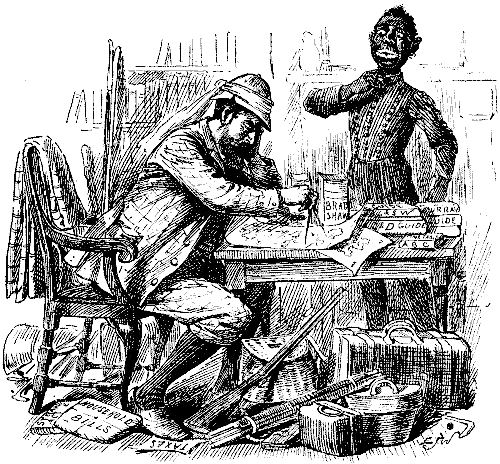
Mr. Robinson Crusoe, Junior, deciding on where to spend his few weeks' holiday.
Of course, directly "P'm'th" was decided upon, some of our friends shook their heads, others observed dubiously that "they had heard it wasn't such a very bad place in August," while the majority bade me farewell with forced cheeriness, expressed the heartiest hopes for our health and happiness in the new climate we were going to try, and in a general way our excellent friends and acquaintances were almost as enthusiastic and hopeful on the score of our enjoying ourselves and benefiting by the change, as were the American acquaintances of Martin Chuzzlewit and Mark Tapley when those two emigrants were starting for the great dismal swamp.
Finding that we had made all our arrangements, and had actually signed and sealed the bond, and delivered ourselves over into the hands of the "P'm'thians," our friends, who, as we subsequently ascertained, had never been near the place, or, if they had, had been there at a hopelessly wrong time, and had pitched their tents in an utterly wrong quarter, made ill-disguised attempts at speaking gently and kindly of "P'm'th," allowing that possibly "it might not, at this time of year, be so hot as had been represented,"—a theory which, like one recently put forward by a tender-hearted theologian, was immediately placed in the Index Expurgatorius by the Inevitable Uncompromising One who professed a thorough knowledge of the climate, and who asserted that in this particular year, when the Summer had been abnormally hot and was going to be more abnormally hot than ever, we should find "P'm'th" absolutely unbearable.
But, as the adventurous hero of "Excelsior" would listen to nobody, so I (representing "we") refused to hear the prognosticators of woe, and adhered manfully to my purpose. In the very hottest season, when the thermometer in every London house went so high that it had to be deluged with wholesome antiseptic Condyment, and doors and windows were everywhere left open so as to obtain a through draught,—for people lived on draughts of all sorts in those doggiest of dog-days and on little else,—we, that is all the Crusoes, were seated in our garden looking on to the heather and the sea, open to all the winds of heaven—and getting one of them, the south-east, blowing softly and sweetly across our south-western height. Gracefully and gratefully we arose to play tennis, and sat down again after the evening meal to take our coffee and cigarettes. Bless thee, P'm'th! thou art delicious! thou art refreshing! Hot in the hottest August ever known thou certainly art, that is, at midday, down in your valley and your town! But up above on the Western Heights, looking across an expanse of purple and yellow, uninclosed by firs, pines, or larches, on to the broad expanse of the deep blue sea, thou art all my fancy painted thee, thou art cucumbery in thy coolness! and as I think of Royat and Aix-les-Bains I smile a smile of gentle pitying wonder, and almost feel inclined to piously pray for all poor bodies suffering from the canicular heat, whether London doth still hold them in its toils, or stifling, smelling Continental cities, are causing them to sigh for the balmy breezes of Old England.
Thus then is it that "P'm'th"—that is "Pinemouth" in its abbreviated form—is the place about which, as being comparatively unknown at this season of the year, I beg to offer to Mr. Punch, and through him to the world at large, for the ultimate benefit of way-worn travellers, a few notes representing an uncommonly pleasant experience, which, by the kind permission of "Mr. P'n'h" aforesaid, shall be "continued in our next" by
"The Man in the South."
A WORD TO THE WEATHERWISE.
[Sir John Bridge: Don't you think there is a great deal of chance as to the weather we are to have to-morrow? Mr. Muir Mackenzie: No. Sir John Bridge: The mass of mankind think there is. Mr. Muir Mackenzie: Unfortunately the mass of mankind are very ignorant.—Bow Street Police Court, Wednesday, September 6.]
Oh, Mr. Muir Mackenzie! we're right glad To hear this news of meteorology. Farewell to all the many doubts we've had, The thing's as easy now as A B C. You know to-morrow's weather at a glance, So, though we would not willingly o'ertask you, When next we seek the weather in advance, We'll simply drop a letter-card to ask you.
A Cure.—"No," said Mrs. R., after some consideration, "although I do feel a touch of rheumatism now and then, yet I do not fancy going abroad for treatment. There's some place where you drink waters and take a bath, and then are tucked up in bed for the remainder of the day. It's in Germany, I fancy, and I think they call the place Underdelinen."
A HINT.
You read my verse; the praises you bestow Can make innocuous the critic's curse, Vain his attack, unfelt his shrewdest blow, You read my verse. You like the rhymes; think not their writer worse If just one hint he cannot well forego, The bard, to put it in a manner terse, Does not exist on praise alone, you know, And sympathy can hardly fill his purse;— You borrow, and you do not buy, although You read my verse!
"Gone Nap!"—It is all up with Mr. G.! The distinguished M.P. for St. Pancras, in whose lineaments Mr. Punch traced a marked resemblance to the features of the Great Emperor of the French, and there and thenceforth raising him from the rank of Mr. Pell as he was formerly known, immediately christening him "Napoleon Boltonparty" (with likeness drawn by Lika-Joko), even he has joined the Unionist Opposition. He is no longer "Going Nap," he has gone. Doubtless, Conservatives have their eye on him: but Napoleon Boltonparty is too wary to be caught "napping."