OUR BOOKING-OFFICE.
Reading edition
"The ever-advancing Woman," observes one of the Baronesses, "has quite come forward this Christmas, daintily attired." Wonderful money-prizes are to be won by the lucky person who guesses the author of "Bid Me not Go," which is the Christmas story of the enterprising Gentlewoman.
"As for Christmas Cards being Christmassy," quoth a young Baron brusquely, "why it's all Walker!" The Baron was about to rebuke the scion of his noble house, but discovered, on application, that the youth had been alluding to the Christmas Card publisher of that name, whose designs are not peculiarly Christmassy, but what the Baroness terms "so dainty!"
S. Hildesheimer & Co.'s clever and amusing Christmas Cards will be much appreciated by young people.
Three books full of stories, to suit all ages. Hutchinson's House. Fifty-two Stories for Children, Fifty-two Stories for Girlhood and Youth, and Fifty-two Stories for Boyhood and Youth. Just a story a week, will last the year. Collected by Alfred H. Miles. You won't find a better if you go for Miles.
Valdmer, the Viking, by Hume Nisbet, was a wonderful Dane, who, after invading England in the Tenth Century, took a trip from Thanet (having invented Ramsgate and Margate) all round America, and thought nothing of it. Those who read this will probably think something of it.
The Hoyden, written by Mrs. Hungerford, and published by Heinemann, is the story of a rather frivolous nineteenth-century tomboy; "but," quoth the Baroness, "though it does not come within measurable distance of The O'Connors of Ballinahinch, it is pleasant light reading."
Mr. Gladstone's Life; Told by Himself, is an alluring title, which, in spite of the volume being issued by so respectable a house as Kegan Paul's, savours of a flam. But it is genuine enough. Every word in the little volume has been spoken or written by Mr. Gladstone. Mr. Leech, whilst modestly disclaiming any imposition of responsibility upon the Premier, has ingeniously linked passages from speeches or letters published under his name during the past sixty years. The result is a really fascinating work. Mr. Gladstone has always been prone to drop into autobiography. Nothing, my Baronite tells me, was more delightful than the speeches he used to deliver in the House of Commons on Friday and Tuesday nights. Some chance reference to Canning, Peel, or Palmerston brought up a flood of recollections, and Mr. G. used to chat of old times with the entranced House.
In a pleasant little book called Essays on Idleness, the authoress, Agnes Repplier, speaking of her cat, observes, "It were ignoble to wish myself in her place, and yet how charming to be able to settle down to a nap, sans peur et sans reproche, at ten o'clock in the morning." Surely instead of "sans peur" she should have written "sans purr," as far more applicable to a cat asleep.
"Here is a work that I prize indeed!" quoth the Baron, surveying with unmixed pleasure two handsome volumes, readable from every point of view of type, handiness, and matter that is of substance and spirit, being a re-issue of the immortal Autocrat of the Breakfast Table, by Oliver Wendell Holmes. "Mind you," he continues, tenderly regarding them, "though this I admit is an édition de luxe, yet do I far and away prefer the simple volume without illustrations. Why illustrations? Why try to impose on us, as by artistic authority, the faces, forms, and the situations that we would infinitely prefer to idealise? Without the faculty of imagination no one can enjoy this work, pictures or no pictures: possessed of the faculty, what need of the illustrations, save so far as they may carry out our own notions of the author's meaning? If they do not, then we quarrel with them. But many thanks for these two volumes, brought out by Messrs. Gay and Bird (delightful association of adjective and substantive, as we have had afortime occasion to remark); for among all hooks, whether at this Christmas Season, when they come in quite with a Charles-Lamblike and Washington-Irvingesque flavour, or at any other time, these be most welcome to the constant lover of old Literary Friends.
Yuletideian Baron de Book-worms."
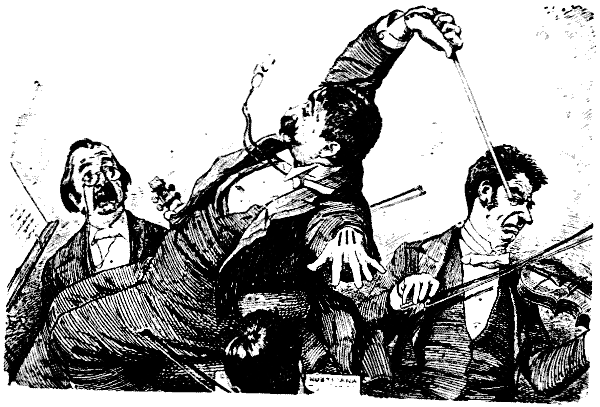
A CONDUCTOR OF HEAT.
A GAME OF CHANCE.
(From an Imaginative French Source.)
War had broken out between France and Great Britain. In the Mediterranean—owing to several French ironclads having got through into the Black Sea and being unable to get out again—the French fleet was shut up in Toulon harbour by a powerful English squadron. It was just at this time that some curious events were taking place in the neighbouring seaside resort of Sablettes-les-Bains, recently purchased by an English company, which was running the place as a kind of compromise between Boulogne and Monte Carlo.
"Messieurs, faites vos jeux!"—was heard the monotonous refrain of the burly "Croupier," who, with face rather pale, and a preoccupied air, was presiding over one of the numerous games of "Petits-Chevaux," combined with "Rouge et Noir" which were proceeding in the gorgeously-upholstered and magnificently-lighted "Salle des Papas Perdus" of the "Cercle des Etrangers" of this Paradise of the Middle Sea.
Suddenly the Croupier sprang from his seat, threw off his loose outer coat, and displayed the well-known uniform of an Officer in Her Majesty's Royal Shropshire Yeomanry Carabineers. All the other Croupiers did the same. Astonishment and dismay were depicted on the countenances of the players.
"Gentlemen," said the Croupier, "I am sorry to say you are all my prisoners. Resist, and you will be shot without mercy!"
"But I had just staked twenty thousand Louis on the black!" ejaculated a bewildered Gaul.
"You have lost your stake, Monsieur," replied the Croupier, with politeness. "It is red, not black;" and, in a moment, all the English visitors who thronged the rooms had also thrown off their overcoats, and the hall was filled with red-coats.
"Treachery! Perfide Alb——" the Gaul shouted; but ere he could rise from his seat to give the alarm to the Toulon garrison, as he had fully intended doing, a hundred swords (made in Birmingham) had passed simultaneously through his body. Their stakes fell from the trembling hands of the players.
"Then are we to understand," asked another Frenchman, who had somewhat recovered from the first shock of surprise, "that the English Government has suppressed Sablettes-les-Bains because it disapproves of the game of Petits-Chevaux?"
"Not at all," replied the Croupier-Officer. "It is a military coup-de-main, that's all. The English company running this place, was, of course, in the pay of the British War Office. By a prearranged system of signals we have been making known everything that is going on at Toulon to the British Admiral out at sea. You may perhaps have noticed what an extremely large orchestra took part in last night's free classical concert; they were English marines disguised as musicians. And the gardens attached to the Casino, which rival those of Monte Carlo, what do you think those grassy slopes crowned with olives and orange-trees are in reality? Why, the artfully-contrived glacis of the impregnable fortress inside which you are now standing, and which I have the honour to command!"
Just then the booming of cannon was heard outside.
"It is our guns playing on the defences of Toulon!" exclaimed the Officer. "Toulon is ours!"
And the treacherous Britons, having cleared the tables of the five-franc pieces still remaining on them, proceeded, with the aid of the Germans and Italians, to the dismemberment of France.
Nautical Economy.
["It is no use our building ships without the men to man them."—Times' Correspondent. ]
Proverb suggested by the above:—"Do not spoil the ship for a pound of tar."
Novel Proceeding.—New Issue, Japhet in Search of Something Farther. By Marriott.
LAW AND JUSTICE v. DUTY "DONE."
(An Imaginary Conversation.)
Scene—Opposite the Griffin.
Time—The present day.
Enter two well-known personages.
Justice. Welcome, Sister. We sometimes are severed, but when we do meet the right prevails.
Law. Certainly, Sister—to a great extent. And what is the cause of our present communion?
Justice. I have to call your attention, Sister, to many great works of mercy recently performed by wielders of the pen—in fact some of my servants.
Law. Your servants are noted for their good works.
Justice. You are very kind. Well, these good servants have defended the poor, protected the weak, and denounced hypocrites.
Law. Very right indeed. But how did they manage it without my assistance?
Justice. You have a short memory. It was with your aid that they brought these good things about. Surely you have not forgotten them?
Law. Well, since I have been combined with Equity I have been doing so much excellent work that I have neither time nor inclination for the recording of details. Well, and your protégés, were they successful?
Justice. Certainly; they won all along the line. Never was the power of the Press manifested to better advantage.
Law. Surely they were not in actions for libel?
Justice. Yes; and although they did much good, were practically mulcted in costs.
Law. Costs! That is in my department!
Justice. And not in mine. Costs in such a matter have nothing to do with Justice!
Law. But (as you say) are inseparably connected with Law!
[They part hurriedly.
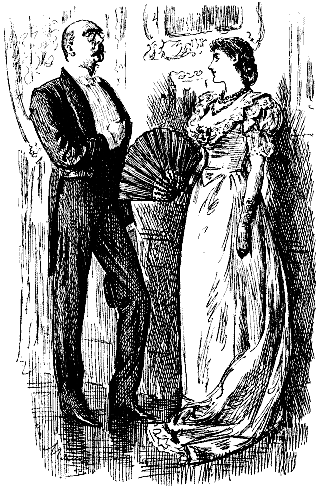
THINGS ONE WOULD RATHER HAVE EXPRESSED DIFFERENTLY.
She. "And you'll have to make a Speech after Dinner, won't you?"
He. "Oh—I shall Just have to talk a little Nonsense to them, you know!"
She. "Ah—And Nobody's better qualified to do that than Yourself!"
THE STOUT SINGER'S SMILE.
O buxom maiden, blithe and gay, With movements light and airy, Some five-and-twenty stone you weigh, Fair, fat and forty fairy! A fairy of the music-halls, Some men might call you ripping; In tights, and satin coat and smalls, You enter, gaily skipping. It is not that which brings me joy, Nor face, nor form entrances, It is your smile, so very coy, Your bashful, girlish glances. Some twenty years ago, no doubt, You were a slender maiden, But now, so long you have been "out," With weight of years you're laden. So when you sing of love-sick grief, And smile so very sweetly, I, too, behind my handkerchief, Smile quite unseen, discreetly. The more you sing the more you smile, Stout charmer, winsome, winning, Dressed like Lord Fauntleroy—meanwhile, Like Cheshire Cat I'm grinning. Then comes the end; you curtsy low, With looks to heaven soaring; You are extremely funny so, I'm positively roaring. They clap, they shout, they thump the floor, These "gents" serenely smoking, You kiss your hand, smile yet once more, And leave me simply choking.