May 10, 1893.
Reading edition
Mr. Punch's Vision at the Opening of the Imperial Institute.
This Spring's soft beauty is a joy for ever; Its loveliness increases; it will never Pass to forgetfulness; we still must keep Fond memories of this Maytime, calm as sleep Full of sweet dreams, and health, and quiet breathing. Therefore, on this May morning are we wreathing A flowery band, to bind us round the earth, Spite of despondence, of the inhuman dearth Of patriot natures, Mammen-ridden days, And Toil's unhealthy and o'erdarkened ways Made for our mending: yes, in spite of all This Mayday Vision moves away the pall From our dark spirits! Keats adapted to the occasion.
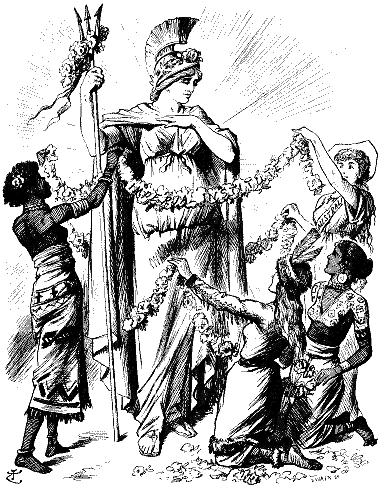
Thy pardon, Adonais, pray, That on this memorable morning We twist those lovely lines astray, As modish maid, her charms adorning A trail may twine of eglantine Into the formal "set" of Fashion. Yet wouldst thou gladly lend thy line To present need; for patriot passion, Love of the little sea-girt land, Has ever fired our English singers. Of England's fame, from strand to strand, Their songs have been the widest wingers. So, Adonais, this great day Were "Welcome as the flowers in May!" The "flowery band" of Keats's song Our Empire's sons to-day are wreathing; Long may it bind, and blossom long. The May-flower's fragrance round us breathing Is nothing sweeter than the thought To patriot hearts of loyal union. Together we have toiled and fought, But gay to-day is our communion. Britannia's helm is crowned with flowers, Britannia's trident's wreathed with posies, And Fancy sees in Flora's showers Thistles and Shamrocks blent with Roses. The Indian Lotus let us twine With gorgeous bloom from Afric's jungles Canadian Birch with Austral Pine. Tape-bound Officialdom oft bungles; Some blow too hot, some breathe too cold, O'er-chill are some, and some o'er-gushing; But the same blood-stream, warm and bold, Through all our veins is ever rushing; And so to all true hearts to-day Comes "Welcome as the flowers in May!" A Queen is with us, to evince Imperial sympathy unfailing; And pleasant to our genial Prince This proof that all seems now plainsailing; With his great purpose. Some sneered, "Whim!" But general shouts now drown their sneering. A special salvo's due to him Amidst to-day's exuberant cheering. Hail the Imperial Institute! And hail the patient Prince promoter! The man who's neither cynic brute, Nor phrase-led sycophantic doter, May echo that. Our patriot tap Is old, well-kept and genuine stingo; Not the chill quidnunc's cold cat-lap, Nor crude fire-water of the Jingo, But sound as good old English ale, Full-bodied, fragrant, mild, and mellow. To try that tap Punch will not fail, Nor any other right good fellow. A bumper of that draught to-day Is "Welcome as the flowers in May!" Weave on! And may that "flowery band" Be surer bond than forged steel fetters. Ho! Hands all round! Whilst hand-in-hand We need not fear the fierce sword-whetters Who'd make the pleasant earth a camp, And stain blood-red the white May-flowers. May echoes of no mailèd tramp Disturb ye in your Spring-deck'd bowers, Glad garland-weavers! Heaven bestow "Sweet dreams, and health, and quiet breathing," One thing above all others know, Ye who the earth-round band are wreathing, To-day, to-morrow, any day, You're "Welcome as the flowers in May!"
"Playing the Duse."—Mr. Horace Sedger announces the engagement at the Lyric of Mlle. Duse. The Manager must be prosperous; at all events, he is not going to the Duse, but the Duse is coming to him. And as to the Theatre—well, if it isn't a success, the Duse is in it!
"She answered 'Yuss'!"—The most recent and most important change of name is from "I MAY" to "I WILL."
MAY 10, 1893.
"THEREFORE ON THIS BRIGHT MAY DAY ARE WE WREATHING A FLOWERY BAND TO BIND US ROUND THE EARTH."—Keats, slightly altered.
THANK YOU!
(For a Photograph, inscribed "With Ethel Travers's kind regards.")
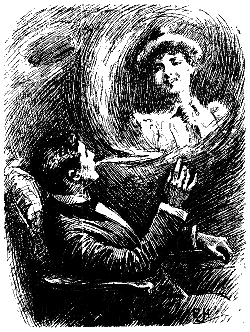
It was only a week in the brightest of summers, We played tennis and golf, and, when ended the day, We made furious love as two amateur mummers, Whilst Act IV. saw us One in the orthodox way. So my holiday ended. I begged a reminder, I asked you to send me a portrait that should Be a sweet recollection, and you, who were kinder Than I ever deserved or dared hope, said you would. Then we parted. Life seemed to be painfully lonely, Though I dreamt of a future with you by my side, Till my common-sense seemed to say, "You, who are only, Just a poor needy teacher, have Her for a bride!" It was true, and I knew it. Yet why had I met you? Why had Fate kept such bitter-sweet fortune in store? So determined I set myself then to forget you, And to let my thoughts dwell on yourself nevermore. First your hair with its gold, next your eyes with their laughter, I forgot in a thoroughly workman-like style. Persevering, I never desisted till after Many months I but faintly remembered your smile. I completely forgot you (I thought) and the warning Was to save me, I chortled, a future of pain, But you undid it all with your picture this morning, And the same old, old trouble starts over again. The Fates are a trifle hard, putting it mildly, For they well might have spared me this finishing touch Of your portrait, which speaking quite calmly yet Wildely, I admire all the more since I hate it so much. I shall treasure it, though. Thanks—a thousand—to you, dear. When in sweet meditation your fancy runs free, Is it asking too much that a stray thought or two, dear, From your kindness of heart may come straying to me?
POLITICS AND POLITENESS.
Dear Mr. Punch,—I see that the Duke of Argyll, when he received the freedom of the Burgh of Paisley, the other day, told the following interesting story:—
"I was going once to call on a lady in London, and when the door was opened and the servant announced my name, I saw the lady advancing to the door with a look of absolute consternation on her face. I could not conceive what had happened, and thought I had entered her room at some inconvenient moment, but, on looking over her shoulder, I perceived Mr. and Mrs. Gladstone sitting at the tea-table, and she evidently thought that there would be some great explosion when we met. She was greatly gratified when nothing of the kind occurred, and we enjoyed a cup of tea as greatly as we had ever done in our lives."
Now, my dear Mr. Punch, I have great sympathy with "the Lady," and think (with her) the meeting, as described by his Grace of Argyll, was mild in the extreme. If something out of the common had taken place, it would have been far more satisfactory. To make my meaning plainer, I give roughly (in dramatic form) what should have happened to have made the action worthy of the occasion.
Scene—A Drawing-room. Lady entertaining Mr. and Mrs. G. at tea. A loud knock heard without.
Mrs. G. (greatly agitated). Oh dear, I am sure it is he!
Mr. G. (with calm dignity). Do not fear—if he appears, I shall know how to deal with him.
Lady (pale but calm). Nay, my good, kind friends, believe me, you shall not suffer from the indiscretion of the servant.
Mrs. G. (pushing her husband into a cupboard). Nay, William, for my sake! And now to conceal myself, so that he may not suspect his presence by my proximity. [Hides behind the curtains.
The Duke of Argyll (breaking open the door, and entering hurriedly). And now, Madam, where is my hated foe? I have tracked him to this house. It is useless to attempt to conceal him.
The Lady (laughing uneasily). Nay, your Grace, you are too facetious! Trace the Premier here! Next you will be saying that he and his good lady were taking tea with me.
The Duke (suspiciously). And, no doubt, so they were! This empty cup, that half-devoured muffin—to whom do they belong?
The Lady (with forced gaiety). Might I not have entertained Mr. and Mrs. Joseph Chamberlain, my Lord Duke?
The Duke (aside). Can I believe her? (Aloud.) But if it is as you say, I will send away my clansmen who throng the street without. (Opens window and calls.) Gang a waddy Caller Herring! They will now depart. (A sneeze heard off.) What was that?
The Lady (terrified). I fancy it was the wind—the cold wind—and now, believe me, Mr. Gladstone will abandon Home Rule.
Mr. G. (suddenly appearing). Never! I tell you to your face that you are a traitor! [Sneezes, and hurriedly closes the window.
The Duke (savagely). That sneeze shall be your last![Takes up a knife lying on the table.
Mr. G. (repeating the action). I am ready, Sir!
Mrs. G. (rushing between them). Oh, William! Do not fight!
The Lady (falling on her knees). I prithee stay!
Mr. G. Never! May the better man win!
The Duke. So be it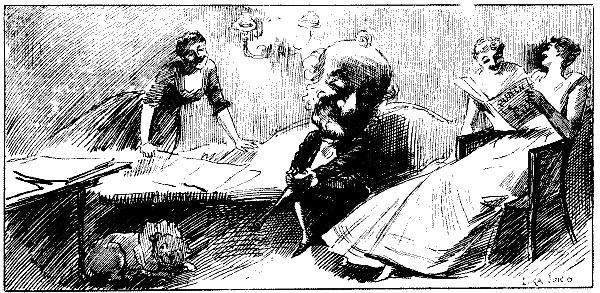
No. 543. The Picture of the Year. Lamp-light reading; or, Mr. Punch among the Pretty Pets. "Dulce est dissipere in joco." H. H. La Thangue.
No. 167. The Right Hon. H. H. Fowler, M.P. "Presentation Portrait," painted by Arthur S. Cope. "When the Right Hon. Gentleman rose to speak, the House, with the exception of a clerk at the table and two small boys (whose presence within the precincts has never been satisfactorily accounted for) was empty."—Extract from The Imaginary Times Parliamentary Report of that date.
No. 350. Mrs. Keeley at the age of Eighty-six. Looking so well and sprightly, that the Artist must have been at considerable pains to induce her to sit still just one moment for her portrait. Long may she remain with us! Our compliments to the Artist, Julia B. Folkard.
No. 434. Mr. Somerscales has given us the best sea-piece of the year. It shows a "Corvette shortening sail to pick up a shipwrecked crew." "A sale in sight appeared!"—and as the picture, so it is said, was immediately sold, so also were those who came too late to make a bid.
No. 524. Gentleman writing. "A nice quiet corner for a little composition away from all those speaking likenesses." J. W. Forster.
No. 533. This is a sad-looking little girl, painted by William Carter. She has an unsettled expression. Is she suffering from what the Clown calls "teezy-weezies-in-the-pandenoodles," and, as Sir John Millais's "Bubbles" served P**rs for an advertisement, is it beyond the range of probability that this, being associated with the name of "Carter," should be intended as a pictorial advertisement for the well-known "L-ttle L-v-r P-lls"?
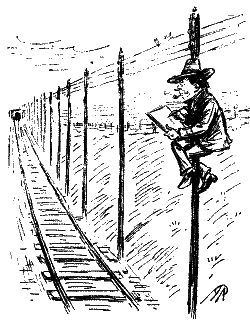
An Artist's work "on the Line."
No. 535. Portrait (presumably) of C. R. Fletcher Lutwidge, Esq. By St. George Hare. Ha! Ha! Ha! By St. George you Ha're bound to laugh directly you look at it. You can't help it. "C. R. F. L." is chuckling to himself and saying, "Ha! Ha! I've just thought of such a funny thing! Ha! Ha! Ha!" And he is enjoying it so! As the song says, "O Mister (I forget the name), what a funny little man you are!"
No. 553. This, by Mr. Markham Skipworth, is a portrait of Dr. E. Ker Gray, LL.D of St. George's Chapel, Mayfair. "Ker Gray!" it ought to be "Ker Scarlet."
No. 862. Portrait of a Gentleman, by Phil R. Morris, A. The Portrait, annoyed at being next to Sidney Cooper's, R A., "Be it ever so humble, &c.," representing head of a jackass, and some sheepish sheep, is evidently saying to itself, "Hang the Hanging Committee! They show me as next door to a donkey."
No. 888. The Wedding Gifts. The pretty Bride is a bit frightened at seeing the Groom leading up two bare-back'd steeds. "Oh!" she cries, "I can't ride them! Why (to her husband) did you give me these?" "My dear," says he, "why not? Here are the bare-backed steeds, and you've already got the Ring." S. E. Waller.
No. 892. "Your Health!" A Birthday Party at Mr. Ernest Hart's. Painted by S. J. Solomon. As a subject, the wisdom of Solomon is questionable as a specimen of Hacademie Hart—ahem! However, to the toast of "Your Health!" as addressed to Mr. Ernest Hart, Master Sol might have added the words, "Most Ernestly and Hartily."
No. 928. Exhibition of Miss Biffin, "who has no legs to speak of." "If you saw my ancles," said Miss Mowcher, "I should go home and kill myself." But Arthur Hacker, whose capital work it is, calls it "Circe."
No. 937. "It might have been," by F. Stuart Sindici, represents Napoleon and Wellington out walking together, in 1847, near the Horse Guards. "It might have been" if .... But it wasn't—though F. Stuart Sindici went nap on it, and dreamt it. Why shouldn't Julius Cæsar and Lord Brougham have hobnobbed together over Pommery '74 at Frascati's in Regent Street, or why shouldn't the Great Duke of Marlborough and Admiral Hamilcar of Carthage, after leaving Hoi Adelphoi at the theatre, have taken supper at Rule's in Maiden Lane? Why not? "It might have been"—of course; why, when you come to think of it, there's hardly anything that mightn't have been, if it had only taken place. Such possible subjects would fill the most vast picture gallery in the Château d'If.
PICK OF THE PICTURES.
(New Gallery, Regent Street. Summary of Sixth Summer Exhibition.)
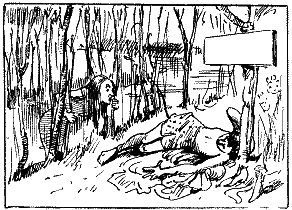
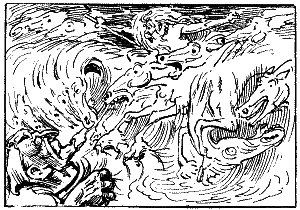
No. 40. The Bather Bothered. Appropriately painted by Mr. Waterhouse, R.A. "Why," exclaims the horrified nymph, "he's lying on my clothes!" No. 216. Night-Mares. Neptune's Horses, but more suggestive of Night Mares. Walter Crane.
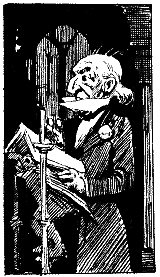
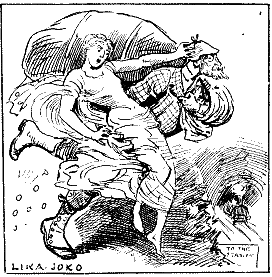
No. 22. "Mr. G." in Churchwarden Church. "Here endeth the Second Reading." Sydney P. Hall. No. 195. Hurried Moments! An Elopement!! "Never mind your things!" he shouted, at the same time that, catching her up and holding her in his strong right arm, he started off at a fast run. "Better to lose your clothes than miss your train!" C. W. Mitchell. No. 27. Posed and Painful! Standing for her photograph, and feels that the head-rest is no rest for the head. J. J. Shannon.
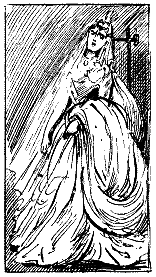
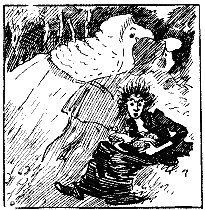
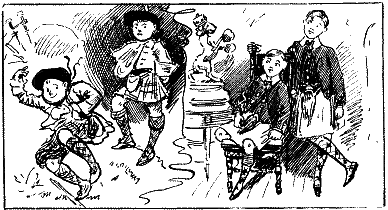
No. 96. The Haunted Glen; or, The Bird-nesting Trespasser Conscience-struck. "Oh! I'll pretend I don't see them!" Hon. John Collier. No. 92. "'Fling' Defiance!" Professor Herkomer's Heel-and-toe lads, "Jock and Charlie," back themselves against (No. 108) Mr. Alfred Hartley's "Harry and Neil,'" sons of Lord Rosebery, attired as they are for a reel or a fling, or any form of National Sc(h)ottische dance.
PICK OF THE PICTURES.
(New Gallery—continued.)
No. 11. "Her First Ball;" or, "Train 'em up in the way she should bowl." Portrait of little girl preparing to be a Lady-Cricketer. She has the ball in her hands, and is only waiting to cry out "Play!" G. P. Jacomb-Hood.
No. 15. Charming Picture of Nobody Nowhere, Miss Anna Alma-Tadema.
No. 20. Portrait of W. Matthew Hale, Esq. By John Parker. "All Hale!"
No. 37. "Silver Mist." This ought to have been the picture of a gentleman in search of a threepenny piece; but it isn't. Fred Hall.
No. 66. The Departing Guest. E. Burne-Jones.
The ending of the party see, "O let us get a cab for thee!" "Nay," quoth the guest, "I've wings! so I, Like to the trout, will take a fly."
No. 112. Alderman J. Stone-Wigg. First Mayor of Tunbridge Wells.
Indeed you look an Alderman, 'Tis true I've seen a balder man. "J. Stone-Wigg" is the name I see, Which "Lost or Stolen-Wig" should be.
No. 160. Portrait of Lady Simpson. Bravo, Mr. Val Prinsep, A.R.A. Uncommonly good. A parody of the old song should have been selected by the Artist as a motto for the picture:—
Lady Simpson has a dog— I don't know its name— Pretty tail has dog, incog. Ribands round the same.
No. 170. "The Spirit of Life." By Archie Macgregor. "Eh, Archie mon! aiblins, 'tis just the whusky-still the Leddie's at, takin' a wee drappit i' the 'ee. And why did ye nae ca' it, 'Still Life'"?
No. 177. Portrait of Mrs. George Lewis. Excellent, Mr. Colour-Sargent! N.B.—Very few "Sergeants" left; but Mr. George Lewis has secured the best of them to paint this portrait.
No. 194. Very charming is "The Closing of an October Day." By George H. Broughton, A.R.A. He has caught the "Early Closing Movement" to the life.
No. 242. "In the Grip of the Sea-Wolf"; or, "Early Bathing at Boulogne." E. M. Hale.
No. 324. And a good Judge too! Portrait of Sir Douglas Straight. The Douglas, "bearded in his den"! Quarter (Sessions) Length. Sad end to a distinguished career to be "quartered, drawn, and hung"! Congratulate Artist, Miss Vera Christie, on good likeness.
EVOLUTION EXTRAORDINARY.
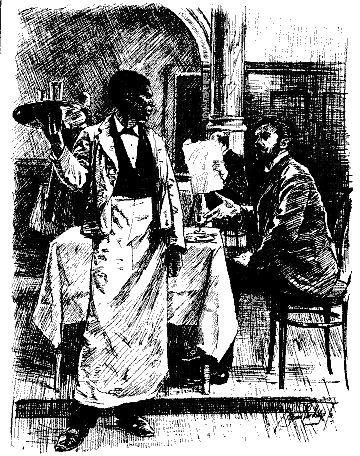
British Tourist (who has been served with a Pig's foot). "What's this? I ordered Quail!"
Negro Waiter. "Wall—y'ev got Quail!"
British Tourist. "Quail! Why a Quail's a Bird!"
Negro Waiter. "Not Here!"
Anti-Epidemic Treatment.
(Being Summary of Robson Roosetem Pasha's Article in New Review.)
Boil Bacillus, Or he'll kill us. From Filter filthy grown Don't drink water, Save rates per quarter, And so "Leave well alone."
Companion Works.—Shortly to appear: My Wife's Bodice. By the Author of His Wife's Soul.
TO MY UMBRELLA.
Good, faithful friend, it seems an age Since last we met and walked together! Upon the Daily Graphic's page For weeks I've watched the coming weather; The meteorologic girl, Despite cold arms, seemed almost jolly, And made no effort to unfurl That wonderful archaic brolly. So I, grown reckless, did as she. And gave you quite a Long Vacation; Such weather cannot always be, Or you would lose your occupation. Think how I've treated you! A pet Might envy all the care I gave you; When worn-out with work and wet, Think how I did my best to save you! You soon looked well, and eased my fears— Recovered after over-pressure. When you "took silk" in other years, Think what I paid for each "refresher"! When last it rained I had to roll You up quite wet; you've been forgotten. It rains once more. What's this? A hole? By Jove, the silk's completely rotten!
The Stage-Coach Fiasco.—The Meet, which was ordered for 11:30 last Thursday, wasn't done, and so there was no Lunch.
ON THE INCOME-TAX.
[By an already over-burdened tax-payer who derived neither enlightenment nor comfort from the wordy war about a "Graduated Income-Tax" between Mr. Bartley and Sir William Harcourt.]
"Graduation" seems vexation, "Differentiation" looks as bad. Their the-o-rie It puzzles me. But their practice drives me mad!
"That's Swear It Is!"—In bygone days, when the Princess's was under the management of Mr. and Mrs. Charles Kean, there was a fine imposed on any member of the company who should make use of bad language in the Green-Room. One evening a distinguished actor so far forgot himself as to let slip an expletive of three simple letters, whereat Mrs. Kean held up her hands in horror and quitted the room, followed by the actresses who happened to be present. Subsequently some wag at the Garrick Club wrote a song whereof the burden was "The Man who said 'dam' in the Green-Room." Tempora mutantur, and now, at the Avenue Theatre, under the management of Mr. and Mrs. Kendal in the Green-Room and behind the scenes, as well as on the stage, "Dam" will be in everyone's mouth, as this happens to be the name of the Author of their latest successful production.
THE NEWEST TALE OF A TUB.
(By a Sufferer from the Modern Laundry System.)
Rub-a-rub-rub! Three ghouls at a tub: Our shirts and our collars they savagely scrub. The fronts they make baggéd, The wristbands quite jaggéd, And send home our linen all rotten and ragged! Scrub-a-scrub-scrub! Three fiends at a tub: In chemical bleachings they dabble and grub. Our shirts each bespatters Then brush them to tatters. The wearers get mad as March hares or as hatters! Rub-a-scrub-scrub! Three hags at a tub: They scrape with a wire-brush, and pound with a club! Smash buttons, burst stitches, And—swell Laundry riches! Who'll save us from this cauldron-tub's dread Three Witches?
The Stock Exchange, Mr. Punch understands, has gone into politics. With a view to test the knowledge of the brokers who "proceshed" to the Guildhall, he asks them,—What is the Commission upon Evicted Tenants? All sellers, no buyers.
Transcriber's Note: Sundry broken punctuation has been corrected.