ESSENCE OF PARLIAMENT.
Reading edition
Extracted From the Diary of Toby, M.P.
House of Commons, Monday Night, March 13.—No use disguising fact that when House discovered Frederick Milner standing behind Front Opposition Bench, brandishing heavy boot in his hand as he addressed Asquith, it held its breath. Political passion runs pretty high of late; Opposition stirred to deepest depths by persistence of Government in attempting to read Home-Rule Bill Second Time before Easter. There have been sittings after midnight; sittings through Saturday; hot words bandied about; preparation for deadly duel in lobby. No one can say whither men may be led when once they permit angry passions to rise. Charles Russell, whose acquaintance with criminal classes is extensive, tells me it is by no means uncommon thing for prisoner in dock to take off boot and hurl it at head of presiding Magistrate or Judge.
"Usually an old woman who does it," he added.
"But this is Sir Frederick Milner, Bart.," I said.
"Um!" said Russell, with odd significance in the observation.
Turns out the apprehension groundless. Milner only wants to know why Police at Leeds and Bradford should enjoy ultimate resources of civilisation in respect of "Scaith's silent boots," whilst London Policemen not so privileged? Milner tells me his earliest idea was to get a pair of the boots, put 'em on, and surprise Speaker by approaching with noiseless tread from behind Chair, lean over his shoulder, and suddenly say, "Boo!" That, Milner thought, would be conclusive proof of the efficacy of the boots as making the tread inaudible. On other hand, Speaker mightn't like it. So, by way of compromise, brought down odd boot in tail-pocket of his coat, and shook it at Home Secretary when he put question.
Asquith behaved very well under trying circumstances. Did not visibly blench; answered, in off-hand manner, that London Police had had opportunity of substituting the silent boot for those in ordinary use, and had not availed themselves of it. Some had objected on domestic grounds. Female friends engaged in responsible posts in certain households on their beat were accustomed to the sound of their footfall on the pavement, and would not have things ready if they approached like rose-leaves flitting over shaven lawns. Others, assuming higher ground, resented silent boot as taking unfair advantage of the burglar or footpad. "Give a 'ardworking cove a fair chanst, that's my motter," one honest fellow in blue said to Home Secretary when Right Hon. Gentleman brought silent boot under his notice. No use attempting to run counter to feeling of this kind. Conclusion in which Dicky Temple heartily concurred.
"Silent boot," he said, "forced upon Metropolitan Police might play in history a part analogous to that of the greased cartridges on which we slipped into the Indian Mutiny."
Milner saw it was evidently no use, so returning boot to coat-tail pocket, moodily regarded Treasury Bench.
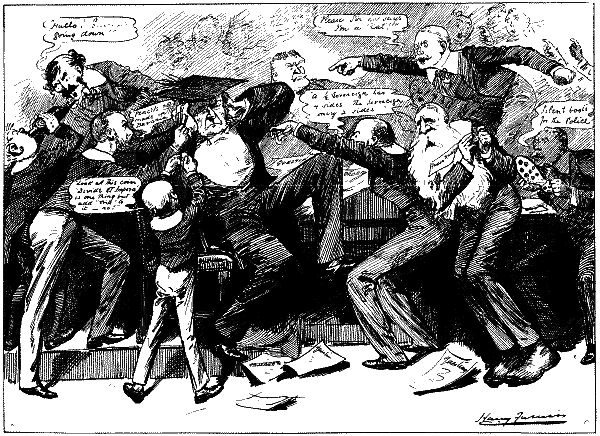
"WANTING TO KNOW;" OR, THE BEWILDERED USHER.
But there were consolations. Squire of Malwood, asked by Prince Arthur what he now thought of prospects of reading Home-Rule Bill Second Time before Easter, admitted impossibility; triumphant shout from Opposition. Not in vain had they sat through morning sitting on Friday discussing the hour at which they should adjourn on Saturday. Not without recompense had they taken care that when Saturday came it should see accomplished the minimum of business. Tussling with Mr. G. ever since Session opened; in first rounds he came off best; drew first blood; seemed likely to carry everything with him; Opposition pulled themselves together; went at it hammer and tongs; and now it is Mr. G. who has retired to corner; the sponge is in requisition on the Treasury Bench; the air around it redolent of the perfume of the indispensable vinegar.
"Guinness will go up a point or two on this," said Ellis Ashmead Bartlett, Knight, who has taken Irish securities under his wing. "Go down a pint or two, you mean," said Wilfrid Lawson, who is irreclaimable.
Business done.—Attack on Justice Mathew and Evicted Tenants' Commission repulsed by 287 Votes against 250.
Tuesday.—Squire of Malwood a changed man. No longer the light-hearted, sometimes almost frivolous youth who through six years sat on Front Opposition Bench, and girded at the Unionist Government. A Minister himself now; Mr. G.'s right-hand man; First Lieutenant of the Ship of State; acting Captain when, as happens just now, Mr. G. temporarily turned in. Once this afternoon something of old spirit stirred within him when Howard Vincent (as he said) used the Stationary Vote as a peg on which to hang Protection heresies. But, for most part, he sits silent and self-communing, saying nothing, but, probably, like the parrot of old, thinking the more. In Conservative ranks feeling of profound respect growing in his favour. Curious to hear them say, "Ah! if everyone on Treasury Bench bore himself like Harcourt, things would be different." Even the blameless Bryce is held up to contumely in contrast with mild-mannered Master of Malwood. As for Charles Russell, after his speech last night, good Conservatives, following an Eastern custom, well enough in its place, spit when they mention his name. For them the model of all Parliamentary virtue is the Squire of Malwood.
Don't know how long this passion of appreciation will last; interesting to observe while yet with us. A lull all round in sympathy with soothing moments of Chancellor of Exchequer. Even J. W. Lowther's perturbed mind at rest. Knows now, to a fraction, how many lead-pencils are annually in use in directing destinies of British Empire. Rumour current that origin of this inquiry was a little undertaking promoted by Hon. Member in substitution of proscribed word-guessing competitions. Sweep got up; £5 entry; every man to guess at precise figure of lead-pencil census; the one coming nearest to clear the pool. Lowther tells me not word of truth in report. In putting his question as to number of lead-pencils in use, and in sticking to it in spite of jeers of bystanders and guilty reticence of Minister, he was actuated simply by motives of public policy; desired, in short, to live up to standard of late lamented Leader and do his duty to his Queen and Country.
Business done.—Great lead-pencil question settled. Excited House Counted Out at 9.20.
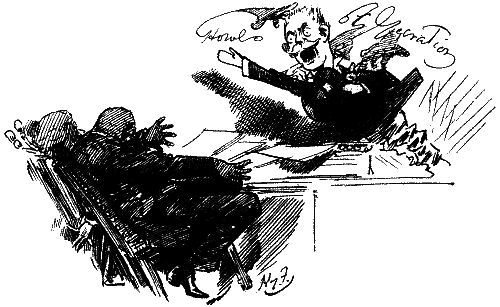
"Back!! Rasch intruder!"
Thursday Night.—House dying to know what Major Frederick Carne Rasch had to say on Navy Estimates. Not being Major of Marines, initial difficulty is to imagine what he did in this galley. If it had been the Army, or even the Militia, the Major would have seemed all right. But what had he to do with the Navy? That, however, is for the Major a minor point. "You Carne be too Rasch when attacking this Government," said Kenyon, with his pretty elliptical speech.
It was half-past ten, and a dull night. Navy Estimates been talked round for nearly five hours. Squire of Malwood meekly hoped that a Vote would now be taken; Dicky Temple presented himself at footlights with bewitching smile on his lips and elegantly bound gilt-edged volume under his arm; bowed to audience; opened volume; proceeding to offer few remarks when Squire swooped down on him with Closure.
This was cue for Rasch. Chairman rose to put question. So did Rasch. Closure must not be debated; attempt to speak is unpardonable breach of order. The Major stood in the imminent deadly breach; House howled; Chairman cried, "Order! Order!" Rasch glared round, and, after moment's hesitation, sat down; up again as soon as Question was put; howls more anguished than ever. Committee having agreed that Question be put, nothing to do but put it, and here was Rasch bubbling over with speech. Chairman on his feet peremptorily signalling Major to sit down; Members near him tugged at his coat-tails; those further off frantically wave deprecatory hands. Major stood to his guns; shouts of "Name! Name!" Chairman, desperately pegging away, succeeded in putting Question, being money-vote for Navy. Major by this time hauled down in his seat. Up again, like Jack out of box. Chairman also on his feet, putting next vote; hubbub tremendous; Major's lips observed in motion; not an articulate syllable rose above uproar.
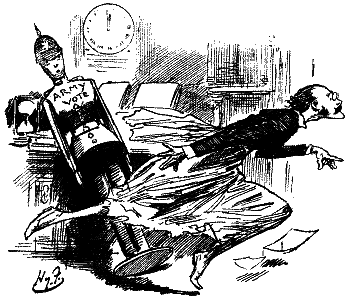
On the Stroke of Twelve; or, Cinderella Balfour!
Meanwhile Chairman had dexterously put and run through supplementary vote for Excess of Expenditure; friends near him had got the catapultic Major down again, in time to hear Chairman declare "the Ayes have it!" Major up again. "Order! order!" shouted the Chairman. "Question: is——" Not quite clear amid uproar what question was; something to do with Army. Anyhow, there was Stanhope standing at table discussing Army Votes. Major again on his feet, his moustache twitching with astonishment. Stanhope a peculiarly painful circumstance; all very well for good Conservative to gird against Government, and jostle Mr. G.'s Chairman of Committees; different (especially for a Major in the Militia) to struggle with Statesman who had been Secretary of State for War on his own side. So Major, defiantly glaring round House slowly dropped into his seat:—"dying with all his music in him," as Justin McCarthy, who knows the poets, said. But what was the tune he meditated? What is the secret of this unspoken speech?
Business done.—Money voted for Naval men. Halt cried on Army Vote.
Friday.—Rasch broken out again; turns up as usual at critical moment. Committee of Supply adjourned at ten minutes to seven; sharp at seven morning sitting must be suspended. Report of Supply under consideration; only tremulous ten minutes to get through it. Rasch resolved, now or never, to finish the speech he commenced yesterday. House, after protest, settles down to listen. Seems Kay Shuttleworth been "saying things" about the warrior. "He behaved towards me," said the Major, "in a manner that would be brusque on the part of Providence addressing a black beetle." House undecided as to which simile more happily bestowed. On the whole, agreed more polite to contemplate U. Kay Shuttleworth as Providence, than Major Rasch as the other thing.
Business done.—Some Votes in Supply.
Transcriber's Note: Missing or illegible/damaged punctuation has been repaired.