Volume 104 — ESSENCE OF PARLIAMENT.
Reading edition
EXTRACTED FROM THE DIARY OF TOBY, M.P.
House of Commons, Monday, February 13.—House filled from floor to topmost range of gallery. Terrible rumour that it is also peopled underneath. Members sitting on two front benches evidently restless through opening passages of Mr. G.'s speech. Weird whispering heard, apparently rising from boots of First Lord of the Treasury. Grandolph pricks up his ears; fancies he recognises voice familiar in Harley Street. First thought, whispered commentary must come from Ladies' Gallery. Right Hon. Gentlemen look up, and conclude it is too remote. Besides, Ladies never talk in the Gallery.
"Moreover than which," said Fergusson, staring stolidly at open network of iron floor, "it comes from quite different quarter."
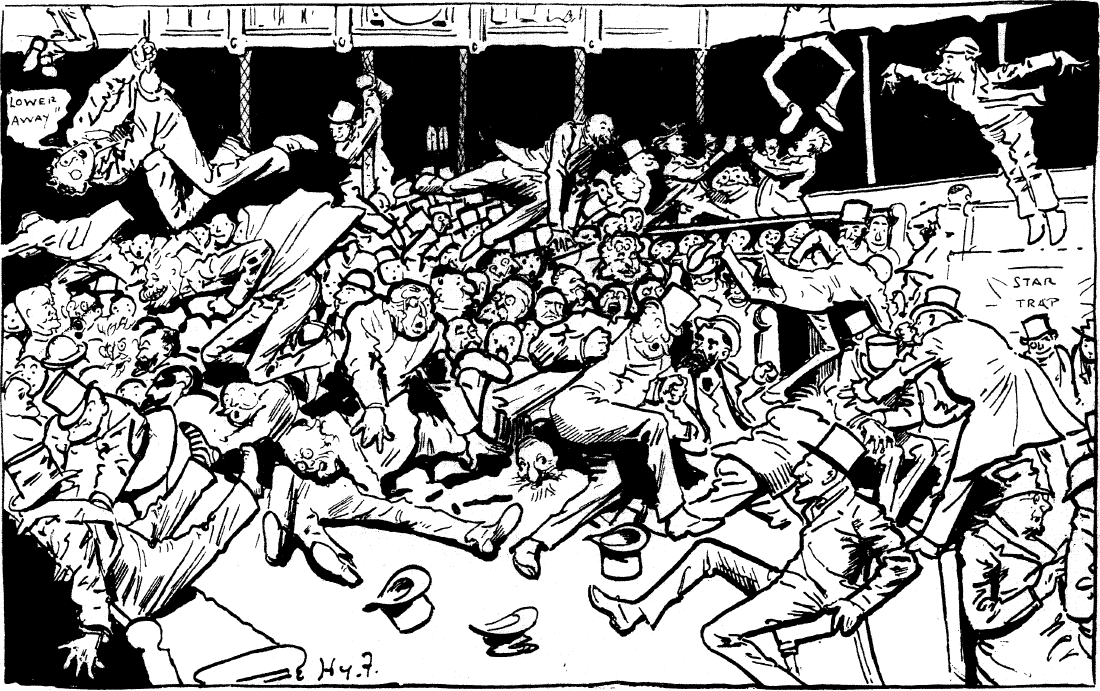
GENTLEMEN OF THE HOUSE OF COMMONS TAKING THEIR SEATS, MONDAY, FEBRUARY 13, 1893.
Even Mr. G., absorbed as he was with great topic, evidently noticed the odd state of things, for towards end of magnificent speech he dropped his voice right down through the grating into the chamber below, so that Strangers in distant Gallery lost the purport of his words. Above-board—or rather above iron grating—House presented spectacle worthy of occasion. Last time anything like it seen was in April, 1886, when first Home-Rule Bill introduced. Singularly like it this afternoon, with chairs blocking the floor in fashion to which Lord-Chamberlain, looking down from Peers' Gallery, admitted he would not permit in any other theatre. Side-galleries filled; Members thronging Bar, sharing the steps of Speaker's Chair, peeping round from behind its recess, sitting on the Gangway steps. The Lords' Gallery thronged, with somewhat disorderly fringe of Viscounts jostling each other on the steps. Not an inch of room to spare in the Diplomatic Gallery, whilst happy strangers rose tier beyond tier on the benches behind. Over the clock H.R.H., debonnaire as usual, able to extract fullest pleasure and interest out of passing moment. By his side, his son and heir; not the one who sat there on the April night nine years ago, but the younger brother, with Cousin May facing him through the grille of Ladies' Gallery. Many other gaps filled up on floor of House, the biggest those created by the flitting of Bright and Parnell.
The figure at table answering to Speaker's call, the "First Lord of the Treasury" is the same, though different. Marvellously little different, considering all that has passed since '86, and remembering the weight of added years when they come on top of fourscore. Scantier the hair, paler the face and more furrowed; but the form still erect, the eye flashing, the right hand beating vigorously, as of yore, on the long-suffering box; the voice even better than it was for a certain period towards close of 1880 Parliament; the mental vision as clear; the fancy as luxuriant; the logic as irresistible; the musical swing of the stately sentences as harmonious. For two hours and a quarter, unfaltering, unfailing, Mr. G. held the unrivalled audience entranced, and sat down amid a storm of cheering, looking almost as fresh as the posy in his button-hole.
Business done.—Mr. G. introduces Home-Rule Bill.
Tuesday.—Colonel Saunderson going about to-day just as if nothing had happened yesterday. But something did. Little misunderstanding arose in connection with appropriation of a Seat. The Colonel, of course, in the row at the door of the House, between eleven and noon. Two hundred Members waiting to get in as soon as doors opened. "Nothing like it seen in civilised world since the rush for Oklahoma," says Lord Playfair, who has been in the United States. "Then, you remember, the intending settlers, gathering from all parts, bivouacked on line marked by military, and on appointed day, at fixed hour, at sound of gun, made the dash into the Promised Land. Lack some of those particulars here. But the passion just the same; equally reckless; every man first, and the Sergeant-at-Arms take the hindmost."
Playfair himself came down two hours later, intending to take his seat in Peers' Gallery, but, finding another mob at entrance, almost as turbulent, concluded he would not add to the tumult by wrestling with anybody for a place in the front rank. So, meeting a Bishop, who had come down with similar intent and abandoned endeavour from analogous reason, they went for a walk in the Park.
Saunderson not a man of that kind. Thoroughly enjoyed himself for exciting three-quarters of hour. Was in first flight of heated and dishevelled senators who crossed the Bar when door flung open, and elderly Messenger was simultaneously flattened at back of it. Saunderson dropped on to first convenient seat; folded his arms; beginning to view the scene when, like the person in the pastoral poem, "he heard a voice which said,"—"You're sitting on my hat!"
"Well," replied Colonel, genially recognising Irish Member of same Province, but another faith, "now you mention it, I thought I did hear something crunch." On examination, found remains of hat.
"Come out of my seat!" said the other Ulster man.
"Not at all," said the Colonel.
"Then I'll take you!" said the Ulster man.
"Do so," said the Colonel. Ulster man seized Colonel by collar and coat, and tugged violently. Rest of conversation was carried on with the Ulster man lying on his back, at full length, partly under his seat. "There was no hat here when I arrived," said the Colonel.
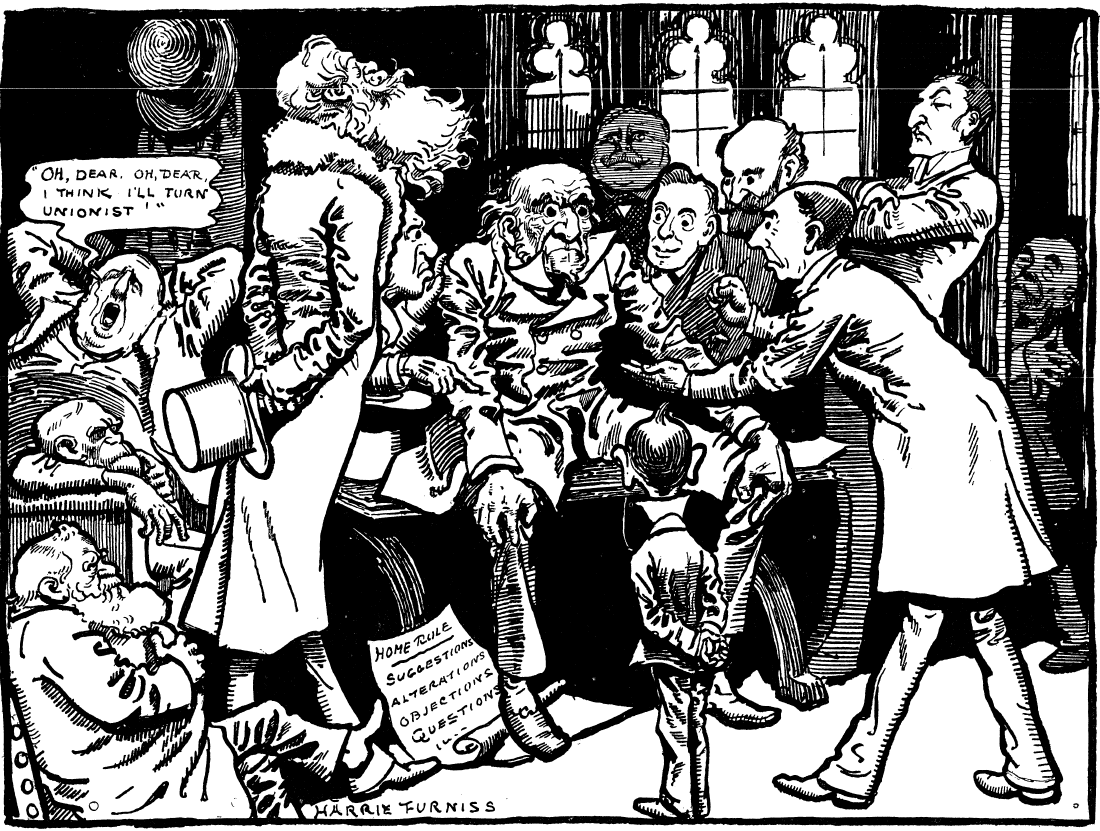
MR. PUNCH'S HISTORICAL CARTOONS. MR. G.'S ROOM IN THE HOUSE OF COMMONS.
"Then how did it get there?" said the Ulster man, under the seat.
"That's for you to explain," said the Colonel, politely assisting Ulster man to rise. "If, when a gentleman is taking his seat, an Hon. Member places his hat upon it, accidents will happen."
Ulster man threatens to bring question under notice of Speaker. "Begad, I hope he will," said the Colonel, smiling grimly. "If you know the gentleman, Toby, tell him I'll keep him in hats through Leap Year if he'll only do it. I should like to give the House an unadorned narrative of the incident. John Roche's deer-stealing story would be nothing to it."
Business done.—Debate on Home-Rule Bill.
Thursday.—Grandolph back again at old post on Front Opposition Bench. All the Parliamentary world gathered to greet him. H.R.H. in old familiar seat over clock, whence, up to Monday, his pleasant presence had long been missed. Not a seat vacant on floor of House. Galleries crammed, whilst, through grille of Ladies' Gallery, bright eyes rained influence. Grandolph had arranged to resume Debate on Home-Rule Bill; should have come on bright and fresh as soon as questions were over. Meanwhile sat on Front Opposition Bench, awaiting the signal to dash in. Incessantly playing with beard, in fashion that testified to high state of nervousness.
Everything excellently planned, the man, the hour, and the surroundings. Only thing forgotten was the dog—dog, you know, that has a little place down at Epsom, and turns up on course just as the ranged horses are straining at the bit, and the flag is upheld for the fall. On this occasion, Irish dog, of course. Introduced in artfullest way. Esmonde, mildest-mannered man that ever whipped for Irish party, casually, as if he were inviting him to have a cigarette, asked Wolmer across House whether it was true that he had called Irish Members "forty paid mercenaries"? Wolmer, an equally well-dressed, civil-spoken young man, smilingly admitted that it was quite true he had couched a remark in the terms quoted, but had certainly not meant anything offensive to Irish Members. Indeed, general aspect of noble Lord, and his tone, suggested feeling of surprise that Esmonde and his friends should not rather have felt complimented by the observation challenged.
This turned out to be polite crossing of swords before duel to the death, a shaking of hands before deadly set-to without gloves. Sexton suddenly dashed in, and, with back-handed stroke at Wolmer, went for the Times who had adopted and improved upon the Viscount's genial remarks. Assault admirably planned; carried on with irresistible vigour, sweeping down earlier resistance of Speaker. Showed what Sexton can do when so deeply moved as to forget himself, and resist besetting temptation to play the fatal windbag.
An hour-and-half's tussle all round House; at end Irish held the field, and, without dissentient voice, Times article declared to be "gross and scandalous breach of privileges of House."
But the hour and half had passed, and with it Randolph's chance of supreme success. House of Commons, though greedy for excitement, will never stand two doses in quick succession. After scene like that, which to-night filled House with fire and smoke, anything that follows is anti-climax. It was a cruel fate, which Grandolph bore uncomplainingly, and fought against with quiet courage. Painfully nervous when he broke the silence of two years, the still crowded House had difficulty in catching his opening sentences. But, as he went on, he recovered himself, and regained mastery over an audience evidently eager to welcome his permanent return to position of old supremacy.
Business done.—The Wanderer returned. Slow music. Air—"Come, Kill the fatted Calf."
Saturday, 12:50, A.M.—Mr. G. just brought in Home-Rule Bill, amid ringing cheers from Ministerialists, who rise to their feet, and wildly wave their hats as Premier passes to table. Been some effective speaking on this last night of Debate. Chamberlain, Blake, and John Morley, each excellent in varied way. Only few Members present to hear Bodkin insert maiden speech in dinner-hour. A remarkable effort, distinguished, among other things, by necessity of Speaker twice interposing, second time with ominous threat that Bodkin could not be tolerated much longer. Bodkin, resuming thread of his discourse, humbly apologised, kept his eye (Bodkin's eye) warily on Speaker, and, when he saw him preparing to rise for third time, abruptly resumed his seat,—returned hurriedly to the needle-case, so to speak,—and thus avoided worse things.
Business done.—Home-Rule Bill read a First Time.